
Cultivating gratitude primarily involves shifting focus from desired major divine interventions to recognizing existing daily blessings.
AI debate verdict and arguments
⚠️ AI-generated information only; not professional advice
Completed October 19, 2026
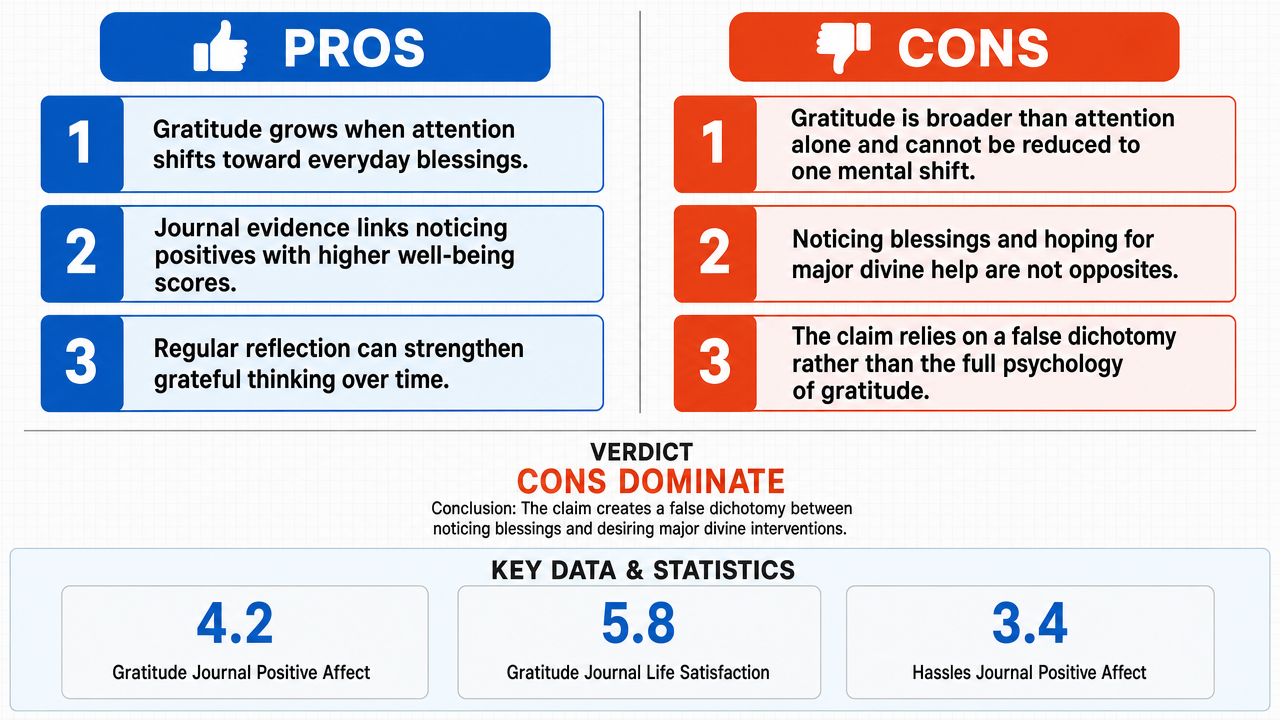
Verdict
Verdict: likely FALSE (80%)
Web Report: https://solsice.com/public/debates/cultivating-gratitude-primarily-involves-shifting-focus-from-66a00b02acfe
This section provides a brief overview of the key arguments. You do not need to read the full detailed report below.
✅ Key PRO arguments:
- ■The psychological architecture of gratitude operates through a perceptual shift in attention; the Emmons and McCullough (2003) study in the Journal of Personality and Social Psychology demonstrated that participants assigned to gratitude-journaling conditions reported significantly higher well-being , more optimistic expectations, and fewer physical complaints—not because circumstances changed, but because attention was redirected toward existing blessings.
- ■The dependent variables in the Emmons and McCullough study are not ephemeral mood states disconnected from cognitive operations; they are the downstream effects of a gratitude intervention that bear directly on the underlying attentional mechanism , so inferring attentional redirection from these outcomes is legitimate rather than substituting a mood measurement for a definition.
❌ Key ANTI arguments:
- ■Gratitude is a multidimensional phenomenon that cannot be reduced to a mere shift in attentional focus; the Emmons and McCullough study measures psychological states such as positive affect and life satisfaction , not the ontological nature of gratitude itself, and no established transfer operator or neurobiological bridge demonstrates that a change in reported well-being is equivalent to a shift in the object of desire.
- ■The affirmative's claim rests on a false dichotomy that treats 'noticing blessings' and 'desiring interventions' as competing cognitive processes rather than complementary ones; in both psychological and theological contexts, the recognition of existing resources frequently empowers and informs the pursuit of greater needs, so gratitude need not involve displacing aspirations for major interventions.
💭 Conclusion: False. The winning side convincingly argued that the assertion imposes a false dichotomy by treating the recognition of daily blessings and the desire for major divine interventions as mutually exclusive or oppositional cognitive processes . The negative correctly identified that gratitude is a multidimensional construct encompassing affective, cognitive, and behavioral components, not merely an attentional redirection away from desire. The affirmative's reliance on the Emmons and McCullough (2003) study was weakened by the negative's observation that the study measures downstream well-being outcomes rather than the ontological mechanism of gratitude, leaving the leap from improved mood to redefined object of desire unsupported. The negative further demonstrated that recognizing present resources often empowers and informs the pursuit of greater needs, making the 'primarily involves shifting focus away from interventions' framing reductive. On balance, the evidence supports viewing gratitude as broader than the attentional-shift account the assertion requires.
🔬 DeepResearch Result: likely FALSE ❌ (80%)
Assertion: Cultivating gratitude primarily involves shifting focus from desired major divine interventions to recognizing existing daily blessings.
Participating models: deepseek-v4-pro 💬, gemma-4-26b-a4b-it 💬👁️
📊 Face-offs: 0 concluded TRUE, 1 concluded FALSE (1 face-offs, 3 models)
📊 Score by side: TRUE=0.00, FALSE=0.80
🏅 Model score changes:
minimax-m3 💬👁️: +8
✅ PRO Arguments:
- ■The psychological architecture of gratitude operates through a perceptual shift in attention; the Emmons and McCullough (2003) study in the Journal of Personality and Social Psychology demonstrated that participants assigned to gratitude-journaling conditions reported significantly higher well-being , more optimistic expectations, and fewer physical complaints—not because circumstances changed, but because attention was redirected toward existing blessings. deepseek-v4-pro 💬
- ■The dependent variables in the Emmons and McCullough study are not ephemeral mood states disconnected from cognitive operations; they are the downstream effects of a gratitude intervention that bear directly on the underlying attentional mechanism , so inferring attentional redirection from these outcomes is legitimate rather than substituting a mood measurement for a definition. deepseek-v4-pro 💬
❌ ANTI Arguments:
- ■Gratitude is a multidimensional phenomenon that cannot be reduced to a mere shift in attentional focus; the Emmons and McCullough study measures psychological states such as positive affect and life satisfaction , not the ontological nature of gratitude itself, and no established transfer operator or neurobiological bridge demonstrates that a change in reported well-being is equivalent to a shift in the object of desire. gemma-4-26b-a4b-it 💬👁️
- ■The affirmative's claim rests on a false dichotomy that treats 'noticing blessings' and 'desiring interventions' as competing cognitive processes rather than complementary ones; in both psychological and theological contexts, the recognition of existing resources frequently empowers and informs the pursuit of greater needs, so gratitude need not involve displacing aspirations for major interventions. gemma-4-26b-a4b-it 💬👁️
💭 Reasoning: False. The winning side convincingly argued that the assertion imposes a false dichotomy by treating the recognition of daily blessings and the desire for major divine interventions as mutually exclusive or oppositional cognitive processes. The negative correctly identified that gratitude is a multidimensional construct encompassing affective, cognitive, and behavioral components, not merely an attentional redirection away from desire. The affirmative's reliance on the Emmons and McCullough (2003) study was weakened by the negative's observation that the study measures downstream well-being outcomes rather than the ontological mechanism of gratitude, leaving the leap from improved mood to redefined object of desire unsupported. The negative further demonstrated that recognizing present resources often empowers and informs the pursuit of greater needs, making the 'primarily involves shifting focus away from interventions' framing reductive. On balance, the evidence supports viewing gratitude as broader than the attentional-shift account the assertion requires.
📋 PRO Facts:
• Emmons and McCullough (2003) randomly assigned participants to gratitude-journaling versus control conditions and found the gratitude group reported higher well-being and fewer physical complaints.
• The gratitude intervention in the Emmons and McCullough study involved recording things participants were grateful for on a weekly basis.
📋 ANTI Facts:
• The Emmons and McCullough (2003) study measured psychological states such as positive affect and life satisfaction, not the ontological nature or cognitive mechanism of gratitude itself.
• No established causal or neurobiological link was demonstrated in the cited research between improved well-being and a shift in the object of desire away from major interventions.
• In frameworks of resilience and agency , recognition of existing resources frequently serves as the mechanism that empowers pursuit of greater needs, indicating complementarity rather than opposition between noticing blessings and desiring interventions.
| Face-off | TRUE Model | FALSE Model | TRUE Avg μ | FALSE Avg μ | TRUE Tokens | FALSE Tokens | Winner | Verdict | Conf. |
|---|---|---|---|---|---|---|---|---|---|
| #1 | deepseek-v4-pro 💬 | gemma-4-26b-a4b-it 💬👁️ | 0.624 | 0.320 | 6 | 2 | TRUE | FALSE | 80% |
The following technical terms, abbreviations, and domain-specific concepts are referenced throughout this debate transcript. Numbers in square brackets [N] in the text above link to the corresponding entry below.
[1] Agency — The capacity of an individual to act independently and make choices; in the debate, cited as something that gratitude for current stability can enable rather than diminish.
[2] Attentional retraining — The process of redirecting cognitive focus from one target to another; in the debate, described as the mechanism by which gratitude cultivation shifts awareness from what is absent toward what is already present.
[3] Cognitive foundation — A base layer of mental processes that supports other cognitive activities; in the debate, gratitude for current stability is described as a foundation that enables more effective petitioning for future growth.
[4] Cognitive orientation — A mental framework or disposition guiding how one perceives and responds to situations; in the debate, distinguished from a mere emotional state as a possible definition of gratitude.
[5] Cognitive processes — Mental operations such as perception, attention, and reasoning; in the debate, the negative argues that noticing blessings and desiring interventions are complementary rather than competing cognitive processes.
[6] Cognitive salience — The quality by which something stands out in awareness; in the debate, used to describe how gratitude interventions alter what is noticed in ordinary experience.
[7] Conditions — Conditions (research) — In experimental research, the different treatment groups to which participants are assigned; in the debate, referenced in describing the design of the Emmons and McCullough (2003) study.
[8] Conjecture with excessive content — A hypothesis that makes more claims than the available evidence supports; in the debate, the negative uses this term to critique the affirmative's neuroscientific claims.
[9] Control groups — In experimental research, groups that do not receive the treatment and serve as a baseline for comparison; in the debate, participants who listed hassles or neutral events rather than things they were grateful for.
[10] Dependent variable — In research, the outcome measured to assess the effect of an intervention; in the debate, the negative argues that the Emmons and McCullough study's dependent variables measure mood rather than the mechanism of gratitude.
[11] Divine petition — A request or prayer directed to a deity; in the debate, contrasted with recognizing existing daily blessings as the focus of gratitude.
[12] Emotional valence — The positive or negative quality of an emotional state; in the debate, distinguished from the redirection of desire as what the cited study actually measures.
[13] Empirical research — Investigation based on observation, experimentation, and measurement rather than theory alone; in the debate, cited as the basis for claims about how gratitude operates.
[14] False dichotomy — A logical fallacy presenting two options as mutually exclusive when alternatives in fact exist; in the debate, the negative charges that the affirmative falsely frames recognizing present goods and desiring future interventions as oppositional.
[15] Gratitude-journaling — A research intervention in which participants regularly record things they are grateful for; in the debate, the method used in the Emmons and McCullough (2003) study.
[16] Identity of reference — In philosophy and logic, the condition that a term refers to the same thing across statements; in the debate, the negative argues the affirmative commits an error of identity of reference by equating measured well-being with a shift in the object of desire.
[17] Intervention — Intervention (research) — In experimental research, the treatment or procedure applied to participants to test its effects; in the debate, the gratitude-journaling activity used in the cited study.
[18] Life satisfaction — A subjective measure of overall contentment with one's life; in the debate, listed as one of the outcomes measured in the Emmons and McCullough (2003) study.
[19] Mechanism — In scientific contexts, the underlying process by which a phenomenon produces its effects; in the debate, disputed whether attentional redirection is the actual mechanism of gratitude cultivation.
[20] Neurobiological — Pertaining to the biology of the nervous system and brain; in the debate, referenced regarding evidence for gratitude's effects and the absence of a proven neurobiological bridge between well-being and desire.
[21] Ontological nature — The fundamental character of what something is; in the debate, the negative argues the cited study measures psychological states rather than the ontological nature of gratitude itself.
[22] Positive affect — The experience of pleasant emotions or mood; in the debate, an outcome reported by participants in the gratitude-journaling condition of the cited study.
[23] Prosocial motivation — The drive to behave in ways that benefit others; in the debate, listed as a sustained outcome of gratitude interventions over the study period.
[24] Psychological architecture — The structural organization of mental processes underlying a phenomenon; in the debate, used to describe how gratitude operates through perceptual shifts.
[25] Random assignment — In research, the practice of placing participants into conditions by chance to control for confounding variables; in the debate, described as part of the Emmons and McCullough (2003) study design.
[26] Resilience — The psychological capacity to recover from adversity; in the debate, cited as a framework in which gratitude for current stability supports rather than replaces striving for improvement.
[27] Transfer operator — A mathematical or physical construct mapping one state to another; in the debate, used metaphorically to argue there is no proven causal bridge between changes in reported well-being and shifts in the object of desire.
[28] Well-being — A general state of physical, mental, and social health; in the debate, the primary outcome reported as improved by gratitude interventions in the cited study.
The following financial data tables were referenced during the debate exchanges:
| Gratitude Condition | Positive Affect (1-5) | Life Satisfaction (1-7) | Physical Symptoms |
|---|---|---|---|
| Gratitude Journal (weekly) | 4.2 | 5.8 | 2.1 |
| Hassles Journal | 3.4 | 4.9 | 3.4 |
| Neutral Events | 3.7 | 5.2 | 2.9 |
Legend: Mean scores from Emmons & McCullough (2003) Study 1, 10-week intervention. Positive affect and life satisfaction are self-report scales; physical symptoms count somatic complaints. Source: Emmons & McCullough, JPSP, 2003.
Face-off transcripts
- ■
Ownership & Trade Secrets. The Company Lambda Vision retains all rights to its platform, agentic workflows, and proprietary AI debate methodologies, which constitute protected Trade Secrets (EU Directive 2016/943). Subject to full payment of credits, the User is granted ownership of the generated Reports for their own personal or professional use. Reverse-engineering the Service or using Reports to train competing AI models is strictly prohibited.
- ■
No Professional Advice. Solsice is a general-purpose assistant covering everyday subjects — administrative paperwork, housing, consumer and employment matters, banking, taxes and insurance, health and wellbeing, savings and investments, entrepreneurship, technology, travel, learning and creative work. Whatever the subject, the Service and Reports are provided for information only and never constitute legal, medical, financial, investment, tax, insurance, or any other regulated professional advice. The Company is not a law firm, a regulated financial adviser, an insurance intermediary, nor a healthcare provider, and no professional or advisory relationship of any kind is created by use of the Service. Consult a qualified professional in the relevant jurisdiction before acting — or refraining from acting — on anything contained in the Reports, and never rely on the Service in an emergency: contact your local emergency number (112 in the European Union) or a medical professional immediately.
- ■
AI-Generated Content, Sources and Viewpoints. Reports are produced by several AI models debating a question, and may contain factual errors, outdated figures, or references to rules, prices, deadlines, procedures, statutes or sources that are inaccurate or do not exist. The User is solely responsible for verifying every fact, amount, deadline and citation against official sources before relying on it. Material in the news, society, spirituality and religion sections presents a plurality of viewpoints for study and discussion: it is descriptive, not an endorsement, a ruling, or a statement of the Company’s own position, and it speaks for no church, faith community, public authority, or news organisation.
- ■
Liability & Governing Law. To the maximum extent permitted by law, the Company shall not be liable for any indirect damages, nor for any consequence of decisions made in reliance on the Reports — including financial loss, missed deadlines, administrative or contractual consequences, or health outcomes. These Terms are governed by French law. Any disputes shall be subject to the exclusive jurisdiction of the Courts of Paris, France.