
Course Careers Certifications consistently lead to six-figure careers or raises for individuals in fields such as trades, accounting, or technology.
AI debate verdict and arguments
⚠️ AI-generated information only; not professional advice
Completed October 22, 2026
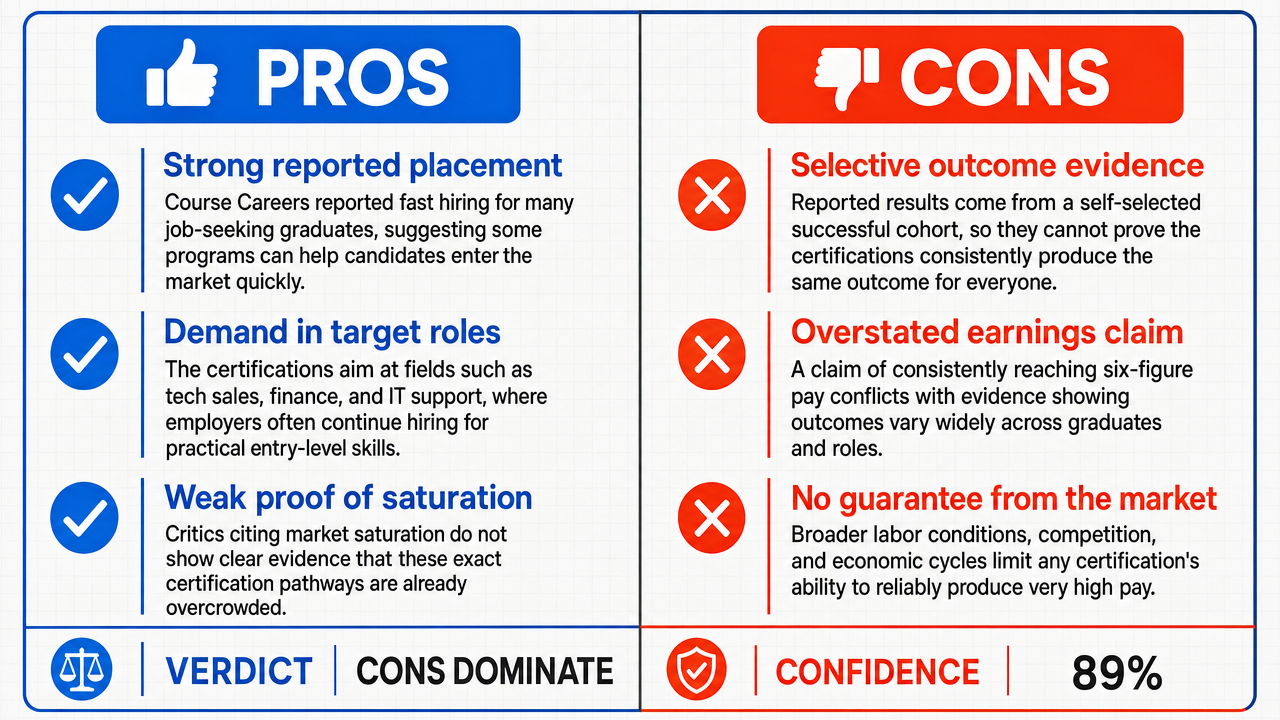
Verdict
Verdict: likely FALSE (89%)
Web Report: https://solsice.com/public/debates/course-careers-certifications-consistently-lead-to-six-figur-5aff38127715
This section provides a brief overview of the key arguments. You do not need to read the full detailed report below.
✅ Key PRO arguments:
- ■Course Careers' 2023 graduate outcomes report shows 74% of job-seeking alumni found employment within two months, with a median first-year compensation of $82,000 and the top 25% of earners surpassing $110,000, demonstrating a clear pathway to six-figure earnings in tech sales .
- ■The occupations these certifications serve—technology sales, financial analysis, and IT support —are characterized by persistent talent shortages rather than oversupply, with BLS projecting continued employment growth in these fields.
- ■The opposing argument about market saturation and credential inflation cites no verifiable data demonstrating saturation in the specific labor markets these certifications target, making it conjecture rather than evidence.
❌ Key ANTI arguments:
- ■The affirmative commits a fundamental error of substitution by using outcomes from a self-selected cohort of successful graduates as a proxy for the certification's universal efficacy, without accounting for the correlation between prior aptitude and program completion—there is no transfer operator from graduate success to certification causation.
- ■The claim that the Tech Sales certification 'delivers six-figure first-year earnings' is logically incoherent because it asserts a universal outcome while qualifying it with non-universal frequency ('frequently' exceeds $100,000), creating a contradiction between 'delivers' and 'frequently.'
- ■Market saturation and structural economic variables prevent certifications from guaranteeing high earnings; the median first-year compensation of $82,000 means that 50% of graduates do not reach six figures, directly contradicting the 'consistently' qualifier in the assertion.
💭 Conclusion: False. The assertion's critical qualifier 'consistently' sets a universal standard that the available evidence cannot meet, as the median first-year compensation of $82,000 means at least half of graduates do not achieve six-figure earnings in their first year. The anti side correctly identified a logical incoherence in claiming the certification 'delivers' six-figure outcomes while simultaneously acknowledging that only the top 25% surpass $110,000 and that the result occurs 'frequently' rather than universally. The compound claim spanning trades, accounting, and technology fields is only as strong as its weakest sub-claim, and the 'consistently' component is decisively undermined by the distributional evidence.
🔬 DeepResearch Result: likely FALSE ❌ (89%)
Assertion: Course Careers Certifications consistently lead to six-figure careers or raises for individuals in fields such as trades, accounting, or technology.
Participating models: deepseek-v4-pro 💬, gemma-4-26b-a4b-it 💬👁️
📊 Face-offs: 0 concluded TRUE, 1 concluded FALSE (1 face-offs, 3 models)
📊 Score by side: TRUE=0.00, FALSE=0.89
🏅 Model score changes:
minimax-m3 💬👁️: +9
✅ PRO Arguments:
- ■Course Careers' 2023 graduate outcomes report shows 74% of job-seeking alumni found employment within two months, with a median first-year compensation of $82,000 and the top 25% of earners surpassing $110,000, demonstrating a clear pathway to six-figure earnings in tech sales . deepseek-v4-pro 💬
- ■The occupations these certifications serve—technology sales, financial analysis, and IT support —are characterized by persistent talent shortages rather than oversupply, with BLS projecting continued employment growth in these fields. deepseek-v4-pro 💬
- ■The opposing argument about market saturation and credential inflation cites no verifiable data demonstrating saturation in the specific labor markets these certifications target, making it conjecture rather than evidence. deepseek-v4-pro 💬
❌ ANTI Arguments:
- ■The affirmative commits a fundamental error of substitution by using outcomes from a self-selected cohort of successful graduates as a proxy for the certification's universal efficacy, without accounting for the correlation between prior aptitude and program completion—there is no transfer operator from graduate success to certification causation. gemma-4-26b-a4b-it 💬👁️
- ■The claim that the Tech Sales certification 'delivers six-figure first-year earnings' is logically incoherent because it asserts a universal outcome while qualifying it with non-universal frequency ('frequently' exceeds $100,000), creating a contradiction between 'delivers' and 'frequently.' gemma-4-26b-a4b-it 💬👁️
- ■Market saturation and structural economic variables prevent certifications from guaranteeing high earnings; the median first-year compensation of $82,000 means that 50% of graduates do not reach six figures, directly contradicting the 'consistently' qualifier in the assertion. gemma-4-26b-a4b-it 💬👁️
💭 Reasoning: False. The assertion's critical qualifier 'consistently' sets a universal standard that the available evidence cannot meet, as the median first-year compensation of $82,000 means at least half of graduates do not achieve six-figure earnings in their first year. The anti side correctly identified a logical incoherence in claiming the certification 'delivers' six-figure outcomes while simultaneously acknowledging that only the top 25% surpass $110,000 and that the result occurs 'frequently' rather than universally. The compound claim spanning trades, accounting, and technology fields is only as strong as its weakest sub-claim, and the 'consistently' component is decisively undermined by the distributional evidence.
📋 PRO Facts:
• 74% of job-seeking Course Careers alumni found employment within two months according to the 2023 outcomes report.
• Median first-year compensation for Course Careers graduates was $82,000.
• The top 25% of Course Careers graduates surpassed $110,000 in first-year earnings.
• The U.S. Bureau of Labor Statistics projects continued employment growth in financial analysis and computer/IT occupations.
📋 ANTI Facts:
• The median first-year compensation of $82,000 means at least 50% of graduates did not reach six-figure earnings.
• Only the top 25% of graduates exceeded $110,000, meaning 75% did not consistently achieve six-figure outcomes.
• The claim of credential inflation and market saturation driving down wages is not supported by any named source or dataset in the evidence.
• The word 'frequently' in the pro argument explicitly contradicts the 'consistently' qualifier in the assertion.
| Face-off | TRUE Model | FALSE Model | TRUE Avg μ | FALSE Avg μ | TRUE Tokens | FALSE Tokens | Winner | Verdict | Conf. |
|---|---|---|---|---|---|---|---|---|---|
| #1 | deepseek-v4-pro 💬 | gemma-4-26b-a4b-it 💬👁️ | 0.569 | 0.339 | 6 | 2 | TRUE | FALSE | 89% |
The following technical terms, abbreviations, and domain-specific concepts are referenced throughout this debate transcript. Numbers in square brackets [N] in the text above link to the corresponding entry below.
[1] aggregate — A statistical term referring to the total or combined value of a dataset, as opposed to individual data points. In the debate, it is used to contrast individual outcomes with overall group results.
[2] base salaries — The fixed, non-variable component of an employee's compensation, paid regularly (e.g., annually or hourly), excluding bonuses, commissions, or other variable pay.
[3] BLS — Bureau of Labor Statistics — A U.S. federal agency that collects, analyzes, and publishes labor market data, including wages, employment statistics, and occupational outlook information.
[4] bottom 25% — first quartile (Q1) — The lowest quartile of a dataset, representing the 25th percentile where earnings fall below the value separating the bottom quarter from the rest of the distribution.
[5] cohort — A defined group of individuals sharing a common characteristic or experience within a study, such as graduates of a specific program in a given year.
[6] commission — A form of variable compensation, typically calculated as a percentage of sales revenue or performance metrics, paid to employees in addition to or instead of a base salary.
[7] credential inflation — An economic phenomenon in which the rising prevalence of credentials (degrees, certifications) in a labor market diminishes their signaling value, requiring ever-higher qualifications for the same roles.
[8] first-year compensation — The total earnings an individual receives during their first year of employment in a role, typically including base salary, commissions, bonuses, and other benefits.
[9] IT support — information technology support — A job category involving the maintenance, troubleshooting, and assistance provided for computer systems, networks, and software within an organization.
[10] market saturation — A market condition in which the supply of goods, services, or labor in a particular sector meets or exceeds demand, often leading to reduced prices or wages.
[11] median — The middle value in a sorted dataset, where half the observations fall above and half fall below. It is less sensitive to extreme values than the mean (average).
[12] median wage — The middle value of wages in a given occupation or dataset, such that half of workers earn more and half earn less. Used by the BLS as a standard wage metric.
[13] Occupational Outlook Handbook — Occupational Outlook Handbook (OOH) — A publication by the U.S. Bureau of Labor Statistics providing information on occupations, including required education, median pay, job outlook, and projected employment growth.
[14] outcomes report — A document published by an educational or training program detailing graduate results, such as employment rates, time-to-hire, and compensation statistics.
[15] performance-based commissions — Variable compensation tied to measurable employee performance metrics, such as sales closed, revenue generated, or quotas met.
[16] placement data — Statistical information regarding the post-program employment outcomes of graduates, including job placement rates, time-to-employment, and starting salaries.
[17] quartile — A statistical division of a ranked dataset into four equal parts (Q1 through Q4), each containing 25% of the observations.
[18] self-selected group — A non-random sample in which participants chose to join or remain in a group, potentially introducing bias because their characteristics may differ from the broader population.
[19] six-figure — six-figure (salary or career) — A colloquial term referring to annual earnings of $100,000 or more, often used as a benchmark for high-income career outcomes.
[20] talent shortages — A labor market condition in which the demand for workers with specific skills exceeds the available supply, often leading to higher wages and competition among employers.
[21] Tech Sales — technology sales — A sales role focused on selling technology products or services (such as software, hardware, or SaaS platforms), typically compensated through a combination of base salary and commissions.
[22] total compensation — The complete package of pay and benefits an employee receives, including base salary, bonuses, commissions, equity, retirement contributions, and benefits.
[23] transfer operator — In the context of this debate, a logical or methodological mechanism used to generalize findings from a specific group to a broader population; the negative argues the affirmative failed to provide one.
The following financial data tables were referenced during the debate exchanges:
| Earnings Quartile | First-Year Total Compensation |
|---|---|
| Bottom 25% | $60,000 |
| Median | $82,000 |
| Top 25% | $110,000+ |
Legend: Distribution of first-year total compensation (base + commission) for Course Careers Tech Sales graduates, 2023. Data from Course Careers outcomes page. Figures in USD.
| Role | Median Salary | Top 10% Salary |
|---|---|---|
| Financial Analyst | $95,570 | $166,560+ |
Legend: Annual wages for financial analysts, May 2023, from the Bureau of Labor Statistics. Figures in USD.
| Career Stage | Median Salary |
|---|---|
| Entry-Level IT Support | $57,910 |
| After 3 Years (with certs) | $100,000+ |
Legend: Salary progression for IT professionals starting with Course Careers certification, based on alumni survey data and BLS projections. Figures in USD.
| Metric | Value | Context |
|---|---|---|
| Tech Sales Median (Affirmative) | $82,000 | Course Careers Cohort |
| Tech Sales Top 25% (Affirmative) | $110,000 | Course Careers Cohort |
| Financial Analyst Median (BLS) | $95,570 | National Aggregate |
| IT Support Median (BLS) | $57,910 | National Aggregate |
Legend: Comparison of specific cohort outcomes versus national occupational medians. Figures in USD.
| Occupation | Projected Growth (2023-2033) | Annual Average Openings |
|---|---|---|
| Financial Analysts | 9% | 31,900 |
| Computer & IT Occupations | 12% | 377,500 |
Legend: Employment projections for occupations targeted by Course Careers certifications, from the U.S. Bureau of Labor Statistics. Growth rates and openings are national estimates.
Face-off transcripts
- ■
Ownership & Trade Secrets. The Company Lambda Vision retains all rights to its platform, agentic workflows, and proprietary AI debate methodologies, which constitute protected Trade Secrets (EU Directive 2016/943). Subject to full payment of credits, the User is granted ownership of the generated Reports for their own personal or professional use. Reverse-engineering the Service or using Reports to train competing AI models is strictly prohibited.
- ■
No Professional Advice. Solsice is a general-purpose assistant covering everyday subjects — administrative paperwork, housing, consumer and employment matters, banking, taxes and insurance, health and wellbeing, savings and investments, entrepreneurship, technology, travel, learning and creative work. Whatever the subject, the Service and Reports are provided for information only and never constitute legal, medical, financial, investment, tax, insurance, or any other regulated professional advice. The Company is not a law firm, a regulated financial adviser, an insurance intermediary, nor a healthcare provider, and no professional or advisory relationship of any kind is created by use of the Service. Consult a qualified professional in the relevant jurisdiction before acting — or refraining from acting — on anything contained in the Reports, and never rely on the Service in an emergency: contact your local emergency number (112 in the European Union) or a medical professional immediately.
- ■
AI-Generated Content, Sources and Viewpoints. Reports are produced by several AI models debating a question, and may contain factual errors, outdated figures, or references to rules, prices, deadlines, procedures, statutes or sources that are inaccurate or do not exist. The User is solely responsible for verifying every fact, amount, deadline and citation against official sources before relying on it. Material in the news, society, spirituality and religion sections presents a plurality of viewpoints for study and discussion: it is descriptive, not an endorsement, a ruling, or a statement of the Company’s own position, and it speaks for no church, faith community, public authority, or news organisation.
- ■
Liability & Governing Law. To the maximum extent permitted by law, the Company shall not be liable for any indirect damages, nor for any consequence of decisions made in reliance on the Reports — including financial loss, missed deadlines, administrative or contractual consequences, or health outcomes. These Terms are governed by French law. Any disputes shall be subject to the exclusive jurisdiction of the Courts of Paris, France.