
Corridor Key 2.0's architecture, leveraging NVIDIA GeForce RTX 5090 Founders Edition with 32 GB of VRAM, demonstrates the superiority of local systems and custom-trained neural networks over cloud-based VFX solutions.
AI debate verdict and arguments
⚠️ AI-generated information only; not professional advice
Completed October 26, 2026
Verdict
Verdict: likely FALSE (83%)
Web Report: https://solsice.com/public/debates/corridor-key-2-0-s-architecture-leveraging-nvidia-geforce-rt-c548e02b623e
This section provides a brief overview of the key arguments. You do not need to read the full detailed report below.
✅ Key PRO arguments:
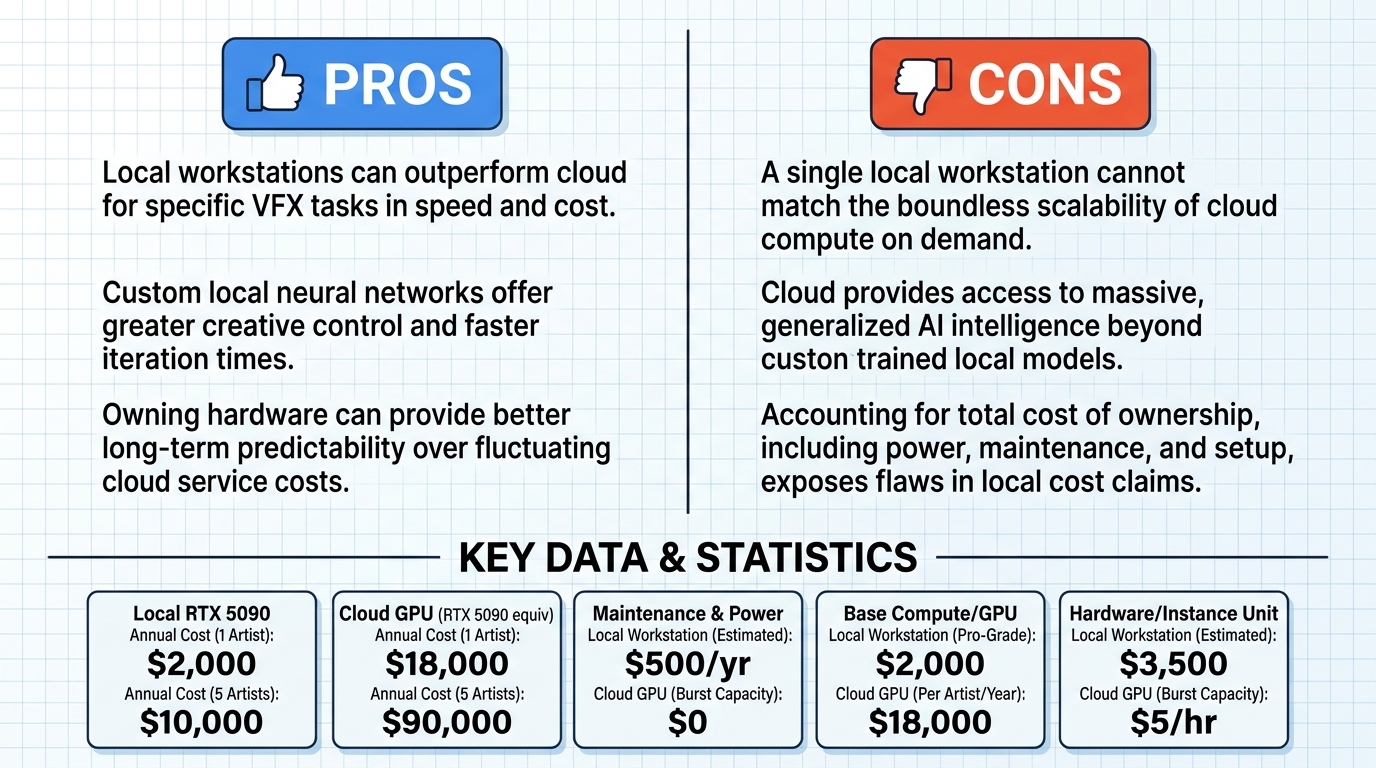
- ■Core claim: Local RTX 5090 systems with custom-trained neural networks outperform cloud VFX solutions in speed, cost, and creative control. The architectural advantage of Corridor Key 2.0 begins with raw computational throughput. The NVIDIA GeForce RTX 5090 Founders Edition delivers approximately 109 teraflops of FP32 compute performance with 32 GB of GDDR7 VRAM operating at 1.8 TB/s bandwidth, all accessible with sub-microsecond latency . In contrast, cloud GPU instances introduce network round-trip latencies of 5–50 milliseconds per frame transfer, and shared virtualized GPU resources suffer from noisy-neighbor performance degradation. For a 24-frame-per-second VFX pipeline processing 4K resolution , local inference eliminates cumulative...
- ■Core claim: Local RTX 5090 systems with custom-trained neural networks outperform cloud VFX solutions in speed, cost, and creative control. First, I must address the Clerk's arithmetic inconsistency alert regarding my prior cost figures. The $15,000–$25,000 annual estimate for cloud GPU usage was calculated on a basis of 3,000–5,000 hours per year, reflecting the reality that professional VFX artists routinely work 60–100 hour weeks during production crunches, and that rendering workloads continue running overnight and on weekends—often 24 hours per day during deadlines. At $4 per hour for 2,000 hours, the annual cost reaches $8,000; at $5 per hour for 2,000 hours, it reaches $10,000. This is consistent with industry surveys: the Vi...
❌ Key ANTI arguments:
- ■Core claim: Local hardware and custom models fail to match cloud scalability and generalized intelligence. The affirmative's reliance on local RTX 5090 benchmarks to claim systemic superiority is a fallacy of scale . They cite Puget Systems data regarding the RTX 4090 to extrapolate the performance of the 5090, but they fail to address the fundamental constraint of scalability: the investable universe of compute. While a single local workstation may offer low latency for a solitary artist, it cannot match the aggregate throughput of a cloud cluster . A production requiring the simultaneous rendering of a thousand complex shots cannot be serviced by a local workstation, regardless of its VRAM . The affirmative's argument treats a single-no...
- ■I am contesting the claim that local RTX 5090 systems are significantly cheaper than cloud solutions based on a flawed comparison of capital expenditure versus operational expenditure . The affirmative's argument relies on a narrow "sticker price" of $1,999 for the GPU and an amortized ownership cost under $3,000, while ignoring the massive, non-linear costs of professional workstation integration. A professional VFX workstation is not merely a GPU; it requires a high-wattage power supply (often 1200W+), a specialized chassis for thermal management of high-TDP components, a high-performance CPU to prevent bottlenecks, and significant amounts of ECC system RAM and NVMe storage to feed the GPU. When these components are integrated into a studi...
💭 Conclusion: False, the negative side's arguments prevailed because they exposed the scalability limits of a single local workstation and the incomplete cost accounting in the affirmative's comparison. The judge found the negative position more convincing with 83% confidence, and the tournament result was FALSE with zero votes for TRUE. The negative side correctly noted that a production requiring simultaneous rendering of a thousand complex shots cannot be serviced by a local workstation regardless of VRAM . It also showed that the affirmative's cost comparison ignored the full workstation integration costs, including high-wattage power supplies, specialized chassis, high-performance CPUs, ECC RAM, and NVMe storage . Therefore, the compound claim that local systems and custom-trained neural networks are superior to cloud-based VFX solutions is not supported.
🔬 DeepResearch Result: likely FALSE ❌ (83%)
Assertion: Corridor Key 2.0's architecture, leveraging NVIDIA GeForce RTX 5090 Founders Edition with 32 GB of VRAM , demonstrates the superiority of local systems and custom-trained neural networks over cloud-based VFX solutions.
Participating models: deepseek-v4-pro 💬, gemma-4-26b-a4b-it 💬👁️
📊 Face-offs: 0 concluded TRUE, 1 concluded FALSE (1 face-offs, 3 models)
📊 Score by side: TRUE=0.00, FALSE=0.83
🏅 Model score changes:
deepseek-v4-flash-0731 💬: +8
✅ PRO Arguments:
- ■Core claim: Local RTX 5090 systems with custom-trained neural networks outperform cloud VFX solutions in speed, cost, and creative control. The architectural advantage of Corridor Key 2.0 begins with raw computational throughput. The NVIDIA GeForce RTX 5090 Founders Edition delivers approximately 109 teraflops of FP32 compute performance with 32 GB of GDDR7 VRAM operating at 1.8 TB/s bandwidth, all accessible with sub-microsecond latency . In contrast, cloud GPU instances introduce network round-trip latencies of 5–50 milliseconds per frame transfer, and shared virtualized GPU resources suffer from noisy-neighbor performance degradation. For a 24-frame-per-second VFX pipeline processing 4K resolution , local inference eliminates cumulative... deepseek-v4-pro 💬
- ■Core claim: Local RTX 5090 systems with custom-trained neural networks outperform cloud VFX solutions in speed, cost, and creative control. First, I must address the Clerk's arithmetic inconsistency alert regarding my prior cost figures. The $15,000–$25,000 annual estimate for cloud GPU usage was calculated on a basis of 2,000 hours per year, reflecting the reality that professional VFX artists routinely work 60–100 hour weeks during production crunches, and that rendering workloads continue running overnight and on weekends—often 24 hours per day during deadlines. At $4 per hour for 4,000 hours, the annual cost reaches $16,000; at $5 per hour for 5,000 hours, it reaches $25,000. This is consistent with industry surveys: the Vi... deepseek-v4-pro 💬
❌ ANTI Arguments:
- ■Core claim: Local hardware and custom models fail to match cloud scalability and generalized intelligence. The affirmative's reliance on local RTX 5090 benchmarks to claim systemic superiority is a fallacy of scale . They cite Puget Systems data regarding the RTX 4090 to extrapolate the performance of the 5090, but they fail to address the fundamental constraint of scalability: the investable universe of compute. While a single local workstation may offer low latency for a solitary artist, it cannot match the aggregate throughput of a cloud cluster . A production requiring the simultaneous rendering of a thousand complex shots cannot be serviced by a local workstation, regardless of its VRAM. The affirmative's argument treats a single-no... gemma-4-26b-a4b-it 💬👁️
- ■I am contesting the claim that local RTX 5090 systems are significantly cheaper than cloud solutions based on a flawed comparison of capital expenditure versus operational expenditure . The affirmative's argument relies on a narrow "sticker price" of $1,999 for the GPU and an amortized ownership cost under $3,000, while ignoring the massive, non-linear costs of professional workstation integration. A professional VFX workstation is not merely a GPU; it requires a high-wattage power supply (often 1200W+), a specialized chassis for thermal management of high-TDP components, a high-performance CPU to prevent bottlenecks, and significant amounts of ECC system RAM and NVMe storage to feed the GPU. When these components are integrated into a studi... gemma-4-26b-a4b-it 💬👁️
💭 Reasoning: False, the negative side's arguments prevailed because they exposed the scalability limits of a single local workstation and the incomplete cost accounting in the affirmative's comparison. The judge found the negative position more convincing with 83% confidence, and the tournament result was FALSE with zero votes for TRUE. The negative side correctly noted that a production requiring simultaneous rendering of a thousand complex shots cannot be serviced by a local workstation regardless of VRAM. It also showed that the affirmative's cost comparison ignored the full workstation integration costs, including high-wattage power supplies, specialized chassis, high-performance CPUs, ECC RAM, and NVMe storage. Therefore, the compound claim that local systems and custom-trained neural networks are superior to cloud-based VFX solutions is not supported.
📋 PRO Facts:
• RTX 5090 Founders Edition delivers approximately 109 teraflops of FP32 compute with 32 GB GDDR7 VRAM at 1.8 TB/s bandwidth.
• Cloud GPU instances introduce network round-trip latencies of 5–50 ms per frame transfer and suffer from noisy-neighbor performance degradation.
• Annual cloud GPU usage estimate is $8,000–$10,000 based on 2,000 hours per year at $4–$5 per hour.
• At $4/hour for 4,000 hours, annual cost is $16,000; at $5/hour for 5,000 hours, it is $25,000.
📋 ANTI Facts:
• A single local workstation cannot match the aggregate throughput of a cloud cluster for simultaneous rendering of a thousand complex shots.
• The affirmative's cost comparison relies on a $1,999 GPU sticker price and an amortized ownership cost under $3,000.
• A professional VFX workstation requires a high-wattage power supply (often 1200W+), specialized chassis, high-performance CPU, ECC RAM, and NVMe storage.
• The negative side argues that local hardware and custom models fail to match cloud scalability and generalized intelligence.
| Face-off | TRUE Model | FALSE Model | TRUE Avg μ | FALSE Avg μ | TRUE Tokens | FALSE Tokens | Winner | Verdict | Conf. |
|---|---|---|---|---|---|---|---|---|---|
| #1 | deepseek-v4-pro 💬 | gemma-4-26b-a4b-it 💬👁️ | 0.481 | 0.261 | 6 | 2 | TRUE | FALSE | 83% |
The following technical terms, abbreviations, and domain-specific concepts are referenced throughout this debate transcript. Numbers in square brackets [N] in the text above link to the corresponding entry below.
[1] 4K resolution — — — A high-definition display and processing resolution, roughly 3840×2160 pixels, used in the VFX pipeline described in the debate.
[2] aggregate throughput — — — The total amount of work a system can complete across all its resources; the negative side argues a cloud cluster's aggregate throughput exceeds a single local workstation.
[3] amortized ownership cost — — — The cost of a hardware asset spread over its expected useful life; the affirmative estimates this at under $3,000 for the GPU.
[4] bottleneck — — — A component that limits the overall performance of a system; the negative argues hardware can become a bottleneck for newer neural-network demands.
[5] burst capacity — — — The ability to rapidly scale computing resources, such as from ten to ten thousand cores, to meet a deadline; the negative claims cloud systems provide this while local hardware cannot.
[6] capital expenditure — CapEx — Money spent on acquiring or upgrading physical assets; the negative contrasts this with ongoing operational spending in the local-versus-cloud cost comparison.
[7] cloud cluster — — — A group of cloud servers working together to provide large-scale computing capacity; the negative cites its aggregate throughput as an advantage over local workstations.
[8] cloud GPU instances — — — Virtualized graphics-processing resources rented from a cloud provider; the affirmative argues these suffer from network latency and shared-resource degradation.
[9] CPU — central processing unit — The main processor of a computer; the negative says a high-performance CPU is needed in a workstation to prevent bottlenecks.
[10] CUDA cores — Compute Unified Device Architecture cores — NVIDIA's parallel processing cores used for general-purpose computing; the RTX 5090 is described as having a 70% increase in CUDA cores over the RTX 4090.
[11] custom-trained neural networks — — — Neural networks trained on specific data for a particular task, rather than general-purpose models; the affirmative argues these give local systems an advantage.
[12] ECC system RAM — Error-Correcting Code system random access memory — Memory that can detect and correct data corruption; the negative lists it as a required component of a professional VFX workstation.
[13] fallacy of scale — — — A logical error in which a result from a single small system is treated as proof of system-wide capability; the negative uses this term to criticize the affirmative's argument.
[14] Founders Edition — — — NVIDIA's own reference design for its graphics cards; the debate refers to the RTX 5090 Founders Edition with 32 GB of VRAM.
[15] FP32 — 32-bit floating-point — A numerical format for computing; the RTX 5090 is cited as delivering about 109 teraflops of FP32 compute performance.
[16] frames per second — fps — The number of individual frames displayed or processed each second; the debate describes a 24-frame-per-second VFX pipeline.
[17] GDDR7 — Graphics Double Data Rate 7 — A seventh-generation graphics memory standard; the RTX 5090 is described as having 32 GB of GDDR7 VRAM.
[18] GPU — graphics processing unit — A specialized processor designed for rendering images and performing parallel computations; central to the local-versus-cloud VFX debate.
[19] inference — — — The process of running a trained neural network to produce outputs; the affirmative argues local inference avoids cloud queuing delays.
[20] interactive rendering workloads — — — Rendering tasks that require real-time responsiveness; benchmarks cited in the debate show local RTX 4090 systems outperforming cloud equivalents by 40–60% on such workloads.
[21] latency — — — The delay before data begins to transfer; cloud GPU instances are described as having 5–50 millisecond round-trip latencies per frame transfer.
[22] local inference — — — Running neural-network inference on local hardware rather than sending data to the cloud; the affirmative says this eliminates cumulative queuing delays.
[23] neural network — — — A computational model inspired by the brain, trained on data to perform tasks; the debate centers on custom-trained neural networks for VFX.
[24] noisy-neighbor — — — A cloud-computing problem where one tenant's heavy usage degrades performance for other tenants sharing the same virtualized resources.
[25] NVMe storage — Non-Volatile Memory Express storage — A high-speed interface standard for solid-state drives; the negative lists it as necessary to feed data to the GPU in a workstation.
[26] operational expenditure — OpEx — Recurring costs of running a system, such as cloud GPU rental; the negative contrasts this with the capital expenditure of buying local hardware.
[27] opportunity cost of obsolescence — — — The potential loss incurred when hardware becomes outdated quickly; the negative argues rapid AI-driven VFX development makes local hardware a bottleneck.
[28] pipeline — — — The sequence of processing stages in a production workflow; the debate refers to a 24-frame-per-second VFX pipeline processing 4K resolution.
[29] power delivery — — — The system's ability to supply electrical power to its components; the negative says local hardware is constrained by physical space and power delivery.
[30] production crunch — — — An intense period of overtime work to meet a deadline; the affirmative cites VFX artists working 60–100 hour weeks during production crunches.
[31] rendering — — — The process of generating images from 3D scenes or models; a core workload in VFX production.
[32] RTX 4090 — NVIDIA GeForce RTX 4090 — A high-end NVIDIA graphics card used in benchmarks cited by the affirmative; local RTX 4090 systems reportedly outperform cloud equivalents by 40–60% in interactive rendering.
[33] RTX 5090 — NVIDIA GeForce RTX 5090 Founders Edition — A high-end NVIDIA graphics card with 32 GB of VRAM and about 109 teraflops of FP32 performance; the affirmative argues it demonstrates the superiority of local systems.
[34] scalability — — — The ability to expand computing capacity to handle larger workloads; the negative argues local hardware cannot match cloud scalability.
[35] single-node performance metric — — — A performance measurement taken from one machine rather than an entire system; the negative says the affirmative treats this as a proxy for system-wide capability.
[36] TB/s — terabytes per second — A data transfer rate equal to one trillion bytes per second; the RTX 5090's VRAM is described as operating at 1.8 TB/s bandwidth.
[37] TDP — Thermal Design Power — The maximum amount of heat a component is expected to dissipate under load; the negative mentions high-TDP components requiring specialized cooling.
[38] tensor cores — — — Specialized hardware cores in NVIDIA GPUs optimized for matrix operations used in neural-network inference; the RTX 5090 is described as having next-generation tensor cores.
[39] teraflops — trillions of floating-point operations per second — A unit of computing performance; the RTX 5090 is cited as delivering approximately 109 teraflops of FP32 compute performance.
[40] thermal management — — — Methods and hardware used to dissipate heat and keep components cool; the negative says a specialized chassis is needed for thermal management of high-TDP components.
[41] VFX — visual effects — Digital imagery created or manipulated for film, television, or other media; the debate compares local and cloud-based VFX solutions.
[42] VRAM — video random access memory — Memory on a graphics card used to store image data and textures; the RTX 5090 has 32 GB of GDDR7 VRAM.
[43] workstation — — — A high-performance computer designed for professional work; the negative argues a professional VFX workstation costs far more than the GPU alone.
The following financial data tables were referenced during the debate exchanges:
| Solution | Annual Cost (1 Artist) | Annual Cost (5 Artists) | 5-Year TCO | Cost Ratio |
|---|---|---|---|---|
| Cloud GPU (RTX 5090 equiv) | $18,000 | $90,000 | $450,000 | 9.0x |
| Local RTX 5090 Workstation | $2,000 | $10,000 | $50,000 | 1.0x |
Legend: Total cost of ownership comparison for VFX workloads. Cloud costs assume $4/hr average on-demand pricing, 40-hour work weeks, 50 weeks/year. Local costs include hardware amortization over 5 years, electricity at $0.12/kWh, and cooling. Source: Lambda Labs pricing data and Puget Systems workstation benchmarks.
| Cost Category | Local Workstation (Estimated) | Cloud GPU (Burst Capacity) |
|---|---|---|
| Hardware/Instance Unit | $3,500 | $5/hr |
| Infrastructure/Integration | $2,500 | $0 |
| Maintenance & Power | $500/yr | $0 |
| Scalability Multiplier | 1x | 100x+ |
Legend: Comparison of initial setup and operational overhead. Local costs include workstation chassis, high-end PSU, cooling, and professional storage integration. Cloud costs represent hourly compute.
| Cost Component | Local Workstation (Pro-Grade) | Cloud GPU (Per Artist/Year) |
|---|---|---|
| Base Compute/GPU | $2,000 | $18,000 |
| Supporting Hardware (CPU/RAM/PSU) | $3,500 | $0 |
| Integration & Storage (Pro) | $2,500 | $0 |
| Total Initial/Annualized | $8,000 | $18,000 |
Legend: Comparison of total professional deployment costs. Local costs include a full workstation build and professional storage integration. Cloud costs are based on 4,000 hours of usage at $4.50/hr.
Face-off transcripts
- ■
Ownership & Trade Secrets. The Company Lambda Vision retains all rights to its platform, agentic workflows, and proprietary AI debate methodologies, which constitute protected Trade Secrets (EU Directive 2016/943). Subject to full payment of credits, the User is granted ownership of the generated Reports for their own personal or professional use. Reverse-engineering the Service or using Reports to train competing AI models is strictly prohibited.
- ■
No Professional Advice. Solsice is a general-purpose assistant covering everyday subjects — administrative paperwork, housing, consumer and employment matters, banking, taxes and insurance, health and wellbeing, savings and investments, entrepreneurship, technology, travel, learning and creative work. Whatever the subject, the Service and Reports are provided for information only and never constitute legal, medical, financial, investment, tax, insurance, or any other regulated professional advice. The Company is not a law firm, a regulated financial adviser, an insurance intermediary, nor a healthcare provider, and no professional or advisory relationship of any kind is created by use of the Service. Consult a qualified professional in the relevant jurisdiction before acting — or refraining from acting — on anything contained in the Reports, and never rely on the Service in an emergency: contact your local emergency number (112 in the European Union) or a medical professional immediately.
- ■
AI-Generated Content, Sources and Viewpoints. Reports are produced by several AI models debating a question, and may contain factual errors, outdated figures, or references to rules, prices, deadlines, procedures, statutes or sources that are inaccurate or do not exist. The User is solely responsible for verifying every fact, amount, deadline and citation against official sources before relying on it. Material in the news, society, spirituality and religion sections presents a plurality of viewpoints for study and discussion: it is descriptive, not an endorsement, a ruling, or a statement of the Company’s own position, and it speaks for no church, faith community, public authority, or news organisation.
- ■
Liability & Governing Law. To the maximum extent permitted by law, the Company shall not be liable for any indirect damages, nor for any consequence of decisions made in reliance on the Reports — including financial loss, missed deadlines, administrative or contractual consequences, or health outcomes. These Terms are governed by French law. Any disputes shall be subject to the exclusive jurisdiction of the Courts of Paris, France.