
Corridor Key 2.0 can complete a professional-grade green screen key of a complex shot with multiple people and motion blur in approximately 30 seconds using a single-frame hint and temporal processing.
AI debate verdict and arguments
⚠️ AI-generated information only; not professional advice
Completed October 24, 2026
Verdict
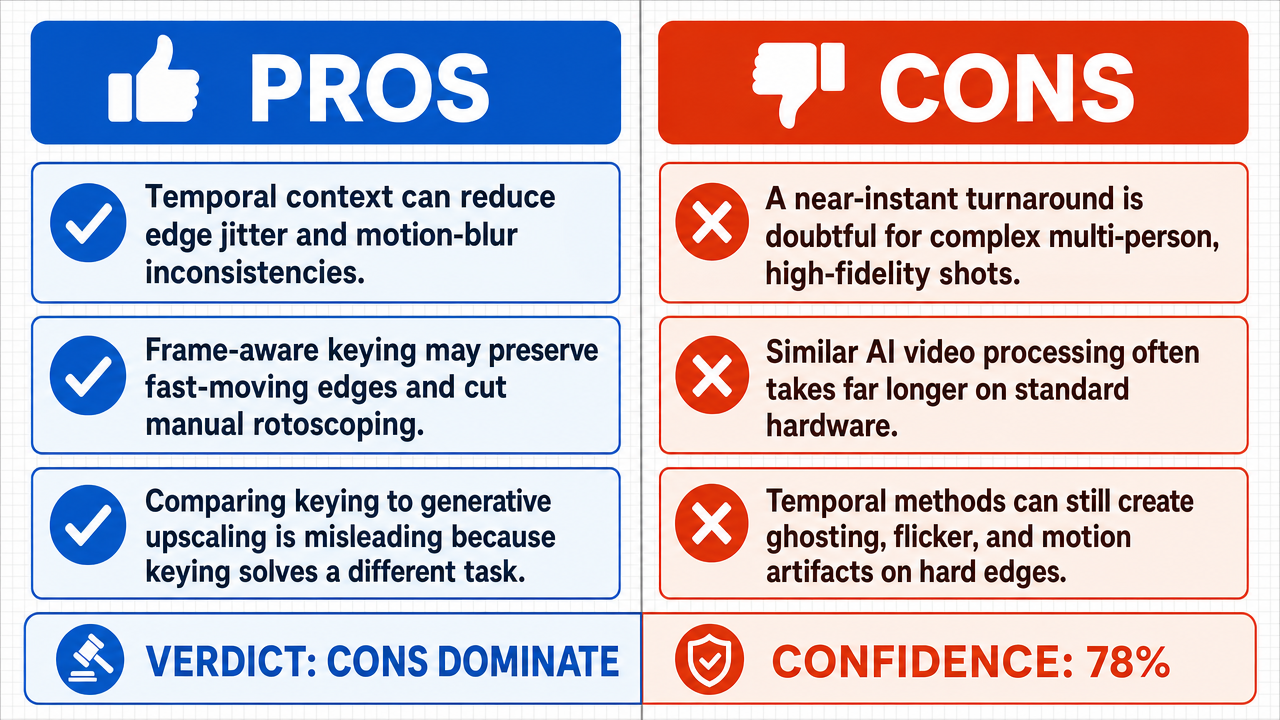
Verdict: likely FALSE (78%)
Web Report: https://solsice.com/public/debates/corridor-key-2-0-can-complete-a-professional-grade-green-scr-6e9f88870dad
This section provides a brief overview of the key arguments. You do not need to read the full detailed report below.
✅ Key PRO arguments:
- ■Corridor Key 2.0 's temporal architecture can use preceding and succeeding frames to reduce inconsistencies caused by motion blur and edge jitter .
- ■Temporal awareness may maintain edge integrity for rapidly moving subjects while reducing the need for manual rotoscoping or iterative refinement , potentially supporting the approximately 30-second workflow.
- ■The comparison with Topaz Video AI is a false equivalence because generative upscaling and frame interpolation synthesize new pixel data , whereas Corridor Key 2.0 performs segmentation of existing pixel boundaries; therefore, Topaz processing times do not directly determine Corridor Key 2.0's speed.
❌ Key ANTI arguments:
- ■The approximately 30-second turnaround was challenged as inconsistent with the computational demands of high-fidelity AI video processing, particularly for complex 4K footage.
- ■The negative side cited a PCMag review of Topaz Video AI reporting that processing a single 4K clip could take hours on standard hardware, arguing that similarly demanding temporal workflows may not plausibly finish in 30 seconds.
- ■Temporal processing does not automatically solve difficult edges; using adjacent frames can introduce ghosting , temporal flickering , and motion-adaptive artifacts , especially with rapid movement or multiple overlapping people.
💭 Conclusion: False is the supported verdict for the compound assertion. The strongest negative case is that temporal processing can itself produce ghosting , temporal flickering , and motion-adaptive artifacts on fast movement or overlapping people, often requiring manual cleanup. Those risks directly weaken the claimed combination of professional-grade output, multiple people, motion blur , a single-frame hint , and roughly 30-second completion, because no end-to-end benchmark in the debate established all of those elements together. The affirmative model correctly noted that segmentation and generative upscaling are different workloads, so the cited hours-long Topaz Video AI run is not decisive proof about Corridor Key 2.0 . Nevertheless, the affirmative side asserted the feasibility of the 30-second workflow without direct timing or quality evidence, leaving the compound claim insufficiently demonstrated and making the false verdict more persuasive.
🔬 DeepResearch Result: likely FALSE ❌ (78%)
Assertion: Corridor Key 2.0 can complete a professional-grade green screen key of a complex shot with multiple people and motion blur in approximately 30 seconds using a single-frame hint and temporal processing .
Participating models: gemma-4-26b-a4b-it 💬👁️, glm-4.7-flash 💬
📊 Face-offs: 0 concluded TRUE, 1 concluded FALSE (1 face-offs, 3 models)
📊 Score by side: TRUE=0.00, FALSE=0.78
🏅 Model score changes:
minimax-m3 💬👁️: +8
✅ PRO Arguments:
- ■Corridor Key 2.0's temporal architecture can use preceding and succeeding frames to reduce inconsistencies caused by motion blur and edge jitter . gemma-4-26b-a4b-it 💬👁️
- ■Temporal awareness may maintain edge integrity for rapidly moving subjects while reducing the need for manual rotoscoping or iterative refinement , potentially supporting the approximately 30-second workflow. gemma-4-26b-a4b-it 💬👁️
- ■The comparison with Topaz Video AI is a false equivalence because generative upscaling and frame interpolation synthesize new pixel data , whereas Corridor Key 2.0 performs segmentation of existing pixel boundaries; therefore, Topaz processing times do not directly determine Corridor Key 2.0's speed. gemma-4-26b-a4b-it 💬👁️
❌ ANTI Arguments:
- ■The approximately 30-second turnaround was challenged as inconsistent with the computational demands of high-fidelity AI video processing, particularly for complex 4K footage. glm-4.7-flash 💬
- ■The negative side cited a PCMag review of Topaz Video AI reporting that processing a single 4K clip could take hours on standard hardware, arguing that similarly demanding temporal workflows may not plausibly finish in 30 seconds. glm-4.7-flash 💬
- ■Temporal processing does not automatically solve difficult edges; using adjacent frames can introduce ghosting , temporal flickering , and motion-adaptive artifacts , especially with rapid movement or multiple overlapping people. glm-4.7-flash 💬
- ■If temporal artifacts require substantial manual cleanup, the assertion that a single-frame hint and temporal processing alone can deliver professional-grade results within approximately 30 seconds is undermined. glm-4.7-flash 💬
💭 Reasoning: False is the supported verdict for the compound assertion. The strongest negative case is that temporal processing can itself produce ghosting, temporal flickering, and motion-adaptive artifacts on fast movement or overlapping people, often requiring manual cleanup. Those risks directly weaken the claimed combination of professional-grade output, multiple people, motion blur, a single-frame hint, and roughly 30-second completion, because no end-to-end benchmark in the debate established all of those elements together. The affirmative model correctly noted that segmentation and generative upscaling are different workloads, so the cited hours-long Topaz Video AI run is not decisive proof about Corridor Key 2.0. Nevertheless, the affirmative side asserted the feasibility of the 30-second workflow without direct timing or quality evidence, leaving the compound claim insufficiently demonstrated and making the false verdict more persuasive.
📋 PRO Facts:
• The affirmative case describes Corridor Key 2.0 as using preceding and succeeding frames to reduce motion-blur and edge-jitter inconsistencies.
• The affirmative case characterizes keying as segmentation of existing pixel boundaries, unlike generative upscaling and frame interpolation that synthesize pixels.
• The affirmative case claims temporal processing can reduce manual rotoscoping and iterative refinement for rapidly moving subjects.
📋 ANTI Facts:
• The negative case cited a PCMag review of Topaz Video AI as evidence that processing a single 4K clip can take hours on standard hardware.
• The negative case states that adjacent-frame processing can introduce ghosting, temporal flickering, and motion-adaptive artifacts.
• The negative case says such artifacts often require significant manual cleanup, undermining the claimed automated 30-second workflow.
| Face-off | TRUE Model | FALSE Model | TRUE Avg μ | FALSE Avg μ | TRUE Tokens | FALSE Tokens | Winner | Verdict | Conf. |
|---|---|---|---|---|---|---|---|---|---|
| #1 | gemma-4-26b-a4b-it 💬👁️ | glm-4.7-flash 💬 | 0.214 | 0.425 | 4 | 4 | FALSE | FALSE | 78% |
The following technical terms, abbreviations, and domain-specific concepts are referenced throughout this debate transcript. Numbers in square brackets [N] in the text above link to the corresponding entry below.
[1] 30-second turnaround — The claimed processing time for completing a complex green-screen key. The debate disputes whether this target is achievable and whether comparisons with other tools are valid.
[2] 4K — The video-resolution designation used when discussing upscaling and processing time. The negative side cites lengthy 4K enhancement times, while the affirmative side argues that enhancement is not comparable to segmentation.
[3] AI — Artificial intelligence, referenced in connection with video tools and models that perform tasks such as segmentation, upscaling, and frame interpolation.
[4] AI models — Models used by AI video tools to process footage. The debate says they can struggle with motion blur and the fidelity requirements of professional keying.
[5] alpha channel fidelity — The quality and accuracy of the transparency information in a key. The debate identifies it as a strict requirement of professional keying that can be compromised by motion blur.
[6] color ranges — User-defined selections of color used in traditional keying workflows. The transcript says a compositor may need several to account for complex lighting or multiple subjects.
[7] compositor — A professional operator who assembles and corrects composited shots. In the transcript, compositors define color ranges or matte layers and may need to clean up temporal artifacts.
[8] computational complexity — The amount of computation required by a processing task. The debate distinguishes generating new pixels through upscaling or interpolation from identifying and isolating existing pixel boundaries.
[9] Corridor Key 2.0 — The system at issue, described as an inference-based green-screen keying tool that uses a single-frame hint and temporal processing. The debate disputes whether it can produce professional-grade results on complex shots in approximately 30 seconds.
[10] edge integrity — The consistency and quality of a keyed subject's boundaries across a shot, especially during rapid movement. Temporal awareness is claimed to help preserve it without frame-by-frame manual work.
[11] edge jitter — Frame-to-frame instability in a subject's boundary. Temporal processing is proposed as a way to resolve this issue.
[12] frame interpolation — A generative video process cited alongside upscaling as synthesizing new pixel data across a sequence.
[13] frame-by-frame manual intervention — Manual correction or refinement performed separately for every frame rather than through automated processing. The debate says complex shots or temporal artifacts can still require this work.
[14] generative upscaling — Increasing video resolution by generating new pixel data. The affirmative side contrasts this work with segmentation that isolates existing pixel boundaries.
[15] ghosting — A visual artifact named as a possible result of temporal processing, particularly around rapidly moving or overlapping subjects.
[16] green screen key — A foreground-and-background separation used to isolate subjects from green-screen footage. The debate concerns the key's quality, stability, and production speed.
[17] green screen keying — The process of isolating subjects from a green-screen background to create a usable key. The affirmative side calls the proposed Corridor Key 2.0 result professional-grade, while the negative side disputes that claim.
[18] inference-based segmentation — A segmentation approach that identifies and isolates existing pixel boundaries in a shot. The affirmative side contrasts it with generative tasks that create new pixel data.
[19] iterative refinement — Repeatedly correcting and improving a result rather than obtaining it in one automated pass. It is cited as work that temporal keying might otherwise avoid.
[20] matte layers — Separate layers used to define foreground-and-background isolation in a keying workflow. Traditional workflows may require several when handling complex lighting or multiple subjects.
[21] motion blur — Blur associated with movement within a shot. It is identified as a difficult condition for professional-grade keying and for AI models.
[22] motion-adaptive artifacts — Processing errors whose behavior changes with subject movement. They are cited as a possible temporal-processing problem in rapidly moving or overlapping scenes.
[23] pixel data — The underlying image information processed in video frames. The debate contrasts synthesizing new pixel data with identifying and isolating existing pixel boundaries.
[24] professional-grade — A quality descriptor used for keying results considered suitable for professional compositing. Whether Corridor Key 2.0 achieves this standard under complex conditions in 30 seconds is disputed.
[25] rotoscoping — A manual, frame-by-frame tracing and masking technique referenced as work that may otherwise be needed when automatic keying cannot resolve difficult motion blur or edges.
[26] single-frame hint — A cue drawn from one frame that guides the keying system, reducing the need for multiple user-entered color ranges or matte layers. Its claimed ability to preserve professional-grade precision is disputed.
[27] spill suppression — A professional-keying quality requirement identified in the debate alongside alpha-channel fidelity. The transcript says AI models can struggle in these areas, particularly with motion blur.
[28] temporal artifacts — Visual or processing errors that occur across frames because of temporal processing. Examples named include ghosting, temporal flickering, and motion-adaptive artifacts.
[29] temporal awareness — An algorithm's use of context from preceding and succeeding frames to interpret and maintain boundaries through motion. The affirmative side says this improves edge consistency.
[30] temporal data — Information taken from frames before and after the frame being processed, allowing the system to use the shot's sequence rather than each frame in isolation.
[31] temporal flickering — Frame-to-frame visual instability in a processed key or image. It is cited as a possible artifact of temporal processing, especially around rapid movement.
[32] temporal mask — A mask applied across an existing shot using temporal information to isolate the subject. The affirmative side distinguishes this work from generative upscaling and frame interpolation.
[33] temporal processing — Processing that uses information from adjacent frames to maintain or refine a result over time. It is proposed to reduce motion blur and edge jitter, but it may also introduce ghosting, temporal flickering, and motion-adaptive artifacts.
[34] temporal processing architecture — The system design that enables the use of preceding and succeeding frame data. The affirmative side credits it with reducing the computational burden of high-complexity keying.
[35] Topaz Video AI — An AI video enhancement suite cited by the negative side as requiring hours to process a 4K clip on standard hardware. The affirmative side disputes the comparison because it characterizes the suite's generative upscaling and frame interpolation as different from boundary segmentation.
Face-off transcripts
- ■
Ownership & Trade Secrets. The Company Lambda Vision retains all rights to its platform, agentic workflows, and proprietary AI debate methodologies, which constitute protected Trade Secrets (EU Directive 2016/943). Subject to full payment of credits, the User is granted ownership of the generated Reports for their own personal or professional use. Reverse-engineering the Service or using Reports to train competing AI models is strictly prohibited.
- ■
No Professional Advice. Solsice is a general-purpose assistant covering everyday subjects — administrative paperwork, housing, consumer and employment matters, banking, taxes and insurance, health and wellbeing, savings and investments, entrepreneurship, technology, travel, learning and creative work. Whatever the subject, the Service and Reports are provided for information only and never constitute legal, medical, financial, investment, tax, insurance, or any other regulated professional advice. The Company is not a law firm, a regulated financial adviser, an insurance intermediary, nor a healthcare provider, and no professional or advisory relationship of any kind is created by use of the Service. Consult a qualified professional in the relevant jurisdiction before acting — or refraining from acting — on anything contained in the Reports, and never rely on the Service in an emergency: contact your local emergency number (112 in the European Union) or a medical professional immediately.
- ■
AI-Generated Content, Sources and Viewpoints. Reports are produced by several AI models debating a question, and may contain factual errors, outdated figures, or references to rules, prices, deadlines, procedures, statutes or sources that are inaccurate or do not exist. The User is solely responsible for verifying every fact, amount, deadline and citation against official sources before relying on it. Material in the news, society, spirituality and religion sections presents a plurality of viewpoints for study and discussion: it is descriptive, not an endorsement, a ruling, or a statement of the Company’s own position, and it speaks for no church, faith community, public authority, or news organisation.
- ■
Liability & Governing Law. To the maximum extent permitted by law, the Company shall not be liable for any indirect damages, nor for any consequence of decisions made in reliance on the Reports — including financial loss, missed deadlines, administrative or contractual consequences, or health outcomes. These Terms are governed by French law. Any disputes shall be subject to the exclusive jurisdiction of the Courts of Paris, France.