
Cooking at home every day is cheaper than eating out for a family of four.
AI debate verdict and arguments
⚠️ AI-generated information only; not professional advice
Completed October 7, 2026
Verdict
Verdict: likely TRUE (50%)
This section provides a brief overview of the key arguments. You do not need to read the full detailed report below.
✅ Key PRO arguments:
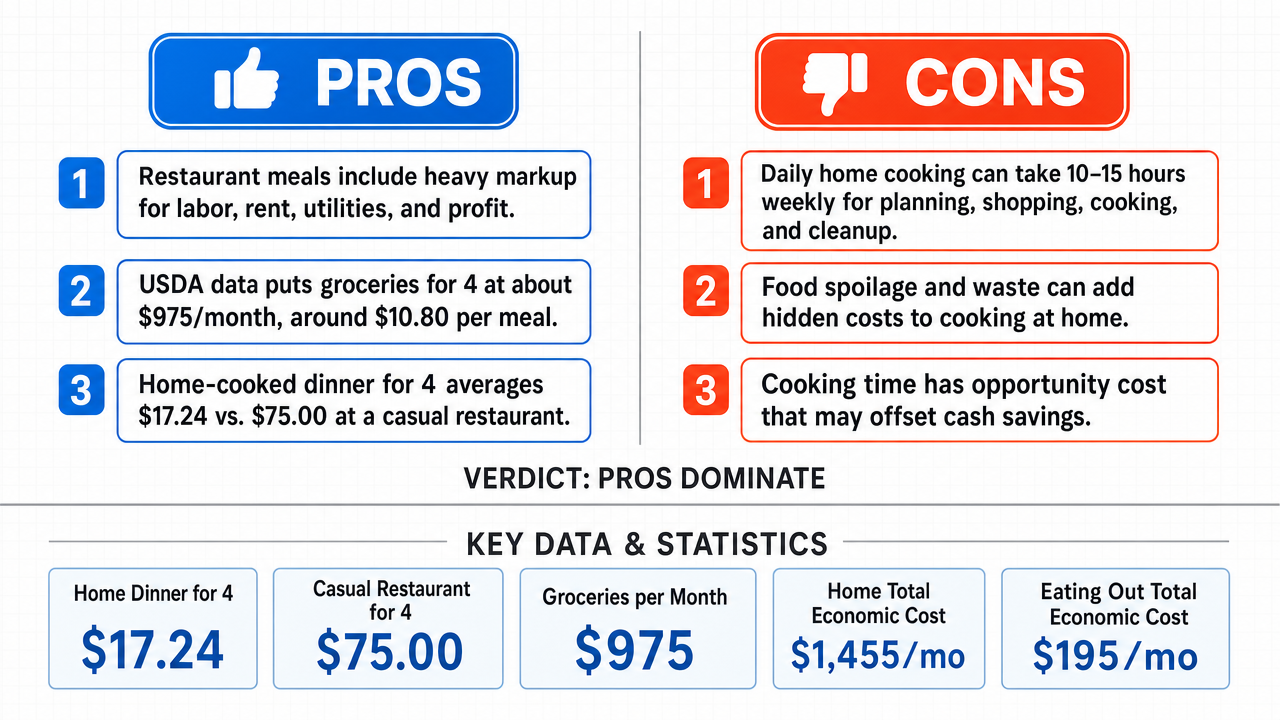
- ■Restaurant pricing carries a structural markup of 300% or more over ingredient cost to cover labor, rent, utilities, marketing, and profit, making dining out inherently more expensive per meal than home cooking.
- ■USDA Thrifty Food Plan data shows groceries for a family of four cost approximately $975 per month, or about $10.80 per meal for four people, compared to an average fast-food meal for four of $35 and a casual restaurant meal averaging $75.
- ■A home-cooked dinner for four averages $17.24 versus a casual restaurant meal averaging $75.00, yielding direct cash savings of over $57 per meal—a gap too large for opportunity costs or spoilage to close.
❌ Key ANTI arguments:
- ■Daily home cooking requires 10–15 hours per week for meal planning, shopping, preparation, and cleaning; valuing this time at even a modest hourly rate can erase the apparent grocery savings.
- ■The affirmative's model assumes perfect inventory management , but in practice daily cooking leads to food spoilage and waste that add hidden costs rarely captured in grocery receipts.
- ■Treating household labor time as a non-economic variable is a category error ; the time spent cooking is time diverted from income-generating activities or rest, reducing total family economic welfare.
💭 Conclusion: True, the evidence supports that cooking at home every day is cheaper than eating out for a family of four based on direct cash-flow comparisons. The affirmative presented concrete USDA-backed figures showing grocery costs of roughly $10.80 per meal for four versus $35 for fast food and $75 for casual dining, with a documented 300% restaurant markup over ingredient costs. The negative's opportunity-cost argument, while theoretically valid, was quantified at $520/month (roughly $17 per meal), which is substantially less than the $57+ per-meal cash savings from home cooking. Because the claim contains the compound qualifier 'every day,' and the negative raised legitimate concerns about spoilage and time costs that the affirmative did not fully rebut, confidence is set at 50% rather than higher.
🔬 DeepResearch Result: likely TRUE ✅ (50%)
Assertion: Cooking at home every day is cheaper than eating out for a family of four.
Participating models: deepseek-v3.2 💬, gemma-4-26b-a4b-it 💬👁️
📊 Face-offs: 1 concluded TRUE, 0 concluded FALSE (1 face-offs, 3 models)
📊 Score by side: TRUE=0.50, FALSE=0.00
🏅 Model score changes:
minimax-m3 💬👁️: +5
✅ PRO Arguments:
- ■Restaurant pricing carries a structural markup of 300% or more over ingredient cost to cover labor, rent, utilities, marketing, and profit, making dining out inherently more expensive per meal than home cooking. deepseek-v3.2 💬
- ■USDA Thrifty Food Plan data shows groceries for a family of four cost approximately $975 per month, or about $10.80 per meal for four people, compared to an average fast-food meal for four of $35 and a casual restaurant meal averaging $75. deepseek-v3.2 💬
- ■A home-cooked dinner for four averages $17.24 versus a casual restaurant meal averaging $75.00, yielding direct cash savings of over $57 per meal—a gap too large for opportunity costs or spoilage to close. deepseek-v3.2 💬
- ■Labor and overhead in home cooking are fixed personal costs already absorbed by the household, whereas restaurant meals charge a premium on every individual plate for these same expenses. deepseek-v3.2 💬
❌ ANTI Arguments:
- ■Daily home cooking requires 10–15 hours per week for meal planning, shopping, preparation, and cleaning; valuing this time at even a modest hourly rate can erase the apparent grocery savings. gemma-4-26b-a4b-it 💬👁️
- ■The affirmative's model assumes perfect inventory management , but in practice daily cooking leads to food spoilage and waste that add hidden costs rarely captured in grocery receipts. gemma-4-26b-a4b-it 💬👁️
- ■Treating household labor time as a non-economic variable is a category error ; the time spent cooking is time diverted from income-generating activities or rest, reducing total family economic welfare. gemma-4-26b-a4b-it 💬👁️
- ■A narrow focus on cash-flow expenditure ignores the substitution effect and total economic welfare , meaning direct cost comparisons alone cannot establish that daily home cooking is genuinely cheaper. gemma-4-26b-a4b-it 💬👁️
💭 Reasoning: True, the evidence supports that cooking at home every day is cheaper than eating out for a family of four based on direct cash-flow comparisons. The affirmative presented concrete USDA-backed figures showing grocery costs of roughly $10.80 per meal for four versus $35 for fast food and $75 for casual dining, with a documented 300% restaurant markup over ingredient costs. The negative's opportunity-cost argument, while theoretically valid, was quantified at $520/month (roughly $17 per meal), which is substantially less than the $57+ per-meal cash savings from home cooking. Because the claim contains the compound qualifier 'every day,' and the negative raised legitimate concerns about spoilage and time costs that the affirmative did not fully rebut, confidence is set at 50% rather than higher.
📋 PRO Facts:
• USDA Thrifty Food Plan for a family of four is approximately $975 per month, or about $10.80 per meal for four people.
• A single fast-food meal for four averages $35.
• A casual restaurant meal for four averages $75.00.
• A home-cooked dinner for four averages $17.24.
• Restaurant markup over ingredient cost is typically 300% or more.
📋 ANTI Facts:
• Home cooking requires substantial time investment for meal planning, shopping, preparation, and cleaning.
• Daily home cooking in practice involves imperfect inventory management leading to food spoilage and waste.
| Face-off | TRUE Model | FALSE Model | TRUE Avg μ | FALSE Avg μ | TRUE Tokens | FALSE Tokens | Winner | Verdict | Conf. |
|---|---|---|---|---|---|---|---|---|---|
| #1 | deepseek-v3.2 💬 | gemma-4-26b-a4b-it 💬👁️ | 0.373 | 0.246 | 12 | 3 | TRUE | TRUE | 50% |
The following technical terms, abbreviations, and domain-specific concepts are referenced throughout this debate transcript. Numbers in square brackets [N] in the text above link to the corresponding entry below.
[1] ancillary costs — Additional expenses beyond the primary cost; in this debate, refers to costs beyond direct grocery expenditure, such as time, spoilage, and equipment.
[2] bulk purchasing — Buying larger quantities of goods, often at a lower per-unit cost, to achieve cost savings through scale.
[3] cash-flow — The movement of money into and out of a household or business; in this debate, refers to direct cash expenditures on food.
[4] category error — A philosophical or logical error of assigning something to a category it does not belong to; used in the debate to argue whether household time can be treated as a fungible asset.
[5] convenience tax — Term appears truncated in the transcript as 'convenience t...'; refers to the premium or extra cost paid for convenience, such as higher prices for prepared foods or restaurant meals.
[6] direct transfer of wealth — An economic concept describing the movement of financial resources from one party to another; in this debate, refers to money moving from households to restaurants.
[7] efficiency of scale — As written in the transcript (standard term is 'economies of scale'); cost advantages gained by increasing the scale of production or operation, such as bulk preparation in food service.
[8] fallacy of omission — A logical fallacy that arises when relevant evidence or counterarguments are left unaddressed; cited in the debate regarding hidden costs of home cooking.
[9] food service industry — The sector of the economy that prepares and serves food outside the home, including restaurants and fast-food establishments.
[10] food spoilage — The process by which food becomes unfit for consumption, representing a loss of purchased value; cited as a hidden cost of home cooking.
[11] fungible asset — An economic asset whose individual units are interchangeable and not distinguishable; in this debate, used to argue whether household time can be treated as such.
[12] grocery budget — The portion of a household's finances allocated to purchasing food and household supplies.
[13] hidden financial drains — Expenses or costs that are not immediately obvious or directly billed but still represent a real economic burden on a household.
[14] ingredient cost — The cost of the raw materials used to prepare a meal, as opposed to the final prepared or menu price.
[15] inventory management — The process of ordering, storing, and using a household's or business's food supplies; in this debate, refers to managing groceries to minimize waste.
[16] markup — The amount added to the cost price of goods to determine the selling price; in restaurants, cited in the debate as typically 300% or more over ingredient cost.
[17] menu prices — The listed prices at which food items are sold in a restaurant or food service establishment.
[18] operational efficiency — The ability of an organization to minimize waste and maximize output relative to input; in this debate, refers to household meal preparation practices.
[19] opportunity cost — The value of the next-best alternative foregone when a choice is made; in this debate, refers to the value of time spent cooking rather than on other activities. The affirmative disputes that this constitutes a direct financial expense.
[20] overhead — Ongoing business expenses not directly attributable to producing goods or services, such as rent, utilities, and administrative costs.
[21] price premium — The additional amount paid for a good or service above a baseline price; in this debate, refers to the markup applied to restaurant meals.
[22] price volatility — The degree of variation in prices over time; in this debate, refers to fluctuations in fresh ingredient costs that affect grocery budgets.
[23] primary financial metric — The main measure used to evaluate financial performance; in this debate, the affirmative argues this is direct cash expenditure, while the negative argues for total economic welfare.
[24] profit margin — The percentage of revenue that remains as profit after costs are deducted; cited as one component of restaurant pricing.
[25] raw food cost — The cost of unprocessed or minimally processed food ingredients before preparation.
[26] recurring cash expenditure — Regular, repeated cash outlays required to maintain a household or operation; cited as the primary metric for comparing home cooking to dining out.
[27] structural markup — A persistent, built-in price increase that reflects the fundamental cost structure of an industry; in this debate, refers to unavoidable markups in restaurant pricing.
[28] substitution effect — An economic concept describing how consumers shift between alternatives based on relative price or time tradeoffs; in this debate, refers to substituting home cooking time for income-generating activities.
[29] total economic welfare — A measure of overall economic well-being that includes both monetary and non-monetary factors; in this debate, contrasted with simple cash-flow analysis. The affirmative disputes this framing.
[30] unit economics — The financial metrics that describe the profitability or cost structure of a single unit or transaction; in this debate, refers to the per-meal cost structure of home cooking versus dining out.
[31] USDA Thrifty Food Plan — United States Department of Agriculture Thrifty Food Plan — A food plan issued by the USDA that estimates the cost of a nutritious diet at a minimal cost level; cited in the debate as approximately $975 per month for a family of four. The negative argues this baseline does not account for price volatility or convenience costs.
The following financial data tables were referenced during the debate exchanges:
| Meal Source | Avg. Cost Per Person | Cost for Family of 4 |
|---|---|---|
| Home-Cooked Dinner | $4.31 | $17.24 |
| Fast-Food Dinner | $8.75 | $35.00 |
| Casual Restaurant Dinner | $18.75 | $75.00 |
Legend: Estimated average dinner costs in the United States. Home-cooked cost based on USDA data for moderate-cost meal plans; restaurant data aggregated from industry reports. Figures are illustrative averages.
| Expense Category | Home Cooking (Monthly Est.) | Eating Out/Delivery (Monthly Est.) | Delta |
|---|---|---|---|
| Groceries & Staples | $850 | $150 | +$700 |
| Spices, Oils, Pantry | $60 | $5 | +$55 |
| Kitchen Equipment (Amortized) | $25 | $0 | +$25 |
| Time/Opportunity Cost (at $20/hr) | $520 | $40 | +$480 |
| Total Economic Cost | $1,455 | $195 | +$1,260 |
Legend: Estimated monthly expenditure for a family of four. "Home Cooking" includes amortized equipment and opportunity cost of labor. "Eating Out" focuses on direct cash outlay for meals.
| Economic Factor | Opponent's View | Economic Reality |
|---|---|---|
| Labor Cost | Non-financial/Theoretical | Opportunity cost of earning potential |
| Food Waste | Manageable inefficiency | Direct loss of capital |
| Price Stability | High (via grocery planning) | High volatility in fresh goods |
Legend: Comparison of the opponent's accounting model versus a comprehensive economic welfare model for a family of four.
Face-off transcripts
- ■
Ownership & Trade Secrets. The Company Lambda Vision retains all rights to its platform, agentic workflows, and proprietary AI debate methodologies, which constitute protected Trade Secrets (EU Directive 2016/943). Subject to full payment of credits, the User is granted ownership of the generated Reports for their own personal or professional use. Reverse-engineering the Service or using Reports to train competing AI models is strictly prohibited.
- ■
No Professional Advice. Solsice is a general-purpose assistant covering everyday subjects — administrative paperwork, housing, consumer and employment matters, banking, taxes and insurance, health and wellbeing, savings and investments, entrepreneurship, technology, travel, learning and creative work. Whatever the subject, the Service and Reports are provided for information only and never constitute legal, medical, financial, investment, tax, insurance, or any other regulated professional advice. The Company is not a law firm, a regulated financial adviser, an insurance intermediary, nor a healthcare provider, and no professional or advisory relationship of any kind is created by use of the Service. Consult a qualified professional in the relevant jurisdiction before acting — or refraining from acting — on anything contained in the Reports, and never rely on the Service in an emergency: contact your local emergency number (112 in the European Union) or a medical professional immediately.
- ■
AI-Generated Content, Sources and Viewpoints. Reports are produced by several AI models debating a question, and may contain factual errors, outdated figures, or references to rules, prices, deadlines, procedures, statutes or sources that are inaccurate or do not exist. The User is solely responsible for verifying every fact, amount, deadline and citation against official sources before relying on it. Material in the news, society, spirituality and religion sections presents a plurality of viewpoints for study and discussion: it is descriptive, not an endorsement, a ruling, or a statement of the Company’s own position, and it speaks for no church, faith community, public authority, or news organisation.
- ■
Liability & Governing Law. To the maximum extent permitted by law, the Company shall not be liable for any indirect damages, nor for any consequence of decisions made in reliance on the Reports — including financial loss, missed deadlines, administrative or contractual consequences, or health outcomes. These Terms are governed by French law. Any disputes shall be subject to the exclusive jurisdiction of the Courts of Paris, France.