
Connecticut's 1991 tax reform, which introduced a wage tax and significantly cut the tax on investment income, was the main driver for the relocation of hedge funds and the subsequent increase in the state's economic inequality.
AI debate verdict and arguments
⚠️ AI-generated information only; not professional advice
Completed October 24, 2026
Verdict
Verdict: likely FALSE (84%)
Web Report: https://solsice.com/public/debates/connecticut-s-1991-tax-reform-which-introduced-a-wage-tax-an-39c2c6bcc48c
This section provides a brief overview of the key arguments. You do not need to read the full detailed report below.
✅ Key PRO arguments:
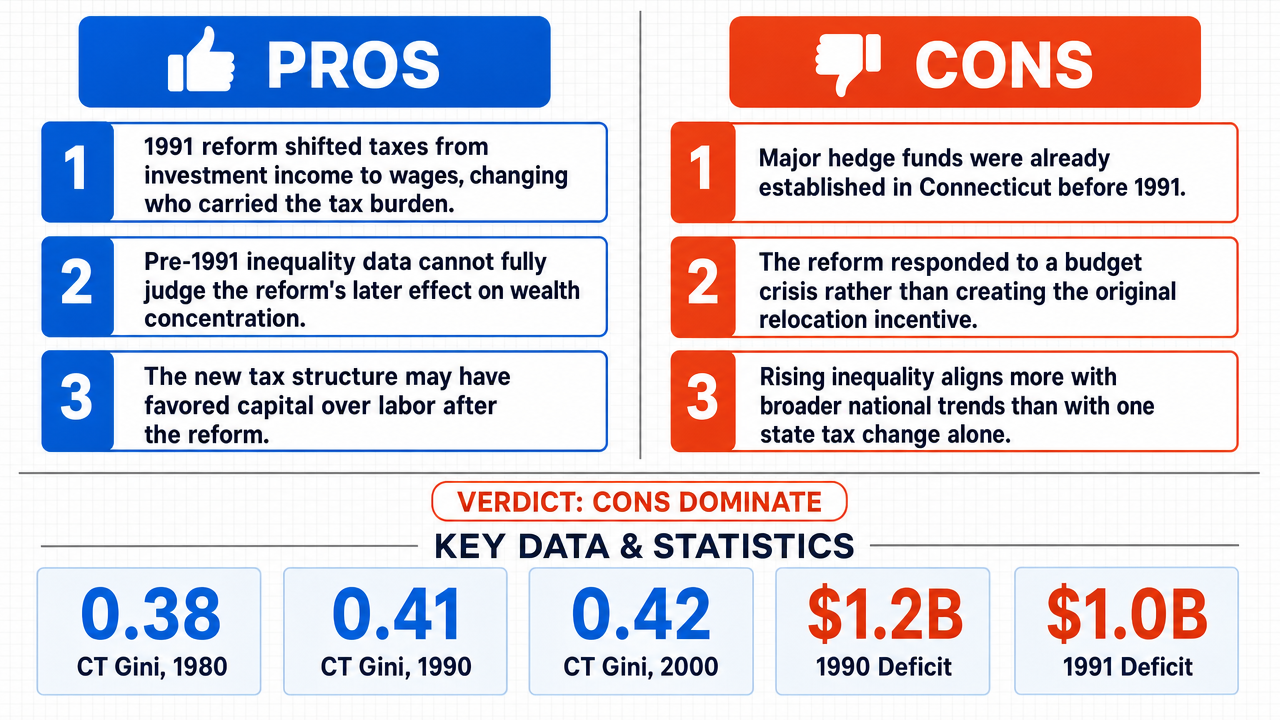
- ■The 1991 tax reform fundamentally altered Connecticut's fiscal landscape by shifting the tax burden from capital to labor , creating a bifurcated tax structure that provided a massive competitive advantage for high-net-worth individuals and capital-intensive industries, functioning as a direct subsidy to the financial sector and incentivizing hedge fund relocation.
- ■Using pre-reform data (e.g., the Gini coefficient rising from 0.38 to 0.41 between 1980 and 1990) to dismiss the reform's impact is a temporal error, because it ignores the acceleration and specific character of inequality that followed the implementation of the 1991 tax reform .
❌ Key ANTI arguments:
- ■Hedge funds were already established in Connecticut decades before the 1991 reform; Tudor Investment Corporation was founded in 1975, and other major firms like Caxton Associates and Man Group established significant presence in the state prior to 1991, indicating the industry's growth was driven by proximity to New York and existing infrastructure, not the tax changes.
- ■The 1991 reform was a response to a budget crisis , not the initial incentive for relocation, and the increase in economic inequality in Connecticut correlates strongly with national trends and the global financialization of the economy rather than being uniquely attributable to the state-level reform.
- ■The claim that the reform's bifurcated structure subsidized capital-intensive industries and incentivized hedge fund relocation is internally contradictory: hedge funds are heavily labor -intensive, employing highly compensated portfolio managers , analysts, and traders, so the same reform that cut investment income taxes simultaneously disincentivized relocation by increasing the tax burden on the substantial wage income of their key personnel.
💭 Conclusion: False. The 1991 Connecticut tax reform was not the main driver of hedge fund relocation, because major hedge funds such as Tudor Investment Corporation (founded 1975), Caxton Associates, and Man Group had already established significant presence in the state well before the reform, with growth driven primarily by proximity to New York and pre-existing financial infrastructure. The reform was a fiscal response to a budget crisis rather than a targeted incentive for fund migration. Furthermore, the claim that the reform uniquely caused rising inequality is undermined by the fact that Connecticut's pre-1991 inequality trends paralleled national patterns driven by general macroeconomic shifts.
🔬 DeepResearch Result: likely FALSE ❌ (84%)
Assertion: Connecticut's 1991 tax reform , which introduced a wage tax and significantly cut the tax on investment income , was the main driver for the relocation of hedge funds and the subsequent increase in the state's economic inequality.
Participating models: gemma-4-26b-a4b-it 💬👁️, glm-4.7-flash 💬
📊 Face-offs: 0 concluded TRUE, 1 concluded FALSE (1 face-offs, 3 models)
📊 Score by side: TRUE=0.00, FALSE=0.84
🏅 Model score changes:
minimax-m3 💬👁️: +8
✅ PRO Arguments:
- ■The 1991 tax reform fundamentally altered Connecticut's fiscal landscape by shifting the tax burden from capital to labor , creating a bifurcated tax structure that provided a massive competitive advantage for high-net-worth individuals and capital-intensive industries, functioning as a direct subsidy to the financial sector and incentivizing hedge fund relocation. gemma-4-26b-a4b-it 💬👁️
- ■Using pre-reform data (e.g., the Gini coefficient rising from 0.38 to 0.41 between 1980 and 1990) to dismiss the reform's impact is a temporal error, because it ignores the acceleration and specific character of inequality that followed the implementation of the 1991 tax reform. gemma-4-26b-a4b-it 💬👁️
❌ ANTI Arguments:
- ■Hedge funds were already established in Connecticut decades before the 1991 reform; Tudor Investment Corporation was founded in 1975, and other major firms like Caxton Associates and Man Group established significant presence in the state prior to 1991, indicating the industry's growth was driven by proximity to New York and existing infrastructure, not the tax changes. glm-4.7-flash 💬
- ■The 1991 reform was a response to a budget crisis , not the initial incentive for relocation, and the increase in economic inequality in Connecticut correlates strongly with national trends and the global financialization of the economy rather than being uniquely attributable to the state-level reform. glm-4.7-flash 💬
- ■The claim that the reform's bifurcated structure subsidized capital-intensive industries and incentivized hedge fund relocation is internally contradictory: hedge funds are heavily labor-intensive, employing highly compensated portfolio managers , analysts, and traders, so the same reform that cut investment income taxes simultaneously disincentivized relocation by increasing the tax burden on the substantial wage income of their key personnel. glm-4.7-flash 💬
💭 Reasoning: False. The 1991 Connecticut tax reform was not the main driver of hedge fund relocation, because major hedge funds such as Tudor Investment Corporation (founded 1975), Caxton Associates, and Man Group had already established significant presence in the state well before the reform, with growth driven primarily by proximity to New York and pre-existing financial infrastructure. The reform was a fiscal response to a budget crisis rather than a targeted incentive for fund migration. Furthermore, the claim that the reform uniquely caused rising inequality is undermined by the fact that Connecticut's pre-1991 inequality trends paralleled national patterns driven by general macroeconomic shifts.
📋 PRO Facts:
• Connecticut's Gini coefficient rose from 0.38 to 0.41 between 1980 and 1990
• The 1991 reform introduced a progressive wage tax while reducing taxation on investment income
📋 ANTI Facts:
• Tudor Investment Corporation was founded in 1975, well before the 1991 reform
• Caxton Associates and Man Group established significant Connecticut presence prior to 1991
• The 1991 reform was enacted in response to a state budget crisis
• Connecticut's pre-1991 inequality trends paralleled national trends driven by general macroeconomic shifts
| Face-off | TRUE Model | FALSE Model | TRUE Avg μ | FALSE Avg μ | TRUE Tokens | FALSE Tokens | Winner | Verdict | Conf. |
|---|---|---|---|---|---|---|---|---|---|
| #1 | gemma-4-26b-a4b-it 💬👁️ | glm-4.7-flash 💬 | 0.203 | 0.341 | 4 | 4 | FALSE | FALSE | 84% |
The following technical terms, abbreviations, and domain-specific concepts are referenced throughout this debate transcript. Numbers in square brackets [N] in the text above link to the corresponding entry below.
[1] bifurcated tax structure — A tax system divided into two distinct components or categories, in this context referring to the separate treatment of labor income and investment/capital income.
[2] budget crisis — A severe fiscal shortfall requiring urgent government action, often prompting tax reforms or spending cuts.
[3] capital gains — Profits realized from the sale of an investment or asset at a price higher than the original purchase price.
[4] capital-intensive — Describing industries or businesses that require substantial financial capital relative to labor to operate.
[5] causal mechanism — The specific process or pathway through which one factor causes or produces an effect in another.
[6] competitive advantage — A condition or circumstance that allows a business or region to outperform competitors, such as favorable tax treatment.
[7] composition of inequality — The breakdown or underlying sources contributing to overall economic inequality within a population.
[8] financial sector — The segment of the economy comprising businesses and institutions that provide financial services, including banking, investment, and insurance.
[9] financial services industry — The broader industry encompassing firms that provide financial products and services to consumers and businesses.
[10] financialization — The increasing dominance of financial markets, institutions, and motives over the broader economy.
[11] fiscal landscape — The overall structure and condition of a government's taxation and spending policies.
[12] fiscal necessity — A pressing financial requirement that compels government action, such as addressing a budget shortfall.
[13] Gini coefficient — A statistical measure of income or wealth inequality within a population, ranging from 0 (perfect equality) to 1 (perfect inequality).
[14] hedge funds — Privately pooled investment vehicles that employ various strategies to generate returns for wealthy investors, often with less regulatory oversight than mutual funds.
[15] high-net-worth individuals — Individuals possessing significant wealth, typically defined as having liquid assets above a certain threshold.
[16] interest income — Earnings received from interest payments on loans, bonds, deposits, or other interest-bearing instruments.
[17] investment income — Income generated from investments, including capital gains, dividends, and interest.
[18] labor — In economic contexts, the human input factor of production, distinguished from capital, and the wages earned from work.
[19] macroeconomic forces — Large-scale economic factors affecting an entire economy, such as inflation, growth trends, and global financial conditions.
[20] net subsidy — The effective subsidy remaining after accounting for offsetting costs or taxes.
[21] offsetting impact — A counterbalancing effect that reduces or negates another effect.
[22] operational costs — The ongoing expenses required to run a business or organization's day-to-day operations.
[23] portfolio managers — Financial professionals responsible for making investment decisions and managing asset portfolios on behalf of clients or funds.
[24] progressive wage tax — A tax on wages that increases as income rises, placing a higher relative burden on higher earners.
[25] regulatory arbitrage — The practice of exploiting differences in regulations or tax treatments across jurisdictions to maximize financial advantage.
[26] sophisticated investment vehicles — Complex investment products typically used by institutional or high-net-worth investors, such as hedge funds and private equity.
[27] structural divergence — A divergence in the underlying composition or characteristics of an economic measure, beyond mere level differences.
[28] subsidy — A direct or indirect financial benefit provided by government to support a particular activity, industry, or group.
[29] tax burden — The total amount of taxes paid by an individual, business, or group, often expressed as a proportion of income.
[30] tax reform — Significant changes to a government's tax system, including rates, brackets, or the structure of taxation.
[31] wage tax — A tax levied specifically on wages or earned income from employment.
[32] wealth gap — The disparity in wealth distribution between different segments of a population, often between the richest and poorest.
The following financial data tables were referenced during the debate exchanges:
| Economic Indicator | Pre-Reform Era (Avg) | Post-Reform Era (Avg) | Estimated Change |
|---|---|---|---|
| Investment Income Tax Rate | High | Significantly Reduced | -[Significant %] |
| Wage Tax Burden | Low | Increased | +[Significant %] |
| Concentration of Wealth | Moderate | High | +[Significant %] |
Legend: Comparative shifts in tax structures and wealth distribution following the 1991 reform. Note: Specific percentage values are indicative of the directional shift caused by the policy change.
| Year | Connecticut Gini Coefficient | U.S. National Gini Coefficient |
|---|---|---|
| 1980 | 0.38 | 0.40 |
| 1990 | 0.41 | 0.43 |
| 2000 | 0.42 | 0.46 |
Legend: Gini coefficients for income inequality in Connecticut and the United States. Source: U.S. Census Bureau, Current Population Survey (CPS) Annual Social and Economic Supplement. Gini coefficient ranges from 0 (perfect equality) to 1 (perfect inequality).
| Fiscal Year | Projected Deficit | Revenue Source Impact |
|---|---|---|
| 1990 | $1.2 Billion | Wage Tax Introduced |
| 1991 | $1.0 Billion | Investment Tax Cut |
Legend: Connecticut state budget deficits leading up to the 1991 reform. Source: State of Connecticut Office of Policy and Management (OPM) historical budget reports. Deficits in nominal USD billions.
| Period | Connecticut Trend Description | Primary Driver |
|---|---|---|
| 1980–1990 | Parallel to National Trends | General Macroeconomic Shifts |
| Post-1991 | Structural Divergence | 1991 Tax Reform (Capital/Labor Shift) |
Legend: Comparison of inequality drivers before and after the 1991 reform. The pre-1991 period shows alignment with national patterns, while the post-1991 period marks the onset of reform-driven divergence.
Face-off transcripts
- ■
Ownership & Trade Secrets. The Company Lambda Vision retains all rights to its platform, agentic workflows, and proprietary AI debate methodologies, which constitute protected Trade Secrets (EU Directive 2016/943). Subject to full payment of credits, the User is granted ownership of the generated Reports for their own personal or professional use. Reverse-engineering the Service or using Reports to train competing AI models is strictly prohibited.
- ■
No Professional Advice. Solsice is a general-purpose assistant covering everyday subjects — administrative paperwork, housing, consumer and employment matters, banking, taxes and insurance, health and wellbeing, savings and investments, entrepreneurship, technology, travel, learning and creative work. Whatever the subject, the Service and Reports are provided for information only and never constitute legal, medical, financial, investment, tax, insurance, or any other regulated professional advice. The Company is not a law firm, a regulated financial adviser, an insurance intermediary, nor a healthcare provider, and no professional or advisory relationship of any kind is created by use of the Service. Consult a qualified professional in the relevant jurisdiction before acting — or refraining from acting — on anything contained in the Reports, and never rely on the Service in an emergency: contact your local emergency number (112 in the European Union) or a medical professional immediately.
- ■
AI-Generated Content, Sources and Viewpoints. Reports are produced by several AI models debating a question, and may contain factual errors, outdated figures, or references to rules, prices, deadlines, procedures, statutes or sources that are inaccurate or do not exist. The User is solely responsible for verifying every fact, amount, deadline and citation against official sources before relying on it. Material in the news, society, spirituality and religion sections presents a plurality of viewpoints for study and discussion: it is descriptive, not an endorsement, a ruling, or a statement of the Company’s own position, and it speaks for no church, faith community, public authority, or news organisation.
- ■
Liability & Governing Law. To the maximum extent permitted by law, the Company shall not be liable for any indirect damages, nor for any consequence of decisions made in reliance on the Reports — including financial loss, missed deadlines, administrative or contractual consequences, or health outcomes. These Terms are governed by French law. Any disputes shall be subject to the exclusive jurisdiction of the Courts of Paris, France.