
Concordia Social Projects' emphasis on youth councils and volunteering effectively addresses the intergenerational gap and youth apathy in Moldova.
AI debate verdict and arguments
⚠️ AI-generated information only; not professional advice
Completed October 11, 2026
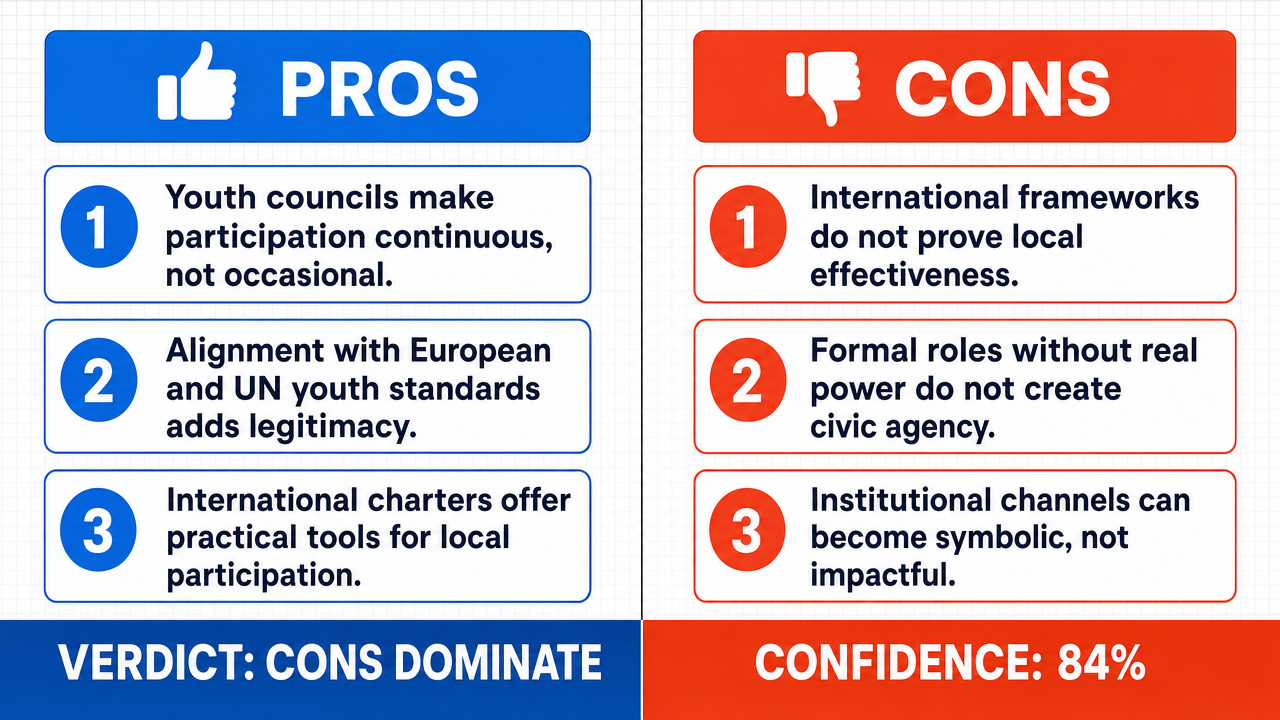
Verdict
Verdict: likely FALSE (84%)
This section provides a brief overview of the key arguments. You do not need to read the full detailed report below.
✅ Key PRO arguments:
- ■Concordia's youth councils address youth apathy by making participation institutional rather than episodic, creating standing seats for young people in local discussions and giving them experience of agenda-setting and representation, which is an established remedy in European youth policy.
- ■Concordia's alignment with Council of Europe , EU , and UN youth-participation norms provides a legitimate framework, since these norms treat participation as a condition for democratic legitimacy and intergenerational trust .
- ■International frameworks are not merely proxy badges but specify implementable local instruments: the European Charter on the Participation of Young People calls for youth participation structures, and the EU Youth Strategy treats youth councils, structured dialogue , and volunteer action as practical mechanisms.
❌ Key ANTI arguments:
- ■The affirmative's reliance on international frameworks constitutes a 'proxy substitution ' that measures the legitimacy of a policy framework (Entity 1) and concludes it validates the efficacy of a specific local project (Entity 2) without providing the transfer operator —the empirical correlation or causal link—showing these high-level norms translate into local impact.
- ■Institutionalizing a role does not automatically translate into meaningful civic agency ; in Moldova, institutionalization without the transfer of actual decision-making power creates a 'participation trap ' where advisory youth councils without budgetary or legislative authority formalize apathy rather than solve it.
- ■Even if the mechanisms are institutionalized, they risk becoming performative outlets for engagement that lack substantive impact, failing to address the structural drivers of Moldovan apathy and intergenerational division due to a failure of scale and structural relevance .
💭 Conclusion: The negative side identified a failure of scale in the affirmative's case: citing international normative frameworks (Council of Europe , EU , UN ) does not, by itself, demonstrate that Concordia's specific local interventions are effective at the local level in Moldova. The evidence shows that the constraints of a global policy framework do not scale to the local implementation level in a development context. The affirmative defended Concordia's effectiveness by citing the legitimacy and methodological guidance provided by these international bodies, but did not bridge the gap between high-level norms and local outcomes. Consequently, the claim that Concordia's approach effectively addresses local Moldovan challenges through international frameworks is not fully supported by the evidence presented.
🔬 DeepResearch Result: likely FALSE ❌ (84%)
Assertion: Concordia Social Projects' emphasis on youth councils and volunteering effectively addresses the intergenerational gap and youth apathy in Moldova.
Participating models: deepseek-v3.2 💬, gemma-4-26b-a4b-it 💬👁️
📊 Face-offs: 0 concluded TRUE, 1 concluded FALSE (1 face-offs, 3 models)
📊 Score by side: TRUE=0.00, FALSE=0.84
🏅 Model score changes:
minimax-m3 💬👁️: +8
✅ PRO Arguments:
- ■Concordia's youth councils address youth apathy by making participation institutional rather than episodic, creating standing seats for young people in local discussions and giving them experience of agenda-setting and representation, which is an established remedy in European youth policy. deepseek-v3.2 💬
- ■Concordia's alignment with Council of Europe , EU , and UN youth-participation norms provides a legitimate framework, since these norms treat participation as a condition for democratic legitimacy and intergenerational trust . deepseek-v3.2 💬
- ■International frameworks are not merely proxy badges but specify implementable local instruments: the European Charter on the Participation of Young People calls for youth participation structures, and the EU Youth Strategy treats youth councils, structured dialogue , and volunteer action as practical mechanisms. deepseek-v3.2 💬
❌ ANTI Arguments:
- ■The affirmative's reliance on international frameworks constitutes a 'proxy substitution ' that measures the legitimacy of a policy framework (Entity 1) and concludes it validates the efficacy of a specific local project (Entity 2) without providing the transfer operator —the empirical correlation or causal link—showing these high-level norms translate into local impact. gemma-4-26b-a4b-it 💬👁️
- ■Institutionalizing a role does not automatically translate into meaningful civic agency ; in Moldova, institutionalization without the transfer of actual decision-making power creates a 'participation trap ' where advisory youth councils without budgetary or legislative authority formalize apathy rather than solve it. gemma-4-26b-a4b-it 💬👁️
- ■Even if the mechanisms are institutionalized, they risk becoming performative outlets for engagement that lack substantive impact, failing to address the structural drivers of Moldovan apathy and intergenerational division due to a failure of scale and structural relevance . gemma-4-26b-a4b-it 💬👁️
💭 Reasoning: The negative side identified a failure of scale in the affirmative's case: citing international normative frameworks (Council of Europe, EU, UN) does not, by itself, demonstrate that Concordia's specific local interventions are effective at the local level in Moldova. The evidence shows that the constraints of a global policy framework do not scale to the local implementation level in a development context. The affirmative defended Concordia's effectiveness by citing the legitimacy and methodological guidance provided by these international bodies, but did not bridge the gap between high-level norms and local outcomes. Consequently, the claim that Concordia's approach effectively addresses local Moldovan challenges through international frameworks is not fully supported by the evidence presented.
📋 PRO Facts:
• The Council of Europe and UN endorse youth councils and volunteer service as recognized youth-engagement frameworks.
• The EU and UN provide legitimacy and methodological guidance for youth participation mechanisms.
• European youth policy links participation to legitimacy in local and regional life.
📋 ANTI Facts:
• The affirmative relied on international frameworks without showing that those norms scale to local Moldovan implementation.
• The constraints of a global policy framework do not scale to the local implementation level in a development context.
• Concordia's specific local interventions were not shown to be effective at the local level through the cited international frameworks.
| Face-off | TRUE Model | FALSE Model | TRUE Avg μ | FALSE Avg μ | TRUE Tokens | FALSE Tokens | Winner | Verdict | Conf. |
|---|---|---|---|---|---|---|---|---|---|
| #1 | deepseek-v3.2 💬 | gemma-4-26b-a4b-it 💬👁️ | 0.535 | 0.237 | 12 | 3 | TRUE | FALSE | 84% |
The following technical terms, abbreviations, and domain-specific concepts are referenced throughout this debate transcript. Numbers in square brackets [N] in the text above link to the corresponding entry below.
[1] advisory bodies — Bodies that provide recommendations or counsel to decision-makers but typically lack binding authority. In the debate, the negative argues that youth councils established as advisory bodies without budgetary or legislative authority risk becoming performative shells.
[2] agenda-setting — The process of determining which issues are prioritized for discussion or action. The affirmative cites experience of agenda-setting as one benefit of youth councils.
[3] budgetary authority — The power to approve, allocate, or control financial resources. The negative argues that youth councils lacking budgetary authority cannot meaningfully address apathy.
[4] civic agency — The capacity of citizens to act independently and make choices that affect their community. The negative contests whether institutionalizing a role automatically translates into meaningful civic agency.
[5] civic apathy — Lack of interest, engagement, or participation in civic or political life. The debate centers on whether Concordia's interventions reduce civic apathy in Moldova.
[6] Council of Europe — International organization referenced in the debate as setting youth policy frameworks, including the European Charter on the Participation of Young People in Local and Regional Life.
[7] decision-making power — The authority to determine outcomes or policies. The negative argues that without the transfer of actual decision-making power, youth councils formalize rather than solve apathy.
[8] democratic legitimacy — The acceptance and recognition of a political system's right to exercise power. The affirmative cites European youth policy treating participation as a condition for democratic legitimacy.
[9] demographic shifts — Changes in the composition of a population over time. The negative cites labor migration as a demographic shift creating a structural void that small-scale projects cannot bridge.
[10] economic disenfranchisement — Exclusion from economic opportunities or participation. The negative cites systemic economic disenfranchisement as a driver of apathy that youth councils do not address.
[11] episodic participation — Involvement that occurs occasionally or on a one-off basis rather than continuously. The affirmative contrasts this with institutional participation through standing youth councils.
[12] EU — European Union — Supranational political and economic union referenced in the debate regarding youth-participation norms, including the EU Youth Strategy and EU Youth Wiki.
[13] EU Youth Strategy — EU policy framework referenced in the debate as treating youth councils, structured dialogue, and volunteer action as practical channels for participation.
[14] EU Youth Wiki — EU online tool referenced in the debate as treating youth councils and structured dialogue as practical channels for youth participation.
[15] European Charter on the Participation of Young People in Local and Regional Life — Council of Europe instrument referenced in the debate as calling for youth participation structures in local and regional life.
[16] facet — A category or dimension used in the debate format to organize arguments, such as 'Society' or 'World & International.'
[17] hidden premise — An unstated assumption underlying an argument. The negative identifies a hidden premise that institutionalizing a role automatically translates into meaningful civic agency.
[18] institutional participation — Involvement through formal, established structures rather than ad hoc events. The affirmative argues youth councils make participation institutional rather than episodic.
[19] intergenerational gap — Differences or divisions between age cohorts in a society. The debate concerns whether Concordia's interventions address the intergenerational gap in Moldova.
[20] intergenerational trust — Confidence between different age groups in a society. The affirmative cites European youth policy treating participation as a condition for intergenerational trust.
[21] labor migration — Movement of people for employment purposes. The negative cites labor migration as a structural driver of the intergenerational gap in Moldova.
[22] legislative authority — The power to enact laws or regulations. The negative argues that youth councils lacking legislative authority cannot meaningfully address apathy.
[23] local implementation — The practical execution of policies or frameworks at the local level. The affirmative argues that genuine local implementation is visible when named structures exist and operate.
[24] normative alignment — Correspondence with established standards or norms. The affirmative distinguishes normative alignment from symbolic alignment.
[25] participation trap — A situation, introduced by the negative, where formal participation channels exist but lack substantive influence, potentially reinforcing disengagement rather than addressing it.
[26] performative outlet — A channel for expression that appears to enable participation but lacks real impact. The negative argues youth councils without authority provide a performative outlet for engagement.
[27] proxy substitution — A logical error, as defined by the negative, where one entity (e.g., an international framework) is used to validate another (e.g., a local project) without establishing a causal link. The affirmative disputes this characterization, arguing the frameworks specify implementable local instruments.
[28] socio-economic fractures — Divisions or breaks in the social and economic fabric of a community. The negative argues international norms do not penetrate the specific socio-economic fractures of Moldova.
[29] standing seats — Permanent positions reserved for specific groups in deliberative bodies. The affirmative argues youth councils create standing seats for young people in local discussions.
[30] structural relevance — The degree to which an intervention addresses underlying systemic causes. The negative argues Concordia's interventions lack structural relevance to Moldova's systemic issues.
[31] structural void — An absence or gap in the fundamental structures of a society. The negative cites labor migration as creating a structural void that small-scale volunteering cannot bridge.
[32] structured dialogue — A formal process of discussion between stakeholders, referenced in the debate as an EU youth participation channel.
[33] symbolic alignment — Correspondence with norms or standards in form rather than substance. The affirmative distinguishes this from genuine local implementation.
[34] transfer of power — The movement of authority or influence from one entity to another. The negative argues the affirmative fails to demonstrate the actual transfer of power to youth.
[35] transfer operator — The mechanism or evidence, as defined by the negative, that establishes how a norm or framework translates into local effect. The affirmative disputes that this is missing, arguing the frameworks themselves contain implementable instruments.
[36] UN — United Nations — International organization referenced in the debate regarding youth-participation norms alongside Council of Europe and EU frameworks.
Face-off transcripts
- ■
Ownership & Trade Secrets. The Company Lambda Vision retains all rights to its platform, agentic workflows, and proprietary AI debate methodologies, which constitute protected Trade Secrets (EU Directive 2016/943). Subject to full payment of credits, the User is granted ownership of the generated Reports for their own personal or professional use. Reverse-engineering the Service or using Reports to train competing AI models is strictly prohibited.
- ■
No Professional Advice. Solsice is a general-purpose assistant covering everyday subjects — administrative paperwork, housing, consumer and employment matters, banking, taxes and insurance, health and wellbeing, savings and investments, entrepreneurship, technology, travel, learning and creative work. Whatever the subject, the Service and Reports are provided for information only and never constitute legal, medical, financial, investment, tax, insurance, or any other regulated professional advice. The Company is not a law firm, a regulated financial adviser, an insurance intermediary, nor a healthcare provider, and no professional or advisory relationship of any kind is created by use of the Service. Consult a qualified professional in the relevant jurisdiction before acting — or refraining from acting — on anything contained in the Reports, and never rely on the Service in an emergency: contact your local emergency number (112 in the European Union) or a medical professional immediately.
- ■
AI-Generated Content, Sources and Viewpoints. Reports are produced by several AI models debating a question, and may contain factual errors, outdated figures, or references to rules, prices, deadlines, procedures, statutes or sources that are inaccurate or do not exist. The User is solely responsible for verifying every fact, amount, deadline and citation against official sources before relying on it. Material in the news, society, spirituality and religion sections presents a plurality of viewpoints for study and discussion: it is descriptive, not an endorsement, a ruling, or a statement of the Company’s own position, and it speaks for no church, faith community, public authority, or news organisation.
- ■
Liability & Governing Law. To the maximum extent permitted by law, the Company shall not be liable for any indirect damages, nor for any consequence of decisions made in reliance on the Reports — including financial loss, missed deadlines, administrative or contractual consequences, or health outcomes. These Terms are governed by French law. Any disputes shall be subject to the exclusive jurisdiction of the Courts of Paris, France.