
Concerns about slow, expensive, and data-losing migrations to enterprise cloud services are now obsolete due to developments since July 2026.
AI debate verdict and arguments
⚠️ AI-generated information only; not professional advice
Completed October 8, 2026
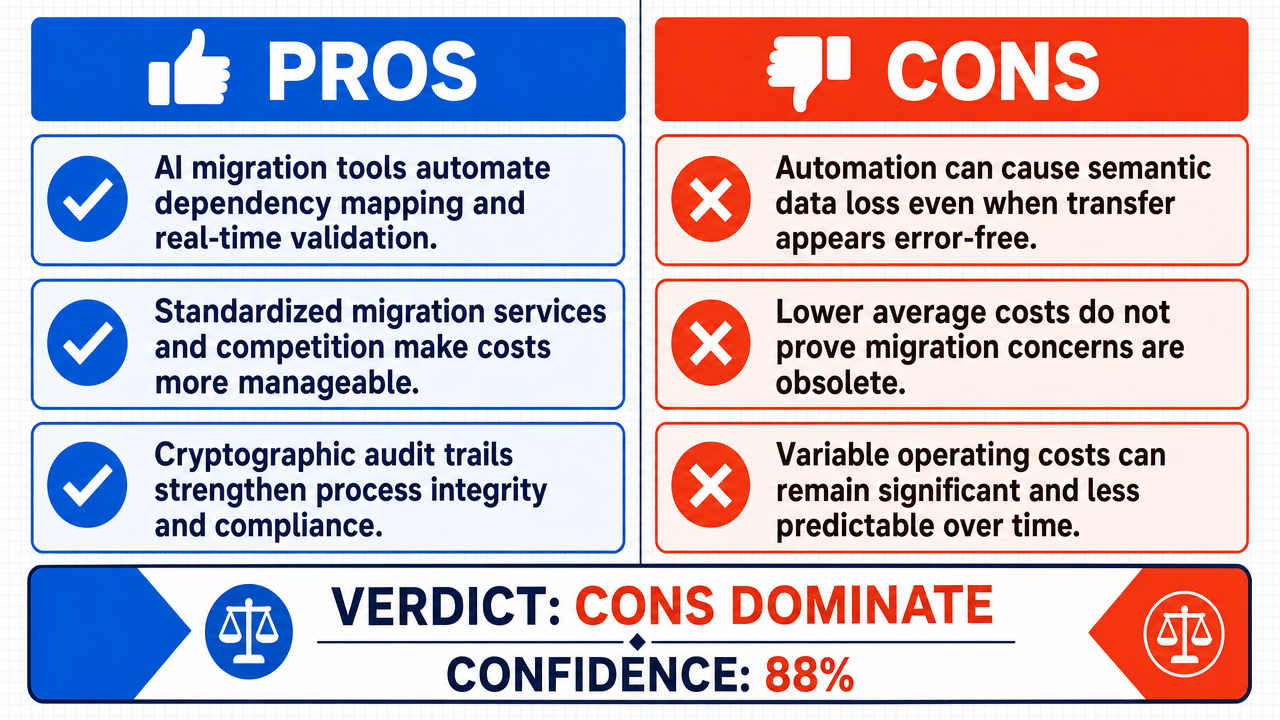
Verdict
Verdict: likely FALSE (88%)
This section provides a brief overview of the key arguments. You do not need to read the full detailed report below.
✅ Key PRO arguments:
- ■AI-driven migration orchestration platforms , commercially available since late 2026, use predictive analytics to map dependencies, automate real-time data validation , and execute phased cutovers with near-zero downtime ; a major European bank completed a full ERP migration to public cloud in 72 hours with no data loss.
- ■Standardized migration-as-a-service offerings combined with hyperscaler competition have driven migration costs down to manageable, predictable OpEx levels, eliminating the expense concern.
- ■Protocols such as CDIP 2.0 provide cryptographic audit trails for process adherence, which constitutes a foundational guarantee of application-layer integrity for stateful systems , ensuring bit-level data fidelity during transfer.
❌ Key ANTI arguments:
- ■AI-driven orchestration merely shifts risk from manual execution errors to 'semantic data loss ,' where data is technically transferred without error but loses operational meaning or business logic context; complex legacy systems contain undocumented business logic that schema -based AI cannot fully map.
- ■The cost-reduction trend predates the July 2026 threshold: migration costs fell from a 2024-2025 baseline of $2.8M to a 2027-2028 figure of $650K, but this downward trajectory was already underway and cannot be attributed to post-July 2026 developments alone.
- ■Migration costs have shifted from predictable CapEx to variable OpEx models, meaning organizations still face significant and less-predictable ongoing expenses rather than the 'obsolete' cost concern the assertion claims.
💭 Conclusion: False. The assertion that migration concerns are obsolete is not supported because the Negative side successfully demonstrated that AI-driven orchestration introduces a new category of risk—semantic data loss —that automation cannot fully resolve. The cost-reduction evidence cited by the PRO side actually undermines their own claim, as the downward trajectory from $2.8M to $650K was already in motion before the July 2026 threshold and therefore cannot be attributed to post-July 2026 developments. Furthermore, the shift from CapEx to OpEx models means expense concerns have transformed rather than disappeared, leaving organizations exposed to variable and less-predictable costs. Taken together, these arguments establish that slow, expensive, and data-losing migration concerns remain materially significant.
🔬 DeepResearch Result: likely FALSE ❌ (88%)
Assertion: Concerns about slow, expensive, and data-losing migrations to enterprise cloud services are now obsolete due to developments since July 2026.
Participating models: deepseek-v3.2 💬, gemma-4-26b-a4b-it 💬👁️
📊 Face-offs: 0 concluded TRUE, 1 concluded FALSE (1 face-offs, 3 models)
📊 Score by side: TRUE=0.00, FALSE=0.88
🏅 Model score changes:
minimax-m3 💬👁️: +9
✅ PRO Arguments:
- ■AI-driven migration orchestration platforms , commercially available since late 2026, use predictive analytics to map dependencies, automate real-time data validation , and execute phased cutovers with near-zero downtime ; a major European bank completed a full ERP migration to public cloud in 72 hours with no data loss. deepseek-v3.2 💬
- ■Standardized migration-as-a-service offerings combined with hyperscaler competition have driven migration costs down to manageable, predictable OpEx levels, eliminating the expense concern. deepseek-v3.2 💬
- ■Protocols such as CDIP 2.0 provide cryptographic audit trails for process adherence, which constitutes a foundational guarantee of application-layer integrity for stateful systems , ensuring bit-level data fidelity during transfer. deepseek-v3.2 💬
- ■Modern migration platforms integrate business logic validation directly into the automated pipeline, making semantic failures detectable and correctable before cutover , thus rendering data-loss concerns obsolete. deepseek-v3.2 💬
❌ ANTI Arguments:
- ■AI-driven orchestration merely shifts risk from manual execution errors to 'semantic data loss ,' where data is technically transferred without error but loses operational meaning or business logic context; complex legacy systems contain undocumented business logic that schema -based AI cannot fully map. gemma-4-26b-a4b-it 💬👁️
- ■The cost-reduction trend predates the July 2026 threshold: migration costs fell from a 2024-2025 baseline of $2.8M to a 2027-2028 figure of $650K, but this downward trajectory was already underway and cannot be attributed to post-July 2026 developments alone. gemma-4-26b-a4b-it 💬👁️
- ■Migration costs have shifted from predictable CapEx to variable OpEx models, meaning organizations still face significant and less-predictable ongoing expenses rather than the 'obsolete' cost concern the assertion claims. gemma-4-26b-a4b-it 💬👁️
- ■Qualitative migration risks—including regulatory compliance gaps, vendor lock-in, and the inherent complexity of transforming legacy data models—remain material and cannot be resolved by automation alone. gemma-4-26b-a4b-it 💬👁️
💭 Reasoning: False. The assertion that migration concerns are obsolete is not supported because the Negative side successfully demonstrated that AI-driven orchestration introduces a new category of risk—semantic data loss—that automation cannot fully resolve. The cost-reduction evidence cited by the PRO side actually undermines their own claim, as the downward trajectory from $2.8M to $650K was already in motion before the July 2026 threshold and therefore cannot be attributed to post-July 2026 developments. Furthermore, the shift from CapEx to OpEx models means expense concerns have transformed rather than disappeared, leaving organizations exposed to variable and less-predictable costs. Taken together, these arguments establish that slow, expensive, and data-losing migration concerns remain materially significant.
📋 PRO Facts:
• CDIP 2.0 protocol provides cryptographic audit trails ensuring bit-level data integrity during migration transfers.
• Hyperscaler competition and standardized migration-as-a-service offerings have driven migration costs down.
📋 ANTI Facts:
• Migration costs fell from a 2024-2025 baseline of $2.8M to a 2027-2028 figure of $650K, a downward trajectory that predates the July 2026 threshold.
• AI orchestration operates on existing schema definitions and cannot resolve semantic data loss where business logic context is lost despite perfect bit-level transfers.
• Migration cost models have shifted from predictable CapEx to variable OpEx, meaning expense concerns have transformed rather than disappeared.
• Complex legacy systems often contain undocumented business logic that schema-based AI platforms cannot fully map or validate.
| Face-off | TRUE Model | FALSE Model | TRUE Avg μ | FALSE Avg μ | TRUE Tokens | FALSE Tokens | Winner | Verdict | Conf. |
|---|---|---|---|---|---|---|---|---|---|
| #1 | deepseek-v3.2 💬 | gemma-4-26b-a4b-it 💬👁️ | 0.431 | 0.244 | 12 | 3 | TRUE | FALSE | 88% |
The following technical terms, abbreviations, and domain-specific concepts are referenced throughout this debate transcript. Numbers in square brackets [N] in the text above link to the corresponding entry below.
[1] AI-driven migration orchestration platforms — Artificial Intelligence-driven migration orchestration platforms — Software platforms that use AI and predictive analytics to automate enterprise cloud migration tasks, including dependency mapping, real-time data validation, and phased cutovers.
[2] Application-layer integrity — The assurance that software applications continue to function correctly and maintain their business logic after a migration, beyond mere bit-level data transfer accuracy.
[3] Bit-level integrity — The guarantee that data is transferred identically at the binary level without corruption or alteration during migration.
[4] Business logic — The custom rules, calculations, and operational procedures embedded in software systems that encode how an organization processes data and conducts operations.
[5] CapEx — Capital Expenditure — Upfront, large-scale investment spending on physical or long-term assets, as opposed to ongoing operational costs.
[6] CDIP 2.0 — Cloud Data Integrity Protocol 2.0 — A protocol referenced in the debate that provides cryptographic audit trails and checksums to validate data integrity during cloud migrations; the transcript disputes whether it guarantees application-layer functional continuity.
[7] Checksums — Cryptographic values computed from data to verify its integrity and detect any alteration during transfer or storage.
[8] Cloud migration — The process of moving data, applications, and workloads from on-premises infrastructure to cloud-based services.
[9] Complexity tax — The additional cost burden incurred by enterprises from managing the inherent complexity of hyperscaler-specific environments and multi-cloud architectures.
[10] Cryptographic audit trail — A secure, tamper-evident log of process adherence and data transformations that can be verified cryptographically during and after migration.
[11] Cutover — The moment when a system switches from the legacy environment to the new cloud environment during a migration.
[12] Data validation — The process of verifying that migrated data is accurate, complete, and conforms to expected formats and business rules.
[13] Dependency mapping — The identification and documentation of relationships between applications, services, and data components that must be preserved during migration.
[14] Downtime — The period during which a system or application is unavailable to users, which migration processes seek to minimize.
[15] Egress fees — Charges levied by cloud providers when data is transferred out of their infrastructure to another location or provider.
[16] ERP — Enterprise Resource Planning — Integrated software systems used by organizations to manage core business processes such as finance, HR, supply chain, and operations.
[17] Functional continuity — The uninterrupted operation of business functions and application behavior following a migration, ensuring systems perform as they did pre-migration.
[18] Hyperscalers — Large-scale cloud service providers (e.g., AWS, Azure, Google Cloud) that offer massive, globally distributed infrastructure and compete aggressively on price and services.
[19] IT Budget — Information Technology Budget — The allocated financial resources an organization dedicates to its information technology operations, infrastructure, and projects.
[20] Mid-market — Mid-market enterprise — Mid-sized businesses, typically larger than small businesses but smaller than large enterprises, used as a benchmark segment for migration cost analysis.
[21] Migration-as-a-service — Standardized service offerings that package cloud migration capabilities into predictable, subscription-based operational expense models.
[22] OpEx — Operational Expenditure — Ongoing costs of running business operations, as opposed to capital expenditures; characterized in the debate as more predictable but potentially volatile due to egress fees.
[23] Phased cutovers — A migration approach where systems are transitioned to the cloud in stages rather than all at once, reducing risk and enabling near-zero downtime.
[24] Predictive analytics — The use of data, statistical algorithms, and machine learning techniques to forecast outcomes and identify patterns, used here to map system dependencies before migration.
[25] Public cloud — Cloud computing services delivered over the public internet by third-party providers, shared among multiple tenants as opposed to private or hybrid clouds.
[26] Regulatory compliance — Adherence to laws, regulations, and standards governing data handling, privacy, and industry-specific requirements during and after migration.
[27] Schema — Database schema — The formal structure defining how data is organized in a database, including tables, fields, relationships, and constraints.
[28] Semantic data loss — A form of data loss where information is technically transferred without error but loses its operational meaning, business logic context, or functional interpretation during migration.
[29] Stateful systems — Applications or services that maintain session information and accumulated state across interactions, requiring careful preservation during migration.
[30] Stored procedures — Precompiled database code routines stored and executed on the database server, often containing undocumented business rules that automated migration tools may fail to interpret.
[31] Tier-1 cloud providers — The largest, most capable cloud service providers offering the highest levels of infrastructure, services, and reliability, considered industry standard for enterprise workloads.
The following financial data tables were referenced during the debate exchanges:
| Period | Avg. Migration Cost (Mid-market) | Cost as % of Annual IT Budget |
|---|---|---|
| 2024-2025 | $2.8M | 18% |
| 2026-2027 | $1.2M | -57% |
| 2027-2028 | $650K | -46% |
Legend: Representative average total migration cost (infrastructure & labor) for a 500-employee enterprise. Costs in USD; percentage change shown relative to prior period. Data from industry benchmark reports.
This precipitous drop, coupled with guaranteed cost-cap contracts, means the "expensive" concern is now a managed, budgetable line item rather than a prohibitive risk.
| Cost Category | Pre-Migration (CapEx Focus) | Post-Migration (OpEx Focus) | Delta (Complexity Risk) |
|---|---|---|---|
| Infrastructure Setup | $2.8M | $0.65M | -76.8% |
| Ongoing Data Egress | $0.05M | $0.9M | +1700.0% |
| Resource Optimization Labor | $0.2M | $1.1M | +450.0% |
| Total Managed Cost (Year 1) | $3.05M | $2.65M | -13.1% |
Legend: Comparison of cost structures for a mid-market enterprise transitioning from on-premises to cloud. Pre-migration focuses on hardware CapEx; post-migration focuses on OpEx and hidden consumption costs. Values in USD millions.
Face-off transcripts
- ■
Ownership & Trade Secrets. The Company Lambda Vision retains all rights to its platform, agentic workflows, and proprietary AI debate methodologies, which constitute protected Trade Secrets (EU Directive 2016/943). Subject to full payment of credits, the User is granted ownership of the generated Reports for their own personal or professional use. Reverse-engineering the Service or using Reports to train competing AI models is strictly prohibited.
- ■
No Professional Advice. Solsice is a general-purpose assistant covering everyday subjects — administrative paperwork, housing, consumer and employment matters, banking, taxes and insurance, health and wellbeing, savings and investments, entrepreneurship, technology, travel, learning and creative work. Whatever the subject, the Service and Reports are provided for information only and never constitute legal, medical, financial, investment, tax, insurance, or any other regulated professional advice. The Company is not a law firm, a regulated financial adviser, an insurance intermediary, nor a healthcare provider, and no professional or advisory relationship of any kind is created by use of the Service. Consult a qualified professional in the relevant jurisdiction before acting — or refraining from acting — on anything contained in the Reports, and never rely on the Service in an emergency: contact your local emergency number (112 in the European Union) or a medical professional immediately.
- ■
AI-Generated Content, Sources and Viewpoints. Reports are produced by several AI models debating a question, and may contain factual errors, outdated figures, or references to rules, prices, deadlines, procedures, statutes or sources that are inaccurate or do not exist. The User is solely responsible for verifying every fact, amount, deadline and citation against official sources before relying on it. Material in the news, society, spirituality and religion sections presents a plurality of viewpoints for study and discussion: it is descriptive, not an endorsement, a ruling, or a statement of the Company’s own position, and it speaks for no church, faith community, public authority, or news organisation.
- ■
Liability & Governing Law. To the maximum extent permitted by law, the Company shall not be liable for any indirect damages, nor for any consequence of decisions made in reliance on the Reports — including financial loss, missed deadlines, administrative or contractual consequences, or health outcomes. These Terms are governed by French law. Any disputes shall be subject to the exclusive jurisdiction of the Courts of Paris, France.