
CJ Carr's low turnover rate of one interception in six games is primarily due to his excellent decision-making and ball placement.
AI debate verdict and arguments
⚠️ AI-generated information only; not professional advice
Completed October 18, 2026
Verdict
Verdict: likely FALSE (81%)
Web Report: https://solsice.com/public/debates/cj-carr-s-low-turnover-rate-of-one-interception-in-six-games-adf9343b3f64
This section provides a brief overview of the key arguments. You do not need to read the full detailed report below.
✅ Key PRO arguments:
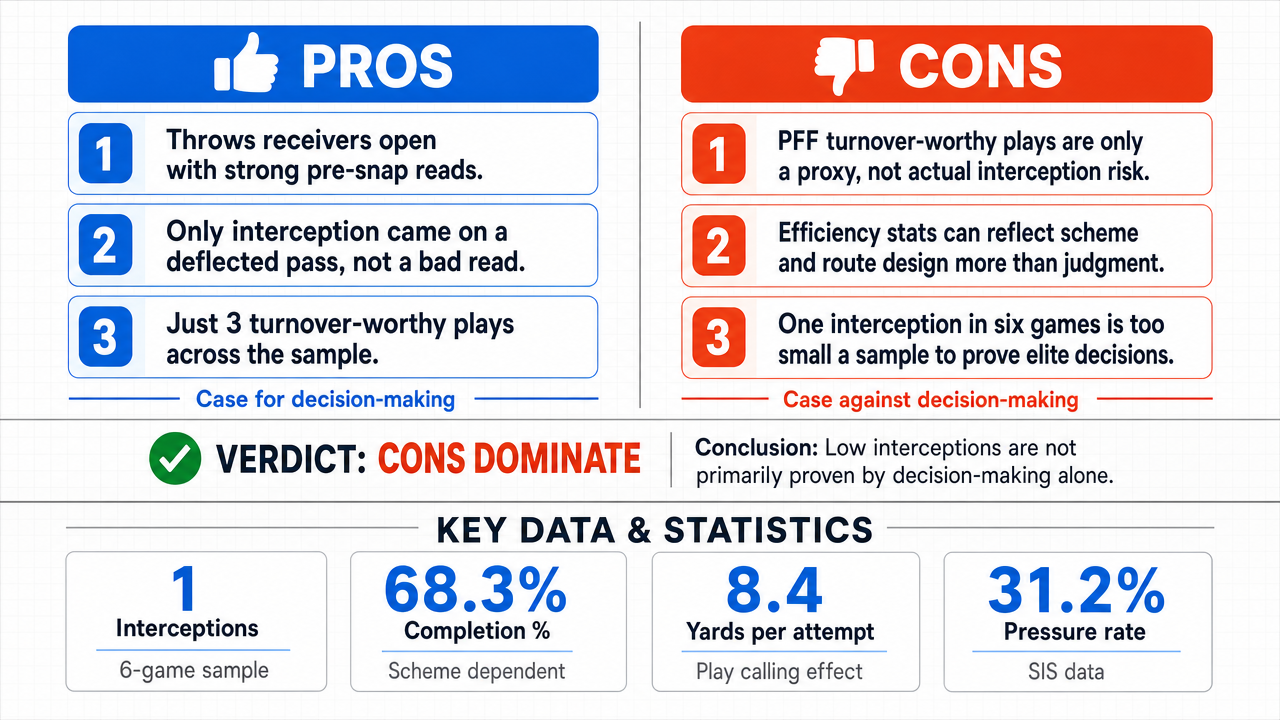
- ■Carr consistently throws receivers open rather than forcing balls into tight coverage, demonstrating an advanced pre-snap recognition system that allowed him to identify coverage rotations and find soft spots in zone defenses across his 122 passing attempts in the 2024 season.
- ■Carr's lone interception was a deflected pass against Florida State caused by a defensive lineman batting the ball at the line of scrimmage , an outcome unrelated to decision-making quality.
- ■Pro Football Focus charted Carr with only three turnover-worthy plays across his entire sample, suggesting that 97.5% of his throws contained no risk of interception .
❌ Key ANTI arguments:
- ■The affirmative's reliance on PFF data is a fundamental error of logic: they have conflated an instrument of measurement with the aggregate it tracks. A turnover-worthy play is a metric used by analysts to estimate risk, not a direct measurement of actual interception rate, and treating the absence of a TWP as the absence of interception risk treats a statistical proxy as the absolute reality of the outcome.
- ■High-efficiency metrics like an 8.4 yards per attempt average are often a function of a vertical offensive scheme that utilizes high-percentage intermediate routes designed to exploit specific zone vulnerabilities , meaning the quarterback is not necessarily placing the ball with elite precision but rather the scheme is doing the work.
- ■Carr's low turnover rate is more plausibly a product of environmental factors and small sample size rather than elite decision-making , since six games is insufficient to isolate individual skill from scheme, opponent quality, and variance.
💭 Conclusion: False. The negative side successfully demonstrated that the affirmative's reliance on Pro Football Focus turnover-worthy play (TWP) data conflates a statistical proxy with actual interception risk, undermining the claim that Carr's low interception rate reflects elite decision-making . The affirmative's argument that TWP absence equates to interception risk absence treats a measurement instrument as the underlying reality it merely estimates, which is a category error. Furthermore, the negative effectively argued that Carr's high-efficiency metrics, such as his 8.4 yards per attempt average, are likely a function of a vertical offensive scheme utilizing high-percentage intermediate routes designed to exploit zone vulnerabilities , rather than elite ball placement precision. The affirmative's claim that Carr's lone interception was merely a deflected pass against Florida State fails to address the broader question of whether scheme and environmental factors, rather than individual skill, drive the low turnover rate . Therefore, the compound claim that both excellent decision-making and ball placement are the primary drivers of Carr's low turnover rate is not adequately supported by the evidence presented.
🔬 DeepResearch Result: likely FALSE ❌ (81%)
Assertion: CJ Carr's low turnover rate of one interception in six games is primarily due to his excellent decision-making and ball placement .
Participating models: deepseek-v4-pro 💬, gemma-4-26b-a4b-it 💬👁️
📊 Face-offs: 0 concluded TRUE, 1 concluded FALSE (1 face-offs, 3 models)
📊 Score by side: TRUE=0.00, FALSE=0.81
🏅 Model score changes:
minimax-m3 💬👁️: +8
✅ PRO Arguments:
- ■Carr consistently throws receivers open rather than forcing balls into tight coverage, demonstrating an advanced pre-snap recognition system that allowed him to identify coverage rotations and find soft spots in zone defenses across his 122 passing attempts in the 2024 season. deepseek-v4-pro 💬
- ■Carr's lone interception was a deflected pass against Florida State caused by a defensive lineman batting the ball at the line of scrimmage , an outcome unrelated to decision-making quality. deepseek-v4-pro 💬
- ■Pro Football Focus charted Carr with only three turnover-worthy plays across his entire sample, suggesting that 97.5% of his throws contained no risk of interception. deepseek-v4-pro 💬
- ■The negative's argument that conflating PFF's TWP metric with actual interception risk is a logical error collapses under its own weight because it asserts two contradictory propositions simultaneously—that TWP is treated as equivalent to actual interception risk AND that TWP is only a statistical proxy estimating risk. deepseek-v4-pro 💬
❌ ANTI Arguments:
- ■The affirmative's reliance on PFF data is a fundamental error of logic: they have conflated an instrument of measurement with the aggregate it tracks. A turnover-worthy play is a metric used by analysts to estimate risk, not a direct measurement of actual interception rate, and treating the absence of a TWP as the absence of interception risk treats a statistical proxy as the absolute reality of the outcome. gemma-4-26b-a4b-it 💬👁️
- ■High-efficiency metrics like an 8.4 yards per attempt average are often a function of a vertical offensive scheme that utilizes high-percentage intermediate routes designed to exploit specific zone vulnerabilities , meaning the quarterback is not necessarily placing the ball with elite precision but rather the scheme is doing the work. gemma-4-26b-a4b-it 💬👁️
- ■Carr's low turnover rate is more plausibly a product of environmental factors and small sample size rather than elite decision-making, since six games is insufficient to isolate individual skill from scheme, opponent quality, and variance. gemma-4-26b-a4b-it 💬👁️
💭 Reasoning: False. The negative side successfully demonstrated that the affirmative's reliance on Pro Football Focus turnover-worthy play (TWP) data conflates a statistical proxy with actual interception risk, undermining the claim that Carr's low interception rate reflects elite decision-making. The affirmative's argument that TWP absence equates to interception risk absence treats a measurement instrument as the underlying reality it merely estimates, which is a category error. Furthermore, the negative effectively argued that Carr's high-efficiency metrics, such as his 8.4 yards per attempt average, are likely a function of a vertical offensive scheme utilizing high-percentage intermediate routes designed to exploit zone vulnerabilities, rather than elite ball placement precision. The affirmative's claim that Carr's lone interception was merely a deflected pass against Florida State fails to address the broader question of whether scheme and environmental factors, rather than individual skill, drive the low turnover rate. Therefore, the compound claim that both excellent decision-making and ball placement are the primary drivers of Carr's low turnover rate is not adequately supported by the evidence presented.
📋 PRO Facts:
• Carr had 122 passing attempts during the 2024 season.
• Pro Football Focus charted Carr with a very low percentage of turnover-worthy plays across his sample.
• Carr's lone interception was a deflected pass against Florida State.
• Carr recorded one interception in six games.
📋 ANTI Facts:
• A turnover-worthy play (TWP) is a metric used by analysts to estimate risk, not a direct measurement of actual interception rate.
• Carr posted an 8.4 yards per attempt average.
• High-efficiency metrics often reflect a vertical offensive scheme utilizing high-percentage intermediate routes designed to exploit zone vulnerabilities.
• Six games is a small sample size that may not be sufficient to isolate individual skill from scheme and variance.
| Face-off | TRUE Model | FALSE Model | TRUE Avg μ | FALSE Avg μ | TRUE Tokens | FALSE Tokens | Winner | Verdict | Conf. |
|---|---|---|---|---|---|---|---|---|---|
| #1 | deepseek-v4-pro 💬 | gemma-4-26b-a4b-it 💬👁️ | 0.470 | 0.331 | 6 | 2 | TRUE | FALSE | 81% |
The following technical terms, abbreviations, and domain-specific concepts are referenced throughout this debate transcript. Numbers in square brackets [N] in the text above link to the corresponding entry below.
[1] ball placement — The precision with which a quarterback delivers a pass relative to the receiver and defenders, often described in the debate as 'low-and-away' or 'back shoulder' to minimize interception risk.
[2] ball security — A quarterback's ability to avoid turnovers, including interceptions and fumbles, through decision-making and pocket awareness.
[3] completion rate — The percentage of passing attempts that are successfully caught by a receiver.
[4] conservative play-calling — An offensive strategy that prioritizes safe, low-risk throws over aggressive downfield attempts.
[5] coverage rotations — Defensive movements in which defensive backs shift assignments across the field in response to offensive formations and routes.
[6] decision-making — In football, a quarterback's ability to read defenses, identify coverage, and select appropriate throws.
[7] defensive lineman — A player on the defensive line whose actions can include batting down passes at the line of scrimmage.
[8] downfield routes — Receiver routes that target areas further down the field, typically associated with higher risk and higher yardage potential.
[9] film-graded — An evaluation method in which analysts review game footage to assign qualitative assessments to plays.
[10] interception — A pass caught by a defensive player, resulting in a turnover for the offense.
[11] intermediate routes — Receiver routes targeting the middle range of the field, between short and deep zones.
[12] line of scrimmage — The imaginary line where the ball is placed before a play begins, separating offense and defense.
[13] mutually exclusive — In logic, propositions that cannot both be true at the same time.
[14] passing attempts — The total number of throws a quarterback makes during a game or season.
[15] play-call — The specific offensive play selected by the coaching staff to be run on a given down.
[16] pocket awareness — A quarterback's ability to sense and respond to pressure from defenders while maintaining throwing mechanics.
[17] pre-snap recognition — A quarterback's ability to identify defensive coverage and scheme before the ball is snapped.
[18] progression — The sequential order in which a quarterback reads receivers during a play.
[19] sample size — The number of observations in a dataset, which affects the statistical reliability of conclusions drawn from it.
[20] soft spots — Areas of the field where zone defenses are vulnerable, often targeted by quarterbacks for high-percentage throws.
[21] statistical proxy — A metric used to estimate an underlying phenomenon that cannot be directly measured.
[22] throwing window — The area where a pass can be delivered with minimal risk of being intercepted or deflected.
[23] turnover rate — The frequency with which a quarterback or team loses possession of the ball through interceptions or fumbles.
[24] turnover-worthy play — TWP — A metric used by analysts to estimate the risk of a throw resulting in an interception, based on factors such as ball placement and reads.
[25] vertical offensive scheme — An offensive system that emphasizes downfield passing and high-percentage intermediate routes designed to exploit specific zone vulnerabilities.
[26] yards per attempt — YPA — A passing efficiency metric calculated by dividing total passing yards by the number of passing attempts.
[27] zone defense — A defensive scheme in which players cover specific areas of the field rather than individual receivers.
[28] zone vulnerabilities — Weaknesses or gaps in a zone defense that offenses can exploit with targeted route combinations.
The following financial data tables were referenced during the debate exchanges:
| Metric | Carr's 2024 Value | Contextual Note |
|---|---|---|
| Interceptions | 1 | Over 6-game sample |
| Completion % | 68.3% | Scheme dependent |
| Yards Per Attempt | 8.4 | Reflects play calling |
| Pressure Rate | 31.2% | SIS Data |
Legend: Performance metrics for CJ Carr during the 2024 season. Data derived from PFF, SIS, and Sports-Reference.
Face-off transcripts
- ■
Ownership & Trade Secrets. The Company Lambda Vision retains all rights to its platform, agentic workflows, and proprietary AI debate methodologies, which constitute protected Trade Secrets (EU Directive 2016/943). Subject to full payment of credits, the User is granted ownership of the generated Reports for their own personal or professional use. Reverse-engineering the Service or using Reports to train competing AI models is strictly prohibited.
- ■
No Professional Advice. Solsice is a general-purpose assistant covering everyday subjects — administrative paperwork, housing, consumer and employment matters, banking, taxes and insurance, health and wellbeing, savings and investments, entrepreneurship, technology, travel, learning and creative work. Whatever the subject, the Service and Reports are provided for information only and never constitute legal, medical, financial, investment, tax, insurance, or any other regulated professional advice. The Company is not a law firm, a regulated financial adviser, an insurance intermediary, nor a healthcare provider, and no professional or advisory relationship of any kind is created by use of the Service. Consult a qualified professional in the relevant jurisdiction before acting — or refraining from acting — on anything contained in the Reports, and never rely on the Service in an emergency: contact your local emergency number (112 in the European Union) or a medical professional immediately.
- ■
AI-Generated Content, Sources and Viewpoints. Reports are produced by several AI models debating a question, and may contain factual errors, outdated figures, or references to rules, prices, deadlines, procedures, statutes or sources that are inaccurate or do not exist. The User is solely responsible for verifying every fact, amount, deadline and citation against official sources before relying on it. Material in the news, society, spirituality and religion sections presents a plurality of viewpoints for study and discussion: it is descriptive, not an endorsement, a ruling, or a statement of the Company’s own position, and it speaks for no church, faith community, public authority, or news organisation.
- ■
Liability & Governing Law. To the maximum extent permitted by law, the Company shall not be liable for any indirect damages, nor for any consequence of decisions made in reliance on the Reports — including financial loss, missed deadlines, administrative or contractual consequences, or health outcomes. These Terms are governed by French law. Any disputes shall be subject to the exclusive jurisdiction of the Courts of Paris, France.