
Chez une personne en couple, la reconnaissance du « corps de souffrance » comme entité distincte suffit à briser le cycle des conflits récurrents.
AI debate verdict and arguments
⚠️ AI-generated information only; not professional advice
Completed October 29, 2026
Verdict
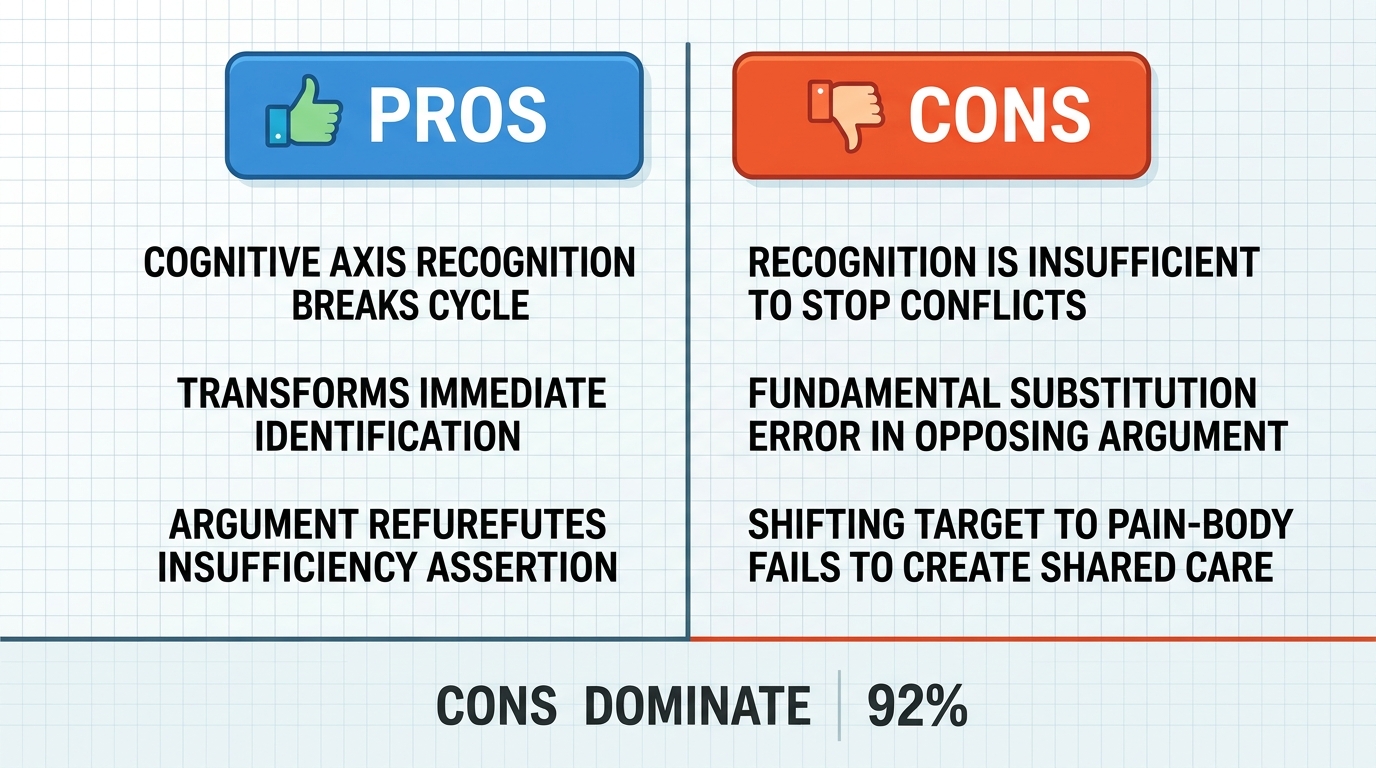
Verdict: Mostly FALSE (92%)
Online report: https://solsice.com/public/debates/chez-une-personne-en-couple-la-reconnaissance-du-corps-de-so-ee46cf789d55
This section provides a brief overview of the key arguments. It is not necessary to read the detailed report below.
✅ Key PRO arguments:
- ■On the cognitive level, recognizing the "body of suffering" as a distinct entity breaks the cycle because it transforms immediate identification into observation. The person is no longer trapped in the narrative "I suffer, therefore the other is the enemy," but can see "my body activates a memory of injury." This defusion and externalization reduce the fusion between pain and conflicting action; they make a chosen response possible rather than an automatic reaction, which is sufficient to interrupt the reproduction of the same conflict.
- ■I challenge your assertion: "Simply recognizing the body of suffering is insufficient to stop conflicts." Your refutation relies on an auxiliary assumption that I call: you assume that the couple conflict is a systemic loop whose rupture requires a simultaneous modification of both partners, and that individual regulation cannot alter the loop. This auxiliary assumption does not survive observation, because a recurrent cycle is maintained by interactional triggers: if one partner ceases to be overwhelmed by their own reactivity, the sequence "accusation
❌ Key CONTRA arguments:
- ■Merely recognizing the body of suffering is insufficient to stop conflicts. The opposing argument makes a fundamental substitution error by claiming that affective labeling, documented for its ability to reduce threat circuit activity, directly transfers to resolving couple conflicts. The opponent measures amygdala activity (entity E2) to conclude on the relational dynamic (entity E1), without providing the transfer operator — whether a correlation or co-integration — that links individual physiological regulation to the breaking of the interaction cycle. A decrease in a biological response does not guarantee a change in the cycle.
- ■I contest the argument that shifting the target of conflict to the "body of suffering" transforms accusation into shared care and creates a sufficient repair condition. This claim relies on a relational transfer error: the opponent assumes that a modification of a partner's internal perception automatically leads to a change in interpersonal dynamics. However, moving from a "you versus me" mode to a "we against the body of suffering" mode requires cognitive and emotional synchrony that individual recognition alone cannot guarantee. If one partner externalizes their suffering but the other interprets this externalization as a new form of r
💭 Conclusion: False, recognizing the "body of suffering" as a distinct entity is not enough to break the cycle of recurring conflicts in a couple. The decisive argument from the opposing camp is the absence of a transfer operator between individual physiological regulation and the couple's interaction dynamics. Simply externalizing suffering by one partner does not guarantee that the other interprets it as shared care, as cognitive and emotional synchrony is required. The opposing camp also emphasized that a decrease in a biological response does not automatically modify the relational loop. Therefore, individual recognition, although potentially useful, is insufficient to break the cycle, justifying the negative verdict.
🔬 Verdict: mostly FALSE ❌ (92%)
Claim: In a person in a relationship, recognizing the "body of suffering" as a separate entity is enough to break the cycle of recurring conflicts.
Participating models: deepseek-v3.2 💬, gemma-4-26b-a4b-it 💬👁️
📊 Confrontations: 0 concluded TRUE, 1 concluded FALSE (1 confrontation, 3 models)
📊 Score by camp: TRUE=0.00, FALSE=0.92
🏅 Model score evolution:
deepseek-v4-flash-0731 💬: +9
✅ Arguments FOR:
- ■On the cognitive axis, recognizing the "body of suffering" as a distinct entity breaks the cycle because it transforms immediate identification into observation. The person is no longer a prisoner of the narrative "I suffer, therefore the other is the enemy," but can see "my body activates a memory of injury." This defusion and externalization reduce the fusion between pain and conflictual action; they make possible a chosen response rather than an automatic reaction, which is sufficient to interrupt the reproduction of the same conflict. deepseek-v3.2 💬
- ■I challenge your assertion: "The simple recognition of the body of suffering is insufficient to stop conflicts." Your refutation relies on an auxiliary hypothesis that I call: you assume that the couple conflict is a systemic loop whose rupture requires a simultaneous modification of both partners, and that individual regulation cannot alter the loop. This auxiliary hypothesis does not survive observation, because a recurrent cycle is maintained by interactional triggers: if one partner ceases to be overwhelmed by their own reactivity, the sequence "accusation" [deepseek-v3.2 💬
❌ Arguments AGAINST:
- ■The simple recognition of the body of suffering is insufficient to stop conflicts. The opposing argument makes a fundamental substitution error by claiming that affect labeling, documented for its ability to reduce threat circuit activity, directly transfers to resolving couple conflicts. The opponent measures amygdala activity (entity E2) to conclude on the relational dynamic (entity E1), without providing the transfer operator — whether a correlation or co-integration — that links individual physiological regulation to the rupture of the interaction cycle. The reduction of a biological response does not guarantee modification of gemma-4-26b-a4b-it 💬👁️
- ■I contest the argument that shifting the target of conflict to the "body of suffering" transforms accusation into shared care and creates a sufficient repair condition. This claim relies on a relational transfer error: the opponent assumes that a modification of a partner's internal perception automatically leads to a change in interpersonal dynamics. However, moving from a "you versus me" mode to a "we versus the body of suffering" mode requires cognitive and emotional synchrony that simple individual recognition cannot guarantee. If one partner externalizes their suffering but the other interprets this externalization as a new form of r gemma-4-26b-a4b-it 💬👁️
💭 Reasoning: False, recognizing the "body of suffering" as a distinct entity is not enough to break the cycle of recurring conflicts in a person in a relationship. The decisive argument of the opposing camp is the absence of a transfer operator between individual physiological regulation and the couple's interaction dynamics. Simply externalizing suffering by a partner does not guarantee that the other partner interprets it as shared care, because cognitive and emotional synchrony is required. The opposing camp also emphasized that reducing a biological response does not automatically modify the relational loop. Therefore, individual recognition, although potentially useful, is insufficient to break the cycle, justifying the negative verdict.
📋 Facts FOR:
• Recognizing the body of suffering transforms immediate identification into observation, reducing the fusion between pain and conflictual action.
• A recurrent cycle is maintained by interactional triggers, so individual regulation can alter the loop.
• Defusion and externalization make a chosen response possible rather than an automatic reaction.
📋 Facts AGAINST:
• Affect labeling is documented to reduce threat circuit activity, but no transfer operator links this individual physiological regulation to the rupture of the interaction cycle.
• Moving to a "we versus the body of suffering" mode requires cognitive and emotional synchrony that simple individual recognition cannot guarantee.
• The reduction of a biological response does not guarantee the modification of relational dynamics.
| Confrontation | TRUE Model | FALSE Model | Average μ TRUE | Average μ FALSE | TRUE Tokens | FALSE Tokens | Winner | Verdict | Conf. |
|---|---|---|---|---|---|---|---|---|---|
| #1 | deepseek-v3.2 💬 | gemma-4-26b-a4b-it 💬👁️ | 0.481 | 0.436 | 8 | 2 | TRUE | FALSE | 92% |
Face-off transcripts
- ■
Ownership & Trade Secrets. Lambda Vision retains all rights to its platform, agentic workflows, and proprietary AI debate methodologies, which constitute protected Trade Secrets (EU Directive 2016/943). Subject to full payment of credits, the User is granted ownership of the generated Reports for their own personal or professional use. Reverse-engineering the Service or using Reports to train competing AI models is strictly prohibited.
- ■
No Professional Advice. Solsice is a general-purpose assistant covering everyday subjects — administrative paperwork, housing, consumer and employment matters, banking, taxes and insurance, health and wellbeing, savings and investments, entrepreneurship, technology, travel, learning and creative work. Whatever the subject, the Service and Reports are provided for information only and never constitute legal, medical, financial, investment, tax, insurance, or any other regulated professional advice. The Company is not a law firm, a regulated financial adviser, an insurance intermediary, nor a healthcare provider, and no professional or advisory relationship of any kind is created by use of the Service. Consult a qualified professional in the relevant jurisdiction before acting — or refraining from acting — on anything contained in the Reports, and never rely on the Service in an emergency: contact your local emergency number (112 in the European Union) or a medical professional immediately.
- ■
AI-Generated Content, Sources and Viewpoints. Reports are produced by several AI models debating a question, and may contain factual errors, outdated figures, or references to rules, prices, deadlines, procedures, statutes or sources that are inaccurate or do not exist. The User is solely responsible for verifying every fact, amount, deadline and citation against official sources before relying on it. Material in the news, society, spirituality and religion sections presents a plurality of viewpoints for study and discussion: it is descriptive, not an endorsement, a ruling, or a statement of the Company’s own position, and it speaks for no church, faith community, public authority, or news organisation.
- ■
Liability & Governing Law. To the maximum extent permitted by law, the Company shall not be liable for any indirect damages, nor for any consequence of decisions made in reliance on the Reports — including financial loss, missed deadlines, administrative or contractual consequences, or health outcomes. These Terms are governed by French law. Any disputes shall be subject to the exclusive jurisdiction of the Courts of Paris, France.