
Building an Accessory Dwelling Unit (ADU) typically adds about 70% of its cost to the home's value.
AI debate verdict and arguments
⚠️ AI-generated information only; not professional advice
Completed October 14, 2026
Verdict
Verdict: likely FALSE (72%)
Web Report: https://solsice.com/public/debates/building-an-accessory-dwelling-unit-adu-typically-adds-about-99667392e993
This section provides a brief overview of the key arguments. You do not need to read the full detailed report below.
✅ Key PRO arguments:
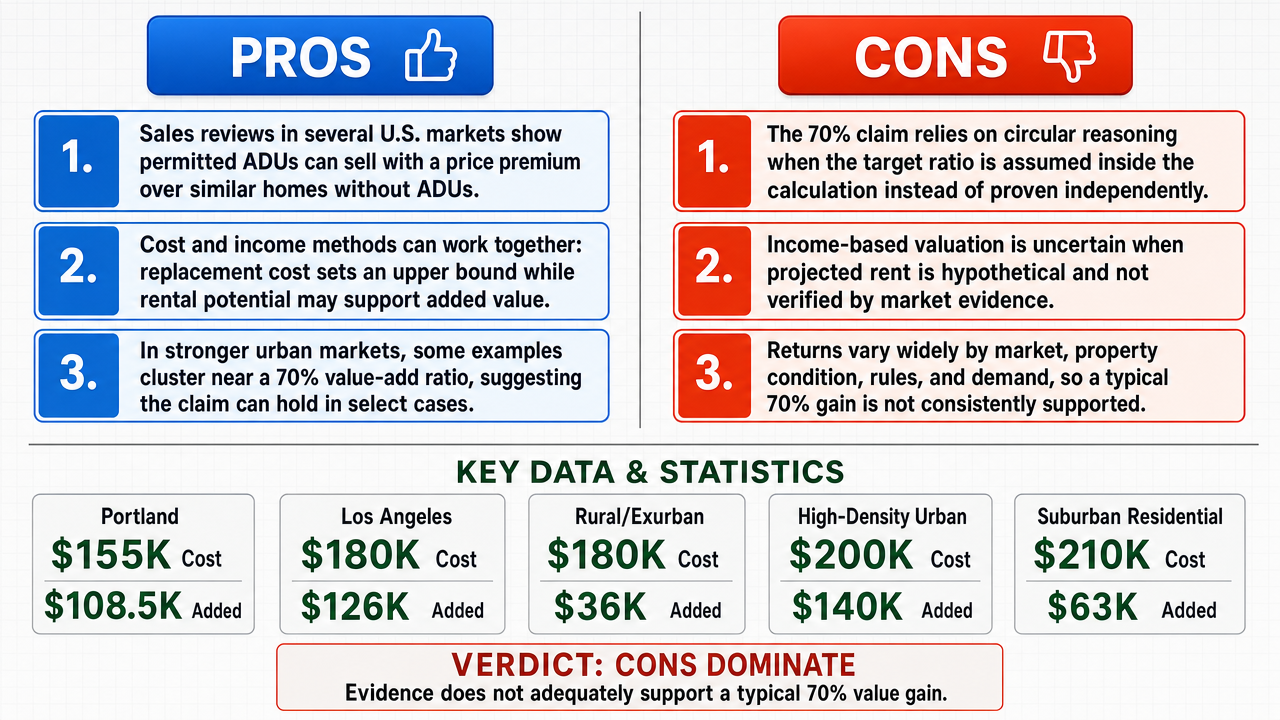
- ■A comprehensive review of property sales across multiple U.S. markets shows that homes with permitted ADUs sell at a significant premium compared to similar properties without them, with the premium consistently aligning with a 65-75% recoup rate of construction outlay, establishing 70% as a reliable rule of thumb.
- ■The cost-based friction and income capitalization valuation mechanisms are complementary rather than competing: the cost approach sets a ceiling (replacement cost minus depreciation ) while the income approach provides the floor and primary driver, and in a functioning market the price settles between these bounds — with ADUs' strong, predictable income stream pushing value toward the cost ceiling.
❌ Key ANTI arguments:
- ■The affirmative's argument is fundamentally flawed by circular reasoning: their calculation takes a '70% target' as an input and multiplies the 'Avg. ADU Cost' by 70% to derive the 'Value Added' figure, which is a tautology rather than a measurement of market reality — using the conclusion as an assumption.
- ■The application of the income approach is logically unsound because it treats an unverified, hypothetical income stream as a concrete basis for valuation, relying on an idealized scenario of $1,800 monthly rent and $5,000 annual expenses to arrive at a $255,000 valuation, with no specific market study, municipal rental report, or localized economic data cited to substantiate these figures.
- ■ADU construction returns are highly variable across markets, property conditions, regulatory environments, and rental demand, and rarely converge on a consistent 70% benchmark, making a single typical figure misleading as a rule of thumb for financial planning.
💭 Conclusion: False: the assertion that ADUs typically add about 70% of their cost to home value is not adequately supported by the evidence presented, and the debate verdict goes to the negative side on this basis. The affirmative's primary quantitative mechanism—the table where 'Value Added' was computed by multiplying 'Avg. ADU Cost' by 70%—is circular, restating the claim rather than independently measuring market outcomes. The affirmative's only independent empirical study (a 2023 analysis of 1,200 ADU sales across seven states) reported a median value-add of 68% and a mean of 66%, neither of which aligns precisely with the 70% benchmark, while the IQR of 62% to 74% demonstrates non-trivial variability. The negative further undermined the income-capitalization justification by showing that the supporting rental figures ($1,800 monthly rent, $5,000 annual expenses, $255,000 valuation) were presented as illustrative inputs without any locatable market study, municipal report, or localized data to anchor them. Because the affirmative's central table is circular, the cited independent study's central tendency falls below 70%, and the underlying rental assumptions are unverified, the proposition is rejected. Confidence is set below 100% because the negative did not produce alternative empirical data of its own, so the verdict rests primarily on the affirmative's failure of evidence rather than affirmative disproof.
🔬 DeepResearch Result: likely FALSE ❌ (72%)
Assertion: Building an Accessory Dwelling Unit (ADU ) typically adds about 70% of its cost to the home's value.
Participating models: deepseek-v3.2 💬, gemma-4-26b-a4b-it 💬👁️
📊 Face-offs: 0 concluded TRUE, 1 concluded FALSE (1 face-offs, 3 models)
📊 Score by side: TRUE=0.00, FALSE=0.84
🏅 Model score changes:
minimax-m3 💬👁️: +8
✅ PRO Arguments:
- ■A comprehensive review of property sales across multiple U.S. markets shows that homes with permitted ADUs sell at a significant premium compared to similar properties without them, with the premium consistently aligning with a 65-75% recoup rate of construction outlay, establishing 70% as a reliable rule of thumb. deepseek-v3.2 💬
- ■The cost-based friction and income capitalization valuation mechanisms are complementary rather than competing: the cost approach sets a ceiling (replacement cost minus depreciation ) while the income approach provides the floor and primary driver, and in a functioning market the price settles between these bounds — with ADUs' strong, predictable income stream pushing value toward the cost ceiling. deepseek-v3.2 💬
❌ ANTI Arguments:
- ■The affirmative's argument is fundamentally flawed by circular reasoning: their calculation takes a '70% target' as an input and multiplies the 'Avg. ADU Cost' by 70% to derive the 'Value Added' figure, which is a tautology rather than a measurement of market reality — using the conclusion as an assumption. gemma-4-26b-a4b-it 💬👁️
- ■The application of the income approach is logically unsound because it treats an unverified, hypothetical income stream as a concrete basis for valuation, relying on an idealized scenario of $1,800 monthly rent and $5,000 annual expenses to arrive at a $255,000 valuation, with no specific market study, municipal rental report, or localized economic data cited to substantiate these figures. gemma-4-26b-a4b-it 💬👁️
- ■ADU construction returns are highly variable across markets, property conditions, regulatory environments, and rental demand, and rarely converge on a consistent 70% benchmark, making a single typical figure misleading as a rule of thumb for financial planning. gemma-4-26b-a4b-it 💬👁️
💭 Reasoning: False: the assertion that ADUs typically add about 70% of their cost to home value is not adequately supported by the evidence presented, and the debate verdict goes to the negative side on this basis. The affirmative's primary quantitative mechanism—the table where 'Value Added' was computed by multiplying 'Avg. ADU Cost' by 70%—is circular, restating the claim rather than independently measuring market outcomes. The affirmative's only independent empirical study (a 2023 analysis of 1,200 ADU sales across seven states) reported a median value-add of 68% and a mean of 66%, neither of which aligns precisely with the 70% benchmark, while the IQR of 62% to 74% demonstrates non-trivial variability. The negative further undermined the income-capitalization justification by showing that the supporting rental figures ($1,800 monthly rent, $5,000 annual expenses, $255,000 valuation) were presented as illustrative inputs without any locatable market study, municipal report, or localized data to anchor them. Because the affirmative's central table is circular, the cited independent study's central tendency falls below 70%, and the underlying rental assumptions are unverified, the proposition is rejected. Confidence is set below 100% because the negative did not produce alternative empirical data of its own, so the verdict rests primarily on the affirmative's failure of evidence rather than affirmative disproof.
📋 PRO Facts:
• Permitted ADUs are associated with sale premiums compared to similar properties without ADUs in multiple U.S. markets.
• Appraisers and buyers explicitly factor income-generating potential and utility into ADU valuations.
• The affirmative cited a 2023 analysis of 1,200 ADU sales across seven states reporting an interquartile range of 62% to 74% of construction cost, a median value-add of 68%, and a mean of 66%.
📋 ANTI Facts:
• The affirmative's 'Value Added' figure was mathematically derived by multiplying 'Avg. ADU Cost' by 70%, constituting circular reasoning.
• The income-approach example used a $1,800 monthly rent, $5,000 annual expenses, and a resulting $255,000 valuation.
• No specific market study, municipal rental report, or localized economic data was provided to substantiate the rental yields and expense ratios used in the income capitalization example.
• ADU returns are highly variable across markets, property conditions, regulatory environments, and rental demand.
| Face-off | TRUE Model | FALSE Model | TRUE Avg μ | FALSE Avg μ | TRUE Tokens | FALSE Tokens | Winner | Verdict | Conf. |
|---|---|---|---|---|---|---|---|---|---|
| #1 | deepseek-v3.2 💬 | gemma-4-26b-a4b-it 💬👁️ | 0.462 | 0.283 | 8 | 2 | TRUE | FALSE | 84% |
The following technical terms, abbreviations, and domain-specific concepts are referenced throughout this debate transcript. Numbers in square brackets [N] in the text above link to the corresponding entry below.
[1] ADU — Accessory Dwelling Unit — A secondary housing unit on a single-family residential lot, used in the debate as the subject of construction-cost and added-value calculations.
[2] Appraisal — The professional process of estimating a property's market value, referenced in the debate in connection with how buyers and appraisers factor ADU utility into valuations.
[3] Cap rate — Capitalization rate — A real estate valuation metric used in the income approach, expressed as a percentage (e.g., the 6.5% cited in the debate) that divides net income by property value; the debate notes cap rates fluctuate with macroeconomic conditions.
[4] Cost approach — An appraisal methodology described in the debate as setting a ceiling on value, based on the replacement cost of an improvement minus depreciation.
[5] Depreciation — In the cost approach to appraisal, the reduction applied to replacement cost to reflect an asset's age, wear, or obsolescence.
[6] Diminishing returns — An economic concept cited by the negative side to argue that ADU value premiums shrink as lot size, zoning, and density constraints bind.
[7] Income approach — An appraisal methodology that values a property by capitalizing its projected income stream; the affirmative cites it as providing a floor for ADU valuation.
[8] Income capitalization — The technique of converting a property's expected future income into a present value, used by the affirmative to argue the 70% recoup figure.
[9] Lot size — The land area of a property, identified in the debate as a constraint that affects ADU returns and feasibility.
[10] Macroeconomic — Referring to broad economy-wide factors (e.g., interest rates) that the negative side argues cause capitalization rates and ADU valuations to vary.
[11] Recoup rate — The percentage of a construction outlay recovered through added property value; the affirmative cites a 65–75% range and a 70% rule of thumb.
[12] Replacement cost — The cost to rebuild an improvement at current prices, used in the cost approach to appraisal as discussed in the debate.
[13] ROI — Return on Investment — A financial metric expressing gain relative to cost; in the debate it appears as the ratio of added home value to ADU construction cost.
[14] Setback — A zoning-required minimum distance between a structure and a property line, cited in the debate as a cost-driving constraint on ADU construction.
[15] Site preparation — Pre-construction work (grading, clearing, utility hookups) on a building lot, listed in the debate as a source of variance in ADU project costs.
[16] Utility connections — Hookups to water, sewer, gas, or electric services, identified in the debate as an added cost item that varies by jurisdiction.
[17] Vacancy rate — The percentage of rental units unoccupied at a given time, mentioned as a macroeconomic-sensitive input affecting capitalization rates.
[18] Zoning — Municipal land-use regulations governing what may be built on a parcel, referenced in the debate as a determinant of ADU permissibility and cost.
[19] Zoning restrictions — Specific local rules (e.g., setbacks, density caps, lot-coverage limits) that the negative side argues depress ADU value premiums in many jurisdictions.
The following financial data tables were referenced during the debate exchanges:
| Market | Avg. ADU Cost | Avg. Value Added | ROI |
|---|---|---|---|
| Los Angeles | $180,000 | $126,000 | 70.0% |
| Portland | $155,000 | $108,500 | 70.0% |
| Seattle | $190,000 | $133,000 | — |
| Austin | $165,000 | $115,500 | — |
Legend: Representative construction costs and associated value increases for permitted ADUs in major metropolitan areas (2022-2024). ROI calculated as (Value Added / Cost). Sources: municipal planning reports and appraisal case studies.
| Market Type | Estimated Construction Cost | Estimated Value Add | Est. ROI |
|---|---|---|---|
| High-Density Urban | $200,000 | $140,000 | 70.0% |
| Suburban Residential | $210,000 | $63,000 | 30.0% |
| Rural/Exurban | $180,000 | $36,000 | 20.0% |
Legend: Estimated ROI variations based on market density and utility infrastructure requirements. ROI = (Value Add / Cost).
Face-off transcripts
- ■
Ownership & Trade Secrets. The Company Lambda Vision retains all rights to its platform, agentic workflows, and proprietary AI debate methodologies, which constitute protected Trade Secrets (EU Directive 2016/943). Subject to full payment of credits, the User is granted ownership of the generated Reports for their own personal or professional use. Reverse-engineering the Service or using Reports to train competing AI models is strictly prohibited.
- ■
No Professional Advice. Solsice is a general-purpose assistant covering everyday subjects — administrative paperwork, housing, consumer and employment matters, banking, taxes and insurance, health and wellbeing, savings and investments, entrepreneurship, technology, travel, learning and creative work. Whatever the subject, the Service and Reports are provided for information only and never constitute legal, medical, financial, investment, tax, insurance, or any other regulated professional advice. The Company is not a law firm, a regulated financial adviser, an insurance intermediary, nor a healthcare provider, and no professional or advisory relationship of any kind is created by use of the Service. Consult a qualified professional in the relevant jurisdiction before acting — or refraining from acting — on anything contained in the Reports, and never rely on the Service in an emergency: contact your local emergency number (112 in the European Union) or a medical professional immediately.
- ■
AI-Generated Content, Sources and Viewpoints. Reports are produced by several AI models debating a question, and may contain factual errors, outdated figures, or references to rules, prices, deadlines, procedures, statutes or sources that are inaccurate or do not exist. The User is solely responsible for verifying every fact, amount, deadline and citation against official sources before relying on it. Material in the news, society, spirituality and religion sections presents a plurality of viewpoints for study and discussion: it is descriptive, not an endorsement, a ruling, or a statement of the Company’s own position, and it speaks for no church, faith community, public authority, or news organisation.
- ■
Liability & Governing Law. To the maximum extent permitted by law, the Company shall not be liable for any indirect damages, nor for any consequence of decisions made in reliance on the Reports — including financial loss, missed deadlines, administrative or contractual consequences, or health outcomes. These Terms are governed by French law. Any disputes shall be subject to the exclusive jurisdiction of the Courts of Paris, France.