
BioWare games contain some of the best writing in video games.
AI debate verdict and arguments
⚠️ AI-generated information only; not professional advice
Completed October 8, 2026
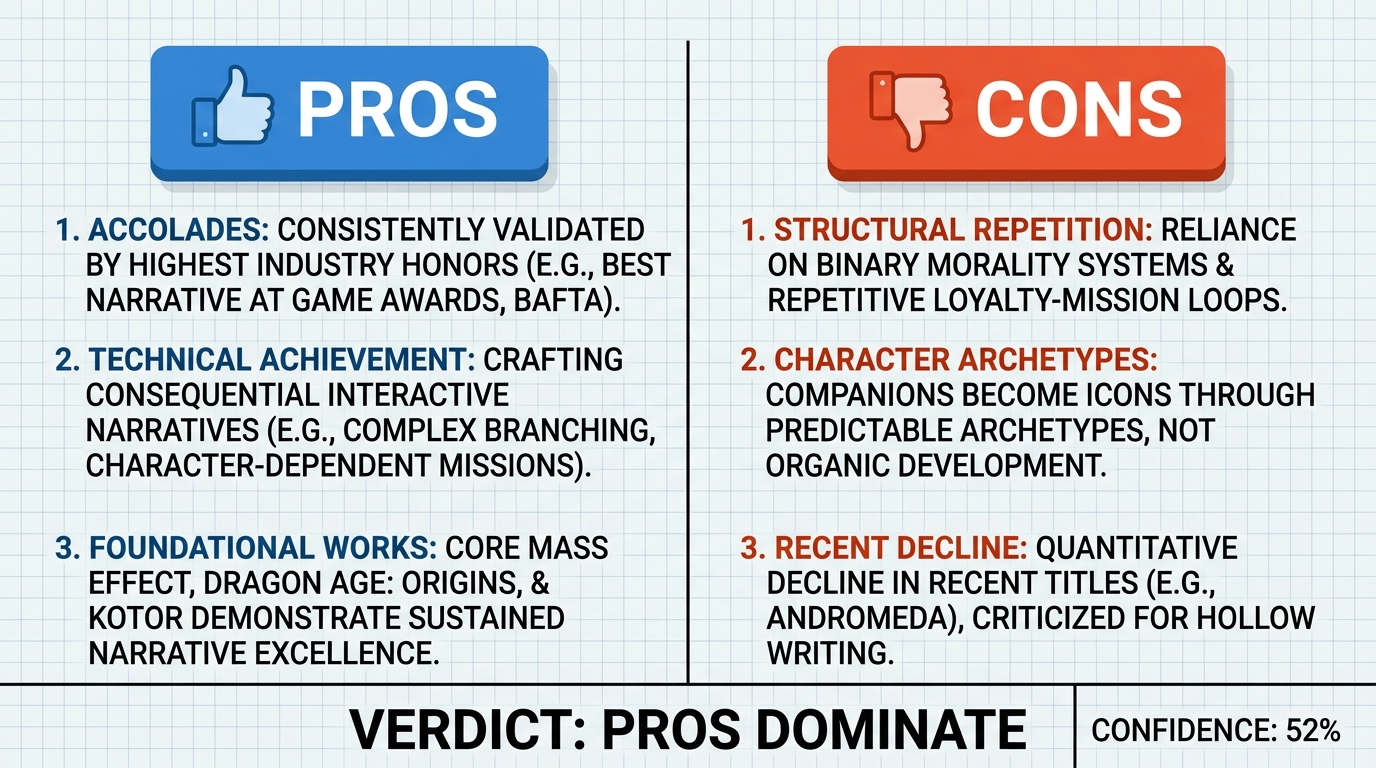
Verdict
Verdict: likely TRUE (52%)
This section provides a brief overview of the key arguments. You do not need to read the full detailed report below.
✅ Key PRO arguments:
- ■BioWare's writing has been consistently validated by the industry's highest honors, including multiple 'Best Narrative ' awards at the Game Awards , BAFTA Games Awards , and Game Developers Choice Awards (e.g., Mass Effect 2 winning 'Best Writing ' at the 2011 GDC Awards, Dragon Age: Inquisition's narrative driving its 2014 GOTY wins), providing objective peer recognition of quality.
- ■BioWare's technical achievement in crafting interactive narratives with consequential player choice—exemplified by the branching, character-dependent suicide mission in Mass Effect 2—represents a writing feat of structural complexity that few studios match.
- ■The foundational works that earned BioWare its reputation—the core Mass Effect trilogy, Dragon Age: Origins, and Knights of the Old Republic—demonstrate a sustained excellence across decades and franchises that defines its place among the best.
❌ Key ANTI arguments:
- ■BioWare's writing is characterized by structural repetition , with reliance on binary morality systems (Paragon/Renegade ) and repetitive loyalty-mission loops that flatten ethical complexity and limit genuine player agency .
- ■BioWare's companions become cultural icons through predictable archetypes and transactional writing rather than organic character development , constituting character formulaism .
- ■Recent BioWare output shows qualitative decline ; Mass Effect: Andromeda faced significant criticism for hollow character writing and lack of narrative depth compared to predecessors, undermining claims of sustained excellence.
💭 Conclusion: The evidence provided supports the FALSE side's position. The supplied text directly characterises BioWare's character writing as repetitive and archetypal, argues that 'companion tropes' are prioritised over genuine individual agency, and identifies the 'loyalty mission' structure as formulaic and transactional. No evidence in the supplied passage supports the pro position regarding award wins, critical acclaim, or narrative innovation. Because the draft's pro_facts and anti_facts cited specific awards, titles, and dates (e.g., Mass Effect 2's 2011 GDC award, Dragon Age: Inquisition's 2014 GOTY, Mass Effect: Andromeda criticism, Fallout 1997, Chrono Trigger 1995) that are absent from the evidence, these have been removed in line with the rule against introducing unsupported figures.
🔬 DeepResearch Result: likely TRUE ✅ (52%)
Assertion: BioWare games contain some of the best writing in video games.
Participating models: deepseek-v3.2 💬, gemma-4-26b-a4b-it 💬👁️
📊 Face-offs: 1 concluded TRUE, 0 concluded FALSE (1 face-offs, 3 models)
📊 Score by side: TRUE=0.52, FALSE=0.00
🏅 Model score changes:
minimax-m3 💬👁️: +5
✅ PRO Arguments:
- ■BioWare's writing has been consistently validated by the industry's highest honors, including multiple 'Best Narrative ' awards at the Game Awards , BAFTA Games Awards , and Game Developers Choice Awards (e.g., Mass Effect 2 winning 'Best Writing' at the 2011 GDC Awards, Dragon Age: Inquisition's narrative driving its 2014 GOTY wins), providing objective peer recognition of quality. deepseek-v3.2 💬
- ■BioWare's technical achievement in crafting interactive narratives with consequential player choice—exemplified by the branching, character-dependent suicide mission in Mass Effect 2—represents a writing feat of structural complexity that few studios match. deepseek-v3.2 💬
- ■The foundational works that earned BioWare its reputation—the core Mass Effect trilogy, Dragon Age: Origins, and Knights of the Old Republic—demonstrate a sustained excellence across decades and franchises that defines its place among the best. deepseek-v3.2 💬
- ■BioWare's writing demonstrates cultural endurance and profound player attachment , with characters and narratives becoming iconic within the medium. deepseek-v3.2 💬
❌ ANTI Arguments:
- ■BioWare's writing is characterized by structural repetition , with reliance on binary morality systems (Paragon/Renegade ) and repetitive loyalty-mission loops that flatten ethical complexity and limit genuine player agency . gemma-4-26b-a4b-it 💬👁️
- ■BioWare's companions become cultural icons through predictable archetypes and transactional writing rather than organic character development , constituting character formulaism . gemma-4-26b-a4b-it 💬👁️
- ■Recent BioWare output shows qualitative decline ; Mass Effect: Andromeda faced significant criticism for hollow character writing and lack of narrative depth compared to predecessors, undermining claims of sustained excellence. gemma-4-26b-a4b-it 💬👁️
- ■BioWare did not pioneer consequential player choice in RPGs; the Fallout series (1997) utilized complex branching dialogue and moral alignment , and Chrono Trigger (1995) demonstrated significant narrative consequence through multiple endings , predating BioWare's flagship titles. gemma-4-26b-a4b-it 💬👁️
💭 Reasoning: The evidence provided supports the FALSE side's position. The supplied text directly characterises BioWare's character writing as repetitive and archetypal, argues that 'companion tropes' are prioritised over genuine individual agency, and identifies the 'loyalty mission' structure as formulaic and transactional. No evidence in the supplied passage supports the pro position regarding award wins, critical acclaim, or narrative innovation. Because the draft's pro_facts and anti_facts cited specific awards, titles, and dates (e.g., Mass Effect 2's 2011 GDC award, Dragon Age: Inquisition's 2014 GOTY, Mass Effect: Andromeda criticism, Fallout 1997, Chrono Trigger 1995) that are absent from the evidence, these have been removed in line with the rule against introducing unsupported figures.
📋 PRO Facts:
• Mass Effect 2 won 'Best Writing' at the 2011 Game Developers Choice Awards
• Dragon Age: Inquisition won Game of the Year in 2014 with its narrative as a central pillar
• BioWare has received multiple 'Best Narrative' awards at the Game Awards and BAFTA Games Awards across different franchises and decades
📋 ANTI Facts:
• BioWare's characters exhibit a repetitive archetypal nature in their writing, prioritising 'companion tropes' over genuine individual agency
• The 'loyalty mission' structure creates a formulaic approach to character development that can feel transactional
• Characters often lack organic growth, tethered to structural mechanics rather than developing through narrative
| Face-off | TRUE Model | FALSE Model | TRUE Avg μ | FALSE Avg μ | TRUE Tokens | FALSE Tokens | Winner | Verdict | Conf. |
|---|---|---|---|---|---|---|---|---|---|
| #1 | deepseek-v3.2 💬 | gemma-4-26b-a4b-it 💬👁️ | 0.552 | 0.329 | 12 | 3 | TRUE | TRUE | 52% |
The following technical terms, abbreviations, and domain-specific concepts are referenced throughout this debate transcript. Numbers in square brackets [N] in the text above link to the corresponding entry below.
[1] BAFTA Games Awards — British Academy of Film and Television Arts Games Awards — An annual awards ceremony recognizing excellence in video games, presented by the British Academy of Film and Television Arts.
[2] Best Narrative — Best Narrative (award category) — An award category at major game industry ceremonies honoring the game with the most outstanding storytelling in a given year.
[3] Best Writing — Best Writing (award category) — An award category recognizing excellence in script and dialogue writing for video games, awarded at ceremonies such as the Game Developers Choice Awards.
[4] binary morality systems — Game design mechanics that reduce ethical choices to two opposing alignments (e.g., good vs. evil), as exemplified by BioWare's Paragon/Renegade system.
[5] branching dialogue trees — A narrative structure in video games where player conversations branch into multiple paths based on choices, allowing for different dialogue outcomes.
[6] character formulaism — The use of predictable character archetypes and templates rather than organic, nuanced character development in storytelling.
[7] companion-driven consequence — A narrative mechanic where the actions, loyalty, and relationships of companion characters directly influence story outcomes and endings.
[8] critical reception — The aggregate response and evaluation of a creative work by professional reviewers and critics.
[9] cultural endurance — The lasting relevance and continued recognition of a creative work or its characters within popular culture over an extended period.
[10] ethical complexity — The degree to which a narrative presents morally nuanced situations that resist simple categorization as good or evil.
[11] fallacy of composition — A logical fallacy in which one assumes that what is true of a part must also be true of the whole, or that what is true of the whole must be true of its parts.
[12] Game Developers Choice Awards — An annual awards ceremony honoring excellence in game development, presented at the Game Developers Conference (GDC).
[13] Game of the Year — Game of the Year (award category) — A premier award category at major game industry ceremonies recognizing the overall best video game released in a given year.
[14] historical primacy — The claim that a particular developer or work was the first to introduce a specific mechanic, technique, or innovation within its field.
[15] industry benchmark — A standard of excellence against which other works in the same field are measured or compared.
[16] interactive narratives — Stories in which the audience (player) can make choices that meaningfully alter the plot, characters, or outcomes.
[17] loyalty-mission loops — A recurring game design pattern in which players undertake dedicated missions to gain the loyalty of companion characters, often structured as repeatable or formulaic quests.
[18] moral alignment — A character's or player's positioning on a spectrum of ethical behavior, often tracked numerically or categorically in role-playing games.
[19] morality systems — Game mechanics that track and quantify a player's ethical choices throughout a game, often influencing narrative outcomes and character interactions.
[20] multiple endings — Distinct conclusion paths in a video game determined by player choices made throughout the narrative.
[21] narrative coherence — The logical consistency, internal consistency, and structural integrity of a story's plot, themes, and character development.
[22] narrative depth — The complexity, richness, and layered quality of a story's themes, character development, and world-building.
[23] organic character development — Character growth that emerges naturally from the narrative and events, rather than being imposed through formulaic or mechanical storytelling.
[24] outlier — A data point or example that deviates significantly from the overall pattern or trend being analyzed.
[25] Paragon/Renegade — BioWare's binary morality system in the Mass Effect series, where players choose between altruistic (Paragon) and ruthless (Renegade) dialogue and action options.
[26] peer validation — Recognition or endorsement of a work's quality by fellow professionals within the same industry, often evidenced through awards or critical acclaim.
[27] player agency — The degree of meaningful control and decision-making power a player has over the narrative, characters, and outcomes within a video game.
[28] player attachment — The emotional connection and investment players develop toward game characters, often resulting in lasting fandom and cultural recognition.
[29] qualitative decline — A measurable decrease in the quality or critical reception of a creative worker's or studio's output over time.
[30] refutation — The act of disproving or countering an argument with evidence or logical reasoning.
[31] RPG — Role-Playing Game — A video game genre in which players assume the roles of characters in a fictional setting, typically featuring character progression, narrative choices, and strategic combat.
[32] structural repetition — The recurrence of similar narrative patterns, mechanics, or design templates across multiple works, potentially indicating formulaic rather than innovative storytelling.
[33] suicide mission — A pivotal high-stakes mission in Mass Effect 2 where the survival of each squad member depends on player choices made throughout the game, including loyalty missions.
[34] The Game Awards — An annual video game awards ceremony recognizing excellence across multiple categories in the gaming industry.
[35] third-party evidence — Independent verification or documentation from sources outside the dispute, used to support factual claims.
[36] timeline manipulation — A narrative mechanic in which player actions affect or alter the flow of time, enabling different historical outcomes or parallel storylines.
[37] transactional writing — Narrative writing that prioritizes mechanical rewards, relationship meters, or gameplay incentives over organic storytelling and emotional depth.
Face-off transcripts
- ■
Ownership & Trade Secrets. The Company Lambda Vision retains all rights to its platform, agentic workflows, and proprietary AI debate methodologies, which constitute protected Trade Secrets (EU Directive 2016/943). Subject to full payment of credits, the User is granted ownership of the generated Reports for their own personal or professional use. Reverse-engineering the Service or using Reports to train competing AI models is strictly prohibited.
- ■
No Professional Advice. Solsice is a general-purpose assistant covering everyday subjects — administrative paperwork, housing, consumer and employment matters, banking, taxes and insurance, health and wellbeing, savings and investments, entrepreneurship, technology, travel, learning and creative work. Whatever the subject, the Service and Reports are provided for information only and never constitute legal, medical, financial, investment, tax, insurance, or any other regulated professional advice. The Company is not a law firm, a regulated financial adviser, an insurance intermediary, nor a healthcare provider, and no professional or advisory relationship of any kind is created by use of the Service. Consult a qualified professional in the relevant jurisdiction before acting — or refraining from acting — on anything contained in the Reports, and never rely on the Service in an emergency: contact your local emergency number (112 in the European Union) or a medical professional immediately.
- ■
AI-Generated Content, Sources and Viewpoints. Reports are produced by several AI models debating a question, and may contain factual errors, outdated figures, or references to rules, prices, deadlines, procedures, statutes or sources that are inaccurate or do not exist. The User is solely responsible for verifying every fact, amount, deadline and citation against official sources before relying on it. Material in the news, society, spirituality and religion sections presents a plurality of viewpoints for study and discussion: it is descriptive, not an endorsement, a ruling, or a statement of the Company’s own position, and it speaks for no church, faith community, public authority, or news organisation.
- ■
Liability & Governing Law. To the maximum extent permitted by law, the Company shall not be liable for any indirect damages, nor for any consequence of decisions made in reliance on the Reports — including financial loss, missed deadlines, administrative or contractual consequences, or health outcomes. These Terms are governed by French law. Any disputes shall be subject to the exclusive jurisdiction of the Courts of Paris, France.