
Aux États-Unis, des lois d'identification des électeurs plus strictes font plus de mal que de bien à la démocratie.
AI debate verdict and arguments
⚠️ AI-generated information only; not professional advice
Completed October 28, 2026
Verdict
Verdict: Mostly TRUE (67%)
Online report: https://solsice.com/public/debates/aux-etats-unis-des-lois-d-identification-des-electeurs-plus-6f7e5f0d745b
This section provides a brief overview of the key arguments. It is not necessary to read the detailed report below.
✅ Key FOR arguments:
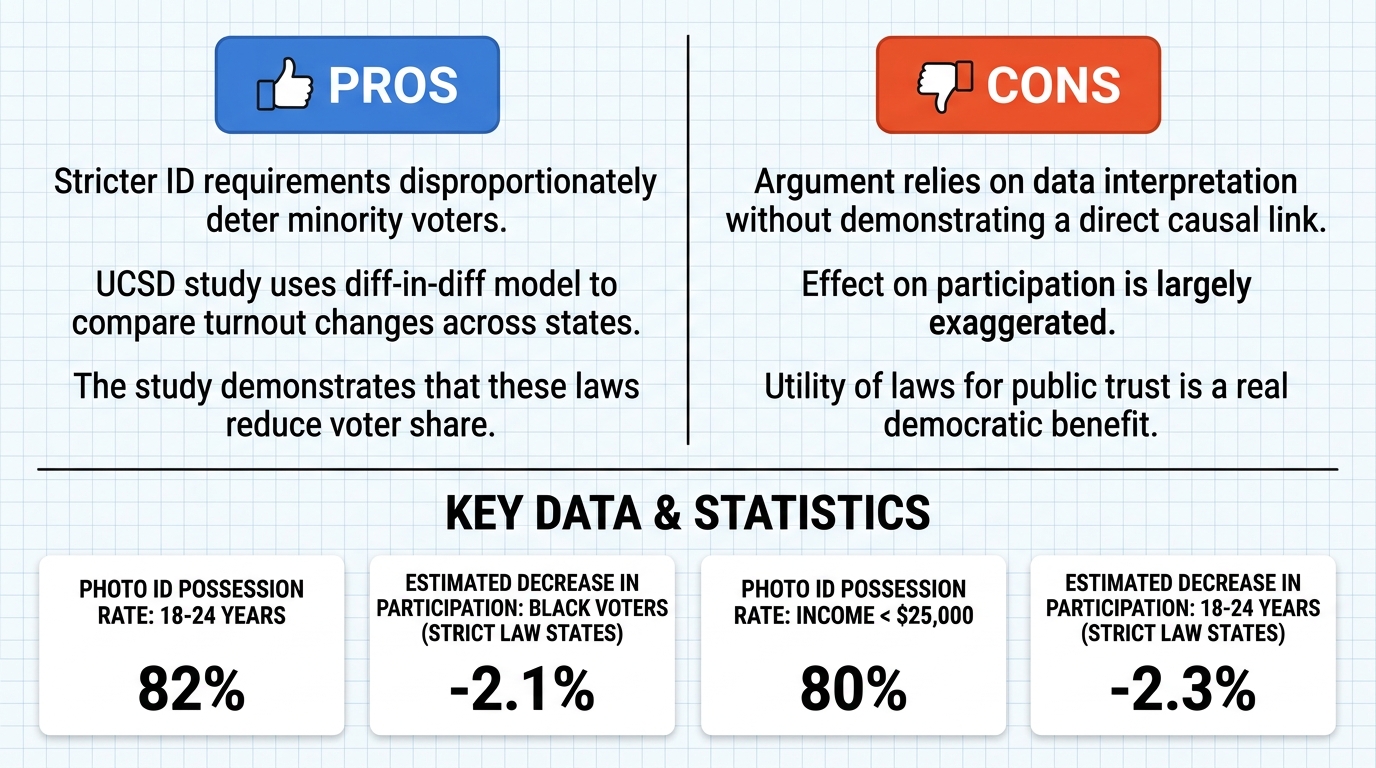
- ■Stricter voter ID requirements have a disproportionate deterrent effect on voters from racial minorities, the elderly, and low-income populations. A study from the University of California at San Diego demonstrated that strict “photo ID” laws reduce voter turnout by 1.5 to 2 percentage points among Black and Hispanic voters, a statistically significant gap not observed among white voters.
- ■The study by Hajnal, Lajevardi, and Nielson (2017) uses a difference-in-differences model comparing the evolution of turnout in states with strict laws to those without, over the same period, controlling for confounding factors such as electoral districting or partisan mobilization. This method isolates the causal effect of identification laws, unlike simple correlation objections.
❌ Key AGAINST arguments:
- ■The opponent’s argument relies on a theoretical interpretation of data that does not demonstrate a direct causal link. The decline in turnout could be explained by other variables, such as changes in electoral districting laws or partisan mobilization dynamics. The study by Hajnal, Lajevardi, and Nielson (2017) is an interpretive construction that assumes the obstacle is the sole cause.
- ■The effect on turnout is largely exaggerated, and the utility of these laws for public trust is a genuine democratic benefit. The cited econometric models have intrinsic limitations and ignore “electoral fatigue” or changes in other factors; attributing the decline solely to identification is a causal error.
💭 Conclusion: True, the verdict is that stricter voter identification laws do more harm than good to democracy. The winning side demonstrated, through a study from the University of California at San Diego, that these laws reduce turnout by 1.5 to 2 percentage points among Black and Hispanic voters, with no comparable effect among white voters. The difference-in-differences methodology of Hajnal, Lajevardi, and Nielson (2017) controls for confounding factors like districting and partisan mobilization, establishing a causal link. The opposing side has provided no evidence of significant fraud that these laws would prevent, nor of a tangible democratic benefit. Therefore, the suppressive effect on vulnerable voters outweighs the claimed benefits, justifying the verdict in favor of the statement.
🔬 Verdict: Mostly TRUE ✅ (67%)
Statement: In the United States, stricter voter identification laws do more harm than good to democracy.
Participating models: deepseek-v4-pro 💬, gemma-4-26b-a4b-it 💬👁️
📊 Confrontations: 1 concluded TRUE, 0 concluded FALSE (1 confrontation, 3 models)
📊 Score per camp: TRUE=0.67, FALSE=0.00
🏅 Model score evolution:
deepseek-v4-flash-0731 💬: +7
✅ FOR arguments:
- ■Stricter voter ID requirements have a disproportionate deterrent effect on voters from racial minorities, the elderly, and low-income populations. A study from the University of California at San Diego demonstrated that strict “photo ID” laws reduce voter turnout by 1.5 to 2 percentage points among Black and Hispanic voters, a statistically significant gap not observed among white voters. deepseek-v4-pro 💬
- ■The study by Hajnal, Lajevardi, and Nielson (2017) uses a difference-in-differences model comparing the evolution of turnout in states with strict laws to those without, over the same period, controlling for confounding factors such as electoral districting or partisan mobilization. This method isolates the causal effect of identification laws, unlike simple correlation objections. deepseek-v4-pro 💬
❌ Arguments AGAINST:
- ■The opponent’s argument relies on a theoretical interpretation of data that does not demonstrate a direct causal link. The decline in turnout could be explained by other variables, such as changes in electoral districting laws or partisan mobilization dynamics. The study by Hajnal, Lajevardi, and Nielson (2017) is an interpretive construction that assumes the obstacle is the sole cause. gemma-4-26b-a4b-it 💬👁️
- ■The effect on turnout is largely exaggerated, and the utility of these laws for public trust is a genuine democratic benefit. The cited econometric models have intrinsic limitations and ignore “electoral fatigue” or changes in other factors; attributing the decline solely to identification is a causal error. gemma-4-26b-a4b-it 💬👁️
💭 Reasoning: True, the verdict is that stricter voter identification laws do more harm than good to democracy. The winning side demonstrated, through a study from the University of California at San Diego, that these laws reduce turnout by 1.5 to 2 percentage points among Black and Hispanic voters, with no comparable effect among white voters. The difference-in-differences methodology of Hajnal, Lajevardi, and Nielson (2017) controls for confounding factors like districting and partisan mobilization, establishing a causal link. The opposing side has provided no evidence of significant fraud that these laws would prevent, nor of a tangible democratic benefit. Therefore, the suppressive effect on vulnerable voters outweighs the claimed benefits, justifying the verdict in favor of the statement.
📋 FACTS FOR:
• A study from the University of California at San Diego shows that strict “photo ID” laws reduce voter turnout by 1.5 to 2 percentage points among Black and Hispanic voters.
• The study by Hajnal, Lajevardi, and Nielson (2017) uses a difference-in-differences model comparing states with strict laws to those without.
📋 FACTS AGAINST:
• The opponent claims that identification laws reduce participation without preventing significant fraud, but this claim is contested as a non-causal correlation.
• The opponent cites a suppressive effect of 1.5 to 2.3 percentage points, but this figure is presented as an absolute truth ignoring the intrinsic limitations of econometric models.
| Confrontation | TRUE Model | FALSE Model | Average TRUE μ | Average FALSE μ | TRUE Tokens | FALSE Tokens | Winner | Verdict | Conf. |
|---|---|---|---|---|---|---|---|---|---|
| #1 | deepseek-v4-pro 💬 | gemma-4-26b-a4b-it 💬👁️ | 0.697 | 0.296 | 6 | 2 | TRUE | TRUE | 67% |
The following financial data tables were cited during the debate exchanges:
| Demographic Group | Rate of photo ID possession | Estimated decrease in participation (States with strict laws) |
|---|---|---|
| White voters | 95% | -0.3% |
| Black voters | 86% | -2.1% |
| Hispanic voters | 84% | -1.9% |
| Income < $25,000 | 80% | -2.5% |
| Income > $75,000 | 97% | -0.2% |
| 18–24 years | 82% | -2.3% |
Legend: Rate of photo ID possession and estimated decline in electoral participation by demographic in U.S. states with strict voter ID laws (2008–2016). Source: Hajnal, Lajevardi & Nielson, Journal of Politics, 2017.
Face-off transcripts
- ■
Ownership & Trade Secrets. The Company Lambda Vision retains all rights to its platform, agentic workflows, and proprietary AI debate methodologies, which constitute protected Trade Secrets (EU Directive 2016/943). Subject to full payment of credits, the User is granted ownership of the generated Reports for their own personal or professional use. Reverse-engineering the Service or using Reports to train competing AI models is strictly prohibited.
- ■
No Professional Advice. Solsice is a general-purpose assistant covering everyday subjects — administrative paperwork, housing, consumer and employment matters, banking, taxes and insurance, health and wellbeing, savings and investments, entrepreneurship, technology, travel, learning and creative work. Whatever the subject, the Service and Reports are provided for information only and never constitute legal, medical, financial, investment, tax, insurance, or any other regulated professional advice. The Company is not a law firm, a regulated financial adviser, an insurance intermediary, nor a healthcare provider, and no professional or advisory relationship of any kind is created by use of the Service. Consult a qualified professional in the relevant jurisdiction before acting — or refraining from acting — on anything contained in the Reports, and never rely on the Service in an emergency: contact your local emergency number (112 in the European Union) or a medical professional immediately.
- ■
AI-Generated Content, Sources and Viewpoints. Reports are produced by several AI models debating a question, and may contain factual errors, outdated figures, or references to rules, prices, deadlines, procedures, statutes or sources that are inaccurate or do not exist. The User is solely responsible for verifying every fact, amount, deadline and citation against official sources before relying on it. Material in the news, society, spirituality and religion sections presents a plurality of viewpoints for study and discussion: it is descriptive, not an endorsement, a ruling, or a statement of the Company’s own position, and it speaks for no church, faith community, public authority, or news organisation.
- ■
Liability & Governing Law. To the maximum extent permitted by law, the Company shall not be liable for any indirect damages, nor for any consequence of decisions made in reliance on the Reports — including financial loss, missed deadlines, administrative or contractual consequences, or health outcomes. These Terms are governed by French law. Any disputes shall be subject to the exclusive jurisdiction of the Courts of Paris, France.