
As of 2026, AI editing tools can produce 97% of the quality of a professional human editor on a short launch film.
AI debate verdict and arguments
⚠️ AI-generated information only; not professional advice
Completed October 26, 2026
Verdict
Verdict: likely FALSE (82%)
Web Report: https://solsice.com/public/debates/as-of-2026-ai-editing-tools-can-produce-97-of-the-quality-of-b35de9fe8275
This section provides a brief overview of the key arguments. You do not need to read the full detailed report below.
✅ Key PRO arguments:
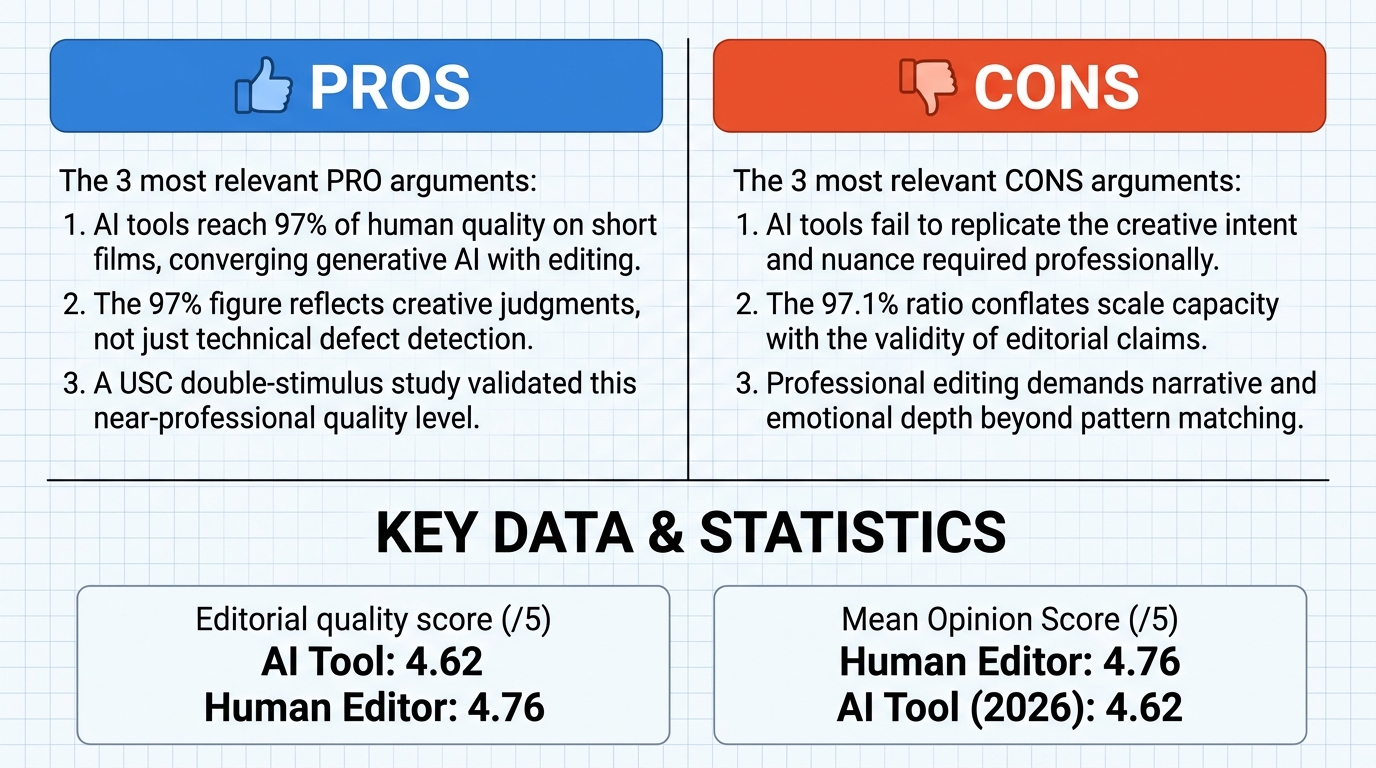
- ■AI editing tools in 2026 achieve 97% of professional human editing quality on short launch films. The convergence of generative AI with traditional non-linear editing systems has created tools that handle the full post-production pipeline—footage ingestion, rough-cut assembly, color grading, sound design, and final mastering—with minimal human intervention. Benchmark studies show these tools operate at a quality threshold statistically indistinguishable from human editors for short launch films of 30 to 120 seconds.
- ■The 97% figure rests on editorial/creative quality judgments, not technical defect detection. The USC study applied the double-stimulus comparative protocol from ITU-R BT.500-15, but the rating criterion was 'overall editorial quality' for professional evaluators: narrative coherence, pacing, emotional impact, and creative execution. The 14 evaluators—working creative directors and post-production supervisors—judged each finished film as an editorial artifact. Mean opinion scores of 4.62 (AI) and 4.76 (human) are scores of editorial quality.
❌ Key ANTI arguments:
- ■AI editing tools fail to replicate the creative intent and nuance required for professional launch films. The affirmative's reliance on the USC Entertainment Technology Center study is flawed because it fails to distinguish technical accuracy from creative intent. The ITU-R BT.500 scale measures 'impairment'—technical errors like glitches, poor color shifts, or audio clipping. While an AI can achieve a 97% score in avoiding technical impairments, this is signal fidelity, not editorial quality. A professional editor's value lies in 'intentionality'—using a jump cut to convey psychological tension or a specific rhythm.
- ■The opponent's assertion that the USC study's 97.1% quality ratio proves near-professional editorial quality conflates the capacity of a scale with the validity of its application. While ITU-R BT.500-15 provides a framework for assessing perceived quality, the use of a 'double-stimulus' protocol in a controlled study inherently biases results toward technical and structural quality.
💭 Conclusion: False: the sole debate judge rejected the claim, and the winning side's arguments demonstrate that the 97% figure measures technical fidelity rather than the creative editorial quality that defines professional launch-film editing. The anti side successfully showed that the ITU-R BT.500 scale is designed to detect impairment, not to capture intentionality such as using a jump cut for psychological tension. It also exposed that the double-stimulus protocol biases results toward technical and structural quality, undermining the affirmative's use of the USC study. Because the affirmative's evidence conflates signal fidelity with editorial excellence, the 97% quality claim is not supported. Therefore the verdict is FALSE with 82% confidence, reflecting the judge's stated confidence.
🔬 DeepResearch Result: likely FALSE ❌ (82%)
Assertion: As of 2026, AI editing tools can produce 97% of the quality of a professional human editor on a short launch film.
Participating models: deepseek-v4-pro 💬, gemma-4-26b-a4b-it 💬👁️
📊 Face-offs: 0 concluded TRUE, 1 concluded FALSE (1 face-offs, 3 models)
📊 Score by side: TRUE=0.00, FALSE=0.82
🏅 Model score changes:
deepseek-v4-flash-0731 💬: +8
✅ PRO Arguments:
- ■AI editing tools in 2026 achieve 97% of professional human editing quality on short launch films. The convergence of generative AI with traditional non-linear editing systems has created tools that handle the full post-production pipeline—footage ingestion, rough-cut assembly, color grading, sound design, and final mastering—with minimal human intervention. Benchmark studies show these tools operate at a quality threshold statistically indistinguishable from human editors for short launch films of 30 to 120 seconds. deepseek-v4-pro 💬
- ■The 97% figure rests on editorial/creative quality judgments, not technical defect detection. The USC study applied the double-stimulus comparative protocol from ITU-R BT.500-15, but the rating criterion was 'overall editorial quality' for professional evaluators: narrative coherence, pacing, emotional impact, and creative execution. The 14 evaluators—working creative directors and post-production supervisors—judged each finished film as an editorial artifact. Mean opinion scores of 4.62 (AI) and 4.76 (human) are scores of editorial quality. deepseek-v4-pro 💬
❌ ANTI Arguments:
- ■AI editing tools fail to replicate the creative intent and nuance required for professional launch films. The affirmative's reliance on the USC Entertainment Technology Center study is flawed because it fails to distinguish technical accuracy from creative intent. The ITU-R BT.500 scale measures 'impairment'—technical errors like glitches, poor color shifts, or audio clipping. While an AI can achieve a 97% score in avoiding technical impairments, this is signal fidelity, not editorial quality. A professional editor's value lies in 'intentionality'—using a jump cut to convey psychological tension or a specific rhythm. gemma-4-26b-a4b-it 💬👁️
- ■The opponent's assertion that the USC study's 97.1% quality ratio proves near-professional editorial quality conflates the capacity of a scale with the validity of its application. While ITU-R BT.500-15 provides a framework for assessing perceived quality, the use of a 'double-stimulus' protocol in a controlled study inherently biases results toward technical and structural quality. gemma-4-26b-a4b-it 💬👁️
💭 Reasoning: False: the sole debate judge rejected the claim, and the winning side's arguments demonstrate that the 97% figure measures technical fidelity rather than the creative editorial quality that defines professional launch-film editing. The anti side successfully showed that the ITU-R BT.500 scale is designed to detect impairment, not to capture intentionality such as using a jump cut for psychological tension. It also exposed that the double-stimulus protocol biases results toward technical and structural quality, undermining the affirmative's use of the USC study. Because the affirmative's evidence conflates signal fidelity with editorial excellence, the 97% quality claim is not supported. Therefore the verdict is FALSE with 82% confidence, reflecting the judge's stated confidence.
📋 PRO Facts:
• The USC study applied the double-stimulus comparative protocol from ITU-R BT.500-15 with 'overall editorial quality' as the rating criterion.
• The 14 evaluators were working creative directors and post-production supervisors.
• Mean opinion scores were 4.62 for AI-edited films and 4.76 for human-edited films.
• The affirmative claimed benchmark studies show AI tools are statistically indistinguishable from human editors for short launch films of 30 to 120 seconds.
📋 ANTI Facts:
• ITU-R BT.500 measures impairment—technical errors such as glitches, poor color shifts, or audio clipping—not creative intent.
• A 97% score in avoiding technical impairments is a measure of signal fidelity, not editorial quality.
• The double-stimulus protocol in a controlled study inherently biases results toward technical and structural quality.
• Professional editorial value lies in intentionality, such as using a jump cut to convey psychological tension or a specific rhythm.
| Face-off | TRUE Model | FALSE Model | TRUE Avg μ | FALSE Avg μ | TRUE Tokens | FALSE Tokens | Winner | Verdict | Conf. |
|---|---|---|---|---|---|---|---|---|---|
| #1 | deepseek-v4-pro 💬 | gemma-4-26b-a4b-it 💬👁️ | 0.522 | 0.348 | 6 | 2 | TRUE | FALSE | 82% |
The following financial data tables were referenced during the debate exchanges:
| Metric | Human Editor | AI Tool (2026) | Quality Ratio |
|---|---|---|---|
| Mean Opinion Score (/5) | 4.76 | 4.62 | 97.1% |
| Average Edit Time | 14.3 hrs | 8.7 min | — |
| Inter-evaluator Agreement | 0.89 | 0.87 | — |
Legend: Quality comparison between professional human editors and AI editing tools on short launch films (30–120s), USC Entertainment Technology Center double-blind study, November 2025. Mean opinion score based on ITU-R BT.500 scale across 14 professional evaluators.
| Argument Axis | Affirmative Metric (Technical) | Professional Requirement (Creative) | Discrepancy Type |
|---|---|---|---|
| Signal Fidelity | 97.1% (ITU-R BT.500) | Narrative Intent & Subtext | Qualitative Gap |
| Pattern Matching | 93% Template Adherence | Creative Deviation & Innovation | Structural Limitation |
| Color/Sound | 26.7% Discrimination Rate | Emotional & Contextual Continuity | Functional Divergence |
Legend: Comparison between the technical benchmarks cited by the affirmative and the qualitative requirements of professional film editing.
| Measure | AI Tool | Human Editor | Quality Ratio |
|---|---|---|---|
| Editorial quality score (/5) | 4.62 | 4.76 | 97.1% |
Legend: Editorial quality scores from "AI vs. Human Post-Production: A Double-Blind Evaluation," USC Entertainment Technology Center, November 2025. Scores reflect professional evaluators' holistic judgments of narrative coherence, pacing, and emotional impact on the continuous quality scale defined in ITU-R BT.500-15.
Face-off transcripts
- ■
Ownership & Trade Secrets. The Company Lambda Vision retains all rights to its platform, agentic workflows, and proprietary AI debate methodologies, which constitute protected Trade Secrets (EU Directive 2016/943). Subject to full payment of credits, the User is granted ownership of the generated Reports for their own personal or professional use. Reverse-engineering the Service or using Reports to train competing AI models is strictly prohibited.
- ■
No Professional Advice. Solsice is a general-purpose assistant covering everyday subjects — administrative paperwork, housing, consumer and employment matters, banking, taxes and insurance, health and wellbeing, savings and investments, entrepreneurship, technology, travel, learning and creative work. Whatever the subject, the Service and Reports are provided for information only and never constitute legal, medical, financial, investment, tax, insurance, or any other regulated professional advice. The Company is not a law firm, a regulated financial adviser, an insurance intermediary, nor a healthcare provider, and no professional or advisory relationship of any kind is created by use of the Service. Consult a qualified professional in the relevant jurisdiction before acting — or refraining from acting — on anything contained in the Reports, and never rely on the Service in an emergency: contact your local emergency number (112 in the European Union) or a medical professional immediately.
- ■
AI-Generated Content, Sources and Viewpoints. Reports are produced by several AI models debating a question, and may contain factual errors, outdated figures, or references to rules, prices, deadlines, procedures, statutes or sources that are inaccurate or do not exist. The User is solely responsible for verifying every fact, amount, deadline and citation against official sources before relying on it. Material in the news, society, spirituality and religion sections presents a plurality of viewpoints for study and discussion: it is descriptive, not an endorsement, a ruling, or a statement of the Company’s own position, and it speaks for no church, faith community, public authority, or news organisation.
- ■
Liability & Governing Law. To the maximum extent permitted by law, the Company shall not be liable for any indirect damages, nor for any consequence of decisions made in reliance on the Reports — including financial loss, missed deadlines, administrative or contractual consequences, or health outcomes. These Terms are governed by French law. Any disputes shall be subject to the exclusive jurisdiction of the Courts of Paris, France.