
Arthur Schopenhauer's concept of 'the Will' accurately explains Squidward Tentacles' pervasive dissatisfaction with his current reality.
AI debate verdict and arguments
⚠️ AI-generated information only; not professional advice
Completed October 11, 2026
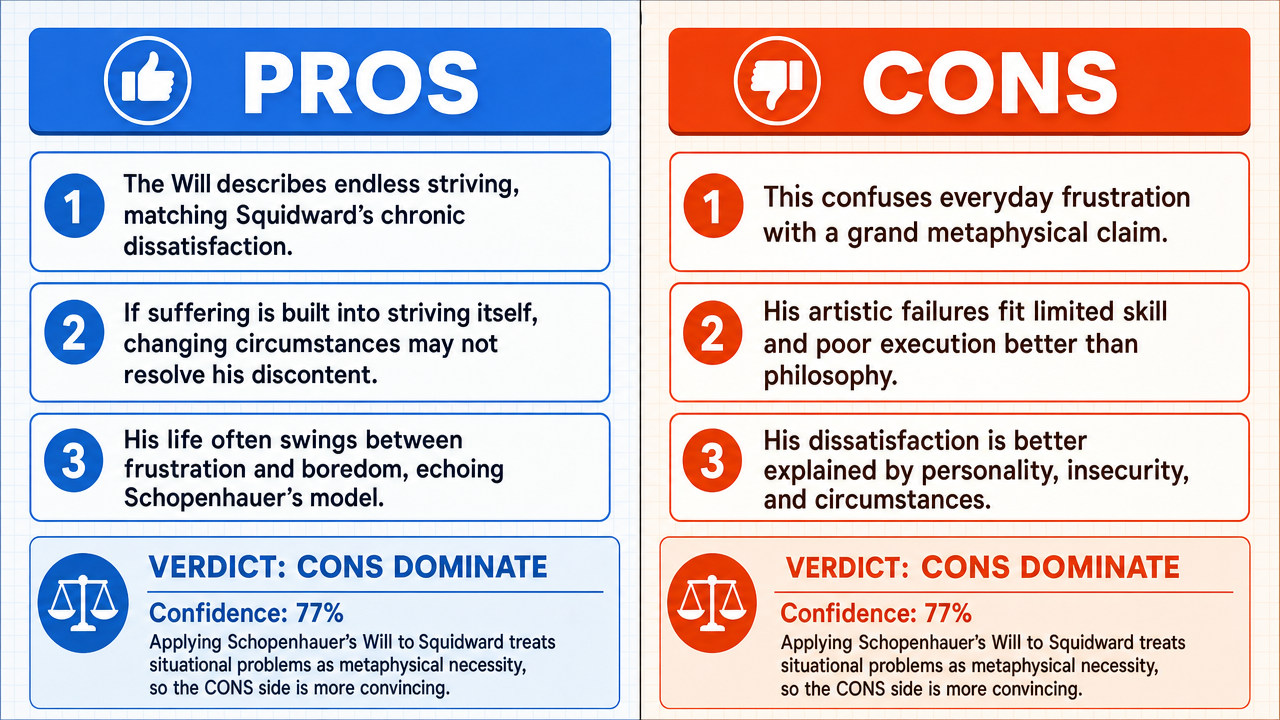
Verdict
Verdict: likely FALSE (77%)
This section provides a brief overview of the key arguments. You do not need to read the full detailed report below.
✅ Key PRO arguments:
- ■Schopenhauer's concept of the Will posits a blind, striving , and insatiable force underlying all existence, and Squidward's chronic dissatisfaction with his job, neighbors, and artistic pursuits is not merely circumstantial but a fundamental state of being that mirrors this metaphysical condition.
- ■Suffering is intrinsic to the individual as a manifestation of the cosmic Will; circumstances are merely the specific forms the Will 's striving takes, so Squidward's dissatisfaction would persist even if his external conditions changed.
- ■Schopenhauer's Will is a theory of endless, frustrated striving in which conscious life swings between pain and boredom , and Squidward's pervasive dissatisfaction accurately fits this explanatory template when projected onto a fictional character.
❌ Key ANTI arguments:
- ■Mapping Squidward's misery onto Schopenhauer's Will commits a fundamental category error by treating circumstantial frustrations as a metaphysical necessity; Schopenhauerian dissatisfaction is ontological , whereas Squidward's unhappiness is contingent on his specific socio-economic environment .
- ■Squidward's artistic pursuits fail due to a lack of technical aptitude rather than a metaphysical failure of aesthetic contemplation , and his engagement is often depicted as genuine, albeit incompetent, self-expression rather than infected striving for personal gratification.
- ■Squidward's dissatisfaction is more accurately explained by a psychological profile characterized by narcissism and low self-efficacy , combined with contingent socio-economic factors like his low-wage service job and annoying neighbors, rather than an inescapable metaphysical Will.
💭 Conclusion: False. The winning side successfully argued that applying Schopenhauer's metaphysical concept of the Will to Squidward Tentacles commits a category error by treating circumstantial frustrations as an ontological necessity. Squidward's dissatisfaction is demonstrably contingent on his specific socio-economic environment , including his low-wage job at the Krusty Krab and his irritating neighbors, rather than reflecting an inescapable metaphysical condition. His artistic failures stem from a lack of technical aptitude and a narcissistic personality profile, not from the blind, insatiable striving that Schopenhauer attributed to the Will. The affirmative's projection of Schopenhauer's metaphysics onto a comedic cartoon character was judged to be an interpretive stretch that overreaches the explanatory scope of the philosophical concept. Therefore, Schopenhauer's Will does not accurately explain Squidward's pervasive dissatisfaction.
🔬 DeepResearch Result: likely FALSE ❌ (77%)
Assertion: Arthur Schopenhauer's concept of 'the Will ' accurately explains Squidward Tentacles' pervasive dissatisfaction with his current reality.
Participating models: deepseek-v3.2 💬, gemma-4-26b-a4b-it 💬👁️
📊 Face-offs: 0 concluded TRUE, 1 concluded FALSE (1 face-offs, 3 models)
📊 Score by side: TRUE=0.00, FALSE=0.77
🏅 Model score changes:
minimax-m3 💬👁️: +8
✅ PRO Arguments:
- ■Schopenhauer's concept of the Will posits a blind, striving , and insatiable force underlying all existence, and Squidward's chronic dissatisfaction with his job, neighbors, and artistic pursuits is not merely circumstantial but a fundamental state of being that mirrors this metaphysical condition. deepseek-v3.2 💬
- ■Suffering is intrinsic to the individual as a manifestation of the cosmic Will; circumstances are merely the specific forms the Will's striving takes, so Squidward's dissatisfaction would persist even if his external conditions changed. deepseek-v3.2 💬
- ■Schopenhauer's Will is a theory of endless, frustrated striving in which conscious life swings between pain and boredom , and Squidward's pervasive dissatisfaction accurately fits this explanatory template when projected onto a fictional character. deepseek-v3.2 💬
❌ ANTI Arguments:
- ■Mapping Squidward's misery onto Schopenhauer's Will commits a fundamental category error by treating circumstantial frustrations as a metaphysical necessity; Schopenhauerian dissatisfaction is ontological , whereas Squidward's unhappiness is contingent on his specific socio-economic environment . gemma-4-26b-a4b-it 💬👁️
- ■Squidward's artistic pursuits fail due to a lack of technical aptitude rather than a metaphysical failure of aesthetic contemplation , and his engagement is often depicted as genuine, albeit incompetent, self-expression rather than infected striving for personal gratification. gemma-4-26b-a4b-it 💬👁️
- ■Squidward's dissatisfaction is more accurately explained by a psychological profile characterized by narcissism and low self-efficacy , combined with contingent socio-economic factors like his low-wage service job and annoying neighbors, rather than an inescapable metaphysical Will. gemma-4-26b-a4b-it 💬👁️
💭 Reasoning: False. The winning side successfully argued that applying Schopenhauer's metaphysical concept of the Will to Squidward Tentacles commits a category error by treating circumstantial frustrations as an ontological necessity. Squidward's dissatisfaction is demonstrably contingent on his specific socio-economic environment, including his low-wage job at the Krusty Krab and his irritating neighbors, rather than reflecting an inescapable metaphysical condition. His artistic failures stem from a lack of technical aptitude and a narcissistic personality profile, not from the blind, insatiable striving that Schopenhauer attributed to the Will. The affirmative's projection of Schopenhauer's metaphysics onto a comedic cartoon character was judged to be an interpretive stretch that overreaches the explanatory scope of the philosophical concept. Therefore, Schopenhauer's Will does not accurately explain Squidward's pervasive dissatisfaction.
📋 PRO Facts:
• Schopenhauer's concept of the Will posits a blind, striving, and insatiable force underlying all existence.
• In Schopenhauer's account, conscious life swings between pain and boredom because desires cannot be finally satisfied.
• Squidward Tentacles is characterized by chronic dissatisfaction with his job, neighbors, and artistic pursuits.
📋 ANTI Facts:
• Squidward's unhappiness is contingent upon his specific socio-economic environment, particularly his repetitive, low-wage service industry labor at the Krusty Krab.
• Squidward's artistic endeavors are often depicted as genuine, albeit incompetent, expressions of his personality rather than failed attempts at disinterested contemplation .
• Squidward's dissatisfaction is more accurately explained by psychological factors such as narcissism and low self-efficacy.
| Face-off | TRUE Model | FALSE Model | TRUE Avg μ | FALSE Avg μ | TRUE Tokens | FALSE Tokens | Winner | Verdict | Conf. |
|---|---|---|---|---|---|---|---|---|---|
| #1 | deepseek-v3.2 💬 | gemma-4-26b-a4b-it 💬👁️ | 0.351 | 0.360 | 12 | 3 | FALSE | FALSE | 77% |
The following technical terms, abbreviations, and domain-specific concepts are referenced throughout this debate transcript. Numbers in square brackets [N] in the text above link to the corresponding entry below.
[1] aesthetic contemplation — In Schopenhauer's framework, the experience of art as a temporary escape from the Will's striving, achieved through disinterested perception of the Ideas objectified in artworks.
[2] aesthetic detachment — A Schopenhauerian state in which the subject contemplates an object without personal desire or ego-driven motivation, briefly suspending the Will's influence.
[3] boredom — In Schopenhauer's metaphysics, one pole of conscious existence (alongside pain) that results when the Will's striving is temporarily satisfied but new objects of desire have not yet arisen.
[4] category error — A philosophical or logical mistake of assigning something to a category it does not belong to; in this debate, the alleged error of treating circumstantial frustrations as a metaphysical necessity.
[5] conjecture — An unproven proposition or supposition offered as evidence; the debate uses the term to characterize claims (e.g., about Squidward's motivations) that lack sufficient support.
[6] disinterested contemplation — A mode of aesthetic engagement in which the perceiver approaches an artwork without personal stake, ego, or desire for gratification, contrasted with 'infected' striving.
[7] hidden premise — An unstated assumption underlying an argument; in this debate, the affirmative is accused of relying on the hidden premise that all suffering is ontological.
[8] low self-efficacy — A psychological concept denoting a diminished belief in one's own capacity to succeed, cited in the debate as a possible explanation for Squidward's failed artistic pursuits.
[9] metaphysical — Pertaining to the fundamental nature of reality and existence; in the debate, contrasted with circumstantial or sociological explanations of suffering.
[10] narcissism — A psychological profile characterized by excessive self-focus and need for admiration, cited in the debate as a possible source of Squidward's dissatisfaction.
[11] objectification — In Schopenhauer's philosophy, the process by which the unitary Will manifests itself as the plurality of individual things, desires, and phenomena in the world.
[12] ontological — Pertaining to the nature of being or existence; in the debate, used to describe suffering that is inherent to existence itself rather than contingent on circumstances.
[13] satirical purpose — A literary function in which a character or situation is used to critique or mock aspects of life; cited as the role Squidward's dissatisfaction plays in the show.
[14] socio-economic environment — The combination of social and economic conditions surrounding an individual (e.g., job, neighbors, social standing), cited as the contingent source of Squidward's unhappiness.
[15] striving — In Schopenhauer's metaphysics, the endless, insatiable wanting that characterizes the Will and that manifests in individuals as unceasing desire.
[16] suffering — In Schopenhauer's framework, the inevitable consequence of the Will's endless striving, since satisfaction is fleeting and desire perpetually reasserts itself.
[17] the Will — Schopenhauer's concept of a blind, striving, and insatiable force underlying all existence, which objectifies itself in individuals and makes perpetual dissatisfaction inescapable.
[18] will-less — A Schopenhauerian state of being free from the Will's striving, attainable momentarily through aesthetic contemplation; the debate disputes whether Squidward ever achieves it.
Face-off transcripts
- ■
Ownership & Trade Secrets. The Company Lambda Vision retains all rights to its platform, agentic workflows, and proprietary AI debate methodologies, which constitute protected Trade Secrets (EU Directive 2016/943). Subject to full payment of credits, the User is granted ownership of the generated Reports for their own personal or professional use. Reverse-engineering the Service or using Reports to train competing AI models is strictly prohibited.
- ■
No Professional Advice. Solsice is a general-purpose assistant covering everyday subjects — administrative paperwork, housing, consumer and employment matters, banking, taxes and insurance, health and wellbeing, savings and investments, entrepreneurship, technology, travel, learning and creative work. Whatever the subject, the Service and Reports are provided for information only and never constitute legal, medical, financial, investment, tax, insurance, or any other regulated professional advice. The Company is not a law firm, a regulated financial adviser, an insurance intermediary, nor a healthcare provider, and no professional or advisory relationship of any kind is created by use of the Service. Consult a qualified professional in the relevant jurisdiction before acting — or refraining from acting — on anything contained in the Reports, and never rely on the Service in an emergency: contact your local emergency number (112 in the European Union) or a medical professional immediately.
- ■
AI-Generated Content, Sources and Viewpoints. Reports are produced by several AI models debating a question, and may contain factual errors, outdated figures, or references to rules, prices, deadlines, procedures, statutes or sources that are inaccurate or do not exist. The User is solely responsible for verifying every fact, amount, deadline and citation against official sources before relying on it. Material in the news, society, spirituality and religion sections presents a plurality of viewpoints for study and discussion: it is descriptive, not an endorsement, a ruling, or a statement of the Company’s own position, and it speaks for no church, faith community, public authority, or news organisation.
- ■
Liability & Governing Law. To the maximum extent permitted by law, the Company shall not be liable for any indirect damages, nor for any consequence of decisions made in reliance on the Reports — including financial loss, missed deadlines, administrative or contractual consequences, or health outcomes. These Terms are governed by French law. Any disputes shall be subject to the exclusive jurisdiction of the Courts of Paris, France.