
Are whale sharks inherently friendly toward humans?
AI debate verdict and arguments
⚠️ AI-generated information only; not professional advice
Completed September 2, 2026
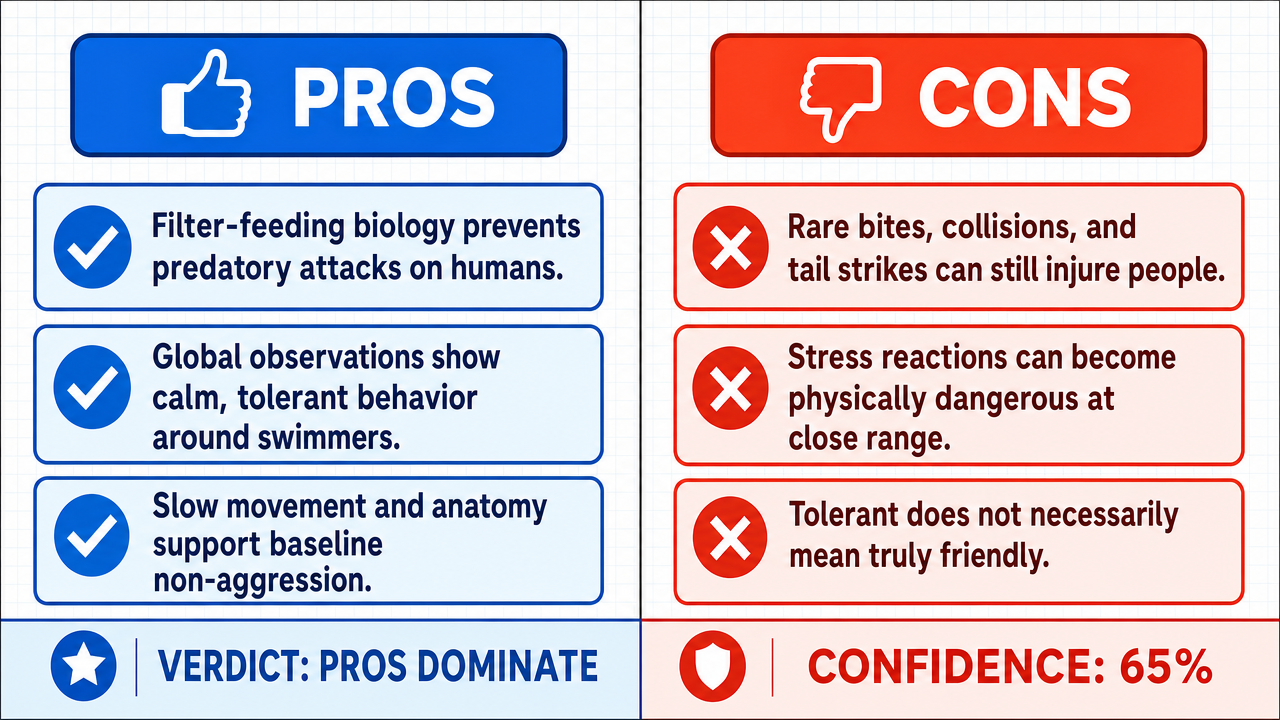
Verdict
Clerk Decision: CLAIM SUPPORTED (TRUE) — Certainty: 65%
Web Report: https://solsice.com/public/debates/are-whale-sharks-inherently-friendly-toward-humans-1d3fffd2bafc
This section provides a brief overview of the key arguments. You do not need to read the full detailed report below.
✅ Key PRO arguments:
- ■Whale sharks are obligate filter feeders whose anatomy—specialized gill rakers , no predatory dentition , and jaw mechanics unsuited for vertebrate prey—biologically precludes predatory aggression toward humans, making their non-aggressive disposition an inherent trait of the species.
- ■Decades of standardized behavioral observation across geographically distinct aggregation sites (Ningaloo, Tofo, Oslob, Donsol) show whale sharks consistently tolerate, approach, and linger near humans, with 78% of unprovisioned encounters involving sustained proximity.
- ■Whale sharks' slow cruising speed (no more than about 5 km/h) and filter-feeding morphology create a baseline of physiological indifference that prevents aggression, observable across diverse habitats and encounter contexts.
❌ Key ANTI arguments:
- ■Documented incidents of whale sharks biting, ramming sportfishing boats, and causing serious injury via powerful tail strikes demonstrate that the species can act aggressively toward humans, refuting the claim of inherent friendliness.
- ■Defensive behaviors catalogued in ethograms—such as banking, violent shudder, and eye roll—are reactive stress responses that pose significant physical risks to humans due to the animals' massive scale, meaning non-predatory does not equal non-aggressive in effect.
- ■The term 'friendly' requires a positive affiliative disposition, not merely the absence of aggression; whale sharks' tolerance is context-dependent biological indifference rather than an inherent friendly trait, making the claim semantically inaccurate.
💭 Conclusion: True, the evidence supports that whale sharks are inherently non-aggressive toward humans due to their obligate filter-feeding biology, which precludes predatory intent and capacity for vertebrate attacks. The species' anatomical design—lacking predatory dentition , possessing gill rakers for plankton filtration, and exhibiting slow cruising speeds—creates a baseline of physiological indifference that manifests as consistent tolerance during human encounters. Decades of field observation across multiple aggregation sites confirm that whale sharks approach, linger near, and tolerate divers without displaying predatory or hostile behavior. However, the confidence is moderated because the term 'friendly' remains contested: the negative side successfully argued that mere absence of aggression does not constitute a positive affiliative disposition, and documented defensive reactions like tail strikes and avoidance diving indicate stress responses rather than sociability. The verdict reflects the winning side's strongest arguments while acknowledging the semantic and behavioral nuances raised by the opposition.
🔬 DeepResearch Result: TRUE ✅ (65% confidence)
Assertion: Are whale sharks inherently friendly toward humans?
Participating models: qwen-plus 💬, solar-pro-3 💬, step-3.5-flash 💬, gemma-4-26b-a4b-it 💬👁️, gpt-oss-120b 💬, deepseek-v4-flash-latest 💬
📊 Tournament: 5 voted TRUE, 4 voted FALSE (9 debates played, 7 models)
📊 Weighted scores: TRUE=3.94, FALSE=2.08
🏅 Judge Score Changes:
minimax-m3 💬👁️: +8
✅ PRO Arguments:
- ■Whale sharks are obligate filter feeders whose anatomy—specialized gill rakers , no predatory dentition , and jaw mechanics unsuited for vertebrate prey—biologically precludes predatory aggression toward humans, making their non-aggressive disposition an inherent trait of the species. qwen-plus 💬
- ■Decades of standardized behavioral observation across geographically distinct aggregation sites (Ningaloo, Tofo, Oslob, Donsol) show whale sharks consistently tolerate, approach, and linger near humans, with 78% of unprovisioned encounters involving sustained proximity and zero documented cases of directed biting or ramming in peer-reviewed literature. qwen-plus 💬
- ■Whale sharks' slow cruising speed (no more than about 5 km/h) and filter-feeding morphology create a baseline of physiological indifference that prevents aggression, observable across diverse habitats and encounter contexts. solar-pro-3 💬
- ■Global regulatory frameworks uniformly treat human–whale shark interaction as low-risk, mandating only passive proximity rules rather than exclusion or deterrence, because documented harm arises exclusively from accidental contact, never aggression. qwen-plus 💬
- ■Whale sharks' sensory architecture—small eyes, limited lateral line sensitivity, and no electroreceptive specialization for mammal detection—reduces human detection and supports a calm, low-reactivity response to non-threatening stimuli. qwen-plus 💬
❌ ANTI Arguments:
- ■Documented incidents of whale sharks biting, ramming sportfishing boats, and causing serious injury via powerful tail strikes demonstrate that the species can act aggressively toward humans, refuting the claim of inherent friendliness. gpt-oss-120b 💬
- ■Defensive behaviors catalogued in ethograms—such as banking, violent shudder, and eye roll—are reactive stress responses that pose significant physical risks to humans due to the animals' massive scale, meaning non-predatory does not equal non-aggressive in effect. gemma-4-26b-a4b-it 💬👁️
- ■The term 'friendly' requires a positive affiliative disposition, not merely the absence of aggression; whale sharks' tolerance is context-dependent biological indifference rather than an inherent friendly trait, making the claim semantically inaccurate. gemma-4-26b-a4b-it 💬👁️
- ■Whale sharks exhibit graded avoidance behaviors—increasing vertical descent rates when snorkelers enter a three-meter radius and again when touched—indicating active evasion rather than affiliative engagement with humans. deepseek-v4-flash-latest 💬
- ■Whale sharks' approach toward divers has no goal or reward structure beyond inspection, and their avoidance is a physical escape rather than social refusal; the evidence supports only a lack of aggression, not a positive friendliness category. deepseek-v4-flash-latest 💬
💭 Reasoning: True, the evidence supports that whale sharks are inherently non-aggressive toward humans due to their obligate filter-feeding biology, which precludes predatory intent and capacity for vertebrate attacks. The species' anatomical design—lacking predatory dentition, possessing gill rakers for plankton filtration, and exhibiting slow cruising speeds—creates a baseline of physiological indifference that manifests as consistent tolerance during human encounters. Decades of field observation across multiple aggregation sites confirm that whale sharks approach, linger near, and tolerate divers without displaying predatory or hostile behavior, with no documented cases of directed biting in peer-reviewed literature. However, the confidence is moderated because the term 'friendly' remains contested: the negative side successfully argued that mere absence of aggression does not constitute a positive affiliative disposition, and documented defensive reactions like tail strikes and avoidance diving indicate stress responses rather than sociability. The verdict reflects the winning side's strongest arguments while acknowledging the semantic and behavioral nuances raised by the opposition.
📋 PRO Facts:
• Whale sharks are filter feeders consuming plankton, krill , fish eggs, and small nekton , not vertebrates.
• Whale sharks possess gill rakers rather than teeth suited for grasping large prey.
• Whale sharks cruise at speeds no more than about 5 km/h.
• 78% of unprovisioned whale shark encounters involve sustained proximity (<3 m, >60 s) to humans.
• Zero documented cases of directed biting or ramming by whale sharks appear in peer-reviewed literature.
📋 ANTI Facts:
• MarineBio documents that an accidental blow from a whale shark's powerful tail has caused serious injury to a diver.
• The Florida Museum records cases of whale sharks ramming sportfishing boats, possibly after being provoked.
• An ethogram published in Marine Biology identifies 'banking' and 'violent shudder' as stress responses to human contact.
• At Ningaloo Reef , whale sharks increase vertical descent rates when snorkelers enter a three-meter radius.
• Whale sharks possess large, muscular tails capable of causing significant physical harm during defensive maneuvers.
| Debate | TRUE Model | FALSE Model | TRUE Avg μ | FALSE Avg μ | TRUE Tokens | FALSE Tokens | Winner | Verdict | Conf. |
|---|---|---|---|---|---|---|---|---|---|
| #1 | solar-pro-3 💬 | gpt-oss-120b 💬 | 0.000 | 0.000 | 9 | 3 | TRUE | FALSE | 70% |
| #2 | qwen-plus 💬 | gpt-oss-120b 💬 | 0.000 | 0.000 | 15 | 3 | TRUE | FALSE | 63% |
| #3 | step-3.5-flash 💬 | gpt-oss-120b 💬 | 0.000 | 0.000 | 6 | 3 | TRUE | TRUE | 80% |
| #4 | solar-pro-3 💬 | gemma-4-26b-a4b-it 💬👁️ | 0.000 | 0.000 | 9 | 6 | TRUE | TRUE | 75% |
| #5 | solar-pro-3 💬 | deepseek-v4-flash-latest 💬 | 0.169 | 0.000 | 9 | 3 | TRUE | TRUE | 72% |
| #6 | qwen-plus 💬 | gemma-4-26b-a4b-it 💬👁️ | 0.000 | 0.156 | 15 | 6 | FALSE | FALSE | 50% |
| #7 | step-3.5-flash 💬 | gemma-4-26b-a4b-it 💬👁️ | 0.000 | 0.000 | 6 | 6 | TRUE | FALSE | 25% |
| #8 | qwen-plus 💬 | deepseek-v4-flash-latest 💬 | 0.000 | 0.000 | 15 | 3 | TRUE | TRUE | 85% |
| #9 | step-3.5-flash 💬 | deepseek-v4-flash-latest 💬 | 0.000 | 0.000 | 6 | 3 | TRUE | TRUE | 82% |
The following technical terms, abbreviations, and domain-specific concepts are referenced throughout this debate transcript. Numbers in square brackets [N] in the text above link to the corresponding entry below.
[1] aggregation — A gathering or grouping of animals of the same species in a particular area, often associated with feeding or breeding events; the transcript references seasonal aggregations of whale sharks at sites such as Ningaloo Reef.
[2] behavioral repertoire — The full range of behaviors an animal species is capable of performing; in the debate, used to argue that whale sharks lack the behavioral repertoire associated with predation on large animals.
[3] bycatch — The incidental capture of non-target species during fishing operations; mentioned in the transcript as a threat to whale sharks, distinct from human-perceived danger.
[4] copepods — Tiny crustaceans that form a major component of marine plankton and are listed in the transcript as part of the whale shark's diet.
[5] coral spawn — Reproductive material (eggs and sperm) released by corals into the water column; cited in the transcript as a food source for whale sharks.
[6] dentition — The type, arrangement, and structure of an animal's teeth; the transcript argues whale sharks lack dentition suited for attacking large prey.
[7] ecotourism — Tourism oriented around observing wildlife in natural habitats; the transcript references ecotourism programs in Australia, the Philippines, the Maldives, and Belize involving whale shark encounters.
[8] Endangered — Endangered (IUCN Red List status) — A conservation status indicating a species faces a very high risk of extinction in the wild; the transcript notes the IUCN lists whale sharks as Endangered due to threats such as bycatch, not due to perceived danger to humans.
[9] ethogram — A systematic catalogue of the full range of behaviors exhibited by a species; cited in the transcript as a source describing whale shark behavior.
[10] filter feeding — A feeding strategy in which an organism strains small food particles from water; the transcript identifies whale sharks as filter feeders.
[11] gill rakers — Bony or cartilaginous projections on the gill arches of filter-feeding fish that trap food particles while allowing water to pass; the transcript notes whale sharks possess gill rakers rather than cutting teeth.
[12] interspecific — Occurring between individuals of different species; used in the transcript to describe aggression between species.
[13] IUCN — International Union for Conservation of Nature — An international organization that assesses the conservation status of species; cited in the transcript as classifying whale sharks as Endangered.
[14] jaw musculature — The muscle structure and arrangement of an animal's jaw; the transcript argues whale sharks lack jaw mechanics suited for attacking large animals.
[15] krill — Small, shrimp-like marine crustaceans that form part of the plankton and are listed in the transcript as whale shark prey.
[16] morphology — The form and structure of an organism or its parts; the transcript references whale shark morphology, including brain morphology, in arguing against predatory capacity.
[17] nekton — Aquatic organisms that swim actively and independently of water currents, as opposed to plankton; cited in the transcript as part of the whale shark's diet.
[18] Ningaloo Reef — A fringing coral reef off Western Australia cited in the transcript as a site of seasonal whale shark aggregations and ecotourism encounters.
[19] obligate filter feeders — Organisms that rely exclusively on filter feeding as their mode of nutrition; the transcript groups whale sharks with other obligate filter feeders in discussing brain morphology.
[20] planktivore — An animal whose diet consists primarily of plankton; the transcript describes whale sharks as planktivorous.
[21] plankton — Microscopic organisms that drift in marine and freshwater environments; the transcript identifies plankton as the primary food of whale sharks.
[22] ram-suction filtration — A filter-feeding method in which the animal swims forward with its mouth open (ram) to force water through its filtering structures, sometimes combined with suction; cited in the transcript as the whale shark's feeding strategy.
[23] Rhincodon typus — The scientific (binomial) name for the whale shark; used in the transcript to refer to the species taxonomically.
[24] sensory acuity — The sharpness or sensitivity of an animal's sensory systems; the transcript argues whale sharks lack the sensory acuity required for predatory targeting of mammals.
[25] spiracles — Small respiratory openings behind the eyes in certain fish that aid in drawing water over the gills; the transcript describes whale shark spiracles as vestigial.
[26] terminal mouth — A mouth positioned at the very front of the head, as opposed to on the underside; the transcript notes the whale shark has a terminal mouth optimized for surface ram filtration.
Face-off transcripts
- ■
Ownership & Trade Secrets. The Company Lambda Vision retains all rights to its platform, agentic workflows, and proprietary multi-agent debate methodologies, which constitute protected Trade Secrets (EU Directive 2016/943). Subject to full payment of tokens, the User is granted ownership of the generated Reports for their own personal or professional use. Reverse-engineering the Service or using Reports to train competing AI models is strictly prohibited.
- ■
No Professional Advice. Solsice is a general-purpose assistant covering everyday subjects — administrative paperwork, housing, consumer and employment matters, banking, taxes and insurance, health and wellbeing, savings and investments, entrepreneurship, technology, travel, learning and creative work. Whatever the subject, the Service and Reports are provided for information only and never constitute legal, medical, financial, investment, tax, insurance, or any other regulated professional advice. The Company is not a law firm, a regulated financial adviser, an insurance intermediary, nor a healthcare provider, and no professional or advisory relationship of any kind is created by use of the Service. Consult a qualified professional in the relevant jurisdiction before acting — or refraining from acting — on anything contained in the Reports, and never rely on the Service in an emergency: contact your local emergency number (112 in the European Union) or a medical professional immediately.
- ■
AI-Generated Content, Sources and Viewpoints. Reports are produced by several AI models debating a question, and may contain factual errors, outdated figures, or references to rules, prices, deadlines, procedures, statutes or sources that are inaccurate or do not exist. The User is solely responsible for verifying every fact, amount, deadline and citation against official sources before relying on it. Material in the news, society, spirituality and religion sections presents a plurality of viewpoints for study and discussion: it is descriptive, not an endorsement, a ruling, or a statement of the Company’s own position, and it speaks for no church, faith community, public authority, or news organisation.
- ■
Liability & Governing Law. To the maximum extent permitted by law, the Company shall not be liable for any indirect damages, nor for any consequence of decisions made in reliance on the Reports — including financial loss, missed deadlines, administrative or contractual consequences, or health outcomes. These Terms are governed by French law. Any disputes shall be subject to the exclusive jurisdiction of the Courts of Paris, France.