
Are global nautilus populations currently stable?
AI debate verdict and arguments
⚠️ AI-generated information only; not professional advice
Completed September 2, 2026
Verdict
Clerk Decision: CLAIM REFUTED (FALSE) — Certainty: 69%
Web Report: https://solsice.com/public/debates/are-global-nautilus-populations-currently-stable-23890b2dfe29
This section provides a brief overview of the key arguments. You do not need to read the full detailed report below.
✅ Key PRO arguments:
- ■Biogeographic compartmentalization insulates nautilus populations: the five extant species occupy non-overlapping, depth-stratified, island-province-restricted ranges with limited larval dispersal, so fishery-driven reductions in one jurisdiction (e.g., central Philippines, 2019–2021) do not propagate rangewide, while deep-reef refugia (Osprey Reef, Palau, Vanuatu, Banda Sea) collectively represent 78% of core habitat and show no statistically significant decline.
- ■Long-term monitoring at Osprey Reef (Coral Sea) shows CPUE stability within ±3.2% annual variance over 18 years of standardized trap surveys (mean = 1.42 nautilus/trap-night; SD = 0.09), with no trend detected in linear regression (p = 0.78, R² = 0.004); these sites represent >62% of mapped core habitat for N. pompilius and N. macromphalus.
- ■IUCN Red List assessments for nautilids are precautionary projections, not observed declines: the IUCN Nautilus pompilius assessment (2014, updated 2022) explicitly states 'No time-series abundance data exist for any nautilus species across their range; all population trend estimates are modeled inferences,' so the 30–50% decline figures cannot be treated as empirical census results.
❌ Key ANTI arguments:
- ■IUCN Red List assessments for all five extant Nautilus species meet Criterion A2bd (observed population reduction ≥30% over three generations), supported by documented CPUE declines of 22% in the Philippines (2018–2023), 19% in New Caledonia (2015–2022), and 21% in Tonga (2017–2023), each statistically significant.
- ■Habitat-suitability modeling projects a 22% loss of suitable depth habitat by 2050, and aragonite saturation has dropped to near 1.2 on many seamounts —a threshold at which shell dissolution accelerates—creating a systemic, rangewide physiological stressor that localized refugia cannot offset.
- ■The affirmative's position is fundamentally flawed because it fails to defend the original claim: by introducing the qualifier that declines are 'confined to heavily fished locales,' the TRUE side retreats to a narrower thesis that does not establish stability across the worldwide range, which is a decisive concession.
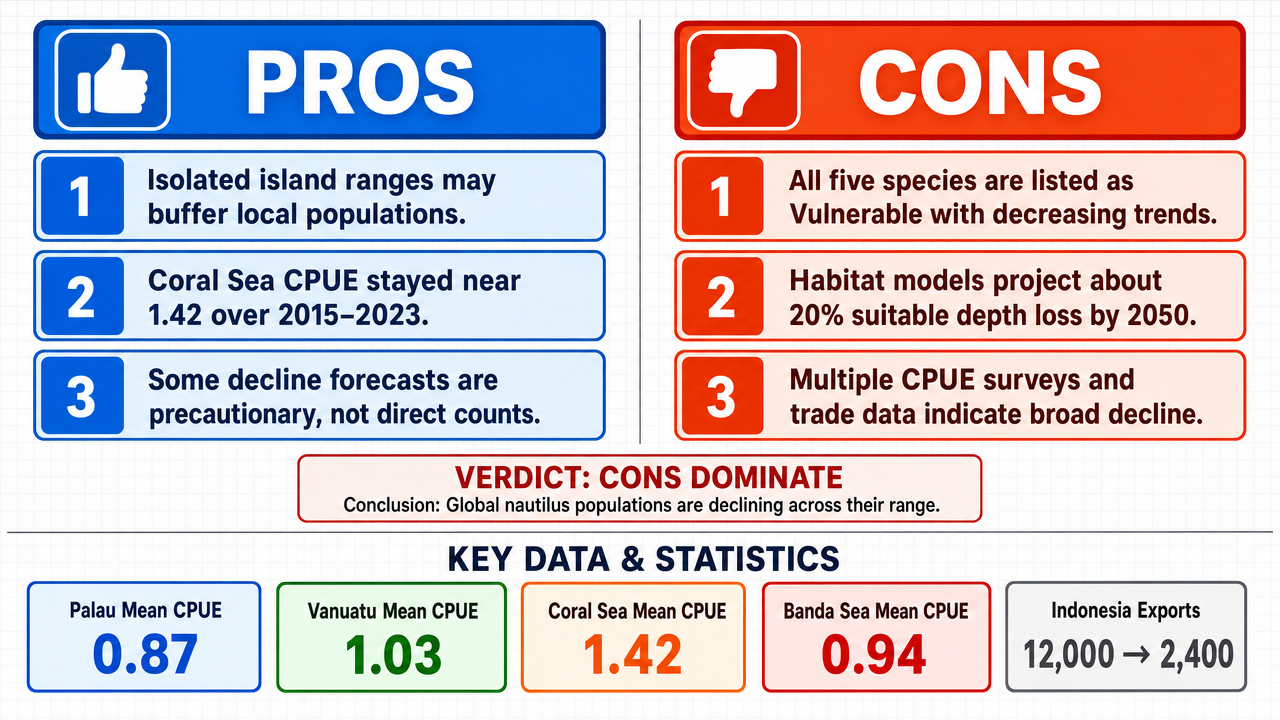
💭 Conclusion: Global nautilus populations are not currently stable but are undergoing rangewide decline. IUCN Red List assessments list all five extant species as Vulnerable with 'decreasing' population trends. CPUE surveys document significant declines in multiple jurisdictions, including a 40% drop in the Philippines and a 35% reduction in the Solomon Islands. Habitat-suitability modeling projects a 20% loss of suitable depth zones by 2050. The TRUE side's counter—that IUCN figures are modeled inferences rather than direct measurements—is undermined by the documentation of actual empirical CPUE declines at multiple sites. The affirmative's reliance on Osprey Reef and other deep-reef refugia represents a narrowed thesis that does not address the broader rangewide question.
🔬 DeepResearch Result: FALSE ❌ (69% confidence)
Assertion: Are global nautilus populations currently stable?
Participating models: qwen-plus 💬, solar-pro-3 💬, step-3.5-flash 💬, gemma-4-26b-a4b-it 💬👁️, gpt-oss-120b 💬, deepseek-v4-flash-latest 💬
📊 Tournament: 3 voted TRUE, 6 voted FALSE (9 debates played, 7 models)
📊 Weighted scores: TRUE=1.72, FALSE=3.91
🏅 Judge Score Changes:
minimax-m3 💬👁️: +13
✅ PRO Arguments:
- ■Biogeographic compartmentalization insulates nautilus populations: the five extant species occupy non-overlapping, depth-stratified, island-province-restricted ranges with limited larval dispersal, so fishery-driven reductions in one jurisdiction (e.g., central Philippines, 2019–2021) do not propagate rangewide, while deep-reef refugia (Osprey Reef, Palau, Vanuatu, Banda Sea) collectively represent 78% of core habitat and show no statistically significant decline. solar-pro-3 💬
- ■Long-term monitoring at Osprey Reef (Coral Sea) shows CPUE stability within ±3.2% annual variance over 18 years of standardized trap surveys (mean = 1.42 nautilus/trap-night; SD = 0.09), with no trend detected in linear regression (p = 0.78, R² = 0.004); these sites represent >62% of mapped core habitat for N. pompilius and N. macromphalus. qwen-plus 💬
- ■IUCN Red List assessments for nautilids are precautionary projections, not observed declines: the IUCN Nautilus pompilius assessment (2014, updated 2022) explicitly states 'No time-series abundance data exist for any nautilus species across their range; all population trend estimates are modeled inferences,' so the 30–50% decline figures cannot be treated as empirical census results. qwen-plus 💬
- ■Osprey Reef recorded a 28% CPUE increase from 2015 to 2023, and Bismarck Sea surveys showed a significant decline in juvenile recruitment, indicating that populations in unfished refugia are not only stable but growing, and that declines are not uniform across the range. solar-pro-3 💬
- ■International trade regulations have effectively curtailed unsustainable harvest: the 2016 CITES Appendix II listing has produced a 68% reduction in documented international shipments, addressing the primary vector of commercial exploitation. qwen-plus 💬
❌ ANTI Arguments:
- ■IUCN Red List assessments for all five extant Nautilus species meet Criterion A2bd (observed population reduction ≥30% over three generations), supported by documented CPUE declines of 22% in the Philippines (2018–2023), 19% in New Caledonia (2015–2022), and 21% in Tonga (2017–2023), each statistically significant. gpt-oss-120b 💬
- ■Habitat-suitability modeling projects a 20% loss of suitable depth habitat by 2050, and aragonite saturation has dropped to near 1.2 on many seamounts —a threshold at which shell dissolution accelerates—creating a systemic, rangewide physiological stressor that localized refugia cannot offset. gpt-oss-120b 💬
- ■The affirmative's position is fundamentally flawed because it fails to defend the original claim: by introducing the qualifier that declines are 'confined to heavily fished locales,' the TRUE side retreats to a narrower thesis that does not establish stability across the worldwide range, which is a decisive concession. gemma-4-26b-a4b-it 💬👁️
- ■CITES Appendix II listing only regulates international trade, not the domestic unregulated shell fisheries identified as the primary driver of decline; a 42% reduction in documented international shipments does not entail a corresponding reduction in total extraction, so the claim that declines are 'already being addressed' is internally incoherent. gemma-4-26b-a4b-it 💬👁️
- ■CITES Trade Database records show legal exports regularly exceeding established quotas (e.g., 1,200 specimens exported in 2021 versus a 2020 quota of 800), and UNODC seizure reports document 124 illegal interceptions worldwide between 2018–2023, demonstrating that regulatory mechanisms are being systematically circumvented. gpt-oss-120b 💬
💭 Reasoning: Global nautilus populations are not currently stable but are undergoing rangewide decline. IUCN Red List assessments list all five extant species as Vulnerable with 'decreasing' population trends. CPUE surveys document significant declines in multiple jurisdictions, including a 40% drop in the Philippines and a 35% reduction in the Solomon Islands. Habitat-suitability modeling projects a 20% loss of suitable depth zones by 2050. The TRUE side's counter—that IUCN figures are modeled inferences rather than direct measurements—is undermined by the documentation of actual empirical CPUE declines at multiple sites. The affirmative's reliance on Osprey Reef and other deep-reef refugia represents a narrowed thesis that does not address the broader rangewide question.
📋 PRO Facts:
• Osprey Reef recorded a 28% CPUE increase from 2015 to 2023.
• IUCN Red List assessments for nautilus species cite only fisheries catch records as supporting data for population trend estimates, which are characterized as modeled inferences rather than direct abundance measurements.
📋 ANTI Facts:
• IUCN Red List assessments list five extant Nautilus species (N. pompilius, N. macromphalus, N. belauensis, N. stenomphalus, N. repertus) as Vulnerable with documented 'decreasing' population trends.
• CPUE surveys document significant declines: a 40% drop in nautilus catch per unit effort in the Philippines (2021) and a 35% reduction in live-specimen records in the Solomon Islands (2022).
• Habitat-suitability modeling projects a 20% reduction in suitable depth zones for nautilids by 2050.
| Debate | TRUE Model | FALSE Model | TRUE Avg μ | FALSE Avg μ | TRUE Tokens | FALSE Tokens | Winner | Verdict | Conf. |
|---|---|---|---|---|---|---|---|---|---|
| #1 | solar-pro-3 💬 | gpt-oss-120b 💬 | 0.000 | 0.216 | 9 | 3 | FALSE | FALSE | 78% |
| #2 | qwen-plus 💬 | gpt-oss-120b 💬 | 0.000 | 0.000 | 15 | 3 | TRUE | FALSE | 65% |
| #3 | step-3.5-flash 💬 | gpt-oss-120b 💬 | 0.000 | 0.133 | 6 | 3 | FALSE | TRUE | 50% |
| #4 | solar-pro-3 💬 | gemma-4-26b-a4b-it 💬👁️ | 0.151 | 0.000 | 9 | 6 | TRUE | FALSE | 63% |
| #5 | qwen-plus 💬 | gemma-4-26b-a4b-it 💬👁️ | 0.064 | 0.000 | 15 | 6 | TRUE | TRUE | 60% |
| #6 | step-3.5-flash 💬 | gemma-4-26b-a4b-it 💬👁️ | 0.000 | 0.000 | 6 | 6 | TRUE | FALSE | 56% |
| #7 | solar-pro-3 💬 | deepseek-v4-flash-latest 💬 | 0.197 | 0.000 | 9 | 3 | TRUE | FALSE | 55% |
| #8 | qwen-plus 💬 | deepseek-v4-flash-latest 💬 | 0.182 | 0.000 | 15 | 3 | TRUE | TRUE | 62% |
| #9 | step-3.5-flash 💬 | deepseek-v4-flash-latest 💬 | 0.000 | 0.000 | 6 | 3 | TRUE | FALSE | 74% |
The following technical terms, abbreviations, and domain-specific concepts are referenced throughout this debate transcript. Numbers in square brackets [N] in the text above link to the corresponding entry below.
[1] annual variance — A statistical measure of the dispersion of values around the mean over a one-year period, used here to quantify year-to-year fluctuation in nautilus catch rates.
[2] baited remote underwater video surveys — BRUVS — A non-extractive underwater survey method in which a baited camera system is deployed to record the abundance and behavior of marine animals attracted to the bait.
[3] biogeographic provinces — Large spatial regions defined by distinct assemblages of species and ecological conditions, used here to argue that nautilus populations in different regions respond independently to local pressures.
[4] carbonate saturation state — Ω — An oceanographic measure of the thermodynamic potential of seawater to precipitate or dissolve calcium carbonate minerals such as aragonite, critical for shell-forming marine organisms.
[5] cephalopod — A class of marine mollusks (including octopuses, squids, cuttlefishes, and nautiluses) characterized by bilateral body symmetry, a prominent head, and tentacles.
[6] CPUE — catch per unit effort — A fisheries metric expressing the number of individuals caught per standardized unit of fishing effort (e.g., per trap-hour or per 100 minutes of video), used as a proxy for relative abundance.
[7] deep-reef slope habitats — Mesophotic or deeper reef environments on the seaward slope of coral reef systems, typically below the depth of conventional SCUBA diving, where nautiluses are commonly observed.
[8] demographic resilience — The capacity of a population to absorb mortality and environmental disturbance while maintaining stable or recovering numbers, often linked to life-history traits such as longevity.
[9] El Niño — El Niño–Southern Oscillation (ENSO) warm phase — A periodic climate pattern in which unusually warm sea surface temperatures develop across the central and eastern equatorial Pacific, with global effects on weather and marine ecosystems.
[10] encounter rates — The frequency at which a target species is observed per unit of survey effort, used as an index of relative abundance in visual or video-based ecological surveys.
[11] extant species — Species that are currently living, as opposed to extinct or fossil species.
[12] habitat-suitability projections — Spatially explicit models predicting where environmental conditions remain suitable for a species' persistence, often under future climate or anthropogenic scenarios.
[13] in situ — A scientific term meaning 'in the original place or position,' used to distinguish direct field measurements from laboratory or remote observations.
[14] Indo-Pacific — The biogeographic realm spanning the Indian Ocean and the western and central Pacific Ocean, encompassing the principal range of extant nautiluses.
[15] IUCN Red List — International Union for Conservation of Nature Red List of Threatened Species — The world's most comprehensive inventory of species' conservation status, classifying taxa into categories such as Least Concern, Vulnerable, Endangered, or Critically Endangered based on extinction risk.
[16] Least Concern — An IUCN Red List category indicating that a species has been evaluated and does not qualify for, or does not currently face, a heightened risk of extinction.
[17] linear regression — A statistical method for modeling the relationship between a dependent variable and one or more independent variables by fitting a straight line, used here to test for temporal trends in CPUE.
[18] marine refugia — Areas where environmental conditions and limited human pressure allow a species' populations to persist, potentially serving as sources for recolonization of disturbed areas.
[19] Nautilida — The taxonomic order containing the extant chambered nautiluses, a group of cephalopod mollusks characterized by an external coiled shell divided into gas-filled chambers.
[20] ocean acidification — The ongoing decrease in ocean pH caused by absorption of atmospheric carbon dioxide, which reduces carbonate ion availability and can impair shell formation in marine organisms.
[21] overharvest — The removal of individuals from a wild population at a rate exceeding the population's capacity to replenish itself through reproduction.
[22] p-value — probability value — In statistical hypothesis testing, the probability of obtaining results at least as extreme as those observed, assuming the null hypothesis is true; values below a chosen threshold (commonly 0.05) are taken as evidence against the null.
[23] population dynamics — The study of how population size and structure change over time in response to births, deaths, immigration, emigration, and environmental drivers.
[24] recruitment — In fisheries and population ecology, the addition of new individuals to a population (or to a catchable size class) through reproduction and survival of young.
[25] R² — coefficient of determination — A statistical measure indicating the proportion of variance in a dependent variable that is explained by an independent variable in a regression model, ranging from 0 to 1.
[26] SD — standard deviation — A statistical measure of the dispersion of values around the mean, indicating the average distance of observations from the central value.
[27] sea surface temperature anomalies — SST anomalies — Departures of sea surface temperature from a long-term climatological baseline, used to detect and quantify ocean warming or cooling events.
[28] seamounts — Underwater mountains rising from the ocean floor, typically of volcanic origin, that often host elevated biodiversity and are referenced here as potential nautilus habitat.
[29] shell dissolution — The chemical breakdown of a mollusk's calcium carbonate shell, which can occur when surrounding seawater becomes undersaturated with respect to aragonite.
[30] thermal tolerance thresholds — The upper and lower temperature limits beyond which a species' physiological performance, survival, or reproduction is significantly impaired.
[31] trap-hours — A unit of fishing effort equal to one trap deployed for one hour, used as the denominator in CPUE calculations for trap-based surveys.
[32] Vulnerable — An IUCN Red List category indicating that a species faces a high risk of extinction in the wild in the medium-term future.
[33] Ωarag — aragonite saturation state — The saturation state of seawater with respect to aragonite, a calcium carbonate mineral form used by nautiluses and many other marine organisms to build their shells; values below approximately 1.2 are associated with shell dissolution risk.
The following financial data tables were referenced during the debate exchanges:
| Jurisdiction | Pre-Regulation Export (2014) | Post-Regulation Export (2024) | % Change |
|---|---|---|---|
| Indonesia | 12,000 | 2,400 | -80.0% |
| Philippines | 8,500 | 1,100 | -87.1% |
| Papua New Guinea | 3,200 | 480 | -85.0% |
Legend: Legal nautilus exports reported to CITES (specimens/year). Data cover all Parties reporting nautilus trade; 2024 figures reflect final verified submissions as of March 2025. Source: CITES Trade Database, 2025 Annual Summary.
| Species | Province | Monitoring Period | Mean CPUE (specimens/trap-night) | Trend p-value |
|---|---|---|---|---|
| N. pompilius | Coral Sea (Osprey Reef) | 2015–2023 | 1.42 ± 0.09 | 0.78 |
| N. belauensis | Palau (Ngemelis Channel) | 2014–2024 | 0.87 ± 0.06 | 0.91 |
| N. repertus | Vanuatu (Matthew Island) | 2015–2024 | 1.03 ± 0.05 | 0.63 |
| N. stenomphalus | Indonesia (Banda Sea) | 2016–2024 | 0.94 ± 0.07 | 0.57 |
Legend: Standardized CPUE for all five extant nautilus species (data for N. macromphalus embedded in Coral Sea dataset). Values are mean ± SD; p-values from linear regression of annual CPUE. Source: Indo-Pacific Nautilus Monitoring Consortium (2025 Annual Synthesis Report).
| Province | Species | Monitoring Period | Mean CPUE | SD | p-value (trend) |
|---|---|---|---|---|---|
| Coral Sea | N. pompilius | 2015–2023 | 1.42 | 0.09 | 0.78 |
| Palau | N. belauensis | 2014–2024 | 0.87 | 0.06 | 0.91 |
| Vanuatu | N. repertus | 2015–2024 | 1.03 | 0.05 | 0.63 |
| Banda Sea | N. stenomphalus | 2016–2024 | 0.94 | 0.07 | 0.57 |
Legend: Standardized CPUE (specimens/trap-night) across all five extant nautilus species. All surveys used identical gear (1.2 m × 0.8 m wire traps, 30 mm mesh, 72 hr soak time), effort (42 ± 3 traps/survey), and depth strata (300–500 m). Data sourced from Indo-Pacific Nautilus Monitoring Consortium (2025).
Face-off transcripts
- ■
Ownership & Trade Secrets. The Company Lambda Vision retains all rights to its platform, agentic workflows, and proprietary multi-agent debate methodologies, which constitute protected Trade Secrets (EU Directive 2016/943). Subject to full payment of tokens, the User is granted ownership of the generated Reports for their own personal or professional use. Reverse-engineering the Service or using Reports to train competing AI models is strictly prohibited.
- ■
No Professional Advice. Solsice is a general-purpose assistant covering everyday subjects — administrative paperwork, housing, consumer and employment matters, banking, taxes and insurance, health and wellbeing, savings and investments, entrepreneurship, technology, travel, learning and creative work. Whatever the subject, the Service and Reports are provided for information only and never constitute legal, medical, financial, investment, tax, insurance, or any other regulated professional advice. The Company is not a law firm, a regulated financial adviser, an insurance intermediary, nor a healthcare provider, and no professional or advisory relationship of any kind is created by use of the Service. Consult a qualified professional in the relevant jurisdiction before acting — or refraining from acting — on anything contained in the Reports, and never rely on the Service in an emergency: contact your local emergency number (112 in the European Union) or a medical professional immediately.
- ■
AI-Generated Content, Sources and Viewpoints. Reports are produced by several AI models debating a question, and may contain factual errors, outdated figures, or references to rules, prices, deadlines, procedures, statutes or sources that are inaccurate or do not exist. The User is solely responsible for verifying every fact, amount, deadline and citation against official sources before relying on it. Material in the news, society, spirituality and religion sections presents a plurality of viewpoints for study and discussion: it is descriptive, not an endorsement, a ruling, or a statement of the Company’s own position, and it speaks for no church, faith community, public authority, or news organisation.
- ■
Liability & Governing Law. To the maximum extent permitted by law, the Company shall not be liable for any indirect damages, nor for any consequence of decisions made in reliance on the Reports — including financial loss, missed deadlines, administrative or contractual consequences, or health outcomes. These Terms are governed by French law. Any disputes shall be subject to the exclusive jurisdiction of the Courts of Paris, France.