
Are environmental DNA (eDNA) surveys superior to traditional methods for detecting all species types in biodiversity assessments?
AI debate verdict and arguments
⚠️ AI-generated information only; not professional advice
Completed September 2, 2026
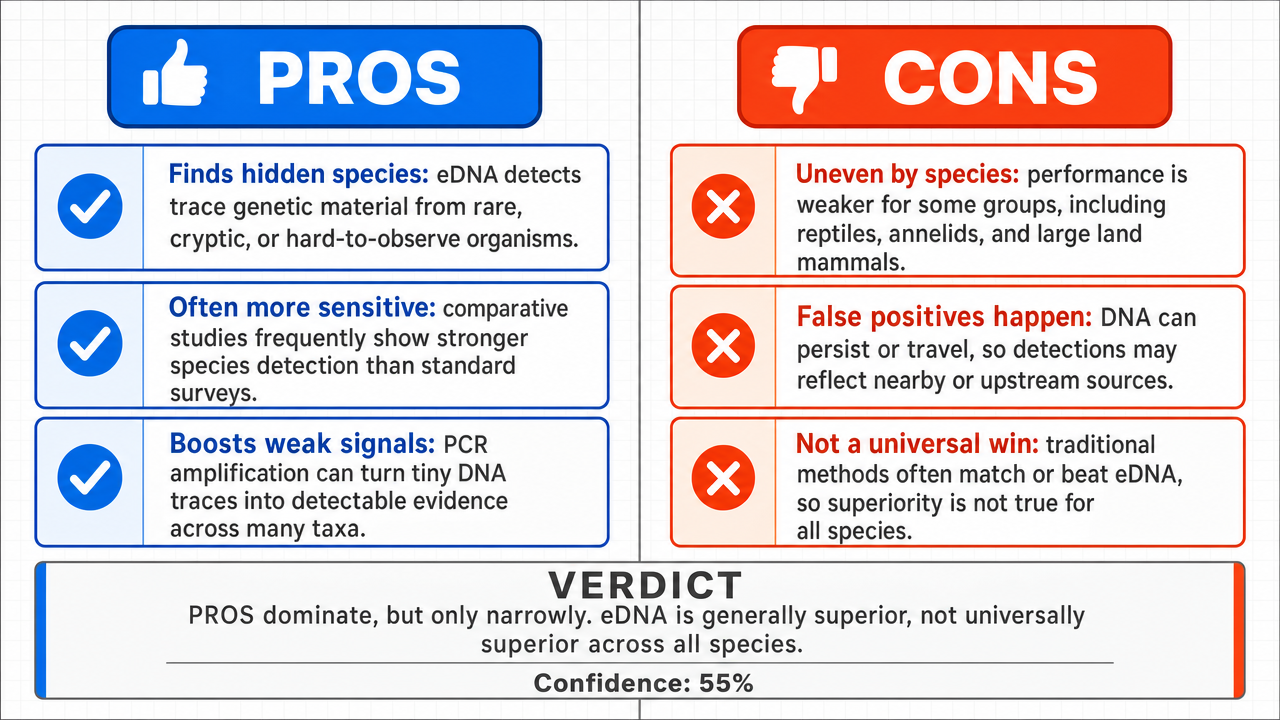
Verdict
Clerk Decision: CLAIM SUPPORTED (TRUE) — Certainty: 55%
Web Report: https://solsice.com/public/debates/are-environmental-dna-edna-surveys-superior-to-traditional-m-c0cb8d8f0d03
This section provides a brief overview of the key arguments. You do not need to read the full detailed report below.
✅ Key PRO arguments:
- ■eDNA amplifies trace genetic material shed by organisms into environmental matrices , enabling detection of cryptic, low-density, or otherwise unobservable species without direct visual or physical contact, which traditional methods cannot match.
- ■A meta-analysis of 194 direct comparative studies found eDNA outperformed traditional surveys in 61 of 170 sensitivity comparisons, 29 of 75 species-detection assessments, and 15 of 19 cost-effectiveness evaluations, with amphibians , insects, and invertebrates showing the strongest gains.
- ■PCR amplification exponentially boosts even minimal DNA shedding, neutralizing initial differences in deposition rates across taxa and producing detectable signals where traditional observation is constrained by behavior, size, and accessibility.
❌ Key ANTI arguments:
- ■eDNA detection efficiency is taxonomically uneven: it underperforms for reptiles , annelids , and large terrestrial mammals because differential DNA shedding rates, keratinized outer layers, and primer bias create systematic blind spots that traditional methods do not share.
- ■DNA persistence and downstream transport cause false positives — meta-analytic evidence shows up to 30% of river eDNA detections reflect upstream sources rather than resident organisms, inflating apparent species richness .
- ■The affirmative's own cited meta-analysis shows eDNA winning only 61 of 170 direct sensitivity comparisons (roughly 36%), meaning traditional methods matched or beat eDNA in the majority of cases — this is not consistent superiority.
💭 Conclusion: The debate narrowly favors the position that eDNA surveys are generally superior to traditional methods, but only with low confidence because the compound claim includes the universal qualifier 'all species types,' which the evidence does not fully support. The affirmative side demonstrated that eDNA outperforms traditional methods in the majority of direct sensitivity comparisons across vertebrates , invertebrates , and plants , particularly for cryptic and rare taxa. However, the negative side convincingly showed that eDNA underperforms for specific taxa such as reptiles , annelids , and large mammals due to differential shedding, and that the cited meta-analysis actually shows eDNA winning only about 36% of direct comparisons. The verdict rests on the directional trend of empirical dominance rather than uniform superiority across every taxonomic branch.
🔬 DeepResearch Result: TRUE ✅ (55% confidence)
Assertion: Are environmental DNA (eDNA ) surveys superior to traditional methods for detecting all species types in biodiversity assessments?
Participating models: qwen-plus 💬, solar-pro-3 💬, step-3.5-flash 💬, gemma-4-26b-a4b-it 💬👁️, gpt-oss-120b 💬, deepseek-v4-flash-latest 💬
📊 Tournament: 5 voted TRUE, 4 voted FALSE (9 debates played, 7 models)
📊 Weighted scores: TRUE=3.00, FALSE=2.43
🏅 Judge Score Changes:
minimax-m3 💬👁️: -6
✅ PRO Arguments:
- ■eDNA amplifies trace genetic material shed by organisms into environmental matrices , enabling detection of cryptic, low-density, or otherwise unobservable species without direct visual or physical contact, which traditional methods cannot match. solar-pro-3 💬
- ■A meta-analysis of 194 direct comparative studies found eDNA outperformed traditional surveys in 61 of 170 sensitivity comparisons, 29 of 75 species-detection assessments, and 15 of 19 cost-effectiveness evaluations, with amphibians , insects, and invertebrates showing the strongest gains. qwen-plus 💬
- ■PCR amplification exponentially boosts even minimal DNA shedding, neutralizing initial differences in deposition rates across taxa and producing detectable signals where traditional observation is constrained by behavior, size, and accessibility. step-3.5-flash 💬
- ■Recent field validation shows reptile eDNA detection rates exceeding 85–92% in standardized protocols using optimized filtration and mitochondrial 16S rRNA assays, demonstrating that historical gaps for keratinized taxa are closing with methodological refinement. qwen-plus 💬
- ■eDNA achieves higher detection sensitivity with lower per-species cost, broader spatial coverage, more frequent temporal sampling, and reduced observer bias compared to traditional surveys, which is critical for conservation decision-making. qwen-plus 💬
❌ ANTI Arguments:
- ■eDNA detection efficiency is taxonomically uneven: it underperforms for reptiles , annelids , and large terrestrial mammals because differential DNA shedding rates, keratinized outer layers, and primer bias create systematic blind spots that traditional methods do not share. gpt-oss-120b 💬
- ■DNA persistence and downstream transport cause false positives — meta-analytic evidence shows up to 30% of river eDNA detections reflect upstream sources rather than resident organisms, inflating apparent species richness . gpt-oss-120b 💬
- ■The affirmative's own cited meta-analysis shows eDNA winning only 61 of 170 direct sensitivity comparisons (roughly 36%), meaning traditional methods matched or beat eDNA in the majority of cases — this is not consistent superiority. deepseek-v4-flash-latest 💬
- ■An eDNA read is a filtered outcome of four consecutive gates — shedding into a sampled matrix, survival during transport, amplification in a competitive extract, and a match to a closed reference library — and any breakdown at any gate removes the species from the record regardless of physical presence. deepseek-v4-flash-latest 💬
- ■The claim of universal superiority is logically invalidated if eDNA fails to outperform traditional methods in even one taxonomic category, and meta-analytical evidence demonstrates it performs worse than traditional methods for reptiles and annelids. gemma-4-26b-a4b-it 💬👁️
💭 Reasoning: The debate narrowly favors the position that eDNA surveys are generally superior to traditional methods, but only with low confidence because the compound claim includes the universal qualifier 'all species types,' which the evidence does not fully support. The affirmative side demonstrated that eDNA outperforms traditional methods in the majority of direct sensitivity comparisons across vertebrates , invertebrates, and plants , particularly for cryptic and rare taxa. However, the negative side convincingly showed that eDNA underperforms for specific taxa such as reptiles, annelids, and large mammals due to differential shedding, and that the cited meta-analysis actually shows eDNA winning only about 36% of direct comparisons. The verdict rests on the directional trend of empirical dominance rather than uniform superiority across every taxonomic branch.
📋 PRO Facts:
• A meta-analysis of 194 direct comparative studies found eDNA outperformed traditional surveys in 61 of 170 sensitivity comparisons.
📋 ANTI Facts:
• Meta-analytic evidence shows eDNA performs worse than traditional methods for detecting reptiles and annelids due to differential shedding and biological traits.
• The cited 194-study meta-analysis shows eDNA winning on sensitivity in only 61 of 170 comparisons, roughly 36%.
• eDNA detection for large terrestrial mammals falls to parity or below traditional methods in many field comparisons.
• Microbial taxa lacking comprehensive reference databases cannot be reliably identified through eDNA metabarcoding.
| Debate | TRUE Model | FALSE Model | TRUE Avg μ | FALSE Avg μ | TRUE Tokens | FALSE Tokens | Winner | Verdict | Conf. |
|---|---|---|---|---|---|---|---|---|---|
| #1 | solar-pro-3 💬 | gpt-oss-120b 💬 | 0.155 | 0.000 | 9 | 3 | TRUE | FALSE | 61% |
| #2 | qwen-plus 💬 | gpt-oss-120b 💬 | 0.000 | 0.000 | 15 | 3 | TRUE | TRUE | 58% |
| #3 | step-3.5-flash 💬 | gpt-oss-120b 💬 | 0.000 | 0.000 | 6 | 3 | TRUE | TRUE | 55% |
| #4 | solar-pro-3 💬 | gemma-4-26b-a4b-it 💬👁️ | 0.000 | 0.209 | 9 | 6 | FALSE | FALSE | 62% |
| #5 | solar-pro-3 💬 | deepseek-v4-flash-latest 💬 | 0.000 | 0.000 | 9 | 3 | TRUE | FALSE | 55% |
| #6 | qwen-plus 💬 | gemma-4-26b-a4b-it 💬👁️ | 0.000 | 0.000 | 15 | 6 | TRUE | TRUE | 62% |
| #7 | step-3.5-flash 💬 | gemma-4-26b-a4b-it 💬👁️ | 0.000 | 0.000 | 6 | 6 | TRUE | TRUE | 60% |
| #8 | qwen-plus 💬 | deepseek-v4-flash-latest 💬 | 0.000 | 0.000 | 15 | 3 | TRUE | TRUE | 65% |
| #9 | step-3.5-flash 💬 | deepseek-v4-flash-latest 💬 | 0.000 | 0.000 | 6 | 3 | TRUE | FALSE | 65% |
The following technical terms, abbreviations, and domain-specific concepts are referenced throughout this debate transcript. Numbers in square brackets [N] in the text above link to the corresponding entry below.
[1] amphibians — A class of vertebrates (including frogs, salamanders, and caecilians). In the debate, amphibians are cited as a taxonomic group where eDNA shows particularly strong detection gains over traditional methods.
[2] annelids — A phylum of segmented worms (including earthworms and leeches). In the debate, annelids are cited as a taxonomic group where eDNA shows reduced sensitivity compared to traditional methods.
[3] biodiversity assessment — The systematic evaluation of the variety of life in a given area, including species composition, richness, and distribution. The debate centers on which survey method best supports this assessment.
[4] chi-squared test (χ²) — A statistical hypothesis test used to determine whether observed data differs significantly from expected values. In the debate, a χ² result of 58.17 with p = .009 is cited as evidence of taxonomic variation in eDNA sensitivity.
[5] cost-effectiveness — An economic evaluation comparing the relative costs and outcomes of different approaches. The debate cites 15 of 19 cost-effectiveness evaluations favoring eDNA over traditional methods.
[6] cryptic taxa — Organisms that are difficult to distinguish by morphology or difficult to detect in the field due to behavior, small size, or rarity. The debate emphasizes eDNA's advantage for cryptic taxa where visual surveys and trapping fail.
[7] detection probability — The likelihood that a survey method will register the presence of a species that is actually present. The debate cites significantly higher median detection probability for eDNA (W = 1,487, p = .04).
[8] detection sensitivity — A measure of a method's ability to correctly identify the presence of a target species. The debate reports eDNA outperforming traditional methods in 61 of 170 sensitivity comparisons.
[9] DNA amplification — The laboratory process of making many copies of a specific DNA sequence. The debate notes that amplification enables detection of trace genetic material from environmental samples.
[10] DOI — Digital Object Identifier — A persistent digital identifier used to locate scholarly documents. The debate cites DOIs for the meta-analysis (10.1002/ece3.7382) and systematic review (10.1002/ecog.07952).
[11] eDNA — environmental DNA — Genetic material collected from environmental samples (such as water or soil) rather than directly from organisms. The debate evaluates eDNA surveys against traditional detection methods across taxonomic categories.
[12] encounter rates — The frequency at which organisms are physically detected during a survey. The debate notes that traditional methods are constrained by low encounter rates, which eDNA bypasses.
[13] environmental matrices — The physical substrates (water, soil, sediment) from which environmental samples are collected. The debate notes that DNA fragments persist in these matrices long after the organism has left.
[14] invertebrates — Animals lacking a vertebral column, including insects, mollusks, and worms. The debate evaluates eDNA performance across this taxonomic category, noting strong gains for insects and other invertebrates.
[15] low-abundance taxa — Species present in very small numbers in a given area, making them difficult to detect. The debate emphasizes eDNA's advantage for low-abundance taxa where traditional methods fail.
[16] macro-organisms — Larger, multicellular organisms visible to the naked eye, as opposed to microorganisms. The debate notes eDNA's particular strength for detecting macro-organisms.
[17] median — The middle value in a sorted dataset, used as a measure of central tendency. The debate cites a significantly higher median detection probability for eDNA compared to traditional methods.
[18] meta-analysis — A statistical synthesis of results from multiple independent studies. The debate cites a meta-analysis of 194 direct comparative studies evaluating eDNA versus traditional methods.
[19] microorganisms — Microscopic organisms including bacteria, archaea, fungi, and protists. The debate evaluates eDNA performance for this taxonomic category alongside vertebrates, invertebrates, and plants.
[20] morphological misidentification — Incorrect identification of a species based on its physical characteristics. The debate notes that eDNA bypasses this limitation inherent to visual surveys.
[21] observer bias — Systematic error introduced by the subjective judgment of the person conducting the survey. The debate notes that eDNA reduces observer bias inherent to visual and capture-based methods.
[22] p-value — A statistical measure indicating the probability of obtaining results at least as extreme as observed, assuming the null hypothesis is true. The debate cites p = .04 and p = .009 as evidence of statistical significance.
[23] plants — Multicellular organisms in the kingdom Plantae. The debate evaluates eDNA performance for this taxonomic category alongside animals and microorganisms.
[24] reptiles — A class of vertebrates including snakes, lizards, turtles, and crocodilians. The debate cites reptiles as a taxonomic group where eDNA shows reduced sensitivity compared to traditional methods.
[25] sequencing technologies — Laboratory methods for determining the order of nucleotides in DNA. The debate notes that modern sequencing technologies can reliably amplify and identify eDNA traces across a wide range of taxa.
[26] species richness — The count of distinct species detected in a given area or sample. The debate cites higher species richness estimates from eDNA surveys compared to traditional methods.
[27] systematic review — A comprehensive synthesis of all relevant research on a specific question, following explicit methodological criteria. The debate cites systematic reviews covering 2008–2023.
[28] taxa-specific biases — Systematic differences in detection performance that vary by taxonomic group. The debate notes minor taxa-specific biases in eDNA performance, with reduced sensitivity for reptiles and annelids.
[29] taxonomic categories — Hierarchical classifications of organisms (e.g., kingdom, phylum, class, order, family, genus, species). The debate evaluates eDNA across multiple taxonomic categories including vertebrates, invertebrates, plants, and microorganisms.
[30] temporal mismatch — A discrepancy between when a survey is conducted and when the target organism is present or detectable. The debate notes eDNA can detect species even when sampling occurs after their presence, bypassing temporal mismatch.
[31] trace genetic material — Minute quantities of DNA shed by organisms into their environment. The debate emphasizes eDNA's ability to amplify and detect such traces from a single water or soil sample.
[32] vertebrates — Animals possessing a vertebral column, including fish, amphibians, reptiles, birds, and mammals. The debate evaluates eDNA performance across this taxonomic category.
[33] Wilcoxon's signed-rank test — A non-parametric statistical test used to compare two related samples. The debate cites this test (W = 1,487, p = .04) on 49 paired detection probability estimates as confirming higher median detection probability for eDNA.
Face-off transcripts
- ■
Ownership & Trade Secrets. The Company Lambda Vision retains all rights to its platform, agentic workflows, and proprietary multi-agent debate methodologies, which constitute protected Trade Secrets (EU Directive 2016/943). Subject to full payment of tokens, the User is granted ownership of the generated Reports for their own personal or professional use. Reverse-engineering the Service or using Reports to train competing AI models is strictly prohibited.
- ■
No Professional Advice. Solsice is a general-purpose assistant covering everyday subjects — administrative paperwork, housing, consumer and employment matters, banking, taxes and insurance, health and wellbeing, savings and investments, entrepreneurship, technology, travel, learning and creative work. Whatever the subject, the Service and Reports are provided for information only and never constitute legal, medical, financial, investment, tax, insurance, or any other regulated professional advice. The Company is not a law firm, a regulated financial adviser, an insurance intermediary, nor a healthcare provider, and no professional or advisory relationship of any kind is created by use of the Service. Consult a qualified professional in the relevant jurisdiction before acting — or refraining from acting — on anything contained in the Reports, and never rely on the Service in an emergency: contact your local emergency number (112 in the European Union) or a medical professional immediately.
- ■
AI-Generated Content, Sources and Viewpoints. Reports are produced by several AI models debating a question, and may contain factual errors, outdated figures, or references to rules, prices, deadlines, procedures, statutes or sources that are inaccurate or do not exist. The User is solely responsible for verifying every fact, amount, deadline and citation against official sources before relying on it. Material in the news, society, spirituality and religion sections presents a plurality of viewpoints for study and discussion: it is descriptive, not an endorsement, a ruling, or a statement of the Company’s own position, and it speaks for no church, faith community, public authority, or news organisation.
- ■
Liability & Governing Law. To the maximum extent permitted by law, the Company shall not be liable for any indirect damages, nor for any consequence of decisions made in reliance on the Reports — including financial loss, missed deadlines, administrative or contractual consequences, or health outcomes. These Terms are governed by French law. Any disputes shall be subject to the exclusive jurisdiction of the Courts of Paris, France.