
Apple's decision to withhold HomeView from the European Union is primarily a a tactic to pressure regulators into relaxing tech legislation
AI debate verdict and arguments
⚠️ AI-generated information only; not professional advice
Completed October 14, 2026
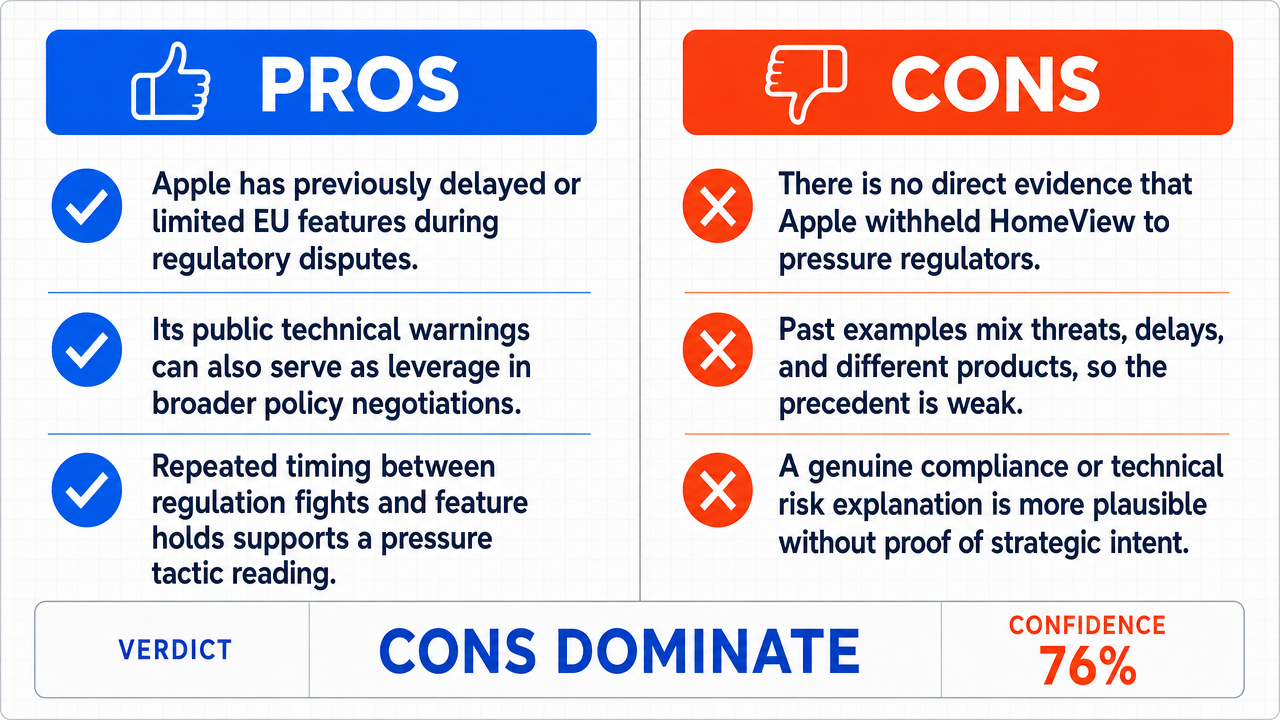
Verdict
Verdict: likely FALSE (76%)
Web Report: https://solsice.com/public/debates/apple-s-decision-to-withhold-homeview-from-the-european-unio-3ff815ffd06a
This section provides a brief overview of the key arguments. You do not need to read the full detailed report below.
✅ Key PRO arguments:
- ■Apple has a documented history of withholding features from the EU market to influence regulatory outcomes, such as delaying the Apple Intelligence AI suite in response to the Digital Markets Act's interoperability rules and threatening to withdraw Apple Pay from the UK in 2022 over a proposed competition law, establishing a clear pattern of using product availability as leverage.
- ■Apple's posture is not purely defensive but a calculated hybrid strategy that uses defensive technical language to achieve offensive regulatory goals, meaning even compliance -framed communications can serve as pressure tactics aimed at regulators.
❌ Key ANTI arguments:
- ■The affirmative's argument relies on an interpretive theory of Apple's motives that lacks direct evidence, treating a correlation between product delays and regulatory tension as a causal link without demonstrating the specific mechanism or internal directive that connects a technical incompatibility to a strategic intent to pressure regulators.
- ■The 'documented history of withholding features' argument is logically inconsistent because it conflates a stated threat (the 2022 UK Apple Pay situation) with an actual completed withholding, attempting to establish a behavioral pattern that the cited evidence does not actually support.
- ■Without evidence that the withholding is a choice made despite technical feasibility, the more parsimonious explanation is that Apple's decision reflects genuine technical compliance necessity with EU regulations rather than a calculated pressure tactic.
💭 Conclusion: False. The negative side prevailed because the affirmative failed to provide direct evidence of Apple's strategic intent, instead relying on an interpretive inference from financial correlations. The affirmative's use of global Services revenue ($85.2B) and operating margin (~70%) to argue motive for withholding HomeView in the EU is logically flawed, as it conflates segment-wide financial metrics with product-specific strategic decisions. Without demonstrating that the HomeView withholding is a choice made despite technical feasibility, the more parsimonious explanation remains genuine technical compliance necessity rather than a calculated pressure tactic. The affirmative's rebuttal was speculative and did not overcome the absence of a concrete causal mechanism linking the withholding to regulatory pressure.
🔬 DeepResearch Result: likely FALSE ❌ (76%)
Assertion: Apple's decision to withhold HomeView from the European Union is primarily a a tactic to pressure regulators into relaxing tech legislation
Participating models: deepseek-v3.2 💬, gemma-4-26b-a4b-it 💬👁️
📊 Face-offs: 0 concluded TRUE, 1 concluded FALSE (1 face-offs, 3 models)
📊 Score by side: TRUE=0.00, FALSE=0.76
🏅 Model score changes:
minimax-m3 💬👁️: +8
✅ PRO Arguments:
- ■Apple has a documented history of withholding features from the EU market to influence regulatory outcomes, such as delaying the Apple Intelligence AI suite in response to the Digital Markets Act's interoperability rules and threatening to withdraw Apple Pay from the UK in 2022 over a proposed competition law, establishing a clear pattern of using product availability as leverage. deepseek-v3.2 💬
- ■Apple's posture is not purely defensive but a calculated hybrid strategy that uses defensive technical language to achieve offensive regulatory goals, meaning even compliance -framed communications can serve as pressure tactics aimed at regulators. deepseek-v3.2 💬
❌ ANTI Arguments:
- ■The affirmative's argument relies on an interpretive theory of Apple's motives that lacks direct evidence, treating a correlation between product delays and regulatory tension as a causal link without demonstrating the specific mechanism or internal directive that connects a technical incompatibility to a strategic intent to pressure regulators. gemma-4-26b-a4b-it 💬👁️
- ■The 'documented history of withholding features' argument is logically inconsistent because it conflates a stated threat (the 2022 UK Apple Pay situation) with an actual completed withholding, attempting to establish a behavioral pattern that the cited evidence does not actually support. gemma-4-26b-a4b-it 💬👁️
- ■Without evidence that the withholding is a choice made despite technical feasibility, the more parsimonious explanation is that Apple's decision reflects genuine technical compliance necessity with EU regulations rather than a calculated pressure tactic. gemma-4-26b-a4b-it 💬👁️
💭 Reasoning: False. The negative side prevailed because the affirmative failed to provide direct evidence of Apple's strategic intent, instead relying on an interpretive inference from financial correlations. The affirmative's use of global Services revenue ($85.2B) and operating margin (~70%) to argue motive for withholding HomeView in the EU is logically flawed, as it conflates segment-wide financial metrics with product-specific strategic decisions. Without demonstrating that the HomeView withholding is a choice made despite technical feasibility, the more parsimonious explanation remains genuine technical compliance necessity rather than a calculated pressure tactic. The affirmative's rebuttal was speculative and did not overcome the absence of a concrete causal mechanism linking the withholding to regulatory pressure.
📋 PRO Facts:
• In 2022, Apple threatened to withdraw Apple Pay from the UK if a proposed competition law was enacted.
• Apple initially withheld the release of its Apple Intelligence suite of AI features from the EU, citing regulatory uncertainties related to the DMA 's interoperability rules.
📋 ANTI Facts:
• The affirmative provided no direct evidence (such as internal directives or strategic communications) linking the HomeView withholding to a deliberate intent to pressure EU regulators.
• The affirmative's financial argument relies on global services revenue and margin figures to draw conclusions about a single product's regional delay, a logically flawed inference that the evidence itself flags as a red herring.
| Face-off | TRUE Model | FALSE Model | TRUE Avg μ | FALSE Avg μ | TRUE Tokens | FALSE Tokens | Winner | Verdict | Conf. |
|---|---|---|---|---|---|---|---|---|---|
| #1 | deepseek-v3.2 💬 | gemma-4-26b-a4b-it 💬👁️ | 0.411 | 0.292 | 8 | 2 | TRUE | FALSE | 76% |
The following technical terms, abbreviations, and domain-specific concepts are referenced throughout this debate transcript. Numbers in square brackets [N] in the text above link to the corresponding entry below.
[1] AI — Artificial Intelligence — A field of computer science focused on creating systems that can perform tasks typically requiring human intelligence, such as learning, reasoning, and perception.
[2] Apple Intelligence — Apple's suite of AI features, mentioned in the transcript as initially withheld from the EU due to DMA-related regulatory uncertainties.
[3] Apple Pay — Apple's mobile payment service, referenced in the transcript in the context of a 2022 threat to withdraw it from the UK over a proposed competition law.
[4] compliance — The act of adhering to or conforming with applicable laws, regulations, or technical standards.
[5] DMA — Digital Markets Act — An EU regulatory instrument referenced in the transcript as containing interoperability rules that affect large technology companies operating in the European Union.
[6] EU — European Union — A political and economic union of European states, referenced in the transcript as the regulatory jurisdiction from which Apple is alleged to be withholding HomeView.
[7] false binary — A logical fallacy that presents only two mutually exclusive options when additional possibilities or middle-ground positions exist.
[8] HomeKit — Apple's smart home platform, described in the transcript as deeply integrated with HomeView and designed to keep sensitive video data protected.
[9] HomeView — An Apple home-related feature identified in the debate as the product being withheld from the EU market.
[10] interoperability — The ability of different systems, products, or services to work together seamlessly; referenced in the transcript as a mandate within the DMA that conflicts with Apple's privacy-centric architecture.
[11] lobbying — The act of attempting to influence the decisions of government officials or regulators, typically through advocacy, communication, or pressure campaigns.
[12] privacy-centric architecture — A system design philosophy that prioritizes user privacy, referenced in the transcript as being in fundamental conflict with the DMA's interoperability mandates.
[13] regulatory uncertainties — Vague or unresolved aspects of regulations that create compliance ambiguity; cited by Apple in the transcript as the reason for delaying Apple Intelligence in the EU.
[14] Secure Video — An Apple feature referenced in the transcript as being deeply integrated with HomeView and designed to ensure sensitive video data remains protected.
[15] transfer operator — In argumentation, the specific mechanism or internal directive that would connect a technical incompatibility to a strategic intent; used in the debate to critique the affirmative's causal reasoning.
The following financial data tables were referenced during the debate exchanges:
| Region | Apple Services Revenue 2023 | Services Growth YoY | Services Operating Margin |
|---|---|---|---|
| Global | $85.2B | +9.1% | ~70% |
| Europe | $22.1B (est.) | +7.5% (est.) | ~70% (est.) |
Legend: Apple's Services segment financials (FY2023). Revenue in USD billions; Europe estimated based on regional sales mix. High margins make ecosystem control critical. Source: Apple Inc. Annual Report (Form 10-K) FY2023.
| Metric | Value |
|---|---|
| Apple Services Operating Margin | ~70% |
| Apple Services Revenue (FY2023) | $85.2B |
| EU Services Revenue (Est. FY2023) | $22.1B |
Legend: Financial data for Apple's Services segment based on FY2023 reports. Operating margins and regional estimates are used to illustrate the scale of the segment.
Face-off transcripts
- ■
Ownership & Trade Secrets. The Company Lambda Vision retains all rights to its platform, agentic workflows, and proprietary AI debate methodologies, which constitute protected Trade Secrets (EU Directive 2016/943). Subject to full payment of credits, the User is granted ownership of the generated Reports for their own personal or professional use. Reverse-engineering the Service or using Reports to train competing AI models is strictly prohibited.
- ■
No Professional Advice. Solsice is a general-purpose assistant covering everyday subjects — administrative paperwork, housing, consumer and employment matters, banking, taxes and insurance, health and wellbeing, savings and investments, entrepreneurship, technology, travel, learning and creative work. Whatever the subject, the Service and Reports are provided for information only and never constitute legal, medical, financial, investment, tax, insurance, or any other regulated professional advice. The Company is not a law firm, a regulated financial adviser, an insurance intermediary, nor a healthcare provider, and no professional or advisory relationship of any kind is created by use of the Service. Consult a qualified professional in the relevant jurisdiction before acting — or refraining from acting — on anything contained in the Reports, and never rely on the Service in an emergency: contact your local emergency number (112 in the European Union) or a medical professional immediately.
- ■
AI-Generated Content, Sources and Viewpoints. Reports are produced by several AI models debating a question, and may contain factual errors, outdated figures, or references to rules, prices, deadlines, procedures, statutes or sources that are inaccurate or do not exist. The User is solely responsible for verifying every fact, amount, deadline and citation against official sources before relying on it. Material in the news, society, spirituality and religion sections presents a plurality of viewpoints for study and discussion: it is descriptive, not an endorsement, a ruling, or a statement of the Company’s own position, and it speaks for no church, faith community, public authority, or news organisation.
- ■
Liability & Governing Law. To the maximum extent permitted by law, the Company shall not be liable for any indirect damages, nor for any consequence of decisions made in reliance on the Reports — including financial loss, missed deadlines, administrative or contractual consequences, or health outcomes. These Terms are governed by French law. Any disputes shall be subject to the exclusive jurisdiction of the Courts of Paris, France.