
Apple HomeView offers significant innovation beyond existing smart home solutions.
AI debate verdict and arguments
⚠️ AI-generated information only; not professional advice
Completed October 14, 2026
Verdict
Verdict: likely FALSE (76%)
Web Report: https://solsice.com/public/debates/apple-homeview-offers-significant-innovation-beyond-existing-ded822851508
This section provides a brief overview of the key arguments. You do not need to read the full detailed report below.
✅ Key PRO arguments:
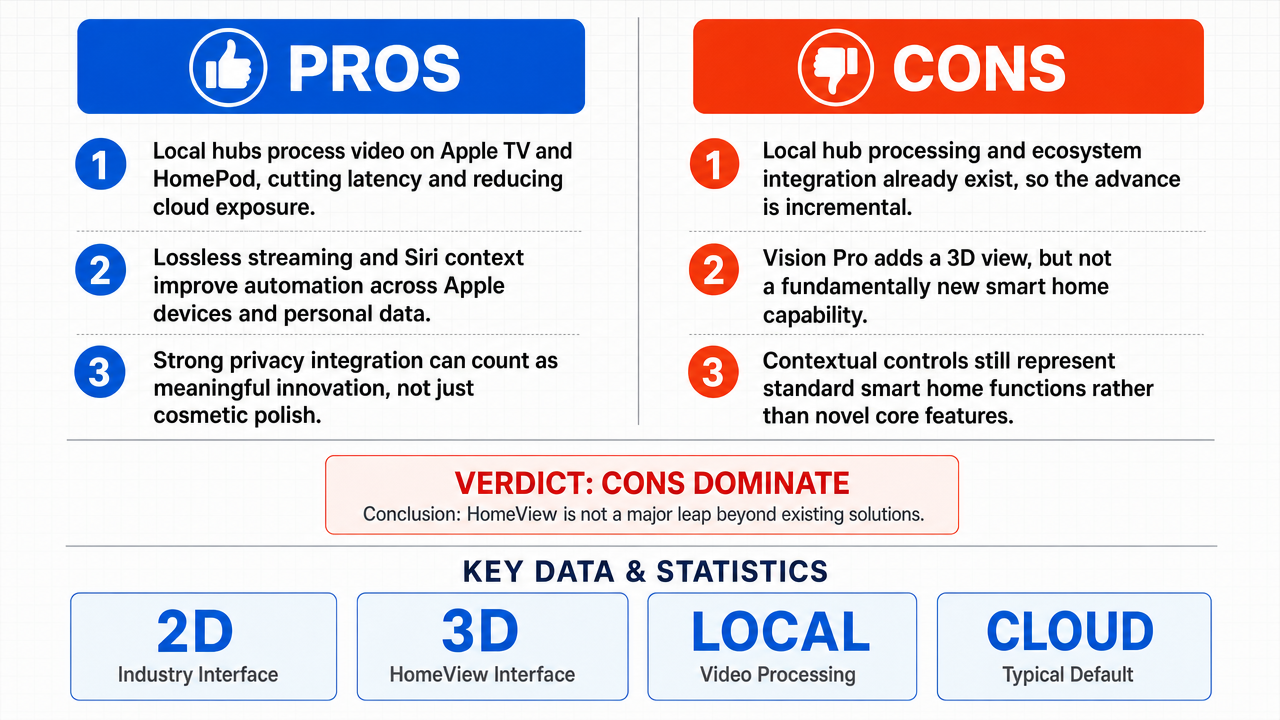
- ■Apple HomeView's architectural integration uses Apple TV and HomePod as secured hubs for local video processing, eliminating latency and reducing cloud vulnerability in ways competitors cannot replicate due to tight hardware-software coupling .
- ■HomeView enables lossless video streaming to Apple devices and advanced Siri automation that understands context across personal calendars, messages, and health data, creating a holistic environment no third-party platform can match.
- ■Dismissing HomeView's privacy model as merely 'polished integration' while also claiming it lacks innovativeness is internally contradictory, since polished integration delivering ecosystem-level security competitors functionally cannot match could itself constitute the innovation.
❌ Key ANTI arguments:
- ■The claim of 'foundational innovation' through ecosystem integration is a fallacy of scale; local processing on hubs like Apple TV and HomePod is a well-established edge computing paradigm used by numerous privacy-focused smart home ecosystems.
- ■Spatial computing via Vision Pro is merely a different visual modality for presenting existing control logic , not a fundamentally distinct capability, since any functional difference must fall into either control logic or visual presentation.
- ■The 'contextual data' and 'device controls' referenced are merely digital representations of standard smart home functions, not novel underlying capabilities.
💭 Conclusion: False. The debate verdict rejects the assertion that Apple HomeView offers significant innovation beyond existing smart home solutions. The winning side successfully demonstrated that HomeView's core architectural features, such as local processing on hubs and edge computing , are well-established industry practices rather than unprecedented innovations. The spatial computing interface was shown to be merely a different visual modality for presenting existing control logic , not a fundamentally new capability. Overall, HomeView was judged to be an incremental refinement of established standards rather than a foundational innovation.
🔬 DeepResearch Result: likely FALSE ❌ (76%)
Assertion: Apple HomeView offers significant innovation beyond existing smart home solutions.
Participating models: deepseek-v3.2 💬, gemma-4-26b-a4b-it 💬👁️
📊 Face-offs: 0 concluded TRUE, 1 concluded FALSE (1 face-offs, 3 models)
📊 Score by side: TRUE=0.00, FALSE=0.76
🏅 Model score changes:
minimax-m3 💬👁️: +8
✅ PRO Arguments:
- ■Apple HomeView's architectural integration uses Apple TV and HomePod as secured hubs for local video processing, eliminating latency and reducing cloud vulnerability in ways competitors cannot replicate due to tight hardware-software coupling . deepseek-v3.2 💬
- ■HomeView enables lossless video streaming to Apple devices and advanced Siri automation that understands context across personal calendars, messages, and health data, creating a holistic environment no third-party platform can match. deepseek-v3.2 💬
- ■Dismissing HomeView's privacy model as merely 'polished integration' while also claiming it lacks innovativeness is internally contradictory, since polished integration delivering ecosystem-level security competitors functionally cannot match could itself constitute the innovation. deepseek-v3.2 💬
- ■HomeView's innovation lies in principle-based user experience and ecosystem-level security that goes beyond merely implementing existing standards. deepseek-v3.2 💬
❌ ANTI Arguments:
- ■The claim of 'foundational innovation' through ecosystem integration is a fallacy of scale; local processing on hubs like Apple TV and HomePod is a well-established edge computing paradigm used by numerous privacy-focused smart home ecosystems. gemma-4-26b-a4b-it 💬👁️
- ■Spatial computing via Vision Pro is merely a different visual modality for presenting existing control logic , not a fundamentally distinct capability, since any functional difference must fall into either control logic or visual presentation. gemma-4-26b-a4b-it 💬👁️
- ■The 'contextual data' and 'device controls' referenced are merely digital representations of standard smart home functions, not novel underlying capabilities. gemma-4-26b-a4b-it 💬👁️
- ■HomeView represents an incremental refinement of established standards rather than a significant innovation, since its core technical approaches mirror industry-standard practices. gemma-4-26b-a4b-it 💬👁️
💭 Reasoning: False. The debate verdict rejects the assertion that Apple HomeView offers significant innovation beyond existing smart home solutions. The winning side successfully demonstrated that HomeView's core architectural features, such as local processing on hubs and edge computing, are well-established industry practices rather than unprecedented innovations. The spatial computing interface was shown to be merely a different visual modality for presenting existing control logic, not a fundamentally new capability. Overall, HomeView was judged to be an incremental refinement of established standards rather than a foundational innovation.
📋 PRO Facts:
• Apple HomeView uses home hubs for local video processing.
📋 ANTI Facts:
• Edge computing and local processing on hubs is a standard industry practice in privacy-focused smart home ecosystems.
• Spatial computing interfaces represent a different visual modality rather than fundamentally new control logic.
• Apple's privacy features, while different from typical industry defaults, represent incremental refinements of established standards.
| Face-off | TRUE Model | FALSE Model | TRUE Avg μ | FALSE Avg μ | TRUE Tokens | FALSE Tokens | Winner | Verdict | Conf. |
|---|---|---|---|---|---|---|---|---|---|
| #1 | deepseek-v3.2 💬 | gemma-4-26b-a4b-it 💬👁️ | 0.506 | 0.229 | 8 | 2 | TRUE | FALSE | 76% |
The following technical terms, abbreviations, and domain-specific concepts are referenced throughout this debate transcript. Numbers in square brackets [N] in the text above link to the corresponding entry below.
[1] automation — smart home automation — In the smart home context, the programmed execution of device actions (e.g., turning on lights, adjusting thermostats) based on triggers, schedules, or sensor inputs without manual user intervention.
[2] cloud-first — cloud-first architecture — A design approach in which data processing and storage are primarily handled on remote cloud servers rather than on local devices, often contrasted with edge or local processing models.
[3] control logic — The underlying rules, commands, and decision-making processes that govern how a system operates and responds to inputs, as distinct from the interface used to present those controls.
[4] edge computing — A computing paradigm in which data processing is performed on local hardware near the data source (e.g., a home hub) rather than on remote cloud servers, used to reduce latency and limit data exposure.
[5] end-to-end encryption — end-to-end encryption (E2EE) — A cryptographic method where data is encrypted on the sender's device and only decrypted on the recipient's device, preventing intermediaries—including cloud providers—from accessing the plaintext content.
[6] facial recognition — An AI-based capability that identifies or verifies individuals by analyzing patterns in facial features, often performed using on-device neural processing in modern smart home cameras.
[7] hardware-software coupling — The tight integration between proprietary hardware components and software optimized for them, enabling capabilities (such as lossless streaming or on-device AI) that third-party platforms cannot easily replicate.
[8] HomeKit — Apple HomeKit — Apple's smart home framework and developer platform that allows third-party devices to integrate with Apple's home automation ecosystem, referenced via developer.apple.com/homekit/.
[9] IoT — Internet of Things — A network of physical devices—such as cameras, lights, and sensors—embedded with connectivity that enables them to collect, exchange, and act on data.
[10] latency — The delay between an input or command and the system's response, often reduced by performing processing locally rather than routing requests to remote cloud servers.
[11] local AI inference — The execution of machine learning model predictions directly on a local device (such as a hub's Neural Engine) rather than on a remote server, used to keep sensitive data on-premises.
[12] lossless video streaming — The transmission of video data without lossy compression, preserving full original quality, typically requiring tight hardware-software integration and sufficient local bandwidth.
[13] Neural Engine — Apple's dedicated on-chip hardware accelerator designed for machine learning tasks such as facial recognition, person detection, and other on-device AI inference.
[14] on-device processing — The handling of computational tasks—such as video analysis or AI inference—directly on the user's local hardware rather than transmitting data to external servers.
[15] person detection — A computer vision capability that identifies the presence of human figures in video feeds, commonly used in smart home security cameras to trigger alerts or automations.
[16] smart home ecosystem — An integrated set of connected devices, hubs, software platforms, and services that collectively enable home automation, monitoring, and control.
[17] spatial computing — A computing paradigm that uses three-dimensional, spatially aware interfaces—often via headsets such as Apple Vision Pro—to interact with digital content overlaid on the physical environment.
[18] visual modality — The mode or format of visual presentation (e.g., 2D dashboard versus 3D spatial interface) used to convey information and controls to a user.
The following financial data tables were referenced during the debate exchanges:
| Feature Category | Industry Standard Implementation | Apple HomeView Implementation | Innovation Status |
|---|---|---|---|
| Data Processing | Edge/Local Computing | Edge/Local Computing | Incremental |
| Privacy Model | End-to-End Encryption | End-to-End Encryption | Incremental |
| Interface Paradigm | 2D Graphical User Interface | 3D Spatial Interface | Modality Shift |
Legend: Comparison of technical implementations between general industry standards and Apple HomeView. "Incremental" denotes parity with existing technological capabilities.
| Privacy Feature | Apple HomeView (HomeKit Secure Video) | Typical Industry Default (e.g., Ring/Nest) |
|---|---|---|
| Video Processing Location | On Home Hub (Local) | Vendor Cloud |
| Facial Recognition Data Path | On‑device Neural Engine | Cloud API |
| End‑to‑End Encryption | Always‑on, user‑keyed | Optional or limited |
| User Opt‑Out Required for Cloud Processing | Yes (Opt‑in) | No (Opt‑out) |
Legend: Comparison of default privacy configurations for video processing in major smart home ecosystems, based on 2023 vendor documentation and technical analyses.
Face-off transcripts
- ■
Ownership & Trade Secrets. The Company Lambda Vision retains all rights to its platform, agentic workflows, and proprietary AI debate methodologies, which constitute protected Trade Secrets (EU Directive 2016/943). Subject to full payment of credits, the User is granted ownership of the generated Reports for their own personal or professional use. Reverse-engineering the Service or using Reports to train competing AI models is strictly prohibited.
- ■
No Professional Advice. Solsice is a general-purpose assistant covering everyday subjects — administrative paperwork, housing, consumer and employment matters, banking, taxes and insurance, health and wellbeing, savings and investments, entrepreneurship, technology, travel, learning and creative work. Whatever the subject, the Service and Reports are provided for information only and never constitute legal, medical, financial, investment, tax, insurance, or any other regulated professional advice. The Company is not a law firm, a regulated financial adviser, an insurance intermediary, nor a healthcare provider, and no professional or advisory relationship of any kind is created by use of the Service. Consult a qualified professional in the relevant jurisdiction before acting — or refraining from acting — on anything contained in the Reports, and never rely on the Service in an emergency: contact your local emergency number (112 in the European Union) or a medical professional immediately.
- ■
AI-Generated Content, Sources and Viewpoints. Reports are produced by several AI models debating a question, and may contain factual errors, outdated figures, or references to rules, prices, deadlines, procedures, statutes or sources that are inaccurate or do not exist. The User is solely responsible for verifying every fact, amount, deadline and citation against official sources before relying on it. Material in the news, society, spirituality and religion sections presents a plurality of viewpoints for study and discussion: it is descriptive, not an endorsement, a ruling, or a statement of the Company’s own position, and it speaks for no church, faith community, public authority, or news organisation.
- ■
Liability & Governing Law. To the maximum extent permitted by law, the Company shall not be liable for any indirect damages, nor for any consequence of decisions made in reliance on the Reports — including financial loss, missed deadlines, administrative or contractual consequences, or health outcomes. These Terms are governed by French law. Any disputes shall be subject to the exclusive jurisdiction of the Courts of Paris, France.