
An RTX 3050 is the most powerful single-slot, slim graphics card available that does not require supplemental PCIe power, suitable for an Optiplex 7040 in 2026.
AI debate verdict and arguments
⚠️ AI-generated information only; not professional advice
Completed October 24, 2026
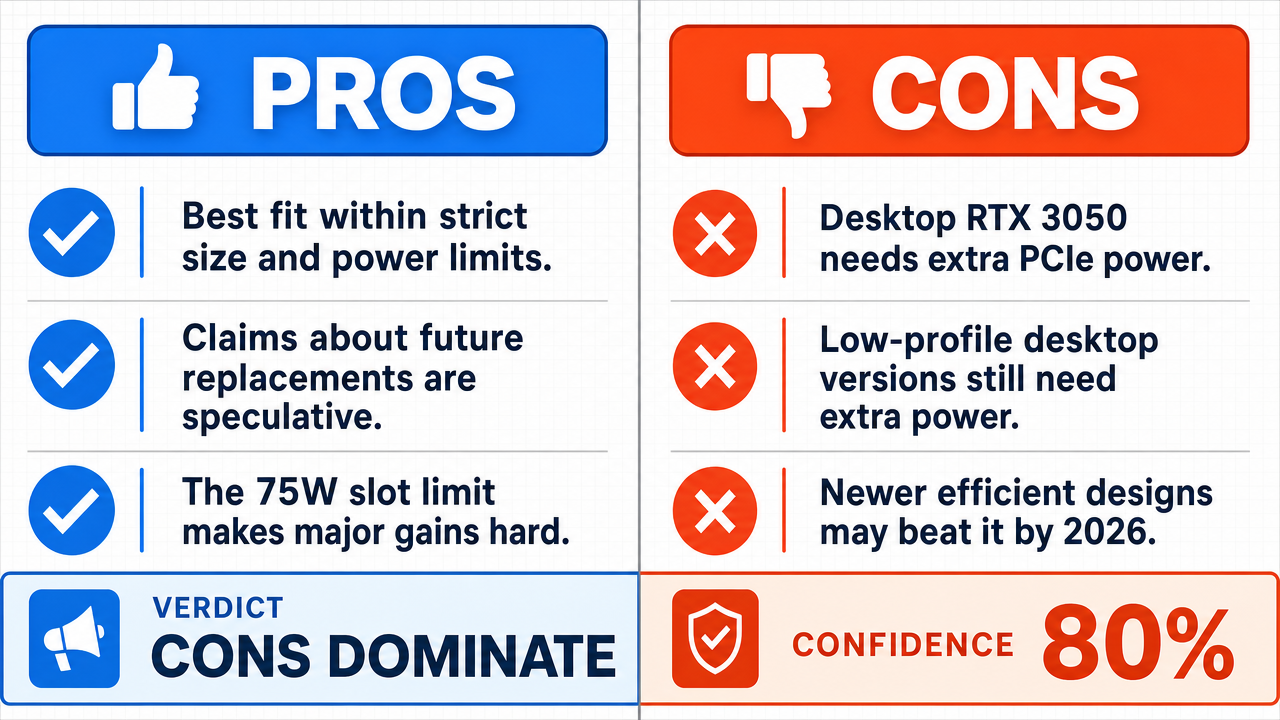
Verdict
Verdict: likely FALSE (80%)
Web Report: https://solsice.com/public/debates/an-rtx-3050-is-the-most-powerful-single-slot-slim-graphics-c-04f5cac62fea
This section provides a brief overview of the key arguments. You do not need to read the full detailed report below.
✅ Key PRO arguments:
- ■The RTX 3050 in a low-profile, single-slot configuration represents the peak of performance within the strict physical and electrical constraints of the Dell OptiPlex 7040 SFF , whose proprietary PSU typically lacks the 6-pin or 8-pin supplemental PCIe connectors found on higher-tier graphics cards.
- ■The opponent's appeal to expected architectural advances by 2026 is speculative speculation that does not establish that a faster card will actually exist within the exact intersection of single-slot width, low-profile height, and operation without supplemental PCIe power.
- ■The performance ceiling for bus-powered cards is governed by the PCIe slot's 75W power limit, so any replacement would need to deliver higher performance while respecting the same physical and electrical envelope.
❌ Key ANTI arguments:
- ■The desktop RTX 3050 requires a supplemental 6-pin PCIe power connector and consumes 170W total power, exceeding the 75W limit of the motherboard slot and the power delivery capabilities of the Dell OptiPlex 7040 SFF 's proprietary PSU , making it fundamentally incompatible with that chassis.
- ■Low-profile versions of the desktop RTX 3050 retain the supplemental power requirement, and the only bus-powered RTX 3050 is the mobile laptop variant , which cannot function as a desktop PCIe graphics card replacement.
- ■By 2026, newer and more efficient architectures are likely to offer superior performance within the same 75W bus power limit or lower while retaining a single-slot , low-profile form factor ; the AMD Radeon RX 6400 already offers competitive performance in this low-profile, single-slot, bus-powered niche.
💭 Conclusion: False — the desktop RTX 3050 fails the claim's bus-powered and OptiPlex 7040 SFF suitability requirements, so it cannot be the qualifying card described. According to the winning side's evidence, the desktop RTX 3050 draws 170W and requires a supplemental 6-pin PCIe connector, exceeding the 75W ceiling of the motherboard slot and the capabilities of the 7040 SFF's proprietary PSU . Low-profile desktop RTX 3050 models keep that power connector, and the only bus-powered RTX 3050 is a mobile laptop variant that cannot replace a desktop PCIe card. The winning side also argues that efficient, single-slot , low-profile alternatives such as the Radeon RX 6400 already compete within the 75W envelope, while continued GPU progress makes the exact 2026 market ranking uncertain. The affirmative's performance-ceiling argument therefore cannot rescue a card that does not meet the no-supplemental-power and chassis-fit conditions, making the FALSE verdict well supported while leaving some uncertainty about the precise 2026 performance hierarchy.
🔬 DeepResearch Result: likely FALSE ❌ (80%)
Assertion: An RTX 3050 is the most powerful single-slot , slim graphics card available that does not require supplemental PCIe power, suitable for an Optiplex 7040 in 2026.
Participating models: gemma-4-26b-a4b-it 💬👁️, glm-4.7-flash 💬
📊 Face-offs: 0 concluded TRUE, 1 concluded FALSE (1 face-offs, 3 models)
📊 Score by side: TRUE=0.00, FALSE=0.88
🏅 Model score changes:
minimax-m3 💬👁️: +9
✅ PRO Arguments:
- ■The RTX 3050 in a low-profile, single-slot configuration represents the peak of performance within the strict physical and electrical constraints of the Dell OptiPlex 7040 SFF , whose proprietary PSU typically lacks the 6-pin or 8-pin supplemental PCIe connectors found on higher-tier graphics cards. gemma-4-26b-a4b-it 💬👁️
- ■The opponent's appeal to expected architectural advances by 2026 is speculative speculation that does not establish that a faster card will actually exist within the exact intersection of single-slot width, low-profile height, and operation without supplemental PCIe power . gemma-4-26b-a4b-it 💬👁️
- ■The performance ceiling for bus-powered cards is governed by the PCIe slot's 75W power limit, so any replacement would need to deliver higher performance while respecting the same physical and electrical envelope. gemma-4-26b-a4b-it 💬👁️
❌ ANTI Arguments:
- ■The desktop RTX 3050 requires a supplemental 6-pin PCIe power connector and consumes 170W total power, exceeding the 75W limit of the motherboard slot and the power delivery capabilities of the Dell OptiPlex 7040 SFF 's proprietary PSU, making it fundamentally incompatible with that chassis. glm-4.7-flash 💬
- ■Low-profile versions of the desktop RTX 3050 retain the supplemental power requirement, and the only bus-powered RTX 3050 is the mobile laptop variant , which cannot function as a desktop PCIe graphics card replacement. glm-4.7-flash 💬
- ■By 2026, newer and more efficient architectures are likely to offer superior performance within the same 75W bus power limit or lower while retaining a single-slot, low-profile form factor ; the AMD Radeon RX 6400 already offers competitive performance in this low-profile, single-slot, bus-powered niche. glm-4.7-flash 💬
- ■The affirmative's position relies on the current market snapshot and extrapolates it into 2026 without accounting for continued GPU technology progress within restrictive power envelopes. glm-4.7-flash 💬
💭 Reasoning: False — the desktop RTX 3050 fails the claim's bus-powered and OptiPlex 7040 SFF suitability requirements, so it cannot be the qualifying card described. According to the winning side's evidence, the desktop RTX 3050 draws 170W and requires a supplemental 6-pin PCIe connector, exceeding the 75W ceiling of the motherboard slot and the capabilities of the 7040 SFF's proprietary PSU. Low-profile desktop RTX 3050 models keep that power connector, and the only bus-powered RTX 3050 is a mobile laptop variant that cannot replace a desktop PCIe card. The winning side also argues that efficient, single-slot, low-profile alternatives such as the Radeon RX 6400 already compete within the 75W envelope, while continued GPU progress makes the exact 2026 market ranking uncertain. The affirmative's performance-ceiling argument therefore cannot rescue a card that does not meet the no-supplemental-power and chassis-fit conditions, making the FALSE verdict well supported while leaving some uncertainty about the precise 2026 performance hierarchy.
📋 PRO Facts:
• The PCIe slot power ceiling cited in the debate is 75W.
• Low-profile RTX 3050 configurations exist, including single-slot designs claimed to fit the OptiPlex 7040 SFF.
• The Dell OptiPlex 7040 SFF has limited internal expansion space and typically uses a proprietary PSU without 6-pin or 8-pin supplemental PCIe connectors.
• The affirmative argued that GPU architectural progress does not by itself guarantee a faster single-slot, low-profile, bus-powered card by 2026.
📋 ANTI Facts:
• The desktop RTX 3050 requires a supplemental 6-pin PCIe power connector.
• The desktop RTX 3050's total power consumption is 170W, above the 75W limit of a PCIe slot.
• Low-profile desktop RTX 3050 models retain the supplemental power requirement.
• The only bus-powered RTX 3050 is the mobile laptop variant, which cannot be used as a desktop PCIe graphics card.
• The Radeon RX 6400 is cited as a competitive low-profile, single-slot, bus-powered option in this class.
| Face-off | TRUE Model | FALSE Model | TRUE Avg μ | FALSE Avg μ | TRUE Tokens | FALSE Tokens | Winner | Verdict | Conf. |
|---|---|---|---|---|---|---|---|---|---|
| #1 | gemma-4-26b-a4b-it 💬👁️ | glm-4.7-flash 💬 | 0.273 | 0.249 | 4 | 4 | TRUE | FALSE | 88% |
The following technical terms, abbreviations, and domain-specific concepts are referenced throughout this debate transcript. Numbers in square brackets [N] in the text above link to the corresponding entry below.
[1] 170W — 170 watts — The total power consumption the negative side attributes to the desktop RTX 3050, using it to argue that the card exceeds the system's 75W slot and chassis power capabilities.
[2] 6-pin — 6-pin supplemental PCIe power connector — A supplemental connector that the affirmative says the OptiPlex 7040 SFF's PSU lacks; the negative says the desktop RTX 3050 requires one.
[3] 75W — 75 watts — The power allowance the debate assigns to the PCIe motherboard slot and uses as the ceiling for bus-powered cards. Both sides recognize it as the relevant ceiling, but disagree over whether the RTX 3050 operates within it.
[4] 8-pin — 8-pin supplemental PCIe power connector — A supplemental PCIe power connector that the affirmative says is unavailable from the OptiPlex PSU and is needed by higher-tier graphics cards.
[5] bus-powered — A graphics card that draws power from the PCIe slot without supplemental PCIe power cables; the debate applies this description to specific RTX 3050 configurations and the Radeon RX 6400.
[6] Dell OptiPlex 7040 — The desktop model identified as the target for a 2026 graphics-card upgrade, with the debate focusing on fitting a slim, single-slot, bus-powered GPU without supplemental power.
[7] external power — Power supplied through supplemental power cables or connectors rather than solely through the PCIe slot; the debate contrasts bus-powered cards with cards requiring such connections.
[8] form factor — The physical dimensions and layout of a graphics card, including its height and the number of expansion slots it occupies.
[9] GPU — graphics processing unit — The graphics-processing component discussed through products such as the RTX 3050 and Radeon RX 6400, including their performance, power requirements, and physical designs.
[10] GPU architecture — The underlying design of a GPU; the negative side argues that future architectures may improve performance per watt while retaining low-power, slim, and single-slot constraints.
[11] graphics card — An expansion card used for graphics output, discussed in the debate in terms of slot width, height, performance, and power requirements.
[12] low-power — Designed to operate within a limited power budget, in the debate referring especially to cards intended to run from PCIe slot power without supplemental connectors.
[13] low-profile (slim) — A reduced-height graphics-card format considered necessary for, or available in, the compact OptiPlex 7040 SFF chassis.
[14] mobile laptop variant — The mobile version of the RTX 3050, described by the negative side as the only bus-powered RTX 3050 and unsuitable as a desktop PCIe card replacement.
[15] motherboard slot — The expansion slot on the motherboard that the debate treats as having a 75W power limit.
[16] multi-slot — A graphics-card design occupying more than one expansion slot; the affirmative says most high-performance developments are directed toward such cards.
[17] OptiPlex 7040 SFF — OptiPlex 7040 Small Form Factor — The compact OptiPlex 7040 chassis whose limited expansion space, slim-card requirement, and proprietary PSU are central to the compatibility dispute.
[18] PCIe — Peripheral Component Interconnect Express — The expansion interface used to connect graphics cards to the motherboard and, according to the debate, supply up to 75W directly through the slot.
[19] PCIe expansion space — The physical room inside the computer chassis available for expansion cards, described as limited in the OptiPlex 7040 SFF.
[20] PCIe x16 slot — PCI Express x16 slot — The PCIe expansion connection identified by the debate as both the graphics-card interface and the direct source of the 75W power allowance.
[21] performance ceiling — The maximum performance achievable while satisfying specified constraints, applied here to the intersection of 75W power, single-slot width, and low-profile height.
[22] performance per watt — A measure of performance output relative to power consumption, cited as an efficiency metric that future GPU architectures may improve.
[23] power delivery — The capacity and means by which a system supplies power to a graphics card; the debate disputes whether the OptiPlex 7040 SFF can deliver enough for the RTX 3050.
[24] power envelope — The range of power consumption within which a proposed GPU must remain to satisfy a system's available power and cooling constraints.
[25] proprietary PSU — The OptiPlex-specific power supply unit; the affirmative says it lacks supplemental PCIe connectors, while the negative cites its power-delivery limits as an incompatibility.
[26] PSU — power supply unit — The system component that supplies power to internal hardware, discussed in relation to whether the OptiPlex 7040 SFF can support a graphics card without supplemental PCIe power.
[27] Radeon RX 6400 — An AMD graphics card cited by the negative side as already offering competitive performance in a low-profile, single-slot, bus-powered design.
[28] RTX 3050 — The graphics-card model at the center of the dispute. The affirmative says specific low-profile, single-slot configurations can run within 75W from the slot without supplemental power, while the negative says desktop versions require a 6-pin connector and 170W and that only the mobile version is bus-powered; the transcript does not resolve this conflict.
[29] SFF — Small Form Factor — An abbreviation for a compact computer chassis, used here for the OptiPlex 7040 SFF whose expansion space and power supply constrain graphics-card selection.
[30] single-slot — A graphics-card design occupying one expansion slot, one of the physical requirements imposed by the proposed OptiPlex 7040 configuration.
[31] supplemental PCIe power — Additional electrical power delivered to a graphics card through dedicated PCIe power connectors rather than through the expansion slot alone.
[32] TDP — thermal design power — A power-related design rating; the debate uses a 75W TDP figure as the direct-slot power ceiling for the RTX 3050 and contrasts it with higher-TDP cards.
Face-off transcripts
- ■
Ownership & Trade Secrets. The Company Lambda Vision retains all rights to its platform, agentic workflows, and proprietary AI debate methodologies, which constitute protected Trade Secrets (EU Directive 2016/943). Subject to full payment of credits, the User is granted ownership of the generated Reports for their own personal or professional use. Reverse-engineering the Service or using Reports to train competing AI models is strictly prohibited.
- ■
No Professional Advice. Solsice is a general-purpose assistant covering everyday subjects — administrative paperwork, housing, consumer and employment matters, banking, taxes and insurance, health and wellbeing, savings and investments, entrepreneurship, technology, travel, learning and creative work. Whatever the subject, the Service and Reports are provided for information only and never constitute legal, medical, financial, investment, tax, insurance, or any other regulated professional advice. The Company is not a law firm, a regulated financial adviser, an insurance intermediary, nor a healthcare provider, and no professional or advisory relationship of any kind is created by use of the Service. Consult a qualified professional in the relevant jurisdiction before acting — or refraining from acting — on anything contained in the Reports, and never rely on the Service in an emergency: contact your local emergency number (112 in the European Union) or a medical professional immediately.
- ■
AI-Generated Content, Sources and Viewpoints. Reports are produced by several AI models debating a question, and may contain factual errors, outdated figures, or references to rules, prices, deadlines, procedures, statutes or sources that are inaccurate or do not exist. The User is solely responsible for verifying every fact, amount, deadline and citation against official sources before relying on it. Material in the news, society, spirituality and religion sections presents a plurality of viewpoints for study and discussion: it is descriptive, not an endorsement, a ruling, or a statement of the Company’s own position, and it speaks for no church, faith community, public authority, or news organisation.
- ■
Liability & Governing Law. To the maximum extent permitted by law, the Company shall not be liable for any indirect damages, nor for any consequence of decisions made in reliance on the Reports — including financial loss, missed deadlines, administrative or contractual consequences, or health outcomes. These Terms are governed by French law. Any disputes shall be subject to the exclusive jurisdiction of the Courts of Paris, France.