
An 'Ozempic pill for insecurity' would eliminate all personal insecurities, leading individuals to deploy 'nothing but love' and focus solely on constructive endeavors.
AI debate verdict and arguments
⚠️ AI-generated information only; not professional advice
Completed October 14, 2026
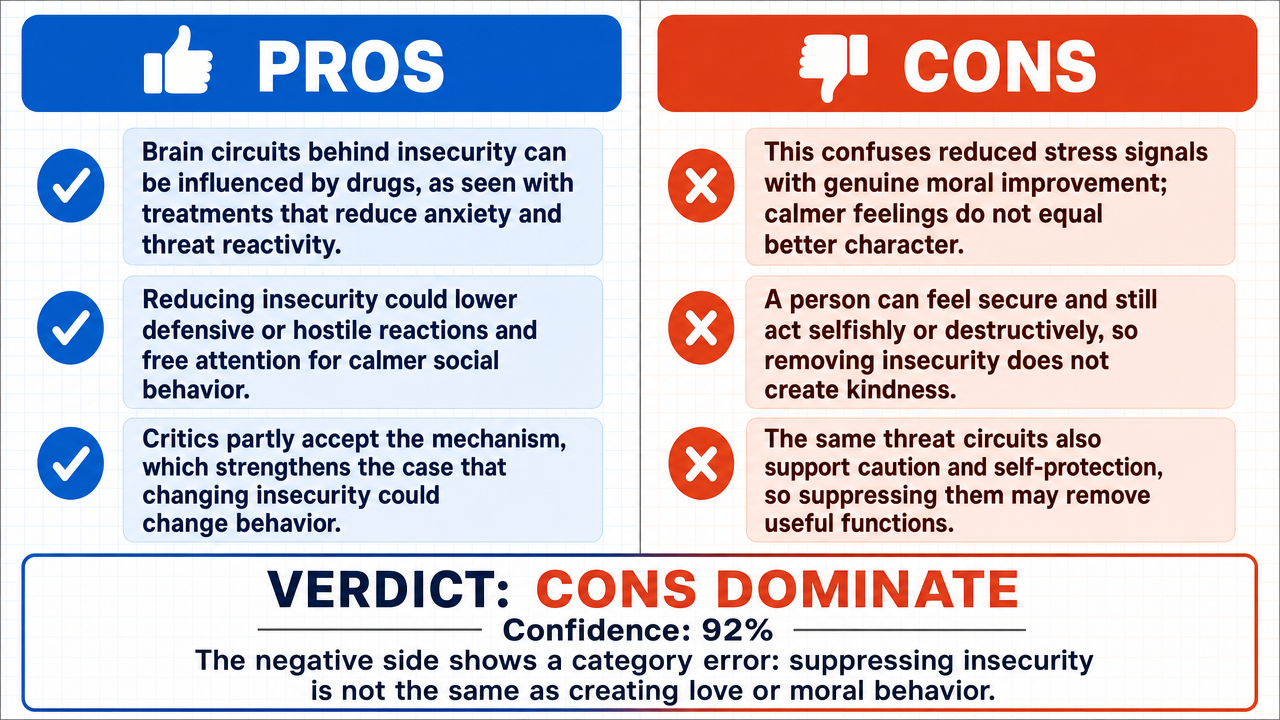
Verdict
Verdict: likely FALSE (92%)
Web Report: https://solsice.com/public/debates/an-ozempic-pill-for-insecurity-would-eliminate-all-personal-85235066ccd5
This section provides a brief overview of the key arguments. You do not need to read the full detailed report below.
✅ Key PRO arguments:
- ■Insecurity is rooted in threat-response circuits (amygdala and prefrontal cortex dysregulation ), and pharmacological interventions like SSRIs , beta-blockers , and oxytocin demonstrate that targeted neurochemical modulation can reshape dominant behavioral patterns and increase prosocial trust.
- ■Silencing insecurity signals would remove the neural basis for defensive, hostile, or selfish actions, freeing cognitive and emotional resources for prosocial engagement and constructive endeavors.
- ■The opponent's critique is self-refuting because they simultaneously describe the affirmative's claim as asserting 'nothing but love' and then deny that consequence is guaranteed, without offering a rival account explaining why love and constructive focus would not follow.
❌ Key ANTI arguments:
- ■The affirmative commits a substitution-of-proxy error: they measure a specific reduction in physiological arousal (e.g., via beta-blockers or oxytocin ) and conclude that suppressing a threat response is functionally equivalent to the presence of altruistic 'love,' without providing the transfer operator that bridges biological state to moral essence.
- ■A person can be biologically calm and free of insecurity while still acting destructively; eliminating the threat-response circuit does not automatically install prosocial motivation, since non-insecure individuals can still be cruel, indifferent, or self-interested.
- ■The affirmative's own neurobiological mechanism reveals a contradiction: suppressing the amygdala and prefrontal threat circuitry would also suppress adaptive caution, boundary-setting, and self-protective discernment, which are necessary for genuine constructive engagement rather than indiscriminate 'love.'
💭 Conclusion: False. The debate verdict is FALSE with high confidence, as the negative side successfully exposed a fundamental category error in the affirmative's reasoning. The affirmative conflated the suppression of insecurity with the active generation of prosocial love, failing to provide a transfer mechanism bridging biological calm to altruistic motivation. The negative further demonstrated that even granting the affirmative's premise, removing insecurity would not guarantee constructive behavior because other drivers of destructive behavior exist independently and because constructive striving depends on goals rather than merely the absence of threat. Because the compound claim requires both that all personal insecurities be eliminated and that this would produce exclusively loving, constructive behavior, and the second sub-claim is the weakest link, confidence reflects only the strength of that unsupported leap.
🔬 DeepResearch Result: likely FALSE ❌ (92%)
Assertion: An 'Ozempic pill for insecurity' would eliminate all personal insecurities, leading individuals to deploy 'nothing but love' and focus solely on constructive endeavors.
Participating models: deepseek-v3.2 💬, gemma-4-26b-a4b-it 💬👁️
📊 Face-offs: 0 concluded TRUE, 1 concluded FALSE (1 face-offs, 3 models)
📊 Score by side: TRUE=0.00, FALSE=0.92
🏅 Model score changes:
minimax-m3 💬👁️: +9
✅ PRO Arguments:
- ■Insecurity is rooted in threat-response circuits (amygdala and prefrontal cortex dysregulation ), and pharmacological interventions like SSRIs , beta-blockers , and oxytocin demonstrate that targeted neurochemical modulation can reshape dominant behavioral patterns and increase prosocial trust. deepseek-v3.2 💬
- ■Silencing insecurity signals would remove the neural basis for defensive, hostile, or selfish actions, freeing cognitive and emotional resources for prosocial engagement and constructive endeavors. deepseek-v3.2 💬
- ■The opponent's critique is self-refuting because they simultaneously describe the affirmative's claim as asserting 'nothing but love' and then deny that consequence is guaranteed, without offering a rival account explaining why love and constructive focus would not follow. deepseek-v3.2 💬
❌ ANTI Arguments:
- ■The affirmative commits a substitution-of-proxy error: they measure a specific reduction in physiological arousal (e.g., via beta-blockers or oxytocin) and conclude that suppressing a threat response is functionally equivalent to the presence of altruistic 'love,' without providing the transfer operator that bridges biological state to moral essence. gemma-4-26b-a4b-it 💬👁️
- ■A person can be biologically calm and free of insecurity while still acting destructively; eliminating the threat-response circuit does not automatically install prosocial motivation, since non-insecure individuals can still be cruel, indifferent, or self-interested. gemma-4-26b-a4b-it 💬👁️
- ■The affirmative's own neurobiological mechanism reveals a contradiction: suppressing the amygdala and prefrontal threat circuitry would also suppress adaptive caution, boundary-setting, and self-protective discernment, which are necessary for genuine constructive engagement rather than indiscriminate 'love.' gemma-4-26b-a4b-it 💬👁️
- ■Insecurity is only one driver among many of human behavior, and removing it would not eliminate greed, ideology, habit, or other non-insecurity-based motivations for destructive action. gemma-4-26b-a4b-it 💬👁️
💭 Reasoning: False. The debate verdict is FALSE with high confidence, as the negative side successfully exposed a fundamental category error in the affirmative's reasoning. The affirmative conflated the suppression of insecurity with the active generation of prosocial love, failing to provide a transfer mechanism bridging biological calm to altruistic motivation. The negative further demonstrated that even granting the affirmative's premise, removing insecurity would not guarantee constructive behavior because other drivers of destructive behavior exist independently and because constructive striving depends on goals rather than merely the absence of threat. Because the compound claim requires both that all personal insecurities be eliminated and that this would produce exclusively loving, constructive behavior, and the second sub-claim is the weakest link, confidence reflects only the strength of that unsupported leap.
📋 PRO Facts:
• Humanistic psychology theory holds that when safety needs are met, individuals naturally strive for self-actualization, which includes creative and constructive expression.
• Growth mindset research suggests that reducing fear of failure can liberate the underlying motivation for self-improvement from fear-based distortion.
• Insecurity can hijack underlying competence and goals, meaning that constructive striving persists independently of insecurity itself.
📋 ANTI Facts:
• Removing a negative stimulus such as insecurity does not inherently populate the resulting vacuum with a specific positive behavior, because the absence of a negative is logically distinct from the presence of a positive.
• Sources of destructive behavior other than personal insecurity, such as psychopathy or ideological hatred, are not necessarily eliminated by removing insecurity, weakening the affirmative's substitution claim.
• Insecurity is only one driver of destructive behaviors; behavioral outputs require both the absence of inhibition and the presence of a driving goal, which removing insecurity does not automatically supply.
| Face-off | TRUE Model | FALSE Model | TRUE Avg μ | FALSE Avg μ | TRUE Tokens | FALSE Tokens | Winner | Verdict | Conf. |
|---|---|---|---|---|---|---|---|---|---|
| #1 | deepseek-v3.2 💬 | gemma-4-26b-a4b-it 💬👁️ | 0.470 | 0.549 | 8 | 2 | FALSE | FALSE | 92% |
The following technical terms, abbreviations, and domain-specific concepts are referenced throughout this debate transcript. Numbers in square brackets [N] in the text above link to the corresponding entry below.
[1] affiliative conduct — affiliative behavior — Behavior that promotes social bonding, attachment, and positive relationships with others. In the debate, the affirmative cites evidence that reducing insecurity increases affiliative conduct such as trust and cooperation.
[2] altruistic intent — altruistic intention — The motivation to act for the benefit of others without expectation of personal gain. The negative argues that the absence of a stress response does not establish the presence of altruistic intent.
[3] amygdala — A brain structure central to threat detection and the fear/stress response. The debate discusses its role in insecurity-driven behavior and the consequences of suppressing its activity.
[4] anxiety — social anxiety — An anxiety condition centered on social evaluation and interaction. The affirmative cites clinical interventions that reduce social anxiety as a model for their proposed 'insecurity pill.'
[5] beta-blockers — beta-adrenergic blockers — A class of drugs cited in the debate as reducing social anxiety and increasing trust and cooperative behavior.
[6] clinical studies — Empirical medical or psychological research involving human subjects. The affirmative cites clinical studies to support claims about the behavioral effects of reducing anxiety.
[7] cortisol — A stress hormone whose levels are used in the debate as a physiological marker of threat-response activity. The negative argues that measuring cortisol reflects the absence of a stress response, not the presence of love.
[8] dysregulation — Abnormal or impaired regulation of a physiological or psychological system. The affirmative describes chronically overactive threat-responses as a dysregulation analogous to pathological hunger or pain.
[9] humanistic psychology — A school of psychology emphasizing intrinsic growth, self-actualization, and positive human potential. The affirmative invokes it to support the claim that removing insecurity would redirect motivation toward contribution.
[10] intrinsic growth — Development driven by internal motivations rather than external pressures. The affirmative argues that removing insecurity would redirect motivation toward intrinsic growth and contribution.
[11] maladaptive behavior — Behavior that undermines an individual's well-being or social functioning. The affirmative describes hostile, defensive, and selfish actions driven by chronic insecurity as maladaptive.
[12] neurobiological — Pertaining to the biology of the nervous system. The affirmative frames its argument along a neurobiological axis, grounding insecurity in brain circuits and neurochemistry.
[13] neurochemical modulation — The targeted alteration of neurotransmitter activity to change brain function and behavior. The affirmative cites it as a proven mechanism for reshaping dominant behavioral patterns, using SSRIs and Ozempic as examples.
[14] oxytocin — A hormone and neuropeptide associated with social bonding. The affirmative cites it as increasing trust and cooperative behavior when administered to reduce social anxiety.
[15] Ozempic — Ozempic (semaglutide) — A pharmaceutical referenced in the debate as a model of targeted intervention that suppresses appetite. The hypothetical 'Ozempic pill for insecurity' is proposed as an analogous drug targeting insecurity rather than appetite.
[16] pathological — Involving disease or abnormal dysfunction. The affirmative characterizes chronically dysregulated threat-responses as a pathological state, analogous to other medical conditions treatable by pharmacology.
[17] pharmacological intervention — A treatment that uses drugs to alter physiological or psychological function. The debate examines whether a pharmacological intervention can eliminate insecurity and, by extension, redirect human behavior.
[18] prefrontal cortex — A brain region involved in executive function, decision-making, and emotional regulation. The debate discusses its dysregulation as part of the neurobiological basis of insecurity.
[19] prosocial — prosocial behavior (prosociality) — Behavior intended to benefit others or promote social harmony. Both sides dispute whether eliminating insecurity would necessarily produce prosocial behavior.
[20] self-refuting — self-refuting argument — A logical concept describing a statement or argument that, by its own content, undermines its own conclusion. The affirmative accuses the negative of a self-refuting contradiction in its critique.
[21] SSRIs — Selective Serotonin Reuptake Inhibitors — A class of antidepressant medications cited in the debate as an example of pharmacological intervention that normalizes neurochemical function to treat anxiety.
[22] threat-response circuits — Neural networks, centered on the amygdala and connected regions, that detect and react to perceived threats. The debate treats insecurity as rooted in these circuits and questions whether their removal would yield prosocial behavior.
[23] transfer operator — A concept borrowed from mathematical or control-theoretic contexts, used in the debate to denote the missing logical or causal link that would establish equivalence between suppressing a threat response and producing altruistic behavior. The negative argues the affirmative has not provided one.
Face-off transcripts
- ■
Ownership & Trade Secrets. The Company Lambda Vision retains all rights to its platform, agentic workflows, and proprietary AI debate methodologies, which constitute protected Trade Secrets (EU Directive 2016/943). Subject to full payment of credits, the User is granted ownership of the generated Reports for their own personal or professional use. Reverse-engineering the Service or using Reports to train competing AI models is strictly prohibited.
- ■
No Professional Advice. Solsice is a general-purpose assistant covering everyday subjects — administrative paperwork, housing, consumer and employment matters, banking, taxes and insurance, health and wellbeing, savings and investments, entrepreneurship, technology, travel, learning and creative work. Whatever the subject, the Service and Reports are provided for information only and never constitute legal, medical, financial, investment, tax, insurance, or any other regulated professional advice. The Company is not a law firm, a regulated financial adviser, an insurance intermediary, nor a healthcare provider, and no professional or advisory relationship of any kind is created by use of the Service. Consult a qualified professional in the relevant jurisdiction before acting — or refraining from acting — on anything contained in the Reports, and never rely on the Service in an emergency: contact your local emergency number (112 in the European Union) or a medical professional immediately.
- ■
AI-Generated Content, Sources and Viewpoints. Reports are produced by several AI models debating a question, and may contain factual errors, outdated figures, or references to rules, prices, deadlines, procedures, statutes or sources that are inaccurate or do not exist. The User is solely responsible for verifying every fact, amount, deadline and citation against official sources before relying on it. Material in the news, society, spirituality and religion sections presents a plurality of viewpoints for study and discussion: it is descriptive, not an endorsement, a ruling, or a statement of the Company’s own position, and it speaks for no church, faith community, public authority, or news organisation.
- ■
Liability & Governing Law. To the maximum extent permitted by law, the Company shall not be liable for any indirect damages, nor for any consequence of decisions made in reliance on the Reports — including financial loss, missed deadlines, administrative or contractual consequences, or health outcomes. These Terms are governed by French law. Any disputes shall be subject to the exclusive jurisdiction of the Courts of Paris, France.