
An individual who is 'down 29 points' still possesses the potential to achieve victory if they take personal responsibility.
AI debate verdict and arguments
⚠️ AI-generated information only; not professional advice
Completed October 26, 2026
Verdict
Verdict: likely FALSE (64%)
Web Report: https://solsice.com/public/debates/an-individual-who-is-down-29-points-still-possesses-the-pote-df66bcb787fc
This section provides a brief overview of the key arguments. You do not need to read the full detailed report below.
✅ Key PRO arguments:
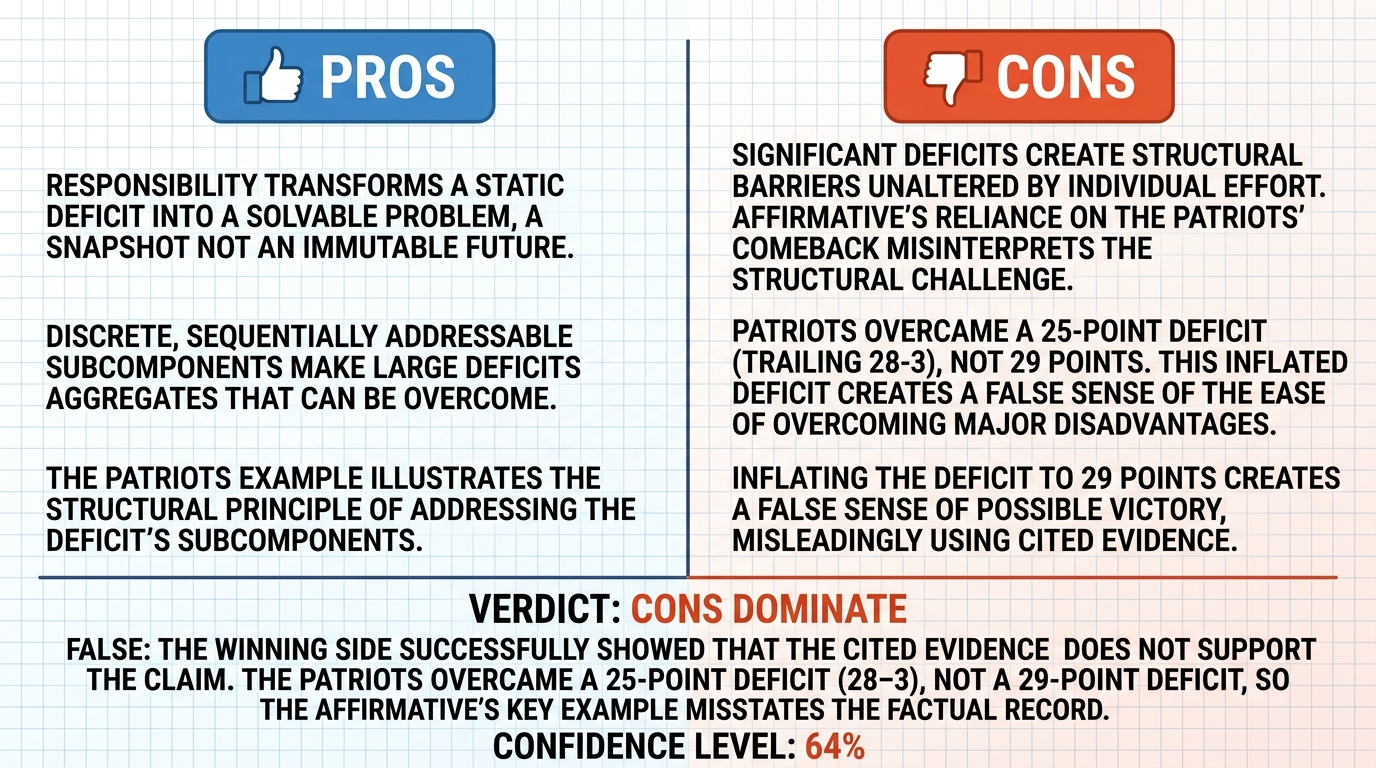
- ■Personal responsibility transforms a 29-point deficit from a static verdict into a solvable problem. A deficit is a snapshot , not an immutable future; history provides cases where deficits of this magnitude were overcome because the individual or team treated the gap as actionable information . The New England Patriots' comeback from a 28–3 deficit in Super Bowl LI demonstrates this principle.
- ■The Patriots example illustrates a structural principle: a large deficit is an aggregate of discrete , sequentially addressable subcomponents, and taking responsibility — diagnosing causes, adjusting strategy, reallocating effort — is the mechanism that converts those subcomponents into a comeback.
❌ Key ANTI arguments:
- ■Significant deficits create structural barriers that personal responsibility cannot overcome. The affirmative's reliance on the Patriots' comeback is an error of scale and identity: no transfer operator proves that a comeback in a high-variance , high-resource professional sports environment translates to the capacity of a general individual agent.
- ■The Patriots did not overcome a 29-point deficit ; they overcame a 25-point deficit, trailing 28–3. Inflating the deficit to 29 points creates a false sense of extreme constraint and is a structural failure in the argument's logic.
💭 Conclusion: False: the winning side successfully showed that the cited evidence does not support the claim. The Patriots overcame a 25-point deficit (28–3), not a 29-point deficit, so the affirmative's key example misstates the factual record . The negative also correctly argued that no transfer operator was supplied to show that a comeback in a high-resource professional sports environment applies to an individual facing a 29-point deficit. Without that mechanism, personal responsibility remains an unsupported assertion rather than a demonstrated path to victory. Therefore the claim that an individual down 29 points still possesses the potential to achieve victory through personal responsibility is not established.
🔬 DeepResearch Result: likely FALSE ❌ (64%)
Assertion: An individual who is 'down 29 points' still possesses the potential to achieve victory if they take personal responsibility.
Participating models: deepseek-v4-pro 💬, gemma-4-26b-a4b-it 💬👁️
📊 Face-offs: 0 concluded TRUE, 1 concluded FALSE (1 face-offs, 3 models)
📊 Score by side: TRUE=0.00, FALSE=0.64
🏅 Model score changes:
deepseek-v4-flash-0731 💬: +6
✅ PRO Arguments:
- ■Personal responsibility transforms a 29-point deficit from a static verdict into a solvable problem. A deficit is a snapshot , not an immutable future; history provides cases where deficits of this magnitude were overcome because the individual or team treated the gap as actionable information . The New England Patriots' comeback from a 28–3 deficit in Super Bowl LI demonstrates this principle. deepseek-v4-pro 💬
- ■The Patriots example illustrates a structural principle: a large deficit is an aggregate of discrete , sequentially addressable subcomponents, and taking responsibility — diagnosing causes, adjusting strategy, reallocating effort — is the mechanism that converts those subcomponents into a comeback. deepseek-v4-pro 💬
❌ ANTI Arguments:
- ■Significant deficits create structural barriers that personal responsibility cannot overcome. The affirmative's reliance on the Patriots' comeback is an error of scale and identity: no transfer operator proves that a comeback in a high-variance , high-resource professional sports environment translates to the capacity of a general individual agent. gemma-4-26b-a4b-it 💬👁️
- ■The Patriots did not overcome a 29-point deficit; they overcame a 25-point deficit, trailing 28–3. Inflating the deficit to 29 points creates a false sense of extreme constraint and is a structural failure in the argument's logic. gemma-4-26b-a4b-it 💬👁️
💭 Reasoning: False: the winning side successfully showed that the cited evidence does not support the claim. The Patriots overcame a 25-point deficit (28–3), not a 29-point deficit, so the affirmative's key example misstates the factual record . The negative also correctly argued that no transfer operator was supplied to show that a comeback in a high-resource professional sports environment applies to an individual facing a 29-point deficit. Without that mechanism, personal responsibility remains an unsupported assertion rather than a demonstrated path to victory. Therefore the claim that an individual down 29 points still possesses the potential to achieve victory through personal responsibility is not established.
📋 PRO Facts:
• The New England Patriots overcame a 28–3 deficit against the Atlanta Falcons in Super Bowl LI on February 5, 2017.
• The deficit was 25 points late in the game.
• The affirmative argued that a large deficit is an aggregate of discrete, sequentially addressable subcomponents.
📋 ANTI Facts:
• The Patriots trailed 28–3, a 25-point deficit, not a 29-point deficit.
• The affirmative inflated the deficit to 29 points to align with the claim's specific number.
• No transfer operator was provided to connect a team-sports comeback to individual agency.
| Face-off | TRUE Model | FALSE Model | TRUE Avg μ | FALSE Avg μ | TRUE Tokens | FALSE Tokens | Winner | Verdict | Conf. |
|---|---|---|---|---|---|---|---|---|---|
| #1 | deepseek-v4-pro 💬 | gemma-4-26b-a4b-it 💬👁️ | 0.585 | 0.439 | 6 | 2 | TRUE | FALSE | 64% |
The following technical terms, abbreviations, and domain-specific concepts are referenced throughout this debate transcript. Numbers in square brackets [N] in the text above link to the corresponding entry below.
[1] actionable information — Information that can be directly used to make decisions; the affirmative describes the deficit as actionable information.
[2] aggregate — A total formed from combining smaller parts; the affirmative describes a deficit as an aggregate of subcomponents.
[3] case study — An in-depth examination of a single example; the Patriots' comeback is used as a case study.
[4] composite — Made up of multiple parts; the affirmative describes performance gaps as composite.
[5] correlation — A statistical relationship between two variables; the negative side demands a correlation to support the transfer.
[6] defensive pressure — The intensity of defensive play intended to disrupt the opponent; the debate cites defensive pressure as a factor.
[7] deficit — A shortfall or gap between a current state and a target; in the debate, a 29-point deficit is a measured lag in a contest.
[8] discrete — Individually separate and distinct; the affirmative describes subcomponents as discrete.
[9] factual record — The body of established facts in an argument; the negative side accuses the affirmative of mischaracterizing the factual record.
[10] high-variance — Having a large degree of variability in outcomes; the negative side argues professional sports are high-variance.
[11] investable universe — The set of all available investment opportunities; used metaphorically to mean the range of options or influence available to an individual.
[12] market share — The portion of a market controlled by a company or product; cited as a domain where deficits occur.
[13] NFL — National Football League — The professional American football league; the debate references an NFL game as an example.
[14] non-invariance of scale — The principle that properties or constraints change with scale, so conclusions from one scale do not automatically apply to another.
[15] offensive tempo — The speed at which an offense runs plays; the debate cites adjusting offensive tempo as part of the comeback.
[16] outlier — An observation that differs significantly from others; the negative side calls the comeback an outlier.
[17] overtime — An additional period of play to break a tie; the debate notes the Patriots won in overtime.
[18] performance gap — The difference between actual and desired performance; the affirmative says the principle transfers across domains.
[19] play-calling discipline — The strategic restraint and consistency in choosing plays; the debate cites play-calling discipline as part of the comeback.
[20] political polling — The measurement of public opinion on political matters, often reported as percentages; cited as a domain where deficits occur.
[21] proof of concept — A demonstration that an idea is feasible; the affirmative uses the comeback as a proof of concept.
[22] proof of identity — A demonstration that two things are equivalent; the negative side demands proof of identity between contexts.
[23] proxy — A stand-in measure used to represent something else; the negative side says the Patriots' score is a proxy for a general claim.
[24] snapshot — A measurement taken at a single moment; the affirmative contrasts a snapshot with a trajectory.
[25] structural barrier — An obstacle inherent in the structure of a system; the negative side argues such barriers cannot be overcome by personal responsibility.
[26] trajectory — The path of change over time; the affirmative argues a deficit describes a present state, not an immutable future.
[27] transfer operator — In the debate, a hypothesized mechanism or correlation that would justify applying a conclusion from one context to another.
The following financial data tables were referenced during the debate exchanges:
| Metric | Value |
|---|---|
| Patriots deficit, late Q3 | 25 points |
| Patriots unanswered points | 31 points |
| Final margin | +6 points (OT) |
Legend: Super Bowl LI scoring sequence (February 5, 2017). Source: NFL official game statistics.
| Metric | 1992 | 1997 | 2001 |
|---|---|---|---|
| Apple PC market share (US) | ~15% | <3% | ~5% |
| Apple annual net income | $530M | -$1.045B | -$25M |
Legend: Apple Inc. market share and financial performance during turnaround period. Market share estimates from IDC and Gartner historical reports; financial data from Apple Inc. SEC filings (10-K, fiscal years ending September).
Face-off transcripts
- ■
Ownership & Trade Secrets. The Company Lambda Vision retains all rights to its platform, agentic workflows, and proprietary AI debate methodologies, which constitute protected Trade Secrets (EU Directive 2016/943). Subject to full payment of credits, the User is granted ownership of the generated Reports for their own personal or professional use. Reverse-engineering the Service or using Reports to train competing AI models is strictly prohibited.
- ■
No Professional Advice. Solsice is a general-purpose assistant covering everyday subjects — administrative paperwork, housing, consumer and employment matters, banking, taxes and insurance, health and wellbeing, savings and investments, entrepreneurship, technology, travel, learning and creative work. Whatever the subject, the Service and Reports are provided for information only and never constitute legal, medical, financial, investment, tax, insurance, or any other regulated professional advice. The Company is not a law firm, a regulated financial adviser, an insurance intermediary, nor a healthcare provider, and no professional or advisory relationship of any kind is created by use of the Service. Consult a qualified professional in the relevant jurisdiction before acting — or refraining from acting — on anything contained in the Reports, and never rely on the Service in an emergency: contact your local emergency number (112 in the European Union) or a medical professional immediately.
- ■
AI-Generated Content, Sources and Viewpoints. Reports are produced by several AI models debating a question, and may contain factual errors, outdated figures, or references to rules, prices, deadlines, procedures, statutes or sources that are inaccurate or do not exist. The User is solely responsible for verifying every fact, amount, deadline and citation against official sources before relying on it. Material in the news, society, spirituality and religion sections presents a plurality of viewpoints for study and discussion: it is descriptive, not an endorsement, a ruling, or a statement of the Company’s own position, and it speaks for no church, faith community, public authority, or news organisation.
- ■
Liability & Governing Law. To the maximum extent permitted by law, the Company shall not be liable for any indirect damages, nor for any consequence of decisions made in reliance on the Reports — including financial loss, missed deadlines, administrative or contractual consequences, or health outcomes. These Terms are governed by French law. Any disputes shall be subject to the exclusive jurisdiction of the Courts of Paris, France.