
An individual who is 5 feet 2 inches tall and weighs 147 pounds is not obese but is 'fat' and 'close to obesity'.
AI debate verdict and arguments
⚠️ AI-generated information only; not professional advice
Completed October 21, 2026
Verdict
Verdict: likely FALSE (70%)
Web Report: https://solsice.com/public/debates/an-individual-who-is-5-feet-2-inches-tall-and-weighs-147-pou-ccdaf4df0b29
This section provides a brief overview of the key arguments. You do not need to read the full detailed report below.
✅ Key PRO arguments:
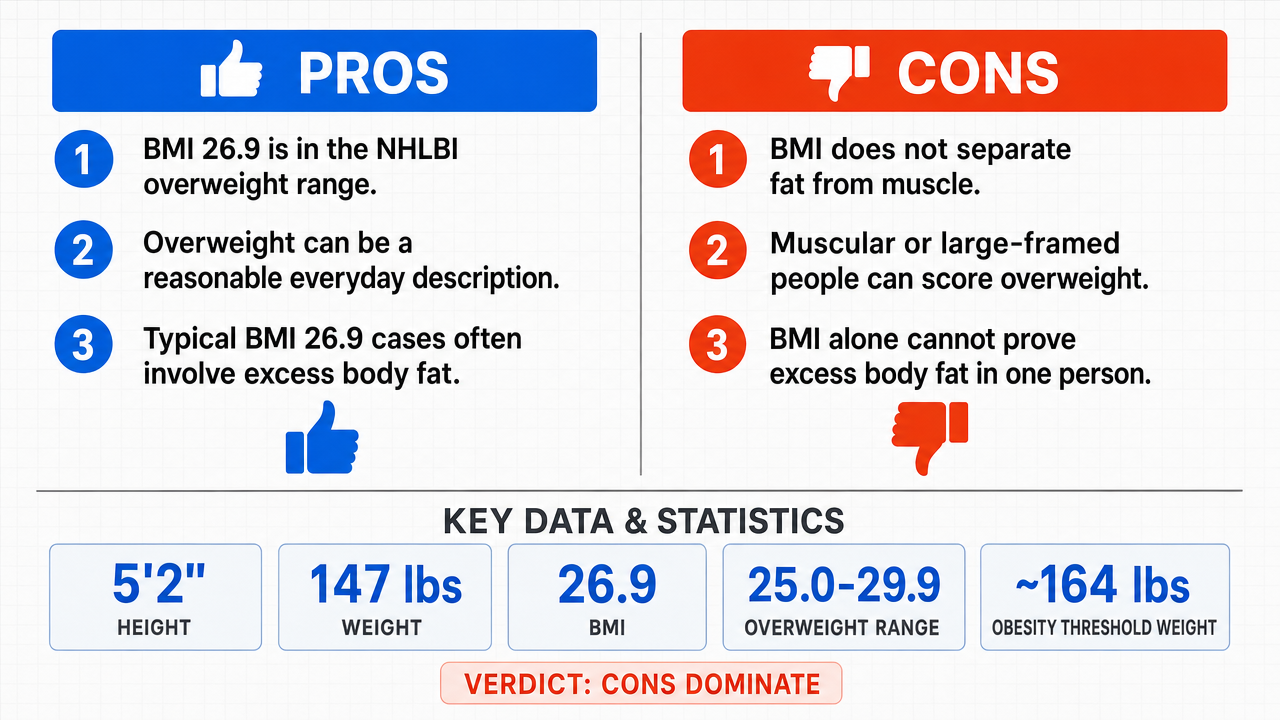
- ■A 5'2", 147-pound individual has a BMI of 26.9 kg/m² , which the NHLBI classifies as 'overweight ' (BMI 25.0–29.9), making 'fat' a reasonable lay description and placing them only 3.1 BMI points from the obesity threshold of 30.
- ■BMI 's misclassification error is overwhelmingly unidirectional at the population level, so the typical case of a BMI 26.9 individual does correspond to excess adiposity rather than high muscle mass.
❌ Key ANTI arguments:
- ■BMI is a simple ratio of mass to height squared that fails to distinguish between fat mass and lean muscle mass , making it an imprecise instrument for characterizing an individual's actual body composition .
- ■An individual with high muscle density or a robust skeletal structure can possess a BMI in the 'overweight ' range without having excess body fat, so labeling them 'fat' is medically inaccurate without further assessment.
- ■The term 'fat' implies a specific physiological state of excess adiposity , and without body composition data (e.g., DEXA, hydrostatic weighing), BMI alone cannot justify applying that label to any given individual.
💭 Conclusion: The BMI calculation of 26.9 is mathematically correct and places the individual in the 'overweight ' statistical category. However, the argument that BMI alone is sufficient to label a specific individual as 'fat' or 'close to obesity ' overreaches what the available evidence can establish. While the evidence confirms the individual is not obese by BMI standards (3.1 points below the threshold), BMI cannot differentiate fat mass from lean mass , and without body composition data, claims about this specific individual's actual body fat percentage are unsupported.
🔬 DeepResearch Result: likely FALSE ❌ (70%)
Assertion: An individual who is 5 feet 2 inches tall and weighs 147 pounds is not obese but is 'fat' and 'close to obesity '.
Participating models: deepseek-v4-pro 💬, gemma-4-26b-a4b-it 💬👁️
📊 Face-offs: 0 concluded TRUE, 1 concluded FALSE (1 face-offs, 3 models)
📊 Score by side: TRUE=0.00, FALSE=0.70
🏅 Model score changes:
minimax-m3 💬👁️: +7
✅ PRO Arguments:
- ■A 5'2", 147-pound individual has a BMI of 26.9 kg/m² , which the NHLBI classifies as 'overweight ' (BMI 25.0–29.9), making 'fat' a reasonable lay description and placing them only 3.1 BMI points from the obesity threshold of 30. deepseek-v4-pro 💬
- ■BMI's misclassification error is overwhelmingly unidirectional at the population level, so the typical case of a BMI 26.9 individual does correspond to excess adiposity rather than high muscle mass. deepseek-v4-pro 💬
❌ ANTI Arguments:
- ■BMI is a simple ratio of mass to height squared that fails to distinguish between fat mass and lean muscle mass , making it an imprecise instrument for characterizing an individual's actual body composition . gemma-4-26b-a4b-it 💬👁️
- ■An individual with high muscle density or a robust skeletal structure can possess a BMI in the 'overweight' range without having excess body fat, so labeling them 'fat' is medically inaccurate without further assessment. gemma-4-26b-a4b-it 💬👁️
- ■The term 'fat' implies a specific physiological state of excess adiposity, and without body composition data (e.g., DEXA, hydrostatic weighing), BMI alone cannot justify applying that label to any given individual. gemma-4-26b-a4b-it 💬👁️
💭 Reasoning: The BMI calculation of 26.9 is mathematically correct and places the individual in the 'overweight' statistical category. However, the argument that BMI alone is sufficient to label a specific individual as 'fat' or 'close to obesity' overreaches what the available evidence can establish. While the evidence confirms the individual is not obese by BMI standards (3.1 points below the threshold), BMI cannot differentiate fat mass from lean mass , and without body composition data, claims about this specific individual's actual body fat percentage are unsupported.
📋 PRO Facts:
• A 5'2" (62 inch), 147-pound individual has a calculated BMI of 26.9 kg/m².
• The NHLBI classifies BMI 25.0–29.9 as 'overweight' and BMI ≥30.0 as 'obese'.
• A BMI of 26.9 is 3.1 points below the clinical obesity threshold of 30.
📋 ANTI Facts:
• BMI is a ratio of total mass to height squared and does not differentiate fat mass from fat-free mass .
• Research published in the International Journal of Obesity demonstrates that BMI cannot reliably distinguish between adipose tissue and lean muscle tissue.
• Individuals with high muscle density can register in the 'overweight' BMI range without clinically significant excess body fat.
| Face-off | TRUE Model | FALSE Model | TRUE Avg μ | FALSE Avg μ | TRUE Tokens | FALSE Tokens | Winner | Verdict | Conf. |
|---|---|---|---|---|---|---|---|---|---|
| #1 | deepseek-v4-pro 💬 | gemma-4-26b-a4b-it 💬👁️ | 0.618 | 0.366 | 6 | 2 | TRUE | FALSE | 70% |
The following technical terms, abbreviations, and domain-specific concepts are referenced throughout this debate transcript. Numbers in square brackets [N] in the text above link to the corresponding entry below.
[1] adiposity — The state of having an excessive accumulation of body fat; a clinical term for fatness used in medical and physiological contexts.
[2] BMI — Body Mass Index — A standardized metric calculated as a person's weight in kilograms divided by the square of their height in meters (kg/m²), used as a screening tool to categorize weight status.
[3] body composition — The relative proportions of fat mass, lean muscle mass, bone, and other tissues that make up an individual's total body weight.
[4] body fat percentage — The proportion of total body mass that is composed of fat tissue, as opposed to lean mass, bone, or water.
[5] bone density — A measure of the mineral content (typically calcium and phosphorus) packed into a given volume of bone, indicating skeletal strength and mass.
[6] categorical error — A logical fallacy in which a term or concept is applied to a situation to which it does not properly belong, often due to conflating distinct categories.
[7] diagnostic error — A misclassification by a screening or diagnostic tool, which can occur as a false positive or false negative relative to the true condition.
[8] false negative — In diagnostic testing, an error in which an individual who truly has the condition is incorrectly classified as not having it by the screening metric.
[9] false positive — In diagnostic testing, an error in which an individual who does not have the condition is incorrectly classified as having it by the screening metric.
[10] fat mass — The total weight of adipose (fat) tissue in the body, distinct from lean or fat-free mass.
[11] fat-free mass — The component of body composition excluding all fat tissue, including muscle, bone, organs, and water.
[12] kg/m² — kilograms per square meter — The standard unit of measurement for Body Mass Index (BMI), expressing weight normalized by height squared.
[13] lean mass — lean body mass — The portion of body weight attributable to muscle, bone, organs, and water, excluding fat tissue.
[14] lean muscle mass — The weight attributable specifically to skeletal muscle tissue, which contributes to overall body weight without representing adiposity.
[15] misclassification error — The rate or frequency at which a classification tool (such as BMI) incorrectly assigns an individual to a category that does not reflect their true status.
[16] NHLBI — National Heart, Lung, and Blood Institute — A U.S. National Institutes of Health institute that publishes clinical guidelines, including the standard BMI classification thresholds for overweight and obesity cited in the debate.
[17] obesity — A clinical classification, per NHLBI guidelines cited in the debate, of having a BMI of 30.0 or higher, indicating excess body fat associated with elevated health risks.
[18] obesity threshold — The BMI value of 30.0 kg/m², which serves as the clinical cutoff separating the 'overweight' category from the 'obese' category.
[19] overweight — A clinical classification, per NHLBI guidelines cited in the debate, of having a BMI between 25.0 and 29.9.
[20] physiological cliff — A metaphorical term used in the debate to argue that crossing a numerical BMI threshold (e.g., 29.9 to 30.0) does not correspond to an abrupt biological change in body composition.
[21] specificity — In diagnostic testing, the proportion of true negatives correctly identified by the test; high specificity means few false positives, as cited in the debate regarding BMI's performance.
[22] statistical demarcation — A numerical cutoff used to separate categories in a classification system, which may not correspond to a meaningful biological boundary.
The following financial data tables were referenced during the debate exchanges:
| Metric | Value |
|---|---|
| Height | 5'2" (62 inches) |
| Weight | 147 lbs |
| Calculated BMI | 26.9 kg/m² |
| Overweight Range | 25.0 – 29.9 kg/m² |
| Obesity Threshold | ≥ 30.0 kg/m² |
| Weight at Obesity Threshold (BMI 30) | ~164 lbs |
| Gap to Obesity | ~17 lbs (3.1 BMI points) |
Legend: BMI calculation and classification for the specified individual. BMI formula: (Weight in lbs / Height in inches²) × 703. Classification thresholds per NHLBI guidelines.
| Metric | BMI Value | Classification (NHLBI) |
|---|---|---|
| Normal Weight | 18.5 – 24.9 | Healthy |
| Overweight | 25.0 – 29.9 | Overweight |
| Obesity | ≥ 30.0 | Obese |
| Target Individual | 26.9 | Overweight |
Legend: BMI classification ranges according to National Heart, Lung, and Blood Institute standards.
| BMI Diagnostic Performance | Men | Women |
|---|---|---|
| Specificity (correctly identifying obesity) | 95% | 99% |
| Sensitivity (correctly identifying non-obesity) | 36% | 49% |
| False-Positive Rate (muscular but classified overweight) | 5% | 1% |
Legend: Diagnostic performance of BMI ≥ 25 for identifying obesity defined by body fat percentage (>25% men, >35% women) in 13,601 US adults. Source: Romero-Corral et al., International Journal of Obesity, 2008.
Face-off transcripts
- ■
Ownership & Trade Secrets. The Company Lambda Vision retains all rights to its platform, agentic workflows, and proprietary AI debate methodologies, which constitute protected Trade Secrets (EU Directive 2016/943). Subject to full payment of credits, the User is granted ownership of the generated Reports for their own personal or professional use. Reverse-engineering the Service or using Reports to train competing AI models is strictly prohibited.
- ■
No Professional Advice. Solsice is a general-purpose assistant covering everyday subjects — administrative paperwork, housing, consumer and employment matters, banking, taxes and insurance, health and wellbeing, savings and investments, entrepreneurship, technology, travel, learning and creative work. Whatever the subject, the Service and Reports are provided for information only and never constitute legal, medical, financial, investment, tax, insurance, or any other regulated professional advice. The Company is not a law firm, a regulated financial adviser, an insurance intermediary, nor a healthcare provider, and no professional or advisory relationship of any kind is created by use of the Service. Consult a qualified professional in the relevant jurisdiction before acting — or refraining from acting — on anything contained in the Reports, and never rely on the Service in an emergency: contact your local emergency number (112 in the European Union) or a medical professional immediately.
- ■
AI-Generated Content, Sources and Viewpoints. Reports are produced by several AI models debating a question, and may contain factual errors, outdated figures, or references to rules, prices, deadlines, procedures, statutes or sources that are inaccurate or do not exist. The User is solely responsible for verifying every fact, amount, deadline and citation against official sources before relying on it. Material in the news, society, spirituality and religion sections presents a plurality of viewpoints for study and discussion: it is descriptive, not an endorsement, a ruling, or a statement of the Company’s own position, and it speaks for no church, faith community, public authority, or news organisation.
- ■
Liability & Governing Law. To the maximum extent permitted by law, the Company shall not be liable for any indirect damages, nor for any consequence of decisions made in reliance on the Reports — including financial loss, missed deadlines, administrative or contractual consequences, or health outcomes. These Terms are governed by French law. Any disputes shall be subject to the exclusive jurisdiction of the Courts of Paris, France.