
An individual's health freedom is being eroded by a growing emphasis on mandatory vaccinations and a push towards digital health passports by 2026.
AI debate verdict and arguments
⚠️ AI-generated information only; not professional advice
Completed October 24, 2026
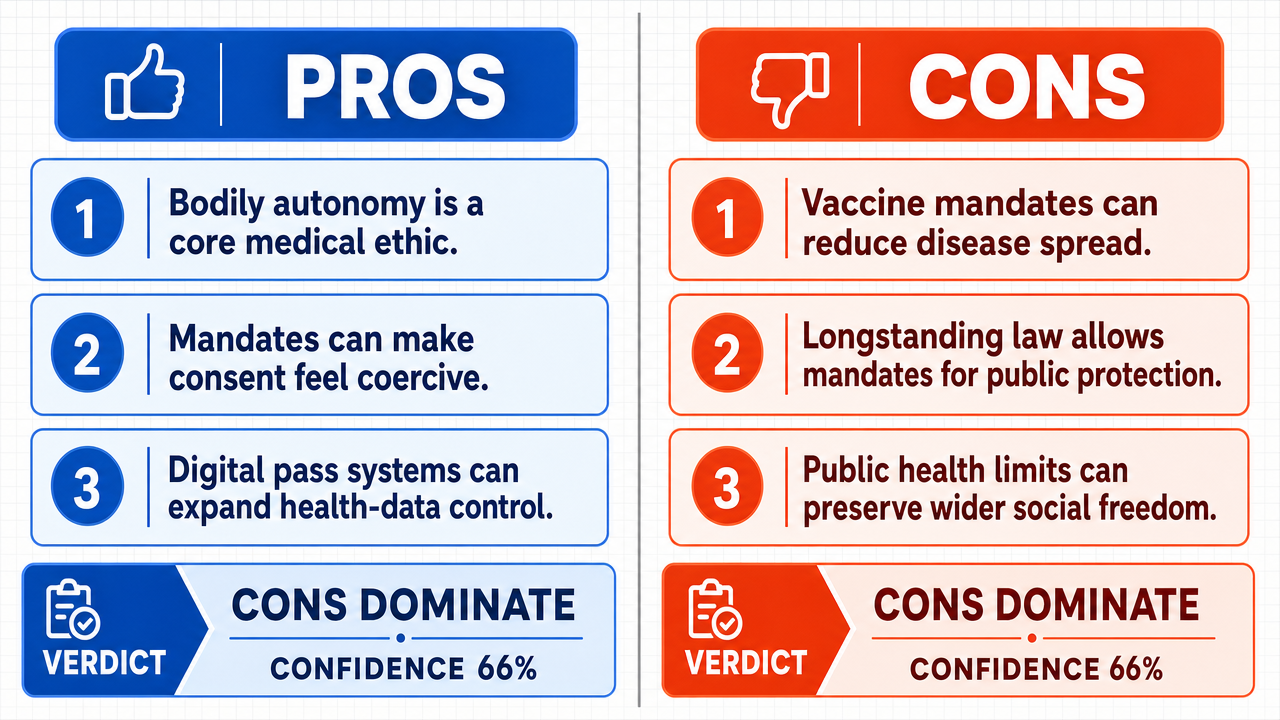
Verdict
Verdict: likely FALSE (66%)
Web Report: https://solsice.com/public/debates/an-individual-s-health-freedom-is-being-eroded-by-a-growing-44b302d3aef6
This section provides a brief overview of the key arguments. You do not need to read the full detailed report below.
✅ Key PRO arguments:
- ■Mandatory vaccination policies undermine the fundamental principle of bodily autonomy , a cornerstone of medical ethics . When vaccination becomes a prerequisite for participation in essential societal functions such as employment, education, or travel, the 'choice' to refuse medical intervention ceases to be free and becomes a coerced decision to avoid social and economic exclusion .
- ■The opponent's position is logically incoherent because it simultaneously claims that mandatory vaccines and digital passports 'enhance public safety and access' and that they 'do not erode freedom.' Asserting both a benefit and the absence of a corresponding cost within the same claim constitutes a logical contradiction, undermining the stability of their argument.
❌ Key ANTI arguments:
- ■Mandatory vaccination policies have proven effective in reducing the transmission of infectious diseases, thereby preserving the collective freedom of society to function without catastrophic health system failure. According to WHO and CDC data, jurisdictions that implemented widespread vaccination mandates saw significant reductions in hospitalization rates and mortality compared to regions with lower compliance.
- ■Established legal precedent spanning over a century has upheld mandatory vaccination for school entry as a legitimate exercise of police power to protect the community from communicable diseases . This demonstrates that the 'conditional' nature of access to public spaces is a fundamental aspect of law, not a novel erosion of rights.
- ■The restriction on individual non-interference is outweighed by the preservation of public health infrastructure, which is a prerequisite for the exercise of other freedoms. Public safety justifies conditions on civil participation , and medical compliance is a valid condition for civil participation under established jurisprudence.
💭 Conclusion: False. The assertion that health freedom is being eroded by mandatory vaccinations and digital health passports is not supported by the evidence presented in this debate. The winning side demonstrated that mandatory vaccination policies have empirically reduced disease transmission, hospitalization rates , and mortality according to WHO and CDC data, thereby preserving collective public health freedom rather than eroding individual liberty . Furthermore, established legal precedent spanning over a century has upheld mandatory vaccination for school entry as a legitimate exercise of police power , indicating that conditional access to public spaces is a longstanding legal principle rather than a novel erosion of rights. The pro side's argument about bodily autonomy , while philosophically coherent, failed to overcome the empirical and legal evidence presented by the anti side. The judge ruled FALSE with 66% confidence, reflecting moderate certainty given the limited single-debate scope and the compound nature of the claim involving both mandatory vaccinations and digital health passports.
🔬 DeepResearch Result: likely FALSE ❌ (66%)
Assertion: An individual's health freedom is being eroded by a growing emphasis on mandatory vaccinations and a push towards digital health passports by 2026.
Participating models: gemma-4-26b-a4b-it 💬👁️, glm-4.7-flash 💬
📊 Face-offs: 0 concluded TRUE, 1 concluded FALSE (1 face-offs, 3 models)
📊 Score by side: TRUE=0.00, FALSE=0.66
🏅 Model score changes:
minimax-m3 💬👁️: +7
✅ PRO Arguments:
- ■Mandatory vaccination policies undermine the fundamental principle of bodily autonomy , a cornerstone of medical ethics . When vaccination becomes a prerequisite for participation in essential societal functions such as employment, education, or travel, the 'choice' to refuse medical intervention ceases to be free and becomes a coerced decision to avoid social and economic exclusion . gemma-4-26b-a4b-it 💬👁️
- ■The opponent's position is logically incoherent because it simultaneously claims that mandatory vaccines and digital passports 'enhance public safety and access' and that they 'do not erode freedom.' Asserting both a benefit and the absence of a corresponding cost within the same claim constitutes a logical contradiction, undermining the stability of their argument. gemma-4-26b-a4b-it 💬👁️
❌ ANTI Arguments:
- ■Mandatory vaccination policies have proven effective in reducing the transmission of infectious diseases, thereby preserving the collective freedom of society to function without catastrophic health system failure. According to WHO and CDC data, jurisdictions that implemented widespread vaccination mandates saw significant reductions in hospitalization rates and mortality compared to regions with lower compliance. glm-4.7-flash 💬
- ■Established legal precedent spanning over a century has upheld mandatory vaccination for school entry as a legitimate exercise of police power to protect the community from communicable diseases . This demonstrates that the 'conditional' nature of access to public spaces is a fundamental aspect of law, not a novel erosion of rights. glm-4.7-flash 💬
- ■The restriction on individual non-interference is outweighed by the preservation of public health infrastructure, which is a prerequisite for the exercise of other freedoms. Public safety justifies conditions on civil participation , and medical compliance is a valid condition for civil participation under established jurisprudence. glm-4.7-flash 💬
💭 Reasoning: False. The assertion that health freedom is being eroded by mandatory vaccinations and digital health passports is not supported by the evidence presented in this debate. The winning side demonstrated that mandatory vaccination policies have empirically reduced disease transmission, hospitalization rates, and mortality according to WHO and CDC data, thereby preserving collective public health freedom rather than eroding individual liberty . Furthermore, established legal precedent spanning over a century has upheld mandatory vaccination for school entry as a legitimate exercise of police power, indicating that conditional access to public spaces is a longstanding legal principle rather than a novel erosion of rights. The pro side's argument about bodily autonomy, while philosophically coherent, failed to overcome the empirical and legal evidence presented by the anti side. The judge ruled FALSE with 66% confidence, reflecting moderate certainty given the limited single-debate scope and the compound nature of the claim involving both mandatory vaccinations and digital health passports.
📋 PRO Facts:
• Bodily autonomy is recognized as a cornerstone of medical ethics.
• Various jurisdictions have implemented vaccine mandates as prerequisites for access to public spaces or services.
📋 ANTI Facts:
• According to WHO and CDC data, jurisdictions that implemented widespread vaccination mandates saw significant reductions in hospitalization rates and mortality compared to regions with lower compliance.
• For over a century, mandatory vaccination for school entry has been upheld by courts as a legitimate exercise of police power to protect the community from communicable diseases.
| Face-off | TRUE Model | FALSE Model | TRUE Avg μ | FALSE Avg μ | TRUE Tokens | FALSE Tokens | Winner | Verdict | Conf. |
|---|---|---|---|---|---|---|---|---|---|
| #1 | gemma-4-26b-a4b-it 💬👁️ | glm-4.7-flash 💬 | 0.188 | 0.517 | 4 | 4 | FALSE | FALSE | 66% |
The following technical terms, abbreviations, and domain-specific concepts are referenced throughout this debate transcript. Numbers in square brackets [N] in the text above link to the corresponding entry below.
[1] biological integrity — The principle of inviolability of the human body, invoked in the debate regarding state interference with an individual's physical person.
[2] bodily autonomy — The principle that individuals have the right to make decisions about their own bodies and medical treatments without external coercion, a concept in medical ethics.
[3] civil participation — Engagement in the activities and institutions of civic life, such as employment, education, and access to public spaces.
[4] communicable diseases — Infectious diseases that can be transmitted from person to person, often the target of public health interventions such as vaccination.
[5] conditional right — A right whose exercise is predicated on meeting specified criteria or conditions, discussed in the context of access contingent on health status verification.
[6] data privacy — The protection of personal information from unauthorized access or misuse, relevant in the context of digital health credential systems.
[7] digital health passports — Digital credentials that verify an individual's health status, such as immunity or test results. The debate disputes whether these function as surveillance mechanisms or solely as logistical verification tools.
[8] European Union Digital COVID Certificate — A digital verification system cited in the debate as an example of a health passport that verifies a specific status without tracking location or collecting personal data beyond the verification event.
[9] function creep — The gradual expansion of a system's use beyond its originally intended purpose, cited as a theoretical risk of digital health passports.
[10] hospitalization rates — A metric measuring the frequency of hospital admissions, used in the debate to assess the effectiveness of vaccination policies.
[11] immunity status — An individual's documented state of protection against a specific disease, often verified through digital health passports.
[12] individual liberty — The freedom of individuals to act and make choices without undue external constraint, contrasted in the debate with collective public health interests.
[13] institutional frameworks — The established structures, rules, and systems within organizations or governments that shape policy implementation.
[14] legal precedent — A previously decided case or ruling that serves as an authority for analogous subsequent situations, cited regarding the upholding of mandatory vaccination for school entry.
[15] mandatory vaccinations — Policies requiring individuals to receive specific vaccines. The debate disputes whether such policies erode individual autonomy or constitute legitimate public health measures.
[16] medical ethics — The branch of ethics dealing with moral principles in the practice of medicine, including patient autonomy and bodily integrity.
[17] mortality — The incidence of death within a population, used as a metric to evaluate public health interventions.
[18] police power — The authority of a state to regulate matters affecting public health, safety, and welfare, cited as the legal basis for vaccination mandates.
[19] public health — The science and practice of protecting and improving community health through preventive measures, education, and policy.
[20] public health infrastructure — The systems, facilities, and resources necessary to protect and promote community health, cited as a prerequisite for individual liberty.
[21] public health law — The body of legal frameworks governing the protection of community health, including the authority to mandate medical interventions.
[22] public sphere — The arena of social life where individuals gather to discuss and address societal concerns, referenced in the context of conditional access.
[23] self-determination — The right of individuals to make choices about their own lives and bodies without external coercion.
[24] social and economic exclusion — The marginalization or denial of access to social and economic opportunities, cited as a consequence of refusing vaccination.
[25] state-mandated medical procedures — Medical interventions required by government authority, discussed as a precedent affecting individual self-determination.
[26] surveillance — The systematic monitoring of individuals' activities or data. The debate disputes whether digital health passports constitute surveillance mechanisms.
[27] vaccine mandates — Government or institutional requirements that individuals be vaccinated against specified diseases. The debate disputes whether these constitute coercion or legitimate exercises of state authority.
[28] verification event — A specific instance of confirming an individual's health status, described in the debate as the limited scope of data collection for digital certificates.
[29] verification tool — A mechanism used to confirm or authenticate a specific status or credential, such as immunity status for access purposes.
Face-off transcripts
- ■
Ownership & Trade Secrets. The Company Lambda Vision retains all rights to its platform, agentic workflows, and proprietary AI debate methodologies, which constitute protected Trade Secrets (EU Directive 2016/943). Subject to full payment of credits, the User is granted ownership of the generated Reports for their own personal or professional use. Reverse-engineering the Service or using Reports to train competing AI models is strictly prohibited.
- ■
No Professional Advice. Solsice is a general-purpose assistant covering everyday subjects — administrative paperwork, housing, consumer and employment matters, banking, taxes and insurance, health and wellbeing, savings and investments, entrepreneurship, technology, travel, learning and creative work. Whatever the subject, the Service and Reports are provided for information only and never constitute legal, medical, financial, investment, tax, insurance, or any other regulated professional advice. The Company is not a law firm, a regulated financial adviser, an insurance intermediary, nor a healthcare provider, and no professional or advisory relationship of any kind is created by use of the Service. Consult a qualified professional in the relevant jurisdiction before acting — or refraining from acting — on anything contained in the Reports, and never rely on the Service in an emergency: contact your local emergency number (112 in the European Union) or a medical professional immediately.
- ■
AI-Generated Content, Sources and Viewpoints. Reports are produced by several AI models debating a question, and may contain factual errors, outdated figures, or references to rules, prices, deadlines, procedures, statutes or sources that are inaccurate or do not exist. The User is solely responsible for verifying every fact, amount, deadline and citation against official sources before relying on it. Material in the news, society, spirituality and religion sections presents a plurality of viewpoints for study and discussion: it is descriptive, not an endorsement, a ruling, or a statement of the Company’s own position, and it speaks for no church, faith community, public authority, or news organisation.
- ■
Liability & Governing Law. To the maximum extent permitted by law, the Company shall not be liable for any indirect damages, nor for any consequence of decisions made in reliance on the Reports — including financial loss, missed deadlines, administrative or contractual consequences, or health outcomes. These Terms are governed by French law. Any disputes shall be subject to the exclusive jurisdiction of the Courts of Paris, France.