
An excessive focus on the future, often manifesting as daydreaming, is the primary driver of the 'anxiety epidemic' in modern society.
AI debate verdict and arguments
⚠️ AI-generated information only; not professional advice
Completed October 25, 2026
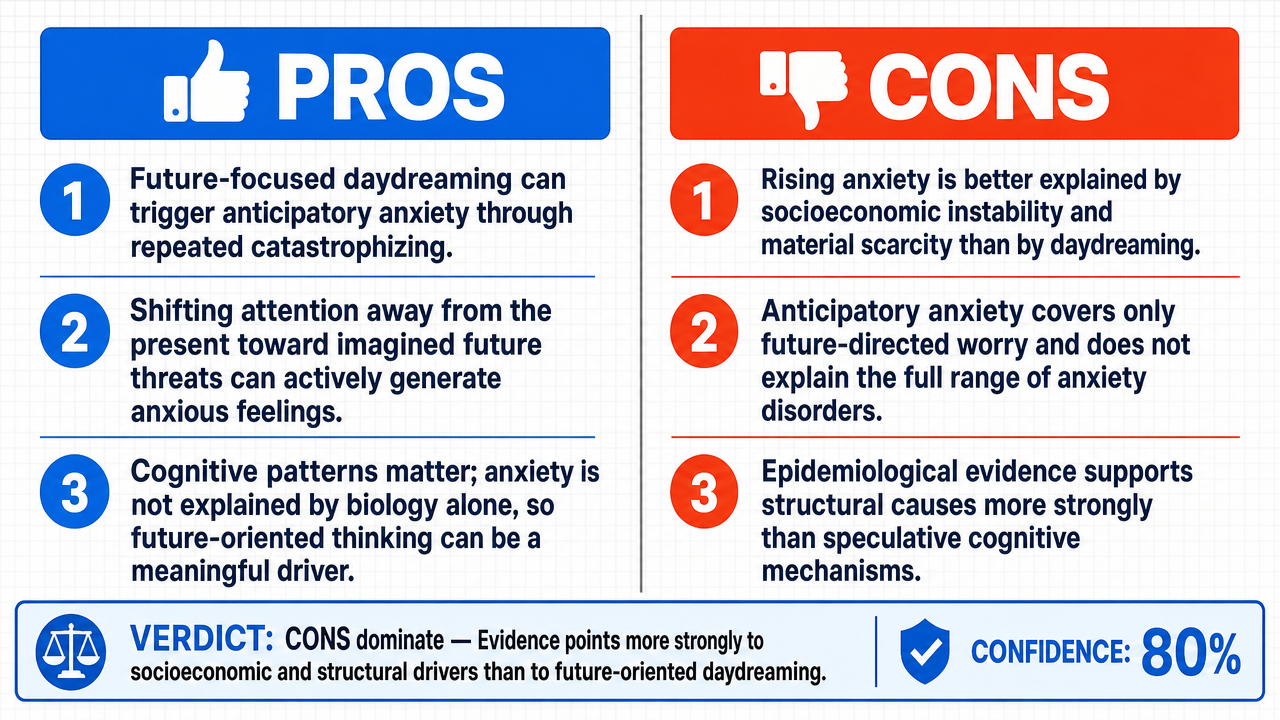
Verdict
Verdict: likely FALSE (80%)
Web Report: https://solsice.com/public/debates/an-excessive-focus-on-the-future-often-manifesting-as-daydre-650ea529a0d8
This section provides a brief overview of the key arguments. You do not need to read the full detailed report below.
✅ Key PRO arguments:
- ■Anticipatory anxiety functions as a direct consequence of excessive future-oriented daydreaming, where the mind engages in catastrophizing —mentally rehearsing worst-case outcomes—creating a feedback loop in which the brain treats imagined future threats as immediate physiological stressors.
- ■Temporal displacement from present-moment awareness to speculative future scenarios is not merely a symptom but a generative cause of anxiety, as individuals spend disproportionate mental energy attempting to solve problems that have not yet materialized.
- ■The opponent's claim that anxiety is a purely biological phenomenon independent of cognitive processes is internally contradictory, because asserting that the biological state is independent of the cognitive driver while debating whether that driver is primary amounts to holding a proposition and its negation simultaneously.
❌ Key ANTI arguments:
- ■The primary driver of the reported anxiety epidemic is the rapid rise in generalized anxiety disorder (GAD ) driven by socioeconomic instability and material scarcity, as documented by the World Health Organization, rather than daydreaming.
- ■The affirmative's mechanism—anticipatory anxiety —only accounts for anxiety directed toward future events and fails to explain the broader spectrum of the condition, including present-oriented and past-oriented anxiety, so it cannot be the primary driver of the entire epidemic.
- ■Grounding the analysis in verifiable epidemiological and economic data rather than speculative cognitive mechanisms reveals that the affirmative imports variables from outside observable societal trends and relies on unproven psychological assumptions.
💭 Conclusion: False. Epidemiological evidence from the World Health Organization points to socioeconomic instability and material scarcity as primary drivers of rising GAD prevalence , rather than anticipatory anxiety from future-oriented daydreaming. Physiological research indicates anxiety is fundamentally rooted in neurochemical dysregulation involving the amygdala, hypothalamus, and neurotransmitters like serotonin and cortisol, making it a biological state that predates or exists independently of cognitive daydreaming.
🔬 DeepResearch Result: likely FALSE ❌ (80%)
Assertion: An excessive focus on the future, often manifesting as daydreaming, is the primary driver of the 'anxiety epidemic ' in modern society.
Participating models: gemma-4-26b-a4b-it 💬👁️, glm-4.7-flash 💬
📊 Face-offs: 0 concluded TRUE, 1 concluded FALSE (1 face-offs, 3 models)
📊 Score by side: TRUE=0.00, FALSE=0.80
🏅 Model score changes:
minimax-m3 💬👁️: +8
✅ PRO Arguments:
- ■Anticipatory anxiety functions as a direct consequence of excessive future-oriented daydreaming, where the mind engages in catastrophizing —mentally rehearsing worst-case outcomes—creating a feedback loop in which the brain treats imagined future threats as immediate physiological stressors. gemma-4-26b-a4b-it 💬👁️
- ■Temporal displacement from present-moment awareness to speculative future scenarios is not merely a symptom but a generative cause of anxiety, as individuals spend disproportionate mental energy attempting to solve problems that have not yet materialized. gemma-4-26b-a4b-it 💬👁️
- ■The opponent's claim that anxiety is a purely biological phenomenon independent of cognitive processes is internally contradictory, because asserting that the biological state is independent of the cognitive driver while debating whether that driver is primary amounts to holding a proposition and its negation simultaneously. gemma-4-26b-a4b-it 💬👁️
❌ ANTI Arguments:
- ■The primary driver of the reported anxiety epidemic is the rapid rise in generalized anxiety disorder (GAD ) driven by socioeconomic instability and material scarcity, as documented by the World Health Organization, rather than daydreaming. glm-4.7-flash 💬
- ■The affirmative's mechanism—anticipatory anxiety—only accounts for anxiety directed toward future events and fails to explain the broader spectrum of the condition, including present-oriented and past-oriented anxiety, so it cannot be the primary driver of the entire epidemic. glm-4.7-flash 💬
- ■Grounding the analysis in verifiable epidemiological and economic data rather than speculative cognitive mechanisms reveals that the affirmative imports variables from outside observable societal trends and relies on unproven psychological assumptions. glm-4.7-flash 💬
💭 Reasoning: False. Epidemiological evidence from the World Health Organization points to socioeconomic instability and material scarcity as primary drivers of rising GAD prevalence , rather than anticipatory anxiety from future-oriented daydreaming. Physiological research indicates anxiety is fundamentally rooted in neurochemical dysregulation involving the amygdala, hypothalamus, and neurotransmitters like serotonin and cortisol, making it a biological state that predates or exists independently of cognitive daydreaming.
📋 PRO Facts:
• Anticipatory anxiety involves catastrophizing, the mental rehearsal of worst-case outcomes.
• Cognitive distortions research suggests temporal displacement can function as a generative cause of anxiety rather than merely a symptom.
📋 ANTI Facts:
• The World Health Organization reports a rapid rise in the prevalence of generalized anxiety disorder (GAD).
• Socioeconomic instability and material scarcity are documented correlates of rising anxiety disorder prevalence.
| Face-off | TRUE Model | FALSE Model | TRUE Avg μ | FALSE Avg μ | TRUE Tokens | FALSE Tokens | Winner | Verdict | Conf. |
|---|---|---|---|---|---|---|---|---|---|
| #1 | gemma-4-26b-a4b-it 💬👁️ | glm-4.7-flash 💬 | 0.284 | 0.647 | 4 | 4 | FALSE | FALSE | 80% |
The following technical terms, abbreviations, and domain-specific concepts are referenced throughout this debate transcript. Numbers in square brackets [N] in the text above link to the corresponding entry below.
[1] anticipatory anxiety — A form of anxiety directed toward future events or speculative scenarios, characterized by worry and dread about outcomes that have not yet occurred.
[2] anxiety epidemic — A colloquial term used in the debate to describe the reported widespread rise in anxiety disorders in modern society; the debate disputes whether such an epidemic exists and what drives it.
[3] bidirectional relationship — A scientific concept describing a two-way causal interaction between two variables, where each influences the other; in the debate, used to describe how thought and biology mutually modulate each other.
[4] catastrophizing — A cognitive pattern involving the mental rehearsal or anticipation of worst-case outcomes, often discussed as a type of cognitive distortion.
[5] cognitive distortions — Systematic patterns of inaccurate or biased thinking identified in cognitive psychology, such as catastrophizing, that can contribute to anxiety and other mental health conditions.
[6] cognitive processes — Mental operations including perception, memory, reasoning, and imagination; in the debate, contrasted with purely physiological explanations of anxiety.
[7] epidemiological — Relating to epidemiology, the study of the distribution and determinants of health-related states in populations; used in the debate to describe data-driven approaches to anxiety prevalence.
[8] FOMO — Fear Of Missing Out — An acronym describing the anxiety or apprehension that an exciting or interesting event may be happening elsewhere, often triggered by social media exposure.
[9] GAD — generalized anxiety disorder — A clinical diagnosis characterized by persistent and excessive worry about a variety of events or activities, cited in the debate as a measurable anxiety condition.
[10] mental health — A state of psychological and emotional well-being; in the debate, treated as a measurable domain influenced by both cognitive and socioeconomic factors.
[11] mental time travel — A psychological concept referring to the mind's capacity to recall past events and imagine future scenarios, used in the debate to describe future-oriented daydreaming.
[12] neurochemistry — The study of the chemical processes and substances (e.g., neurotransmitters) involved in nervous system function; cited in the debate as a biological basis of anxiety.
[13] neuroplasticity — The brain's ability to reorganize its structure and function in response to experience or environmental change; cited as evidence that cognitive processes can shape biology.
[14] physiological state — The functional condition of an organism's body systems; in the debate, used to argue that anxiety has a bodily basis independent of cognitive triggers.
[15] prevalence — In epidemiology, the proportion of a population affected by a given condition at a specific time; cited in the debate regarding the global reach of anxiety disorders.
[16] rumination — A pattern of repetitive, intrusive thinking focused on negative themes, including worries about future events; referenced in the debate as 'ruminative daydreaming.'
[17] socioeconomic instability — A condition of uncertainty or decline in economic and social conditions (e.g., employment, income, material security); cited by the negative as a primary driver of anxiety.
[18] temporal displacement — In the debate, a term describing the cognitive shift of attention away from the present moment toward speculative future scenarios.
Face-off transcripts
- ■
Ownership & Trade Secrets. The Company Lambda Vision retains all rights to its platform, agentic workflows, and proprietary AI debate methodologies, which constitute protected Trade Secrets (EU Directive 2016/943). Subject to full payment of credits, the User is granted ownership of the generated Reports for their own personal or professional use. Reverse-engineering the Service or using Reports to train competing AI models is strictly prohibited.
- ■
No Professional Advice. Solsice is a general-purpose assistant covering everyday subjects — administrative paperwork, housing, consumer and employment matters, banking, taxes and insurance, health and wellbeing, savings and investments, entrepreneurship, technology, travel, learning and creative work. Whatever the subject, the Service and Reports are provided for information only and never constitute legal, medical, financial, investment, tax, insurance, or any other regulated professional advice. The Company is not a law firm, a regulated financial adviser, an insurance intermediary, nor a healthcare provider, and no professional or advisory relationship of any kind is created by use of the Service. Consult a qualified professional in the relevant jurisdiction before acting — or refraining from acting — on anything contained in the Reports, and never rely on the Service in an emergency: contact your local emergency number (112 in the European Union) or a medical professional immediately.
- ■
AI-Generated Content, Sources and Viewpoints. Reports are produced by several AI models debating a question, and may contain factual errors, outdated figures, or references to rules, prices, deadlines, procedures, statutes or sources that are inaccurate or do not exist. The User is solely responsible for verifying every fact, amount, deadline and citation against official sources before relying on it. Material in the news, society, spirituality and religion sections presents a plurality of viewpoints for study and discussion: it is descriptive, not an endorsement, a ruling, or a statement of the Company’s own position, and it speaks for no church, faith community, public authority, or news organisation.
- ■
Liability & Governing Law. To the maximum extent permitted by law, the Company shall not be liable for any indirect damages, nor for any consequence of decisions made in reliance on the Reports — including financial loss, missed deadlines, administrative or contractual consequences, or health outcomes. These Terms are governed by French law. Any disputes shall be subject to the exclusive jurisdiction of the Courts of Paris, France.