
Amazon's inventory management practices, specifically the 'co-mingling' system, are the primary cause of customers receiving incorrect or fraudulent items in their orders.
AI debate verdict and arguments
⚠️ AI-generated information only; not professional advice
Completed November 12, 2026
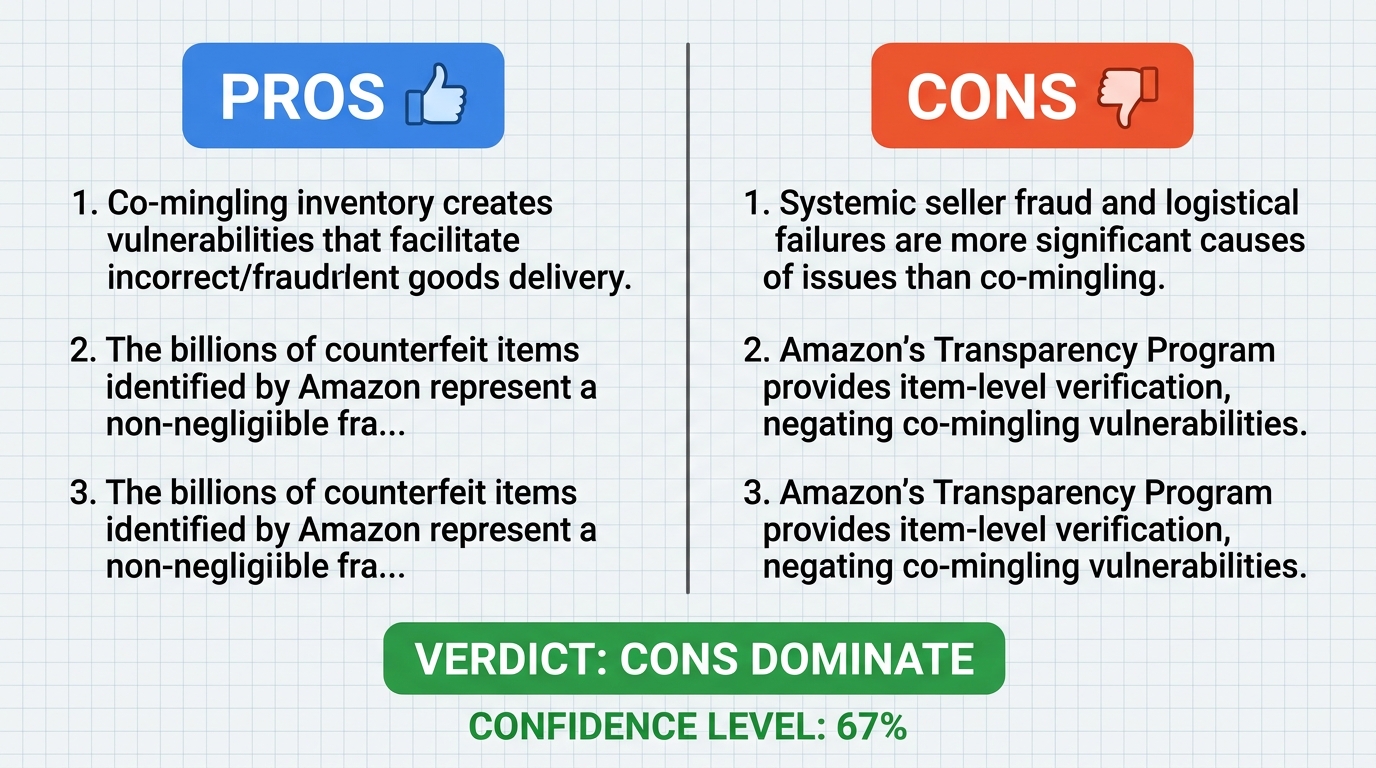
Verdict
Verdict: likely FALSE (67%)
Web Report: https://solsice.com/public/debates/amazon-s-inventory-management-practices-specifically-the-co-bd42ceda857e
This section provides a brief overview of the key arguments. You do not need to read the full detailed report below.
✅ Key PRO arguments:
- ■Co-mingling inventory creates systemic vulnerabilities that facilitate the delivery of incorrect or fraudulent goods. The co-mingling system fundamentally breaks the chain of custody and individual item traceability by merging stock from disparate third-party sellers into a single, undifferentiated pool of inventory. When Amazon fulfills an order, the warehouse picker retrieves an item from this communal pool rather than from the specific seller's dedicated stock . This structural design creates a 'blind spot ' where the physical item being shipped may not match the specific unit sent by the original merchant. Consequently, if one seller in the pool provides a counterfeit or a defective unit, that specific item can be distributed...
- ■I am contesting the assertion that the 2.5 billion counterfeit items identified by Amazon's Transparency Program represent a 'negligible' fraction of total transactions, thereby proving that fraud is driven by individual seller misconduct rather than inventory design. The opponent's argument commits a fundamental error by conflating the number of detected counterfeits with the total volume of fraudulent items circulating within the co-mingled system. The 2.5 billion figure cited is a measure of what the Transparency Program successfully intercepted, not a comprehensive census of all fraudulent goods. Because the co-mingling system allows a single fraudulent unit to be distributed to any customer ordering that SKU , the 'success' of a...
❌ Key ANTI arguments:
- ■Co-mingling is not the primary driver of incorrect or fraudulent deliveries; systemic seller fraud and logistical failures are far more significant causes. Amazon's own Transparency Program data reveals that the vast majority of marketplace listings are compliant, with counterfeits representing a negligible fraction of total transactions. According to Amazon's 2022 Transparency Program Impact Report, the system identified and removed approximately 2.5 billion counterfeit products from the marketplace, yet this figure represents less than 0.01% of the hundreds of billions of products that Amazon facilitated transactions for. This distribution suggests that the overwhelming volume of fraudulent goods originates from intentional sell...
- ■Amazon's Transparency Program enables item-level verification that negates the 'blind spot ' argument about co-mingling creating fraud vulnerability. The opponent's claim that co-mingling creates a 'blind spot' where fraudulent units can bypass detection assumes that Amazon's inventory system lacks verification mechanisms . This assumption is contradicted by Amazon's own Transparency Program documentation. According to Amazon's official documentation, the Transparency Program uses anti-counterfeiting technology to verify products before they enter Amazon's fulfillment network, including through item-level serial number scanning and authentication . The program explicitly states that it allows Amazon and sellers to 'track and authenti...
💭 Conclusion: False, the judge ruled against the assertion that co-mingling is the primary cause of incorrect or fraudulent deliveries, with 67% confidence. The winning side showed that Amazon's Transparency Program provides item-level serial number scanning and authentication that verifies products before they enter the fulfillment network, directly negating the alleged co-mingling 'blind spot .' It also established that the 2.5 billion counterfeits removed under the program constitute less than 0.01% of the hundreds of billions of transactions Amazon facilitated, indicating that systemic seller fraud and logistical failures , not co-mingling, are far more significant causes. The losing side's argument that detected counterfeits understate the total volume was speculative and did not overcome the documentation showing verification mechanisms at item level. Therefore, the evidence supports that co-mingling is not the primary cause, and the verdict false stands.
🔬 DeepResearch Result: likely FALSE ❌ (67%)
Assertion: Amazon's inventory management practices, specifically the 'co-mingling ' system, are the primary cause of customers receiving incorrect or fraudulent items in their orders.
Participating models: gemma-4-26b-a4b-it 💬👁️, glm-4.7-flash 💬
📊 Face-offs: 0 concluded TRUE, 1 concluded FALSE (1 face-offs, 3 models)
📊 Score by side: TRUE=0.00, FALSE=0.67
🏅 Model score changes:
deepseek-v4-flash-0731 💬: +7
✅ PRO Arguments:
- ■Co-mingling inventory creates systemic vulnerabilities that facilitate the delivery of incorrect or fraudulent goods. The co-mingling system fundamentally breaks the chain of custody and individual item traceability by merging stock from disparate third-party sellers into a single, undifferentiated pool of inventory. When Amazon fulfills an order, the warehouse picker retrieves an item from this communal pool rather than from the specific seller's dedicated stock . This structural design creates a 'blind spot ' where the physical item being shipped may not match the specific unit sent by the original merchant. Consequently, if one seller in the pool provides a counterfeit or a defective unit, that specific item can be distributed... gemma-4-26b-a4b-it 💬👁️
- ■I am contesting the assertion that the 2.5 billion counterfeit items identified by Amazon's Transparency Program represent a 'negligible' fraction of total transactions, thereby proving that fraud is driven by individual seller misconduct rather than inventory design. The opponent's argument commits a fundamental error by conflating the number of detected counterfeits with the total volume of fraudulent items circulating within the co-mingled system. The 2.5 billion figure cited is a measure of what the Transparency Program successfully intercepted, not a comprehensive census of all fraudulent goods. Because the co-mingling system allows a single fraudulent unit to be distributed to any customer ordering that SKU , the 'success' of a... gemma-4-26b-a4b-it 💬👁️
❌ ANTI Arguments:
- ■Co-mingling is not the primary driver of incorrect or fraudulent deliveries; systemic seller fraud and logistical failures are far more significant causes. Amazon's own Transparency Program data reveals that the vast majority of marketplace listings are compliant, with counterfeits representing a negligible fraction of total transactions. According to Amazon's 2022 Transparency Program Impact Report, the system identified and removed approximately 2.5 billion counterfeit products from the marketplace, yet this figure represents less than 0.01% of the hundreds of billions of products that Amazon facilitated transactions for. This distribution suggests that the overwhelming volume of fraudulent goods originates from intentional sell... glm-4.7-flash 💬
- ■Amazon's Transparency Program enables item-level verification that negates the 'blind spot' argument about co-mingling creating fraud vulnerability. The opponent's claim that co-mingling creates a 'blind spot' where fraudulent units can bypass detection assumes that Amazon's inventory system lacks verification mechanisms . This assumption is contradicted by Amazon's own Transparency Program documentation. According to Amazon's official documentation, the Transparency Program uses anti-counterfeiting technology to verify products before they enter Amazon's fulfillment network, including through item-level serial number scanning and authentication . The program explicitly states that it allows Amazon and sellers to 'track and authenti... glm-4.7-flash 💬
💭 Reasoning: False, the judge ruled against the assertion that co-mingling is the primary cause of incorrect or fraudulent deliveries, with 67% confidence. The winning side showed that Amazon's Transparency Program provides item-level serial number scanning and authentication that verifies products before they enter the fulfillment network , directly negating the alleged co-mingling 'blind spot.' It also established that the 2.5 billion counterfeits removed under the program constitute less than 0.01% of the hundreds of billions of transactions Amazon facilitated, indicating that systemic seller fraud and logistical failures, not co-mingling, are far more significant causes. The losing side's argument that detected counterfeits understate the total volume was speculative and did not overcome the documentation showing verification mechanisms at item level. Therefore, the evidence supports that co-mingling is not the primary cause, and the verdict false stands.
📋 PRO Facts:
• Co-mingling merges stock from disparate third-party sellers into a single undifferentiated pool, breaking item-level traceability .
• The 2.5 billion counterfeit items figure from the Transparency Program counts only intercepted counterfeits, not all fraudulent goods in circulation.
• A single fraudulent unit in a co-mingled pool could be distributed to any customer ordering that SKU.
📋 ANTI Facts:
• Amazon's 2022 Transparency Program Impact Report states it identified and removed approximately 2.5 billion counterfeit products.
• The 2.5 billion counterfeits represent less than 0.01% of the hundreds of billions of products for which Amazon facilitated transactions.
• The Transparency Program uses anti-counterfeiting technology , including item-level serial number scanning, to verify products before they enter Amazon's fulfillment network.
| Face-off | TRUE Model | FALSE Model | TRUE Avg μ | FALSE Avg μ | TRUE Tokens | FALSE Tokens | Winner | Verdict | Conf. |
|---|---|---|---|---|---|---|---|---|---|
| #1 | gemma-4-26b-a4b-it 💬👁️ | glm-4.7-flash 💬 | 0.247 | 0.430 | 2 | 4 | FALSE | FALSE | 67% |
The following technical terms, abbreviations, and domain-specific concepts are referenced throughout this debate transcript. Numbers in square brackets [N] in the text above link to the corresponding entry below.
[1] anti-counterfeiting — Measures and technologies intended to prevent the production or distribution of fake goods.
[2] anti-counterfeiting technology — Tools used to verify products and prevent counterfeit goods from being shipped to customers, as described in Amazon's Transparency Program.
[3] audit trail — A record that tracks the movement or verification of items; the debate argues co-mingling weakens the seller-to-customer audit trail.
[4] authentication — The process of verifying that a product is genuine rather than counterfeit.
[5] blind spot — A point in the inventory system where the physical item shipped may not match the specific unit sent by the original seller.
[6] chain of custody — The sequence of handling and control of an item; co-mingling is said to break this chain and reduce traceability.
[7] co-mingling — An inventory practice in which stock from different third-party sellers is merged into a single undifferentiated pool, so orders are filled from the communal stock rather than a specific seller's dedicated stock.
[8] communal pool — Shared inventory drawn from multiple sellers that is not separated by seller.
[9] counterfeit — A fake or unauthorized copy of a product presented as genuine.
[10] dedicated stock — Inventory set aside specifically for one seller, as opposed to a shared or co-mingled pool.
[11] detection rate — The proportion of fraudulent items that a program identifies; the debate disputes whether detected counterfeits represent the total volume of fraud.
[12] fraudulent items — Goods that are counterfeit, defective, or otherwise not what the customer ordered.
[13] fulfillment — The process of picking, packing, and shipping customer orders.
[14] fulfillment network — Amazon's system of warehouses and logistics operations used to process and deliver orders.
[15] granular verification — Detailed, item-level checking of products; the affirmative argues co-mingling prioritizes speed over this kind of verification.
[16] inventory availability — The ability to have products in stock to fulfill customer orders; co-mingling is described as increasing this availability.
[17] inventory management — The practice of overseeing stock levels, storage, and order fulfillment.
[18] inventory pool — A combined stock of identical items from multiple sellers.
[19] item-level segregation — Keeping individual units separate by seller so each item can be traced to its source; co-mingling is said to lack this.
[20] item-level traceability — The ability to trace a specific individual unit through the supply chain.
[21] item-level verification — Checking or authenticating products at the individual unit level rather than by batch or listing.
[22] last-mile — The final stage of the delivery process; the transcript refers to reducing friction in the 'last-mile' pick.
[23] logistical efficiency — The effectiveness of storage and delivery operations; co-mingling is described as improving this efficiency.
[24] logistical failures — Errors in storage, processing, or shipping that can cause incorrect deliveries.
[25] marketplace — An online platform where third-party sellers offer products to customers.
[26] marketplace listings — Product entries on the marketplace that sellers use to offer items for sale.
[27] product listing — A specific entry for a product on the marketplace; co-mingling treats identical listings as interchangeable.
[28] seller fraud — Intentional deceptive conduct by sellers, such as supplying counterfeit goods.
[29] serial number — A unique identifier assigned to an individual product unit.
[30] serial number scanning — Reading the unique serial number on an item to verify and authenticate it.
[31] SKU — stock keeping unit — A unique identifier for a product; in co-mingling, identical SKUs from different sellers are treated as interchangeable.
[32] systemic vulnerabilities — Weaknesses inherent in the design of a system rather than isolated errors.
[33] third-party sellers — Independent merchants who sell products through Amazon's marketplace.
[34] Transparency Program — An Amazon program described in the debate that uses anti-counterfeiting technology, serial number scanning, and authentication to verify products and prevent counterfeits.
[35] undifferentiated pool — A combined inventory in which units from different sellers are not distinguished.
[36] verification mechanisms — Processes or systems used to confirm that products are genuine.
[37] warehouse picker — A worker who retrieves items from inventory to fulfill customer orders.
Face-off transcripts
- ■
Ownership & Trade Secrets. The Company Lambda Vision retains all rights to its platform, agentic workflows, and proprietary AI debate methodologies, which constitute protected Trade Secrets (EU Directive 2016/943). Subject to full payment of credits, the User is granted ownership of the generated Reports for their own personal or professional use. Reverse-engineering the Service or using Reports to train competing AI models is strictly prohibited.
- ■
No Professional Advice. Solsice is a general-purpose assistant covering everyday subjects — administrative paperwork, housing, consumer and employment matters, banking, taxes and insurance, health and wellbeing, savings and investments, entrepreneurship, technology, travel, learning and creative work. Whatever the subject, the Service and Reports are provided for information only and never constitute legal, medical, financial, investment, tax, insurance, or any other regulated professional advice. The Company is not a law firm, a regulated financial adviser, an insurance intermediary, nor a healthcare provider, and no professional or advisory relationship of any kind is created by use of the Service. Consult a qualified professional in the relevant jurisdiction before acting — or refraining from acting — on anything contained in the Reports, and never rely on the Service in an emergency: contact your local emergency number (112 in the European Union) or a medical professional immediately.
- ■
AI-Generated Content, Sources and Viewpoints. Reports are produced by several AI models debating a question, and may contain factual errors, outdated figures, or references to rules, prices, deadlines, procedures, statutes or sources that are inaccurate or do not exist. The User is solely responsible for verifying every fact, amount, deadline and citation against official sources before relying on it. Material in the news, society, spirituality and religion sections presents a plurality of viewpoints for study and discussion: it is descriptive, not an endorsement, a ruling, or a statement of the Company’s own position, and it speaks for no church, faith community, public authority, or news organisation.
- ■
Liability & Governing Law. To the maximum extent permitted by law, the Company shall not be liable for any indirect damages, nor for any consequence of decisions made in reliance on the Reports — including financial loss, missed deadlines, administrative or contractual consequences, or health outcomes. These Terms are governed by French law. Any disputes shall be subject to the exclusive jurisdiction of the Courts of Paris, France.