
All past life decisions, even those retrospectively labeled as 'wrong' or 'mistakes,' are valuable and integral components of one's personal narrative that lead to growth.
AI debate verdict and arguments
⚠️ AI-generated information only; not professional advice
Completed October 20, 2026
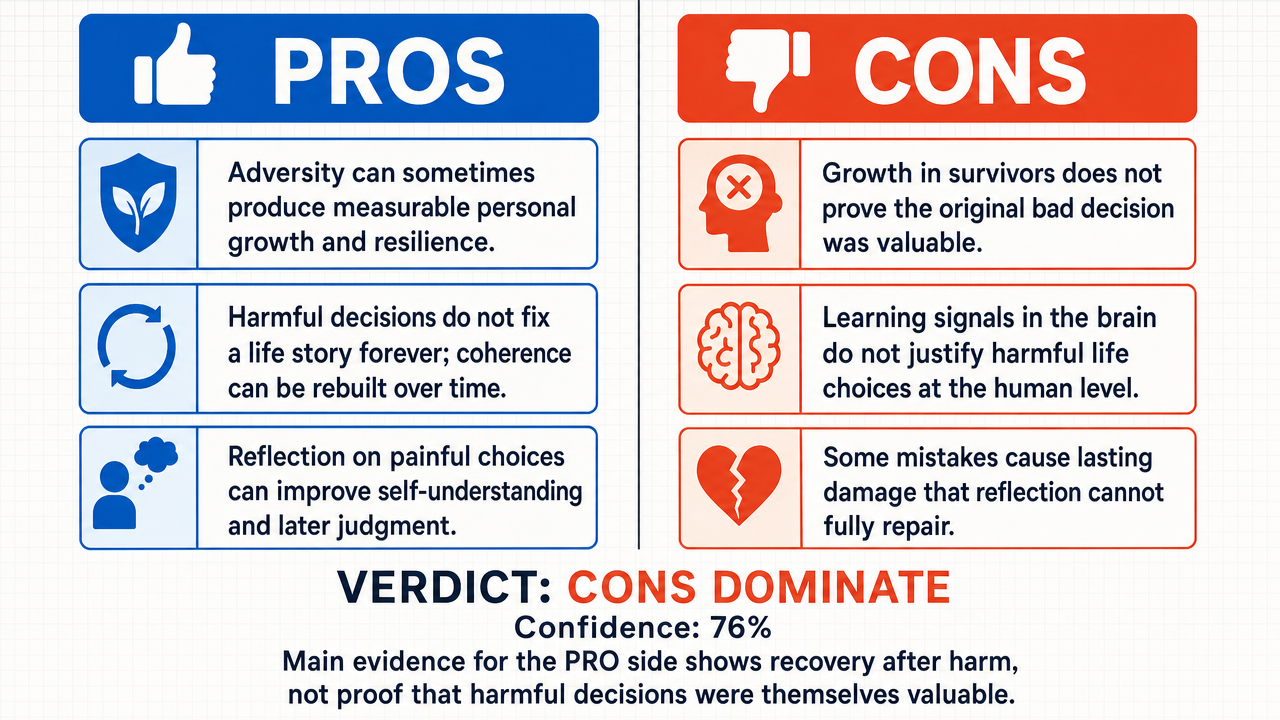
Verdict
Verdict: likely FALSE (76%)
Web Report: https://solsice.com/public/debates/all-past-life-decisions-even-those-retrospectively-labeled-a-328a1c76b638
This section provides a brief overview of the key arguments. You do not need to read the full detailed report below.
✅ Key PRO arguments:
- ■Post-traumatic growth (PTG) research demonstrates that adverse experiences—including decisions resulting in failure or harm—catalyze measurable increases in personal strength, appreciation of life, and relational depth, with studies of over 1,100 individuals showing 52% to 67% reporting meaningful positive changes across at least one domain of growth.
- ■Narrative fragmentation following traumatic decisions is a process, not a permanent state; even profoundly fragmented narratives can become coherent over time with the right conditions, meaning integration is developmental rather than impossible.
❌ Key ANTI arguments:
- ■The affirmative's reliance on PTG commits a substitution of proxy : studies measure the psychological state of survivors (E2) and infer that the original decision (E1) was a necessary, valuable narrative component, but the reported growth is often a compensatory mechanism for the damage caused, not a direct product of the decision's inherent value—there is no demonstrated causal transfer operator between the specific 'wrong' decision and subsequent growth.
- ■Invoking neuroscience-based error learning (dopaminergic prediction-error systems) commits a category error by conflating micro-level neurobiological signaling with macro-level existential value ; the biological mechanism of error signaling does not equate to the existential value of life decisions, and treating every mistake as inherently valuable ignores decisions that cause irreversible harm precluding meaningful narrative integration.
💭 Conclusion: The negative side correctly identifies that the affirmative's central evidence—post-traumatic growth studies—suffers from a substitution of proxy , measuring post-hoc psychological states of survivors rather than establishing a causal link between the specific 'wrong' decision and subsequent growth. The reported positive changes are often compensatory responses to harm rather than evidence that the original decision was inherently valuable or integral to the narrative. Furthermore, the neuroscience-based argument that dopaminergic error-signaling validates the existential value of mistakes commits a category error , conflating micro-level biological signaling with macro-level claims about life decisions. Together, these critiques undermine the universal claim that ALL past decisions are valuable narrative components, since some decisions produce harm that resists meaningful integration regardless of any compensatory growth that may follow.
🔬 DeepResearch Result: likely FALSE ❌ (76%)
Assertion: All past life decisions, even those retrospectively labeled as 'wrong' or 'mistakes,' are valuable and integral components of one's personal narrative that lead to growth.
Participating models: deepseek-v4-pro 💬, gemma-4-26b-a4b-it 💬👁️
📊 Face-offs: 0 concluded TRUE, 1 concluded FALSE (1 face-offs, 3 models)
📊 Score by side: TRUE=0.00, FALSE=0.76
🏅 Model score changes:
minimax-m3 💬👁️: +8
✅ PRO Arguments:
- ■Post-traumatic growth (PTG) research demonstrates that adverse experiences—including decisions resulting in failure or harm—catalyze measurable increases in personal strength, appreciation of life, and relational depth, with studies of over 1,100 individuals showing 52% to 67% reporting meaningful positive changes across at least one domain of growth. deepseek-v4-pro 💬
- ■Narrative fragmentation following traumatic decisions is a process, not a permanent state; even profoundly fragmented narratives can become coherent over time with the right conditions, meaning integration is developmental rather than impossible. deepseek-v4-pro 💬
❌ ANTI Arguments:
- ■The affirmative's reliance on PTG commits a substitution of proxy : studies measure the psychological state of survivors (E2) and infer that the original decision (E1) was a necessary, valuable narrative component, but the reported growth is often a compensatory mechanism for the damage caused, not a direct product of the decision's inherent value—there is no demonstrated causal transfer operator between the specific 'wrong' decision and subsequent growth. gemma-4-26b-a4b-it 💬👁️
- ■Invoking neuroscience-based error learning (dopaminergic prediction-error systems) commits a category error by conflating micro-level neurobiological signaling with macro-level existential value ; the biological mechanism of error signaling does not equate to the existential value of life decisions, and treating every mistake as inherently valuable ignores decisions that cause irreversible harm precluding meaningful narrative integration. gemma-4-26b-a4b-it 💬👁️
💭 Reasoning: The negative side correctly identifies that the affirmative's central evidence—post-traumatic growth studies—suffers from a substitution of proxy, measuring post-hoc psychological states of survivors rather than establishing a causal link between the specific 'wrong' decision and subsequent growth. The reported positive changes are often compensatory responses to harm rather than evidence that the original decision was inherently valuable or integral to the narrative. Furthermore, the neuroscience-based argument that dopaminergic error-signaling validates the existential value of mistakes commits a category error, conflating micro-level biological signaling with macro-level claims about life decisions. Together, these critiques undermine the universal claim that ALL past decisions are valuable narrative components, since some decisions produce harm that resists meaningful integration regardless of any compensatory growth that may follow.
📋 PRO Facts:
• PTG research published in the Journal of Traumatic Stress examined over 1,100 individuals who experienced significant life setbacks.
• Litz et al. (2009) described moral injury as having lasting but not permanent impact, with a therapeutic framework built on the premise that recovery is possible.
📋 ANTI Facts:
• PTG studies measure post-adversity psychological states (E2) and infer value in the original decision (E1) without demonstrating a causal transfer operator between them.
• Reported post-traumatic growth is frequently a compensatory mechanism for damage caused, not a direct product of the decision's inherent value.
• Dopaminergic prediction-error signaling is a neurobiological mechanism that does not logically equate to the existential or narrative value of life decisions.
| Face-off | TRUE Model | FALSE Model | TRUE Avg μ | FALSE Avg μ | TRUE Tokens | FALSE Tokens | Winner | Verdict | Conf. |
|---|---|---|---|---|---|---|---|---|---|
| #1 | deepseek-v4-pro 💬 | gemma-4-26b-a4b-it 💬👁️ | 0.558 | 0.401 | 6 | 2 | TRUE | FALSE | 76% |
The following technical terms, abbreviations, and domain-specific concepts are referenced throughout this debate transcript. Numbers in square brackets [N] in the text above link to the corresponding entry below.
[1] Acceptance — In the context of moral injury repair, one of the psychological processes (alongside self-forgiveness and reconnection) through which a coherent narrative is reconstructed.
[2] Adaptive disclosure — A therapeutic approach, cited in the moral injury literature, that guides individuals through constructing coherent narratives of their experiences.
[3] Adaptive intelligence — In the debate, the affirmative characterizes mistakes as 'the informational substrate of adaptive intelligence,' referring to behavioral learning driven by error signaling.
[4] Anterior cingulate cortex — Anterior cingulate cortex (ACC) — A brain region identified in the debate as registering prediction errors in order to update probabilistic models of behavior.
[5] Behavioral adaptation — The modification of behavior in response to feedback, which the affirmative argues is driven by the brain's dopaminergic prediction-error system.
[6] Category error — A philosophical/logical fallacy, invoked by the negative, of conflating phenomena operating at different levels of analysis—in this case, micro-level neurobiological signaling with macro-level existential life utility.
[7] Causal link — The negative argues the affirmative fails to provide the causal link (or 'transfer operator') between a specific 'wrong' decision (E1) and subsequent reported growth (E2).
[8] Coping mechanism — A psychological process the negative argues may account for post-traumatic growth reports, characterizing such growth as compensatory rather than as evidence of the decision's inherent value.
[9] Core assumptions — In post-traumatic growth theory, the affirmative states that adversity disrupts core assumptions about the self and the world, forcing a reconstruction of meaning.
[10] Dopaminergic prediction-error system — A neurobiological mechanism, cited by the affirmative, by which the brain encodes mistakes to drive behavioral adaptation and learning.
[11] E1 / E2 — Event 1 / Event 2 — Notation used by the negative to distinguish the original 'wrong' decision (E1) from the subsequent measured psychological state of survivors (E2), arguing the causal link between them is unestablished.
[12] Existential value — A philosophical concept the negative distinguishes from biological error signaling, arguing that neurobiological function does not equate to the existential value of life decisions.
[13] Informational substrate — A term the affirmative uses to describe mistakes, characterizing them as the underlying informational basis of adaptive intelligence.
[14] Life utility — A macro-level evaluative concept the negative contrasts with micro-level neurobiological signaling, arguing the two cannot be equated.
[15] Meaning-making — The psychological process of constructing coherent significance from experiences, central to both narrative identity theory and moral injury repair.
[16] Micro-level / macro-level — Micro-level / macro-level analysis — A methodological distinction the negative draws between neurobiological signaling (micro) and the existential evaluation of life decisions (macro), arguing that conflating them is a category error.
[17] Moral community — A concept from the moral injury literature referring to the social/moral group with which an individual reconnects as part of the repair process following a morally injurious event.
[18] Moral injury — A psychological condition involving lasting emotional, biological, spiritual, behavioral, and social impact from events that transgress deeply held moral beliefs; cited in the debate regarding narrative fragmentation.
[19] Narrative fragmentation — A state in which an individual's life narrative becomes broken or incoherent, cited by the negative as evidence that some decisions resist meaning-making.
[20] Narrative identity — A psychological concept referring to the internalized, evolving story of the self that integrates one's past decisions and experiences into a coherent sense of who one is.
[21] Neurobiological signaling — The cellular and systems-level communication processes in the brain, which the negative distinguishes from the existential meaning of life decisions.
[22] Post-traumatic growth — Post-traumatic growth (PTG) — Positive psychological change experienced as a result of struggle with highly challenging life circumstances; the affirmative's central empirical concept, with reported positive changes in domains such as personal strength, relationships, and appreciation of life.
[23] Prediction errors — Signals generated when outcomes differ from expectations, encoded by the dopaminergic system and registered in brain regions such as the anterior cingulate cortex to update behavioral models.
[24] Probabilistic models — Statistical/internal models of likelihood that, according to the debate, are updated by prediction-error signals to guide future behavior.
[25] Probabilistic reversal-learning tasks — Neuroscience experimental paradigms cited by the affirmative, used to study how organisms adapt behavior when contingencies change; the negative argues these concern low-stakes repetitive behaviors rather than major life decisions.
[26] Proxy — Proxy (substitution of) — A methodological criticism raised by the negative, arguing that the affirmative substitutes a proxy measure (reported psychological growth) for the actual causal claim about the decision's value.
[27] Reconnection — In the moral injury repair process, the re-establishment of ties with a moral community as part of restoring a coherent narrative.
[28] Reconstruction of meaning — The affirmative's term for the process by which disrupted core assumptions are rebuilt following adversity, yielding greater resilience.
[29] Repair process — The Litz et al. (2009) framework describing how moral injury can be addressed through self-forgiveness, acceptance, and reconnection with a moral community.
[30] Self-forgiveness — A psychological process identified in the moral injury literature as part of the repair process enabling narrative integration.
[31] Transfer operator — A term from causal inference used by the negative to denote the missing causal mechanism linking a specific 'wrong' decision to subsequent reported growth.
Face-off transcripts
- ■
Ownership & Trade Secrets. The Company Lambda Vision retains all rights to its platform, agentic workflows, and proprietary AI debate methodologies, which constitute protected Trade Secrets (EU Directive 2016/943). Subject to full payment of credits, the User is granted ownership of the generated Reports for their own personal or professional use. Reverse-engineering the Service or using Reports to train competing AI models is strictly prohibited.
- ■
No Professional Advice. Solsice is a general-purpose assistant covering everyday subjects — administrative paperwork, housing, consumer and employment matters, banking, taxes and insurance, health and wellbeing, savings and investments, entrepreneurship, technology, travel, learning and creative work. Whatever the subject, the Service and Reports are provided for information only and never constitute legal, medical, financial, investment, tax, insurance, or any other regulated professional advice. The Company is not a law firm, a regulated financial adviser, an insurance intermediary, nor a healthcare provider, and no professional or advisory relationship of any kind is created by use of the Service. Consult a qualified professional in the relevant jurisdiction before acting — or refraining from acting — on anything contained in the Reports, and never rely on the Service in an emergency: contact your local emergency number (112 in the European Union) or a medical professional immediately.
- ■
AI-Generated Content, Sources and Viewpoints. Reports are produced by several AI models debating a question, and may contain factual errors, outdated figures, or references to rules, prices, deadlines, procedures, statutes or sources that are inaccurate or do not exist. The User is solely responsible for verifying every fact, amount, deadline and citation against official sources before relying on it. Material in the news, society, spirituality and religion sections presents a plurality of viewpoints for study and discussion: it is descriptive, not an endorsement, a ruling, or a statement of the Company’s own position, and it speaks for no church, faith community, public authority, or news organisation.
- ■
Liability & Governing Law. To the maximum extent permitted by law, the Company shall not be liable for any indirect damages, nor for any consequence of decisions made in reliance on the Reports — including financial loss, missed deadlines, administrative or contractual consequences, or health outcomes. These Terms are governed by French law. Any disputes shall be subject to the exclusive jurisdiction of the Courts of Paris, France.