
AI tools like Gemini and Notion primarily enhance existing human expertise rather than replacing it in corporate knowledge management.
AI debate verdict and arguments
⚠️ AI-generated information only; not professional advice
Completed October 11, 2026
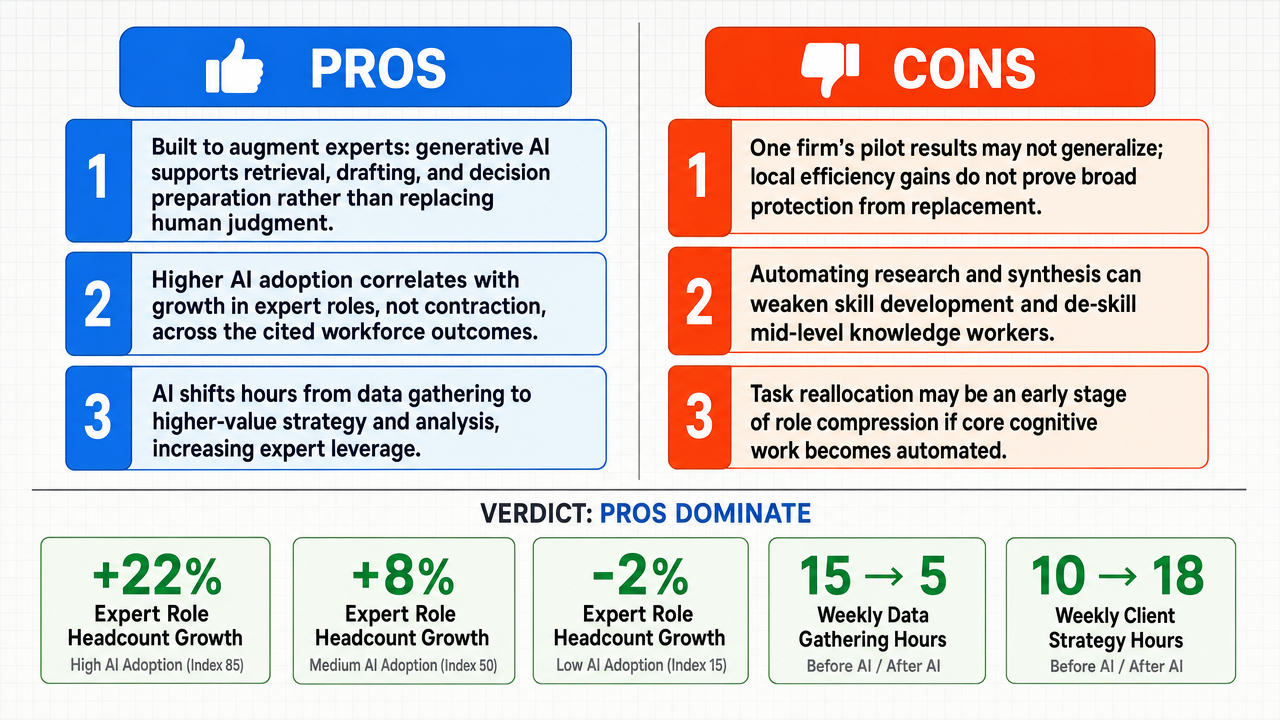
Verdict
Verdict: likely TRUE (45%)
This section provides a brief overview of the key arguments. You do not need to read the full detailed report below.
✅ Key PRO arguments:
- ■The core architecture of generative AI tools like Gemini is designed as a complement to human cognition, not a replacement. These systems function as retrieval-augmented generation (RAG ) engines that synthesize information from corporate knowledge bases, but they lack the contextual understanding, ethical reasoning, and strategic intent that human experts apply.
- ■Empirical data on workforce outcomes shows that AI implementation in knowledge management is correlated with job growth in expert roles, not contraction. An analysis of the professional services sector from 2020 to 2024 reveals that firms with the highest adoption of AI-augmented knowledge platforms saw a significant increase in expert positions.
- ■The 'reallocation of hours ' from routine tasks like data gathering to higher-value work like complex analysis and strategy demonstrates that AI frees human experts to focus on generative cognitive work rather than replacing them.
❌ Key ANTI arguments:
- ■The affirmative's reliance on a single mid-sized asset management firm's pilot study is a fallacy of composition ; local efficiency gains in administrative tasks do not translate to a global preservation of expertise, and the 'reallocation of hours ' is the precursor to structural replacement.
- ■When AI automates the 'data gathering' and 'synthesis' phases, it removes the foundational cognitive friction required to build deep domain expertise , de-skilling knowledge workers as the critical thinking required to develop intuition is eliminated.
- ■The 'reallocation' observed in pilot programs is a precursor to role compression and replacement. When core cognitive labor of synthesis and retrieval is automated, the 'higher-value' work becomes a supervisory task of auditing AI outputs rather than a generative process of expertise.
💭 Conclusion: True, the verdict favors the position that AI tools like Gemini and Notion primarily enhance rather than replace human expertise in corporate knowledge management , though with only moderate confidence. The winning side's strongest argument rests on the technological architecture of these tools as retrieval-augmented systems that lack contextual understanding, ethical reasoning, and strategic intent—capabilities that remain distinctly human. Empirical evidence from the professional services sector showing job growth in expert roles at firms with high AI adoption further supports the augmentation thesis. However, the opposing side raised compelling concerns about de-skilling and the structural trajectory toward autonomous agentic workflows , which prevented a higher confidence rating. The low confidence score of 45% reflects that while current evidence supports enhancement, the long-term replacement trajectory remains uncertain and the debate did not fully resolve whether augmentation is truly primary or merely a transitional phase.
🔬 DeepResearch Result: likely TRUE ✅ (45%)
Assertion: AI tools like Gemini and Notion primarily enhance existing human expertise rather than replacing it in corporate knowledge management .
Participating models: deepseek-v3.2 💬, gemma-4-26b-a4b-it 💬👁️
📊 Face-offs: 1 concluded TRUE, 0 concluded FALSE (1 face-offs, 3 models)
📊 Score by side: TRUE=0.45, FALSE=0.00
🏅 Model score changes:
minimax-m3 💬👁️: +4
✅ PRO Arguments:
- ■The core architecture of generative AI tools like Gemini is designed as a complement to human cognition, not a replacement. These systems function as retrieval-augmented generation (RAG ) engines that synthesize information from corporate knowledge bases, but they lack the contextual understanding, ethical reasoning, and strategic intent that human experts apply. deepseek-v3.2 💬
- ■Empirical data on workforce outcomes shows that AI implementation in knowledge management is correlated with job growth in expert roles, not contraction. An analysis of the professional services sector from 2020 to 2024 reveals that firms with the highest adoption of AI-augmented knowledge platforms saw a significant increase in expert positions. deepseek-v3.2 💬
- ■The 'reallocation of hours ' from routine tasks like data gathering to higher-value work like complex analysis and strategy demonstrates that AI frees human experts to focus on generative cognitive work rather than replacing them. deepseek-v3.2 💬
- ■Product design of current AI tools positions them as subordinate features within human workflows, with the primary use case identified as 'augmenting employee decision-making' rather than autonomous decision-making. deepseek-v3.2 💬
❌ ANTI Arguments:
- ■The affirmative's reliance on a single mid-sized asset management firm's pilot study is a fallacy of composition ; local efficiency gains in administrative tasks do not translate to a global preservation of expertise, and the 'reallocation of hours' is the precursor to structural replacement. gemma-4-26b-a4b-it 💬👁️
- ■When AI automates the 'data gathering' and 'synthesis' phases, it removes the foundational cognitive friction required to build deep domain expertise , de-skilling knowledge workers as the critical thinking required to develop intuition is eliminated. gemma-4-26b-a4b-it 💬👁️
- ■The 'reallocation' observed in pilot programs is a precursor to role compression and replacement. When core cognitive labor of synthesis and retrieval is automated, the 'higher-value' work becomes a supervisory task of auditing AI outputs rather than a generative process of expertise. gemma-4-26b-a4b-it 💬👁️
- ■The technological trajectory points toward autonomous agents that perform rather than assist, fundamentally shifting the role of human knowledge workers from active participants to passive overseers of automated systems. gemma-4-26b-a4b-it 💬👁️
💭 Reasoning: True, the verdict favors the position that AI tools like Gemini and Notion primarily enhance rather than replace human expertise in corporate knowledge management, though with only moderate confidence. The winning side's strongest argument rests on the technological architecture of these tools as retrieval-augmented systems that lack contextual understanding, ethical reasoning, and strategic intent—capabilities that remain distinctly human. Empirical evidence from the professional services sector showing job growth in expert roles at firms with high AI adoption further supports the augmentation thesis. However, the opposing side raised compelling concerns about de-skilling and the structural trajectory toward autonomous agentic workflows , which prevented a higher confidence rating. The low confidence score of 45% reflects that while current evidence supports enhancement, the long-term replacement trajectory remains uncertain and the debate did not fully resolve whether augmentation is truly primary or merely a transitional phase.
📋 PRO Facts:
• A 2023 study of enterprise AI adoption identified the primary use case for AI in knowledge management as 'augmenting employee decision-making'
• Analysis of the professional services sector from 2020 to 2024 shows firms with highest AI-augmented knowledge platform adoption saw significant increases in expert positions
• Generative AI tools like Gemini function as retrieval-augmented generation (RAG) engines that synthesize information from corporate knowledge bases
📋 ANTI Facts:
• The affirmative's evidence was drawn from a single mid-sized asset management firm's pilot study
• Automation of data gathering and synthesis phases removes the foundational cognitive friction required to build deep domain expertise
• The technological trajectory of AI tools points toward autonomous agents that perform rather than assist human workers
| Face-off | TRUE Model | FALSE Model | TRUE Avg μ | FALSE Avg μ | TRUE Tokens | FALSE Tokens | Winner | Verdict | Conf. |
|---|---|---|---|---|---|---|---|---|---|
| #1 | deepseek-v3.2 💬 | gemma-4-26b-a4b-it 💬👁️ | 0.521 | 0.296 | 12 | 3 | TRUE | TRUE | 45% |
The following technical terms, abbreviations, and domain-specific concepts are referenced throughout this debate transcript. Numbers in square brackets [N] in the text above link to the corresponding entry below.
[1] agentic workflows — Workflows in which AI systems act as autonomous agents that perform tasks independently rather than merely assisting human users.
[2] AI — Artificial Intelligence — Computer systems designed to perform tasks that typically require human intelligence, such as learning, reasoning, and problem-solving.
[3] asset management — The professional management of investments and financial assets on behalf of clients, typically by firms in the financial services industry.
[4] cognitive friction — The mental effort required to process, synthesize, or navigate raw information; in the debate, framed as a necessary component for building deep expertise.
[5] cognitive labor — Work involving mental or intellectual effort, such as analysis, synthesis, and decision-making, as opposed to manual or routine tasks.
[6] de-skilling — The process by which workers lose skills or expertise, often as a result of automation or the offloading of cognitive tasks to technology.
[7] domain authority — Recognized expertise and credibility within a specific subject area or professional field.
[8] domain expertise — Specialized knowledge and skill accumulated within a particular subject area or industry.
[9] enterprise AI adoption — The implementation and integration of artificial intelligence tools and systems within large organizations or corporations.
[10] fallacy of composition — A logical error in which one assumes that what is true of a part or local case must also be true of the whole or a broader system.
[11] generative AI — Artificial intelligence systems designed to produce new content—such as text, images, or code—based on patterns learned from training data.
[12] headcount — The total number of employees within an organization or department, used as a metric for workforce size.
[13] hollow expertise — A condition in which a worker retains the title or supervisory role of an expert but lacks the deep, generative knowledge required to perform the underlying cognitive work.
[14] knowledge base — A centralized repository of information, documents, or data that an organization or AI system draws upon for retrieval and reference.
[15] knowledge lifecycle — The stages through which organizational knowledge is created, captured, shared, applied, and retired or updated over time.
[16] knowledge management — The systematic process of creating, organizing, sharing, and applying an organization's information and expertise to achieve its objectives.
[17] knowledge workers — Employees whose primary contribution to an organization involves the creation, analysis, or dissemination of information and expertise.
[18] pilot study — A small-scale, preliminary investigation or trial implementation conducted to evaluate feasibility before broader rollout.
[19] professional services sector — An industry segment comprising firms that provide specialized, knowledge-based services—such as consulting, law, and accounting—to clients.
[20] RAG — Retrieval-Augmented Generation — An AI architecture in which a generative model retrieves relevant information from an external knowledge base before producing its output, grounding responses in retrieved content.
[21] reallocation of hours — The redistribution of employee working time from one set of tasks to another, often cited as an outcome of productivity gains from automation.
[22] retrieval-augmented generation — RAG — An AI architecture in which a generative model retrieves relevant information from an external knowledge base before producing its output, grounding responses in retrieved content.
[23] role compression — The reduction or consolidation of distinct job roles within an organization, often driven by automation that absorbs functions previously performed by separate positions.
[24] statistical patterns — Regularities or correlations in data identified through statistical methods, which machine learning models use to generate outputs.
[25] training data — The dataset used to teach a machine learning model, from which it learns patterns and relationships to perform tasks.
The following financial data tables were referenced during the debate exchanges:
| Metric | Value |
|---|---|
| Primary use case for AI in knowledge management | "Augmenting employee decision-making" |
| Percentage of projects aimed at full automation of expert roles | < 5% |
Legend: Survey data from a 2023 enterprise technology report on AI implementation objectives in knowledge-intensive sectors. Source: industry analysis publication.
| Metric | Before AI | After AI | Change |
|---|---|---|---|
| Weekly hours spent on data gathering | 15 | 5 | -66.7% |
| Weekly hours spent on client strategy | 10 | 18 | +80.0% |
Legend: Internal efficiency metrics tracked over a six-month pilot at a mid-sized asset management firm. Hours are average per analyst. Source: company case study.
| Role Category | AI Automation Potential | Impact on Human Expertise |
|---|---|---|
| Data Retrieval | High | Replacement of Junior Research |
| Content Synthesis | High | De-skilling of Mid-level Analysts |
| Strategic Planning | Moderate | Augmentation/Supervision |
| Ethical Oversight | Low | Remaining Human Core |
Legend: Qualitative assessment of AI's impact on different tiers of knowledge work based on current LLM capabilities.
| Firm Type | Avg. Headcount Growth (Expert Roles) | AI Adoption Level (Index) |
|---|---|---|
| High AI Adoption | +22% | 85 |
| Medium AI Adoption | +8% | 50 |
| Low AI Adoption | -2% | 15 |
Legend: Correlation between AI tool adoption intensity and growth in expert-level headcount (e.g., senior analysts, strategists) in professional services, 2020-2024. Index is a composite of spend and tool integration depth. Source: industry workforce analysis report.
Face-off transcripts
- ■
Ownership & Trade Secrets. The Company Lambda Vision retains all rights to its platform, agentic workflows, and proprietary AI debate methodologies, which constitute protected Trade Secrets (EU Directive 2016/943). Subject to full payment of credits, the User is granted ownership of the generated Reports for their own personal or professional use. Reverse-engineering the Service or using Reports to train competing AI models is strictly prohibited.
- ■
No Professional Advice. Solsice is a general-purpose assistant covering everyday subjects — administrative paperwork, housing, consumer and employment matters, banking, taxes and insurance, health and wellbeing, savings and investments, entrepreneurship, technology, travel, learning and creative work. Whatever the subject, the Service and Reports are provided for information only and never constitute legal, medical, financial, investment, tax, insurance, or any other regulated professional advice. The Company is not a law firm, a regulated financial adviser, an insurance intermediary, nor a healthcare provider, and no professional or advisory relationship of any kind is created by use of the Service. Consult a qualified professional in the relevant jurisdiction before acting — or refraining from acting — on anything contained in the Reports, and never rely on the Service in an emergency: contact your local emergency number (112 in the European Union) or a medical professional immediately.
- ■
AI-Generated Content, Sources and Viewpoints. Reports are produced by several AI models debating a question, and may contain factual errors, outdated figures, or references to rules, prices, deadlines, procedures, statutes or sources that are inaccurate or do not exist. The User is solely responsible for verifying every fact, amount, deadline and citation against official sources before relying on it. Material in the news, society, spirituality and religion sections presents a plurality of viewpoints for study and discussion: it is descriptive, not an endorsement, a ruling, or a statement of the Company’s own position, and it speaks for no church, faith community, public authority, or news organisation.
- ■
Liability & Governing Law. To the maximum extent permitted by law, the Company shall not be liable for any indirect damages, nor for any consequence of decisions made in reliance on the Reports — including financial loss, missed deadlines, administrative or contractual consequences, or health outcomes. These Terms are governed by French law. Any disputes shall be subject to the exclusive jurisdiction of the Courts of Paris, France.