
AI-powered application generation, as demonstrated on the Xiaomi 18 Pro, will become a widely adopted feature in mainstream smartphones by 2028.
AI debate verdict and arguments
⚠️ AI-generated information only; not professional advice
Completed October 11, 2026
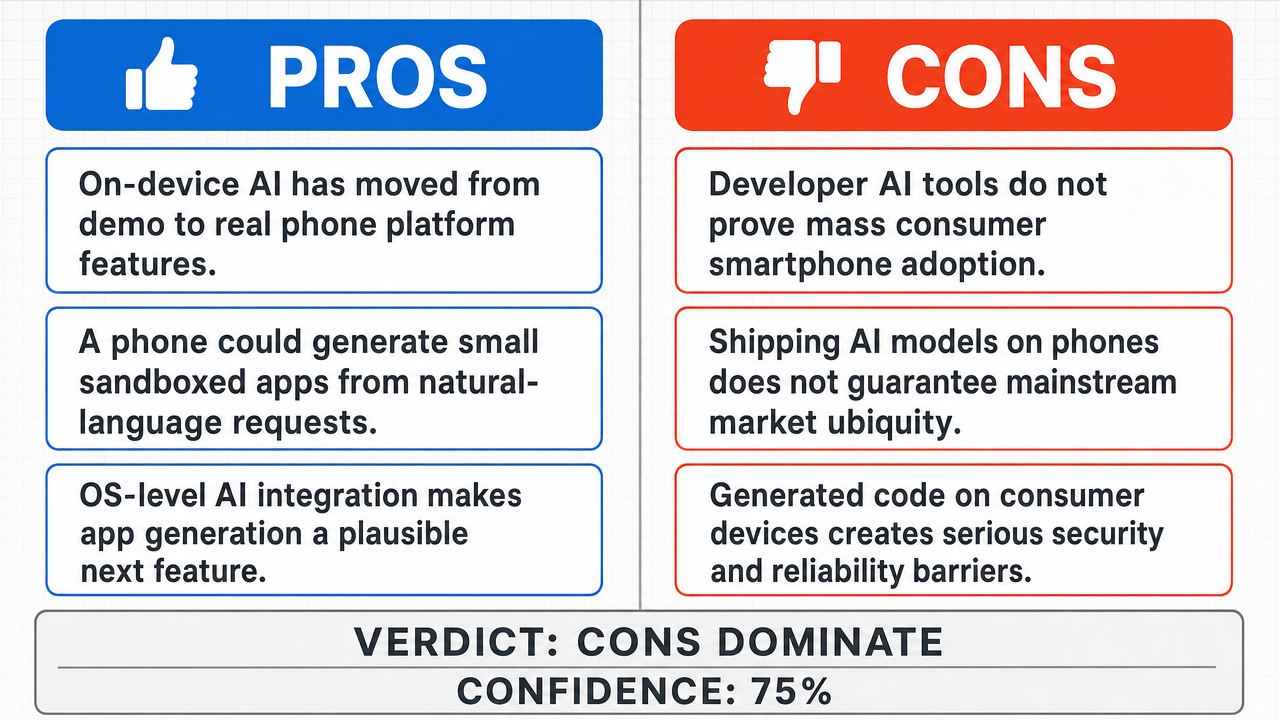
Verdict
Verdict: likely FALSE (75%)
This section provides a brief overview of the key arguments. You do not need to read the full detailed report below.
✅ Key PRO arguments:
- ■Smartphone hardware and on-device generative models have moved from proof-of-concept to platform product , with Google describing Gemini Nano as an on-device generative model for Android, Apple introducing Apple Intelligence for iPhone and iPad, and Qualcomm and MediaTek marketing mobile NPUs for AI workloads , making the Xiaomi 18 Pro demonstration a leading-edge marker on a convergent stack .
- ■The claim concerns AI-powered application generation as a consumer-facing OS feature where a user describes a need and the phone creates a constrained, sandboxed app—not the full professional IDE workflow of source-code authorship, debugging , architecture, and release management—so the affirmative does not commit a fallacy of scale by referencing developer tools.
- ■The capability-and-platform axis is the strongest support: if a phone can already run or route generative model inference and OS-level AI, the next productizable step is turning natural-language intent into a functional app, and the trajectory of platform integration supports mainstream adoption by 2028.
❌ Key ANTI arguments:
- ■The affirmative commits a fallacy of scale by using developer-centric tools such as GitHub Copilot , Replit , Project IDX , and AppSheet to predict consumer smartphone behavior; professional IDEs assume high-bandwidth input, complex debugging workflows, and deep architectural oversight that are absent in a mobile intent-to-app interface.
- ■Current shipping status of on-device AI models like Gemini Nano or Apple Intelligence is not a proxy for future market ubiquity ; a product can be on the market without ever achieving the wide adoption required by the core claim, so the affirmative's reasoning holds a proposition and its negation at once.
- ■Mobile hardware is insufficient to manage the non-deterministic security risks of generated code running on consumer devices, creating a structural barrier that prevents mainstream adoption regardless of capability demonstrations.
💭 Conclusion: False. The negative won by demonstrating that the affirmative's evidence—developer-centric AI coding tools and current on-device AI shipping status—does not logically entail mainstream consumer adoption of AI-powered app generation on smartphones by 2028. The fallacy-of-scale argument effectively severed the link between professional IDE workflows and consumer mobile UX, while the security and economic-incompatibility arguments introduced structural barriers that the affirmative did not adequately rebut. The affirmative's strongest point about convergent platform capability was acknowledged but treated as a leading-edge marker rather than proof of widespread adoption. Confidence is set at 75% reflecting the judge's assessment that the negative's structural-barrier arguments were decisive but not overwhelming, as the capability trajectory remains plausible.
🔬 DeepResearch Result: likely FALSE ❌ (75%)
Assertion: AI-powered application generation, as demonstrated on the Xiaomi 18 Pro, will become a widely adopted feature in mainstream smartphones by 2028.
Participating models: deepseek-v3.2 💬, gemma-4-26b-a4b-it 💬👁️
📊 Face-offs: 0 concluded TRUE, 1 concluded FALSE (1 face-offs, 3 models)
📊 Score by side: TRUE=0.00, FALSE=0.75
🏅 Model score changes:
minimax-m3 💬👁️: +8
✅ PRO Arguments:
- ■Smartphone hardware and on-device generative models have moved from proof-of-concept to platform product , with Google describing Gemini Nano as an on-device generative model for Android, Apple introducing Apple Intelligence for iPhone and iPad, and Qualcomm and MediaTek marketing mobile NPUs for AI workloads , making the Xiaomi 18 Pro demonstration a leading-edge marker on a convergent stack . deepseek-v3.2 💬
- ■The claim concerns AI-powered application generation as a consumer-facing OS feature where a user describes a need and the phone creates a constrained, sandboxed app—not the full professional IDE workflow of source-code authorship, debugging , architecture, and release management—so the affirmative does not commit a fallacy of scale by referencing developer tools. deepseek-v3.2 💬
- ■The capability-and-platform axis is the strongest support: if a phone can already run or route generative model inference and OS-level AI, the next productizable step is turning natural-language intent into a functional app, and the trajectory of platform integration supports mainstream adoption by 2028. deepseek-v3.2 💬
❌ ANTI Arguments:
- ■The affirmative commits a fallacy of scale by using developer-centric tools such as GitHub Copilot , Replit , Project IDX , and AppSheet to predict consumer smartphone behavior; professional IDEs assume high-bandwidth input, complex debugging workflows, and deep architectural oversight that are absent in a mobile intent-to-app interface. gemma-4-26b-a4b-it 💬👁️
- ■Current shipping status of on-device AI models like Gemini Nano or Apple Intelligence is not a proxy for future market ubiquity ; a product can be on the market without ever achieving the wide adoption required by the core claim, so the affirmative's reasoning holds a proposition and its negation at once. gemma-4-26b-a4b-it 💬👁️
- ■Mobile hardware is insufficient to manage the non-deterministic security risks of generated code running on consumer devices, creating a structural barrier that prevents mainstream adoption regardless of capability demonstrations. gemma-4-26b-a4b-it 💬👁️
- ■Ephemeral, AI-generated software is economically incompatible with the established mobile app economy, which depends on app store distribution, monetization, and discoverability frameworks that AI-generated apps would disrupt or bypass. gemma-4-26b-a4b-it 💬👁️
💭 Reasoning: False. The negative won by demonstrating that the affirmative's evidence—developer-centric AI coding tools and current on-device AI shipping status—does not logically entail mainstream consumer adoption of AI-powered app generation on smartphones by 2028. The fallacy-of-scale argument effectively severed the link between professional IDE workflows and consumer mobile UX, while the security and economic-incompatibility arguments introduced structural barriers that the affirmative did not adequately rebut. The affirmative's strongest point about convergent platform capability was acknowledged but treated as a leading-edge marker rather than proof of widespread adoption. Confidence is set at 75% reflecting the judge's assessment that the negative's structural-barrier arguments were decisive but not overwhelming, as the capability trajectory remains plausible.
📋 PRO Facts:
• Google has described Gemini Nano as an on-device generative model for Android.
• Apple has introduced Apple Intelligence as an integrated generative system for iPhone and iPad.
• Qualcomm and MediaTek are marketing mobile NPUs for AI workloads.
📋 ANTI Facts:
• Professional IDEs assume high-bandwidth input, complex debugging workflows, and deep architectural oversight absent in mobile intent-to-app interfaces.
• A product can be on the market without achieving widespread adoption.
• AI-generated code introduces non-deterministic security risks on consumer devices.
• The established mobile app economy depends on app store distribution, monetization, and discoverability frameworks.
| Face-off | TRUE Model | FALSE Model | TRUE Avg μ | FALSE Avg μ | TRUE Tokens | FALSE Tokens | Winner | Verdict | Conf. |
|---|---|---|---|---|---|---|---|---|---|
| #1 | deepseek-v3.2 💬 | gemma-4-26b-a4b-it 💬👁️ | 0.573 | 0.243 | 12 | 3 | TRUE | FALSE | 75% |
The following technical terms, abbreviations, and domain-specific concepts are referenced throughout this debate transcript. Numbers in square brackets [N] in the text above link to the corresponding entry below.
[1] AI inference — The process of running a trained artificial intelligence model to produce outputs (predictions, text, code) from new input data, as opposed to the training phase.
[2] AI workloads — Computational tasks associated with running AI models, such as inference or training, which impose specific requirements on hardware (e.g., NPUs, GPUs).
[3] App Clip — A lightweight, no-install, on-demand surface of an iOS app that lets users access a small portion of an app's functionality without downloading the full application.
[4] Apple Intelligence — Apple's integrated generative AI system introduced for iPhone, iPad, and Mac, providing on-device and server-based AI features.
[5] AppSheet — A Google-owned no-code/low-code platform that allows users to build mobile and web applications from data sources without traditional programming.
[6] convergent stack — A combination of overlapping technology layers (silicon, OS, models, tools) that are maturing together to enable a new product capability.
[7] debugging — The process of identifying, tracing, and fixing errors or unexpected behavior in software code.
[8] enterprise-grade — A descriptor for software or services designed to meet the reliability, security, and scalability requirements of large organizations rather than individual consumers.
[9] ephemeral software — Software that is short-lived, disposable, or generated on demand for a single use rather than installed and maintained as a persistent application.
[10] fallacy of scale — A reasoning error in which a property observed at one scale (e.g., professional developers) is assumed to transfer linearly to a very different scale (e.g., mass-market consumers) without accounting for structural differences.
[11] Gemini Nano — Google's smallest variant of the Gemini family of generative AI models, designed to run on-device on Android smartphones.
[12] generative model — A machine learning model (e.g., large language model) trained to produce new content such as text, images, or code in response to prompts.
[13] GitHub Copilot — An AI-powered coding assistant, developed by GitHub and OpenAI, that suggests or generates code completions inside developer environments.
[14] Google Play Instant — An Android feature that allows users to run a streamed or lightweight version of an app without installing it, analogous to Apple's App Clips.
[15] hallucinated — hallucinated (in AI context) — Referring to outputs produced by a generative AI model that are plausible-sounding but factually incorrect, fabricated, or not grounded in the input or training data.
[16] IDE — Integrated Development Environment — A software application that provides comprehensive facilities for programmers, typically including a code editor, build tools, and a debugger.
[17] intent-to-app — A user interface paradigm in which a user expresses a desired outcome in natural language and the system automatically generates a corresponding application or workflow.
[18] low-code — A software development approach that minimizes hand-written code by using visual drag-and-drop interfaces, prebuilt components, and configuration to build applications.
[19] mainstream adoption — The stage at which a technology transitions from early or niche users to widespread, everyday use by the general consumer market.
[20] market ubiquity — The state of a product or feature being available and used across essentially the entire addressable market, rather than only in specific segments.
[21] MediaTek Dimensity — A family of mobile system-on-chip (SoC) processors from MediaTek that integrate CPUs, GPUs, and NPUs designed for on-device AI workloads in smartphones.
[22] mini-app — A lightweight, sub-application that runs inside a host platform (e.g., WeChat) without a separate install, providing a focused piece of functionality.
[23] mobile NPU — mobile Neural Processing Unit — A dedicated processor block in a smartphone chipset optimized for neural network and AI inference operations, offloading such work from the CPU and GPU.
[24] natural-language intent — A user's desired outcome or goal expressed in everyday spoken or written language, which a system must interpret to take action or generate output.
[25] non-deterministic — Describing a system or output that is not reliably reproducible from the same input; generative AI models are typically non-deterministic, producing different outputs on repeated runs.
[26] OEM — Original Equipment Manufacturer — A company that builds products (here, smartphones) using components from other suppliers, as distinct from the component makers themselves.
[27] on-device AI — AI models and inference that run locally on a user's device (e.g., a phone) rather than being processed on remote cloud servers.
[28] on-device generative model — A generative AI model small and efficient enough to be executed directly on consumer hardware such as a smartphone, without requiring cloud connectivity.
[29] platform product — A feature or capability integrated into an underlying operating system or platform (rather than a standalone third-party app) and shipped to end users as part of that platform.
[30] productization — The process of turning a prototype, research result, or internal tool into a packaged, supported, consumer- or enterprise-ready product.
[31] Project IDX — Google's AI-assisted, browser-based integrated development environment aimed at full-stack application development.
[32] proof of concept — A demonstration that a technology or idea is technically feasible, typically preceding a full product launch.
[33] Qualcomm AI Hub — Qualcomm's platform for distributing and running AI models optimized for its Snapdragon mobile chipsets and NPUs.
[34] Replit — An online, browser-based development environment and hosting platform that supports collaborative coding and AI-assisted programming.
[35] sandboxing — A security technique in which untrusted code is executed in a restricted environment that limits its access to system resources, preventing it from affecting the host system.
[36] WeChat mini programs — Sub-applications that run inside the WeChat messaging platform without requiring a separate download, providing app-like functionality within the host app.
Face-off transcripts
- ■
Ownership & Trade Secrets. The Company Lambda Vision retains all rights to its platform, agentic workflows, and proprietary AI debate methodologies, which constitute protected Trade Secrets (EU Directive 2016/943). Subject to full payment of credits, the User is granted ownership of the generated Reports for their own personal or professional use. Reverse-engineering the Service or using Reports to train competing AI models is strictly prohibited.
- ■
No Professional Advice. Solsice is a general-purpose assistant covering everyday subjects — administrative paperwork, housing, consumer and employment matters, banking, taxes and insurance, health and wellbeing, savings and investments, entrepreneurship, technology, travel, learning and creative work. Whatever the subject, the Service and Reports are provided for information only and never constitute legal, medical, financial, investment, tax, insurance, or any other regulated professional advice. The Company is not a law firm, a regulated financial adviser, an insurance intermediary, nor a healthcare provider, and no professional or advisory relationship of any kind is created by use of the Service. Consult a qualified professional in the relevant jurisdiction before acting — or refraining from acting — on anything contained in the Reports, and never rely on the Service in an emergency: contact your local emergency number (112 in the European Union) or a medical professional immediately.
- ■
AI-Generated Content, Sources and Viewpoints. Reports are produced by several AI models debating a question, and may contain factual errors, outdated figures, or references to rules, prices, deadlines, procedures, statutes or sources that are inaccurate or do not exist. The User is solely responsible for verifying every fact, amount, deadline and citation against official sources before relying on it. Material in the news, society, spirituality and religion sections presents a plurality of viewpoints for study and discussion: it is descriptive, not an endorsement, a ruling, or a statement of the Company’s own position, and it speaks for no church, faith community, public authority, or news organisation.
- ■
Liability & Governing Law. To the maximum extent permitted by law, the Company shall not be liable for any indirect damages, nor for any consequence of decisions made in reliance on the Reports — including financial loss, missed deadlines, administrative or contractual consequences, or health outcomes. These Terms are governed by French law. Any disputes shall be subject to the exclusive jurisdiction of the Courts of Paris, France.