
Adaptability is the most crucial trait for success when unforeseen problems arise.
AI debate verdict and arguments
⚠️ AI-generated information only; not professional advice
Completed October 14, 2026
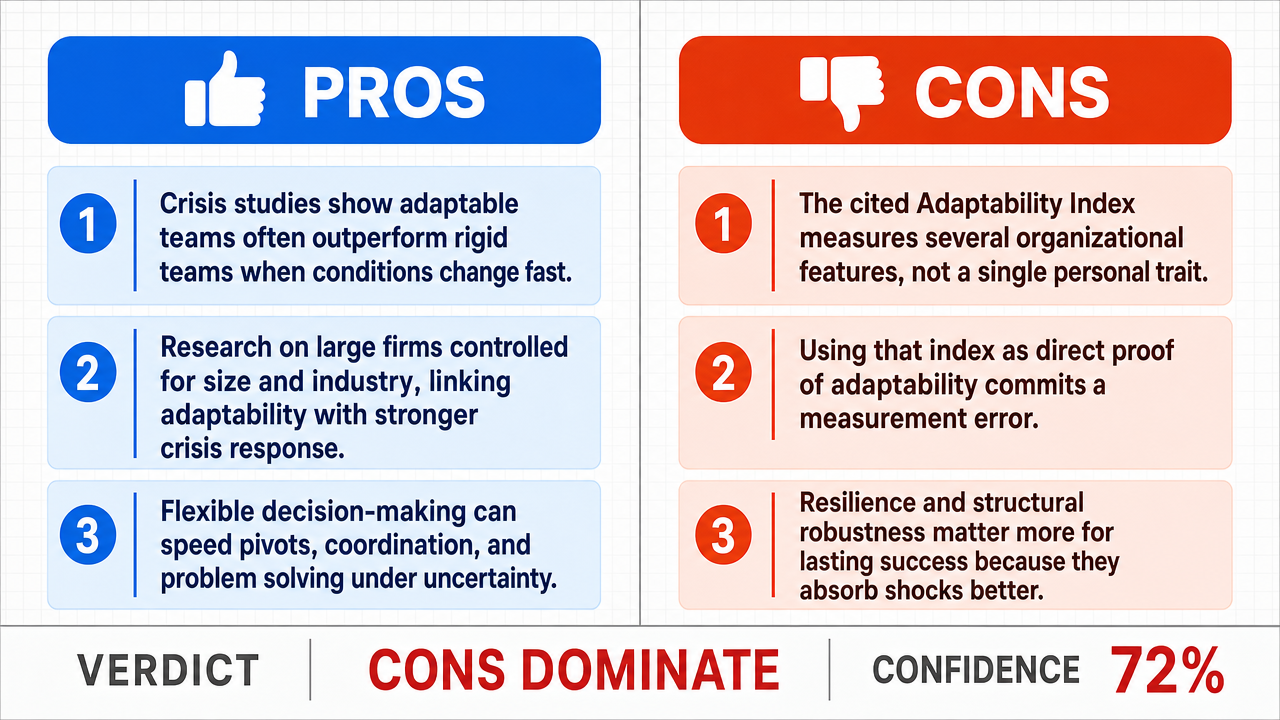
Verdict
Verdict: likely FALSE (72%)
Web Report: https://solsice.com/public/debates/adaptability-is-the-most-crucial-trait-for-success-when-unfo-febee572247d
This section provides a brief overview of the key arguments. You do not need to read the full detailed report below.
✅ Key PRO arguments:
- ■Empirical data from organizational studies shows adaptable teams significantly outperform rigid ones during crises. Companies scoring high on adaptability metrics saw markedly smaller revenue declines (-12% vs -31%) and faster recovery (8 months vs 18 months) during the 2020 pandemic shock.
- ■The cited research in the Journal of Business Research used regression analysis on S&P 500 firms and specifically controlled for variables such as firm size, industry sector, and liquidity , thereby isolating adaptability as the causal driver of superior crisis performance.
❌ Key ANTI arguments:
- ■The affirmative's argument suffers from a fundamental error in identity of the referent : the 'Adaptability Index ' is a composite metric of decentralized decision-making and process iteration, and no transfer operator has been provided proving that revenue recovery was a direct result of adaptability rather than scale, liquidity , or sector-specific market mandates .
- ■The argument commits a fallacy of the instrument : the 'Adaptability Index ' is treated as a direct measure of a behavioral trait when it is actually a proxy for organizational complexity and resource density. In large-cap S&P 500 firms, decentralized decision-making and rapid process iteration are structural characteristics correlated with firm size, not independent variables.
- ■Resilience and structural robustness are more critical than adaptability for long-term success, because firms with greater resource density can absorb shocks through liquidity buffers and scale advantages rather than through behavioral flexibility alone.
💭 Conclusion: False. The negative successfully demonstrated that the affirmative's central empirical evidence—the 2020 pandemic Adaptability Index study—commits a fallacy of the instrument by treating a composite metric as an independent behavioral trait when it is actually a proxy for organizational complexity and resource density. The affirmative failed to provide a transfer operator proving that adaptability, rather than scale, liquidity , or sector-specific advantages, was the causal driver of the observed -12% vs -31% revenue decline differential. Because the causal link between adaptability and successful outcomes remains unestablished, the claim that adaptability is the most crucial trait cannot be sustained. The evidence also presents Structural Robustness and Redundancy/Buffering as alternative risk management strategies with high survival probabilities under stress, which the negative's framing leverages.
🔬 DeepResearch Result: likely FALSE ❌ (72%)
Assertion: Adaptability is the most crucial trait for success when unforeseen problems arise.
Participating models: deepseek-v3.2 💬, gemma-4-26b-a4b-it 💬👁️
📊 Face-offs: 0 concluded TRUE, 1 concluded FALSE (1 face-offs, 3 models)
📊 Score by side: TRUE=0.00, FALSE=0.72
🏅 Model score changes:
minimax-m3 💬👁️: +7
✅ PRO Arguments:
- ■Empirical data from organizational studies shows adaptable teams significantly outperform rigid ones during crises. Companies scoring high on adaptability metrics saw markedly smaller revenue declines (-12% vs -31%) and faster recovery (8 months vs 18 months) during the 2020 pandemic shock. deepseek-v3.2 💬
- ■The cited research in the Journal of Business Research used regression analysis on S&P 500 firms and specifically controlled for variables such as firm size, industry sector, and liquidity , thereby isolating adaptability as the causal driver of superior crisis performance. deepseek-v3.2 💬
❌ ANTI Arguments:
- ■The affirmative's argument suffers from a fundamental error in identity of the referent : the 'Adaptability Index ' is a composite metric of decentralized decision-making and process iteration, and no transfer operator has been provided proving that revenue recovery was a direct result of adaptability rather than scale, liquidity, or sector-specific market mandates . gemma-4-26b-a4b-it 💬👁️
- ■The argument commits a fallacy of the instrument : the 'Adaptability Index' is treated as a direct measure of a behavioral trait when it is actually a proxy for organizational complexity and resource density. In large-cap S&P 500 firms, decentralized decision-making and rapid process iteration are structural characteristics correlated with firm size, not independent variables. gemma-4-26b-a4b-it 💬👁️
- ■Resilience and structural robustness are more critical than adaptability for long-term success, because firms with greater resource density can absorb shocks through liquidity buffers and scale advantages rather than through behavioral flexibility alone. gemma-4-26b-a4b-it 💬👁️
💭 Reasoning: False. The negative successfully demonstrated that the affirmative's central empirical evidence—the 2020 pandemic Adaptability Index study—commits a fallacy of the instrument by treating a composite metric as an independent behavioral trait when it is actually a proxy for organizational complexity and resource density. The affirmative failed to provide a transfer operator proving that adaptability, rather than scale, liquidity, or sector-specific advantages, was the causal driver of the observed -12% vs -31% revenue decline differential. Because the causal link between adaptability and successful outcomes remains unestablished, the claim that adaptability is the most crucial trait cannot be sustained. The evidence also presents Structural Robustness and Redundancy/Buffering as alternative risk management strategies with high survival probabilities under stress, which the negative's framing leverages.
📋 PRO Facts:
• High-adaptability companies experienced an average revenue decline of -12% in 2020, compared to -31% for low-adaptability companies.
• High-adaptability companies recovered in an average of 8 months, versus 18 months for low-adaptability companies.
• The Adaptability Index scores were 85 for high-adaptability firms and 32 for low-adaptability firms in the cited dataset.
📋 ANTI Facts:
• The 'Adaptability Index' used in the cited study is a composite metric combining decentralized decision-making and process iteration, not a direct measure of a behavioral trait.
• In large-cap S&P 500 firms, decentralized decision-making and rapid process iteration are structural characteristics correlated with firm size and resource density, not independent variables.
| Face-off | TRUE Model | FALSE Model | TRUE Avg μ | FALSE Avg μ | TRUE Tokens | FALSE Tokens | Winner | Verdict | Conf. |
|---|---|---|---|---|---|---|---|---|---|
| #1 | deepseek-v3.2 💬 | gemma-4-26b-a4b-it 💬👁️ | 0.549 | 0.369 | 8 | 2 | TRUE | FALSE | 72% |
The following technical terms, abbreviations, and domain-specific concepts are referenced throughout this debate transcript. Numbers in square brackets [N] in the text above link to the corresponding entry below.
[1] Adaptability Index — A composite metric referenced in the debate, constructed from survey measures of strategic agility and operational flexibility (including decentralized decision-making and rapid process iteration), used to score firms on adaptability.
[2] Burden of proof — A debate/logic concept referring to the obligation of a party to provide sufficient evidence or argument to support their claim; raised in the affirmative's rebuttal regarding the negative's dismissal of the pandemic data.
[3] Capital reserves — A firm's stock of capital or financial buffers; in the debate, the negative argues that high liquidity and capital reserves enable decentralized structures and rapid iteration, making the Adaptability Index collinear with scale.
[4] Causal link — A demonstrated cause-and-effect relationship between two variables, as opposed to mere correlation; the negative argues the affirmative has not shown that adaptability (rather than scale or liquidity) caused the observed revenue recovery.
[5] Centralized structures — Organizational designs in which decision-making authority is concentrated at the top; the negative argues low-liquidity firms are structurally constrained to such risk-averse protocols.
[6] Cognitive flexibility — The mental capacity to switch between thinking about different concepts or to adapt behavior in response to changing goals or environments; referenced by the affirmative as part of adaptability.
[7] Collinear — Collinear (collinearity) — A statistical condition in which predictor variables in a regression model are highly correlated with each other; the negative argues the Adaptability Index is collinear with scale and liquidity, undermining the regression controls.
[8] Composite metric — An index constructed by combining multiple underlying measures into a single score; the Adaptability Index is described as a composite of decentralized decision-making and process iteration.
[9] Correlation — A statistical association between two variables; the affirmative cites a correlation between adaptability scores and revenue recovery, while the negative disputes whether this reflects causation.
[10] Decentralized decision-making — An organizational structure in which authority and decision-making are distributed across lower levels rather than concentrated at the top; one of the components of the Adaptability Index.
[11] Decisive differentiator — A factor that decisively distinguishes successful outcomes from unsuccessful ones; the affirmative claims adaptability is the decisive differentiator when plans fail, a claim the negative contests.
[12] Fallacy of the instrument — A methodological/logical error in which a proxy variable is treated as a direct measure of the underlying construct; the negative argues the Adaptability Index is a proxy for organizational complexity and resource density rather than a direct measure of adaptability.
[13] Hidden premise — An unstated assumption underlying an argument; the affirmative accuses the negative of relying on a hidden premise that structural advantages, not adaptability, drive recovery.
[14] Identity of the referent — A debate/logic concept concerning whether a term in an argument refers to the same thing across claims; the negative argues the affirmative commits an error of identity by conflating large-cap structural advantages with adaptability.
[15] Large-cap — Large-capitalization — A designation for companies with a large total market value of outstanding shares; the debate concerns S&P 500 firms, which are large-cap, and whether their recovery reflects adaptability or structural advantages of scale.
[16] Liquidity — The ease with which an asset can be converted to cash without affecting its market price, or a firm's available cash and cash-equivalent assets; the negative argues liquidity enables the structural features measured by the Adaptability Index.
[17] Liquidity ratios — Financial ratios (such as the current or quick ratio) that measure a firm's ability to meet short-term obligations; the affirmative states the cited study controlled for pre-crisis liquidity ratios in its regression.
[18] Market cap — Market capitalization — The total market value of a company's outstanding shares, calculated as share price multiplied by shares outstanding; the affirmative states the cited study controlled for firm size measured by market cap.
[19] Operational flexibility — An organization's ability to adjust its operations quickly in response to changing conditions; one of the survey-based components of the Adaptability Index.
[20] Organizational complexity — The degree of differentiation and interdependence within an organization's structure; the negative argues the Adaptability Index is a proxy for organizational complexity rather than adaptability per se.
[21] P-value — A statistical measure indicating the probability of observing the data (or more extreme) if the null hypothesis is true; the affirmative cites a p-value <0.01 as evidence that adaptability remained a statistically significant predictor after controls.
[22] Proxy — Proxy variable — A variable used as a stand-in for another variable that is difficult to measure directly; the negative argues the Adaptability Index functions as a proxy for resource density and scale, not the behavioral trait itself.
[23] Rapid process iteration — The practice of quickly cycling through repeated rounds of designing, testing, and revising business processes; one of the components of the Adaptability Index.
[24] Regression analysis — A statistical method for estimating the relationships among variables, often used to isolate the effect of one variable while holding others constant; the affirmative states the cited study used regression to control for size, sector, and liquidity.
[25] Resilience — The capacity to withstand and recover from adverse events; the negative's core claim is that resilience and structural robustness are more critical than adaptability for long-term success.
[26] Revenue retention — The degree to which a firm preserves its revenue base during a downturn; the affirmative states adaptability was a statistically significant predictor of revenue retention in the cited study.
[27] Revenue run-rate — An extrapolation of current revenue over a longer period, often used to project annualized performance; the debate defines recovery as a return to pre-crisis revenue run-rate.
[28] Risk-averse — A preference for avoiding or minimizing risk; the negative argues low-liquidity firms are structurally constrained to centralized, risk-averse protocols.
[29] S&P 500 — Standard & Poor's 500 — A stock market index tracking the performance of 500 large-cap U.S. companies; the cited study analyzed S&P 500 firms during the 2020 COVID-19 crisis.
[30] Sector-specific market mandates — Industry- or sector-driven requirements or conditions that affect firm performance; the negative lists these among the structural advantages that may explain large-cap recovery independent of adaptability.
[31] Statistically significant — A result unlikely to have occurred by chance under the null hypothesis, typically at a conventional threshold (e.g., p < 0.05); the affirmative cites p < 0.01 to support adaptability's predictive power after controls.
[32] Strategic agility — An organization's capacity to sense, respond to, and capitalize on change in its environment; one of the survey-based components of the Adaptability Index.
[33] Structural robustness — The strength and stability of an organization's underlying structures; the negative argues structural robustness is more critical than adaptability for long-term success.
[34] Transfer operator — A term used in the debate (not a standard statistical term) by the negative to denote the specific correlation or causal link that would prove revenue recovery resulted from adaptability rather than from scale, liquidity, or sector mandates.
The following financial data tables were referenced during the debate exchanges:
| Company Type | Avg. Revenue Decline 2020 | Time to Recovery (Months) | Adaptability Index Score |
|---|---|---|---|
| High Adaptability | -12% | 8 | 85 |
| Low Adaptability | -31% | 18 | 32 |
Legend: Analysis of S&P 500 firms during the COVID-19 crisis (2020–2021). Adaptability Index based on survey metrics for strategic agility and operational flexibility. Recovery defined as return to pre-crisis revenue run-rate.
| Risk Management Strategy | Impact on Volatility | Cost of Implementation | Survival Probability (High Stress) |
|---|---|---|---|
| Reactive Adaptation | High | Low | Moderate |
| Structural Robustness | Low | High | High |
| Redundancy/Buffering | Low | Moderate | Very High |
Legend: Comparative analysis of organizational responses to extreme volatility. "Survival Probability" refers to the likelihood of maintaining operational continuity during a 3-sigma event.
Face-off transcripts
- ■
Ownership & Trade Secrets. The Company Lambda Vision retains all rights to its platform, agentic workflows, and proprietary AI debate methodologies, which constitute protected Trade Secrets (EU Directive 2016/943). Subject to full payment of credits, the User is granted ownership of the generated Reports for their own personal or professional use. Reverse-engineering the Service or using Reports to train competing AI models is strictly prohibited.
- ■
No Professional Advice. Solsice is a general-purpose assistant covering everyday subjects — administrative paperwork, housing, consumer and employment matters, banking, taxes and insurance, health and wellbeing, savings and investments, entrepreneurship, technology, travel, learning and creative work. Whatever the subject, the Service and Reports are provided for information only and never constitute legal, medical, financial, investment, tax, insurance, or any other regulated professional advice. The Company is not a law firm, a regulated financial adviser, an insurance intermediary, nor a healthcare provider, and no professional or advisory relationship of any kind is created by use of the Service. Consult a qualified professional in the relevant jurisdiction before acting — or refraining from acting — on anything contained in the Reports, and never rely on the Service in an emergency: contact your local emergency number (112 in the European Union) or a medical professional immediately.
- ■
AI-Generated Content, Sources and Viewpoints. Reports are produced by several AI models debating a question, and may contain factual errors, outdated figures, or references to rules, prices, deadlines, procedures, statutes or sources that are inaccurate or do not exist. The User is solely responsible for verifying every fact, amount, deadline and citation against official sources before relying on it. Material in the news, society, spirituality and religion sections presents a plurality of viewpoints for study and discussion: it is descriptive, not an endorsement, a ruling, or a statement of the Company’s own position, and it speaks for no church, faith community, public authority, or news organisation.
- ■
Liability & Governing Law. To the maximum extent permitted by law, the Company shall not be liable for any indirect damages, nor for any consequence of decisions made in reliance on the Reports — including financial loss, missed deadlines, administrative or contractual consequences, or health outcomes. These Terms are governed by French law. Any disputes shall be subject to the exclusive jurisdiction of the Courts of Paris, France.