
Acting boldly and making decisions based on 'gut feelings' without sufficient information or patience, especially if driven by past pain, will lead to lack and self-preservation at others' expense by 2028.
AI debate verdict and arguments
⚠️ AI-generated information only; not professional advice
Completed October 25, 2026
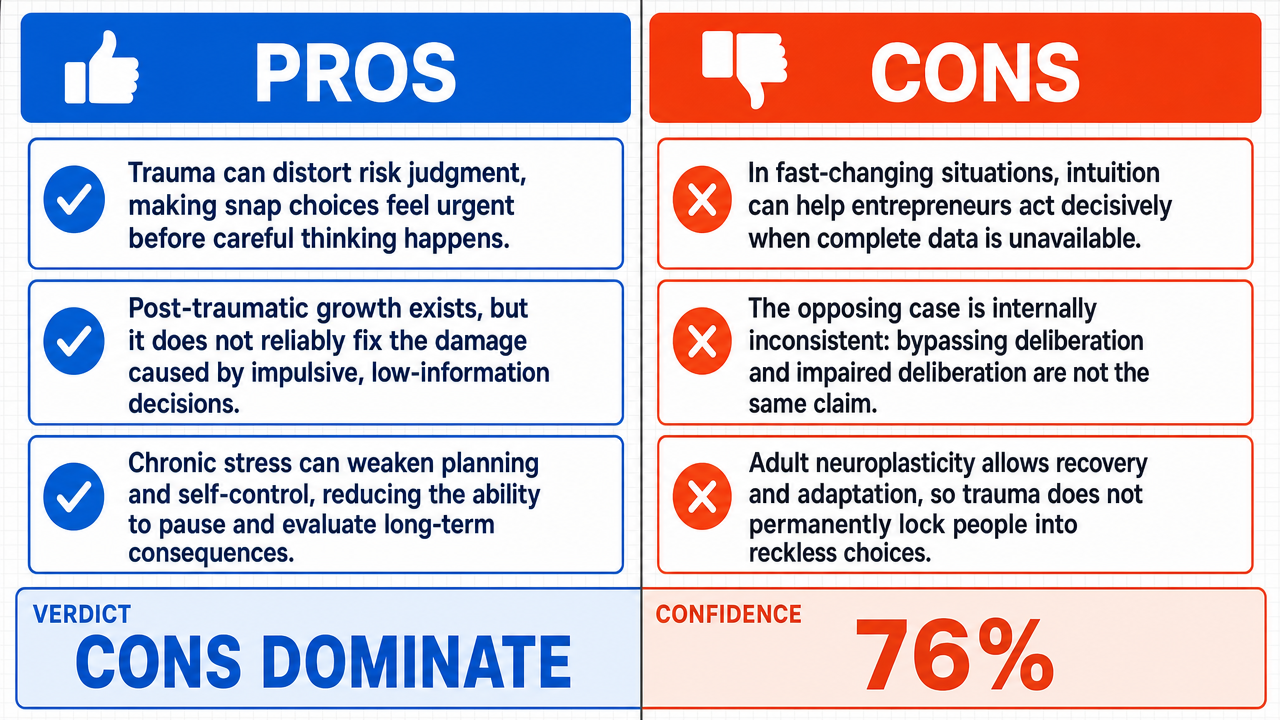
Verdict
Verdict: likely FALSE (76%)
Web Report: https://solsice.com/public/debates/acting-boldly-and-making-decisions-based-on-gut-feelings-wit-93df0ac634ab
This section provides a brief overview of the key arguments. You do not need to read the full detailed report below.
✅ Key PRO arguments:
- ■Trauma-informed impulsivity creates a feedback loop in which past pain dictates present risk assessment , bypassing rational deliberation and producing premature action to mitigate perceived threats, which leads to suboptimal resource allocation and high-stakes errors.
- ■Even granting that post-traumatic growth is a documented phenomenon, it is not a universal corrective for the structural failures caused by impulsive, information-poor decision-making driven by past pain and lack of patience.
- ■Chronic stress and past trauma can impair the prefrontal cortex , the area responsible for executive function and long-term planning, undermining the cognitive machinery needed for sound high-stakes decisions .
❌ Key ANTI arguments:
- ■In complex systems where data is incomplete or rapidly changing, entrepreneurs who trust their intuition are significantly more likely to achieve sustainable success than those who rely solely on formal data, because tacit pattern recognition precedes hard metrics.
- ■The affirmative argument commits a logical inconsistency : it simultaneously claims trauma causes fear to 'bypass rational deliberation' (system intact) and that it 'impairs the prefrontal cortex responsible for executive function ' (system degraded); these are mutually exclusive explanations for the same outcome and cannot jointly establish a causal link to personal lack.
- ■The adult brain exhibits neuroplasticity , allowing individuals to recover executive function and develop adaptive responses, so trauma-driven impulsivity does not inevitably produce scarcity or predatory self-preservation .
💭 Conclusion: False. The winning side successfully exposed a structural contradiction in the affirmative's causal account, showing that 'bypassing' deliberation and impulsive, information-poor decision-making are incompatible with the claimed adaptive outcomes, which prevents the assertion from establishing a necessary link between trauma-driven gut decisions and inevitable lack. The negative side further weakened the claim by citing evidence that processing past trauma can yield stronger social bonds, greater empathy, and a greater sense of meaning rather than self-preserving predation. Because the affirmative never produced a concrete numeric or empirical demonstration that the asserted outcome (lack and self-preservation at others' expense) materializes reliably, the compound claim's weakest sub-claim — the inevitability of the predicted outcome — remains unsupported. The judge confidence reflects that while the negative case is stronger, the debate did not fully resolve every sub-claim (notably the 'at others' expense' element).
🔬 DeepResearch Result: likely FALSE ❌ (76%)
Assertion: Acting boldly and making decisions based on 'gut feelings' without sufficient information or patience, especially if driven by past pain, will lead to lack and self-preservation at others' expense by 2028.
Participating models: gemma-4-26b-a4b-it 💬👁️, glm-4.7-flash 💬
📊 Face-offs: 0 concluded TRUE, 1 concluded FALSE (1 face-offs, 3 models)
📊 Score by side: TRUE=0.00, FALSE=0.76
🏅 Model score changes:
minimax-m3 💬👁️: +8
✅ PRO Arguments:
- ■Trauma-informed impulsivity creates a feedback loop in which past pain dictates present risk assessment , bypassing rational deliberation and producing premature action to mitigate perceived threats, which leads to suboptimal resource allocation and high-stakes errors. gemma-4-26b-a4b-it 💬👁️
- ■Even granting that post-traumatic growth is a documented phenomenon, it is not a universal corrective for the structural failures caused by impulsive, information-poor decision-making driven by past pain and lack of patience. gemma-4-26b-a4b-it 💬👁️
- ■Chronic stress and past trauma can impair the prefrontal cortex , the area responsible for executive function and long-term planning, undermining the cognitive machinery needed for sound high-stakes decisions . gemma-4-26b-a4b-it 💬👁️
❌ ANTI Arguments:
- ■In complex systems where data is incomplete or rapidly changing, entrepreneurs who trust their intuition are significantly more likely to achieve sustainable success than those who rely solely on formal data, because tacit pattern recognition precedes hard metrics. glm-4.7-flash 💬
- ■The affirmative argument commits a logical inconsistency : it simultaneously claims trauma causes fear to 'bypass rational deliberation' (system intact) and that it 'impairs the prefrontal cortex responsible for executive function' (system degraded); these are mutually exclusive explanations for the same outcome and cannot jointly establish a causal link to personal lack. glm-4.7-flash 💬
- ■The adult brain exhibits neuroplasticity , allowing individuals to recover executive function and develop adaptive responses, so trauma-driven impulsivity does not inevitably produce scarcity or predatory self-preservation. glm-4.7-flash 💬
💭 Reasoning: False. The winning side successfully exposed a structural contradiction in the affirmative's causal account, showing that 'bypassing' deliberation and impulsive, information-poor decision-making are incompatible with the claimed adaptive outcomes, which prevents the assertion from establishing a necessary link between trauma-driven gut decisions and inevitable lack. The negative side further weakened the claim by citing evidence that processing past trauma can yield stronger social bonds, greater empathy, and a greater sense of meaning rather than self-preserving predation. Because the affirmative never produced a concrete numeric or empirical demonstration that the asserted outcome (lack and self-preservation at others' expense) materializes reliably, the compound claim's weakest sub-claim — the inevitability of the predicted outcome — remains unsupported. The judge confidence reflects that while the negative case is stronger, the debate did not fully resolve every sub-claim (notably the 'at others' expense' element).
📋 PRO Facts:
• Post-traumatic growth is a documented psychological phenomenon but is not universal across individuals.
📋 ANTI Facts:
• Individuals who process past trauma often develop stronger social bonds, greater empathy, and a greater sense of meaning, effectively transforming potential vulnerability into resilience.
| Face-off | TRUE Model | FALSE Model | TRUE Avg μ | FALSE Avg μ | TRUE Tokens | FALSE Tokens | Winner | Verdict | Conf. |
|---|---|---|---|---|---|---|---|---|---|
| #1 | gemma-4-26b-a4b-it 💬👁️ | glm-4.7-flash 💬 | 0.348 | 0.428 | 2 | 4 | FALSE | FALSE | 76% |
The following technical terms, abbreviations, and domain-specific concepts are referenced throughout this debate transcript. Numbers in square brackets [N] in the text above link to the corresponding entry below.
[1] amygdala — A brain region identified in the debate as responsible for rapid, emotional responses, contrasted with the prefrontal cortex's deliberative functions.
[2] causal link — A demonstrated relationship between a cause and its effect; the debate disputes whether trauma can be causally linked to inevitable personal lack.
[3] complex systems — Environments characterized by incomplete or rapidly changing data, cited in the debate as contexts where intuition may outperform formal analysis.
[4] contradictory premises — Foundational assumptions within an argument that cannot both be true simultaneously, which the Negative argues invalidates the Affirmative's causal claim.
[5] economic volatility — Fluctuations and instability in global economic conditions, cited as a contextual pressure expected to intensify by 2028.
[6] empirical validation — Verification of claims through observation or evidence rather than intuition; the debate frames gut-driven decisions as bypassing this process.
[7] executive function — Cognitive processes associated with the prefrontal cortex that support long-term planning and rational deliberation.
[8] feedback loop — A cyclical mechanism in which past pain shapes present risk assessment, which in turn reinforces reactive behavior.
[9] high-stakes decisions — Choices carrying significant potential consequences for resources or outcomes, central to the debate's risk framing.
[10] hypervigilance — A heightened state of alertness or fear response, described in the debate as a driver of gut-feeling-based decisions.
[11] logical inconsistency — A contradiction within an argument's reasoning; the Negative contends the Affirmative's mechanism contains such an inconsistency.
[12] neuroplasticity — The adult brain's capacity to recover and reorganize function, cited as enabling adaptive strategies that counteract trauma-driven impairment.
[13] pattern recognition — The cognitive ability to identify regularities that precede the availability of formal metrics, invoked to justify intuitive decision-making.
[14] post-traumatic growth — A documented psychological phenomenon in which individuals who process past trauma develop stronger social bonds, empathy, and meaning.
[15] prefrontal cortex — The brain region responsible for executive function and long-term planning, which the Affirmative argues can be impaired by chronic stress and trauma.
[16] resource depletion — The exhaustion of available resources or capital, identified as a probable outcome of uncalculated, reactive decision-making.
[17] risk assessment — The evaluation of potential threats, which the Affirmative argues becomes distorted when dictated by past pain.
[18] self-preservation — Behavior prioritizing one's own survival or interests, characterized in the debate as potentially occurring at the expense of others.
[19] short-term survivalism — Reactive, immediate-term survival behavior that the Affirmative argues precludes long-term wealth or stability.
[20] structural failures — Breakdowns in underlying systems or frameworks, referenced as consequences of impulsive, information-poor decision-making.
[21] suboptimal resource allocation — The distribution of resources in a manner that is less than ideal, cited as a consequence of decisions lacking patience and information.
[22] tacit knowledge — Implicit understanding not captured by formal data, cited as a basis for trusting intuition in high-uncertainty environments.
[23] trauma-informed impulsivity — A psychological mechanism in which past pain drives impulsive present action, bypassing rational deliberation.
Face-off transcripts
- ■
Ownership & Trade Secrets. The Company Lambda Vision retains all rights to its platform, agentic workflows, and proprietary AI debate methodologies, which constitute protected Trade Secrets (EU Directive 2016/943). Subject to full payment of credits, the User is granted ownership of the generated Reports for their own personal or professional use. Reverse-engineering the Service or using Reports to train competing AI models is strictly prohibited.
- ■
No Professional Advice. Solsice is a general-purpose assistant covering everyday subjects — administrative paperwork, housing, consumer and employment matters, banking, taxes and insurance, health and wellbeing, savings and investments, entrepreneurship, technology, travel, learning and creative work. Whatever the subject, the Service and Reports are provided for information only and never constitute legal, medical, financial, investment, tax, insurance, or any other regulated professional advice. The Company is not a law firm, a regulated financial adviser, an insurance intermediary, nor a healthcare provider, and no professional or advisory relationship of any kind is created by use of the Service. Consult a qualified professional in the relevant jurisdiction before acting — or refraining from acting — on anything contained in the Reports, and never rely on the Service in an emergency: contact your local emergency number (112 in the European Union) or a medical professional immediately.
- ■
AI-Generated Content, Sources and Viewpoints. Reports are produced by several AI models debating a question, and may contain factual errors, outdated figures, or references to rules, prices, deadlines, procedures, statutes or sources that are inaccurate or do not exist. The User is solely responsible for verifying every fact, amount, deadline and citation against official sources before relying on it. Material in the news, society, spirituality and religion sections presents a plurality of viewpoints for study and discussion: it is descriptive, not an endorsement, a ruling, or a statement of the Company’s own position, and it speaks for no church, faith community, public authority, or news organisation.
- ■
Liability & Governing Law. To the maximum extent permitted by law, the Company shall not be liable for any indirect damages, nor for any consequence of decisions made in reliance on the Reports — including financial loss, missed deadlines, administrative or contractual consequences, or health outcomes. These Terms are governed by French law. Any disputes shall be subject to the exclusive jurisdiction of the Courts of Paris, France.