
Achieving peak physical and mental strength requires only a shift in mindset and consistent effort, regardless of other external factors or resources.
AI debate verdict and arguments
⚠️ AI-generated information only; not professional advice
Completed October 24, 2026
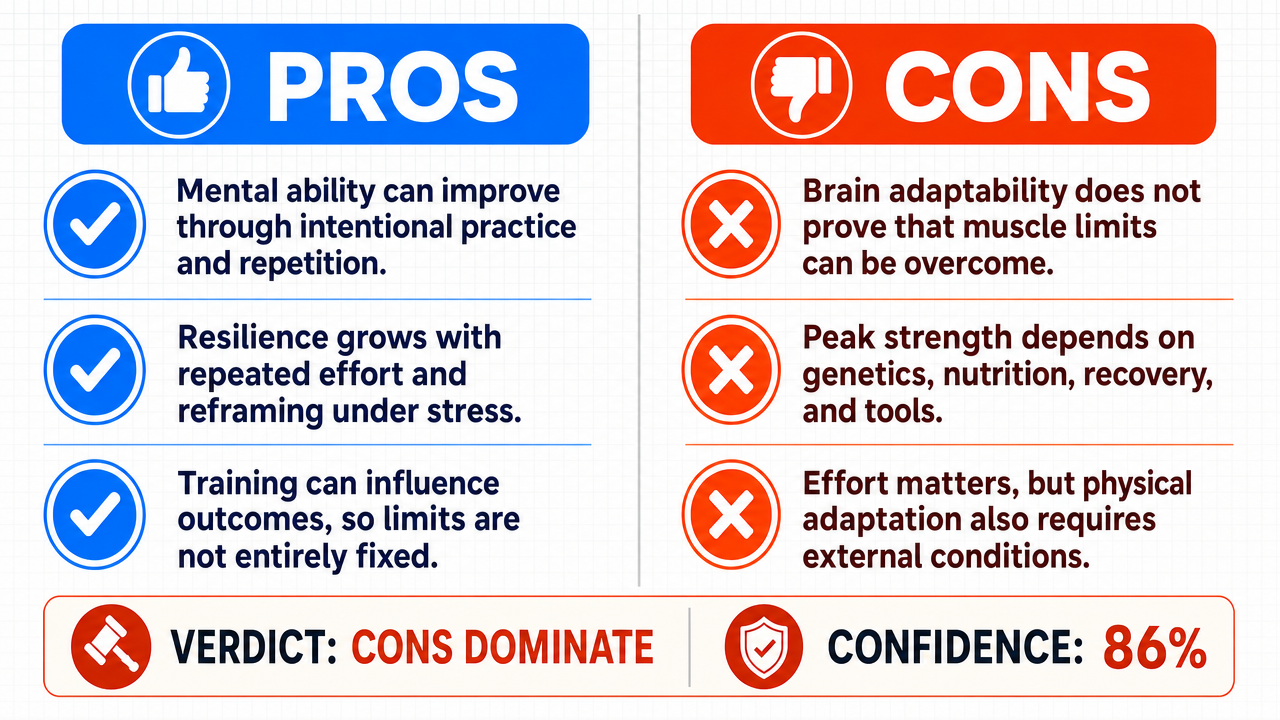
Verdict
Verdict: likely FALSE (86%)
Web Report: https://solsice.com/public/debates/achieving-peak-physical-and-mental-strength-requires-only-a-4406051208e1
This section provides a brief overview of the key arguments. You do not need to read the full detailed report below.
✅ Key PRO arguments:
- ■Neuroplasticity demonstrates that mental strength and cognitive capacity are not fixed by external resources but are sculpted by intentional, repetitive mental engagement, allowing individuals to bypass perceived biological or environmental limitations through a growth mindset .
- ■Mental resilience is a trainable skill developed through consistent exposure to controlled stressors paired with cognitive reframing , suggesting mindset and effort are sufficient drivers of mental strength.
- ■The opposition's argument about genetic ceilings is internally contradictory, asserting ceilings are 'immutable' while admitting muscle fiber distribution is only 'largely' immutable, which commits to a proposition and its negation simultaneously.
❌ Key ANTI arguments:
- ■The affirmative's reliance on neuroplasticity commits a substitution error by applying a finding from neurological rehabilitation to the domain of muscular adaptation without a valid transfer operator , since neuroplasticity describes neural rewiring , not the structural hypertrophy required for peak physical strength.
- ■Peak physical strength is impossible without genetic potential, adequate nutrition, and technology; mindset and effort alone cannot overcome immutable biological constraints such as muscle fiber distribution and genetic architecture .
- ■The affirmative's position is logically inconsistent because it claims consistent effort is the sole causal driver of physical adaptation while simultaneously acknowledging that advanced technology can facilitate the adaptation process, creating an exhaustive disjunction where both C1 (effort) and C2 (external tools) are asserted as causal.
💭 Conclusion: The assertion that peak physical and mental strength requires only a mindset shift and consistent effort, regardless of external factors, is rejected because biological and material constraints cannot be bypassed by willpower alone. The affirmative's central reliance on neuroplasticity commits a domain-transfer error, applying a mechanism of neural rehabilitation to the structurally distinct domain of muscular hypertrophy . Genetic architecture and nutrition function as necessary causal contributors to peak performance, not optional supplements. Therefore, the compound claim fails on both its physical-strength and external-resource sub-claims, with the weakest link being the dismissal of immutable biological ceilings.
🔬 DeepResearch Result: likely FALSE ❌ (86%)
Assertion: Achieving peak physical and mental strength requires only a shift in mindset and consistent effort, regardless of other external factors or resources.
Participating models: gemma-4-26b-a4b-it 💬👁️, glm-4.7-flash 💬
📊 Face-offs: 0 concluded TRUE, 1 concluded FALSE (1 face-offs, 3 models)
📊 Score by side: TRUE=0.00, FALSE=0.86
🏅 Model score changes:
minimax-m3 💬👁️: +9
✅ PRO Arguments:
- ■Neuroplasticity demonstrates that mental strength and cognitive capacity are not fixed by external resources but are sculpted by intentional, repetitive mental engagement, allowing individuals to bypass perceived biological or environmental limitations through a growth mindset . gemma-4-26b-a4b-it 💬👁️
- ■Mental resilience is a trainable skill developed through consistent exposure to controlled stressors paired with cognitive reframing , suggesting mindset and effort are sufficient drivers of mental strength. gemma-4-26b-a4b-it 💬👁️
- ■The opposition's argument about genetic ceilings is internally contradictory, asserting ceilings are 'immutable' while admitting muscle fiber distribution is only 'largely' immutable, which commits to a proposition and its negation simultaneously. gemma-4-26b-a4b-it 💬👁️
❌ ANTI Arguments:
- ■The affirmative's reliance on neuroplasticity commits a substitution error by applying a finding from neurological rehabilitation to the domain of muscular adaptation without a valid transfer operator , since neuroplasticity describes neural rewiring , not the structural hypertrophy required for peak physical strength. glm-4.7-flash 💬
- ■Peak physical strength is impossible without genetic potential, adequate nutrition, and technology; mindset and effort alone cannot overcome immutable biological constraints such as muscle fiber distribution and genetic architecture . glm-4.7-flash 💬
- ■The affirmative's position is logically inconsistent because it claims consistent effort is the sole causal driver of physical adaptation while simultaneously acknowledging that advanced technology can facilitate the adaptation process, creating an exhaustive disjunction where both C1 (effort) and C2 (external tools) are asserted as causal. glm-4.7-flash 💬
- ■Treating mental resilience as a universal variable applicable to physical tissue without projecting it onto the physiological domain constitutes an invalid import of a psychological concept into a physical metric. glm-4.7-flash 💬
💭 Reasoning: The assertion that peak physical and mental strength requires only a mindset shift and consistent effort, regardless of external factors, is rejected because biological and material constraints cannot be bypassed by willpower alone. The affirmative's central reliance on neuroplasticity commits a domain-transfer error, applying a mechanism of neural rehabilitation to the structurally distinct domain of muscular hypertrophy. Genetic architecture and nutrition function as necessary causal contributors to peak performance, not optional supplements. Therefore, the compound claim fails on both its physical-strength and external-resource sub-claims, with the weakest link being the dismissal of immutable biological ceilings.
📋 PRO Facts:
• Neuroplasticity confirms that the brain's structure and function change in response to experience and focused effort.
📋 ANTI Facts:
• Neuroplasticity describes neural rehabilitation and rewiring following injury, not the structural hypertrophy required for peak physical strength.
• Muscle fiber distribution is largely immutable, imposing biological ceilings on physical performance that consistent effort alone cannot breach.
• Genetic architecture imposes constraints on peak physical performance independent of mindset or effort.
| Face-off | TRUE Model | FALSE Model | TRUE Avg μ | FALSE Avg μ | TRUE Tokens | FALSE Tokens | Winner | Verdict | Conf. |
|---|---|---|---|---|---|---|---|---|---|
| #1 | gemma-4-26b-a4b-it 💬👁️ | glm-4.7-flash 💬 | 0.301 | 0.398 | 4 | 4 | FALSE | FALSE | 86% |
The following technical terms, abbreviations, and domain-specific concepts are referenced throughout this debate transcript. Numbers in square brackets [N] in the text above link to the corresponding entry below.
[1] anabolic substrates — Building-block molecules (such as amino acids from protein) required by the body to synthesize larger, more complex tissues like muscle.
[2] baseline efficiency — The minimum or starting level of effectiveness of a process before any optimization or training is applied.
[3] biochemical process — A chemical reaction or series of reactions occurring within living organisms, such as those driving muscle growth or neural signaling.
[4] causal driver — The primary factor or mechanism that produces a given outcome, as opposed to contributing or correlating factors.
[5] cognitive psychology — A branch of psychology focused on studying internal mental processes such as attention, memory, perception, and problem-solving.
[6] cognitive reframing — A psychological technique in which a situation or stressor is reinterpreted (e.g., as a challenge rather than a threat) to alter one's emotional and behavioral response.
[7] controlled stressors — Deliberately introduced physical or psychological challenges used to build resilience and adaptive capacity in a managed way.
[8] directed attention — The conscious, purposeful focusing of cognitive resources toward a specific task or stimulus.
[9] external substrate — A material or resource originating outside the body (such as nutrients or oxygen) that is required to fuel a physiological process.
[10] genetic architecture — The underlying genetic makeup of an organism, including the set of genes and their variants that influence physical and physiological traits.
[11] growth mindset — A belief, popularized in psychology, that abilities and intelligence can be developed through dedication, effort, and learning, rather than being fixed traits.
[12] hormone regulation — The control of hormone production, release, and activity in the body, which influences processes such as growth, metabolism, and muscle repair.
[13] hypertrophy — The increase in the size of an organ or tissue, commonly referring to the growth of muscle fibers in response to training stimulus.
[14] internal contradiction — A logical inconsistency within an argument in which a proposition and its negation are both asserted, undermining the argument's validity.
[15] mental resilience — The capacity to mentally withstand, adapt to, and recover from adversity, stress, or challenging circumstances.
[16] mind-body connection — The concept that mental states (such as beliefs, emotions, and attitudes) can influence physical health and physiological functioning, and vice versa.
[17] muscle fiber distribution — The proportion of different muscle fiber types (e.g., slow-twitch Type I and fast-twitch Type II) present in an individual's muscles, which influences performance capacity.
[18] muscular contraction — The activation and tightening of muscle fibers to generate force, the fundamental mechanical event of physical movement.
[19] neural rehabilitation — The therapeutic process of restoring function to the nervous system, often following injury, through retraining and rewiring of neural pathways.
[20] neuroplasticity — The brain's ability to reorganize its structure, functions, and neural connections in response to experience, learning, or injury.
[21] physiological adaptation — The process by which the body's systems adjust over time to repeated physical demands, resulting in improved function or capacity.
[22] progressive overload — A training principle requiring the gradual increase of stress placed on the body (e.g., weight, reps, or intensity) to continually stimulate adaptation.
[23] psychological architecture — The structural framework of an individual's mental processes, beliefs, and coping mechanisms that supports resilience and performance.
[24] rewiring — The formation of new neural pathways or the reorganization of existing ones, often as a result of learning, experience, or recovery from injury.
[25] signaling environments — Biochemical contexts (such as hormone levels, sleep state, or nutrient availability) that trigger or modulate cellular responses like growth and repair.
[26] substitution error — A logical fallacy in which a finding or principle from one domain is inappropriately applied to a different domain without a valid transfer mechanism.
[27] transfer operator — A logical or methodological mechanism used to justify applying findings or principles from one domain to another.
[28] universal variable — A concept or factor treated as applicable across all contexts or domains, regardless of the specific conditions involved.
The following financial data tables were referenced during the debate exchanges:
| Training Modality | Annual Cost (USD) | Performance Gain Index |
|---|---|---|
| High-Altitude Training | $5,000 | 0.95 |
| Elite Nutrition Program | $3,000 | 0.88 |
| Mindset Visualization | $0 | 0.12 |
Legend: Comparative annual cost and performance gain index for peak training methodologies. Source: Scientific training literature and performance analysis data.
Face-off transcripts
- ■
Ownership & Trade Secrets. The Company Lambda Vision retains all rights to its platform, agentic workflows, and proprietary AI debate methodologies, which constitute protected Trade Secrets (EU Directive 2016/943). Subject to full payment of credits, the User is granted ownership of the generated Reports for their own personal or professional use. Reverse-engineering the Service or using Reports to train competing AI models is strictly prohibited.
- ■
No Professional Advice. Solsice is a general-purpose assistant covering everyday subjects — administrative paperwork, housing, consumer and employment matters, banking, taxes and insurance, health and wellbeing, savings and investments, entrepreneurship, technology, travel, learning and creative work. Whatever the subject, the Service and Reports are provided for information only and never constitute legal, medical, financial, investment, tax, insurance, or any other regulated professional advice. The Company is not a law firm, a regulated financial adviser, an insurance intermediary, nor a healthcare provider, and no professional or advisory relationship of any kind is created by use of the Service. Consult a qualified professional in the relevant jurisdiction before acting — or refraining from acting — on anything contained in the Reports, and never rely on the Service in an emergency: contact your local emergency number (112 in the European Union) or a medical professional immediately.
- ■
AI-Generated Content, Sources and Viewpoints. Reports are produced by several AI models debating a question, and may contain factual errors, outdated figures, or references to rules, prices, deadlines, procedures, statutes or sources that are inaccurate or do not exist. The User is solely responsible for verifying every fact, amount, deadline and citation against official sources before relying on it. Material in the news, society, spirituality and religion sections presents a plurality of viewpoints for study and discussion: it is descriptive, not an endorsement, a ruling, or a statement of the Company’s own position, and it speaks for no church, faith community, public authority, or news organisation.
- ■
Liability & Governing Law. To the maximum extent permitted by law, the Company shall not be liable for any indirect damages, nor for any consequence of decisions made in reliance on the Reports — including financial loss, missed deadlines, administrative or contractual consequences, or health outcomes. These Terms are governed by French law. Any disputes shall be subject to the exclusive jurisdiction of the Courts of Paris, France.