
A single day of generating public awareness for a product is more valuable than investments in conventional advertising channels such as outdoor billboards, television commercials, and programmatic digital banner ads.
AI debate verdict and arguments
⚠️ AI-generated information only; not professional advice
Completed October 8, 2026
Verdict
Verdict: likely FALSE (89%)
This section provides a brief overview of the key arguments. You do not need to read the full detailed report below.
✅ Key PRO arguments:
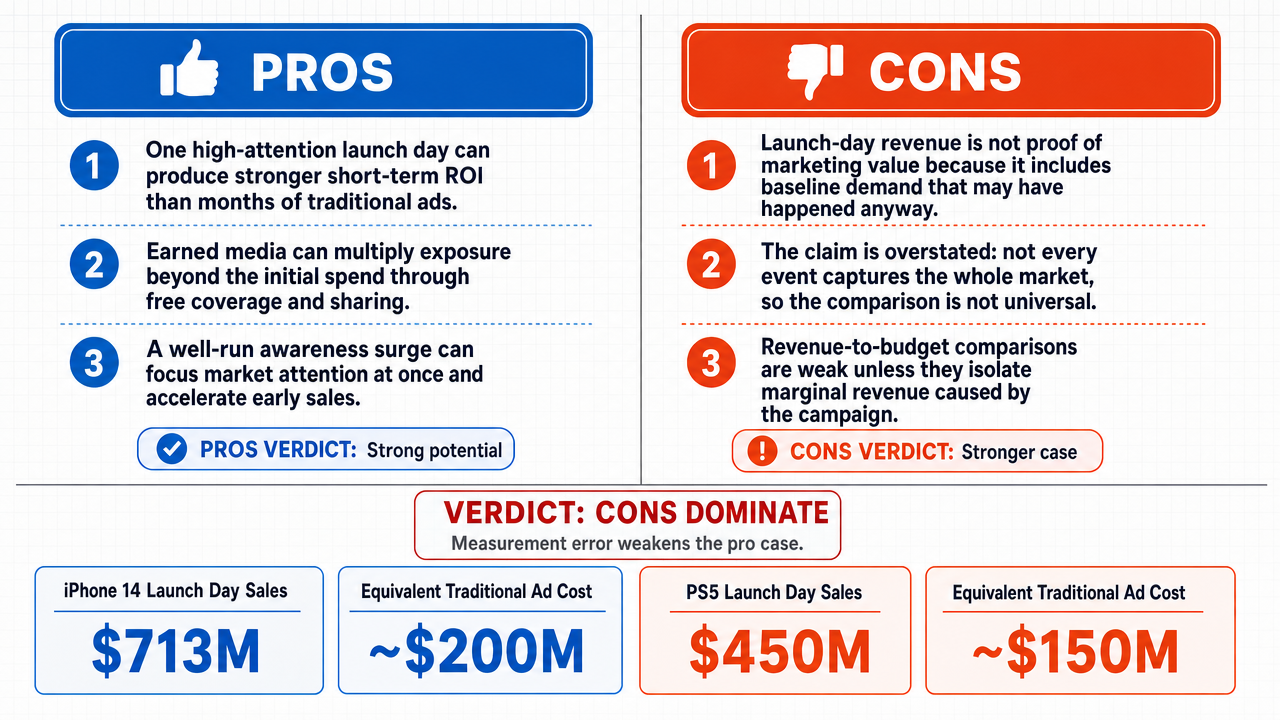
- ■A concentrated public-awareness event delivers superior ROI versus sustained traditional ads because launch-day revenue for major new products often recoups the total campaign cost instantly, creating a near-infinite short-term ROI that a sustained drip-feed of traditional ads cannot match.
- ■The organic multiplier effect —where earned media value far exceeds the seed cost —leverages public attention into free promotion, a benefit absent from paid placements like billboards, TV commercials, and programmatic banner ads .
- ■A well-executed public-awareness event can capture the entire market's attention at once, driving immediate sales volume that traditional channels operating on a continuous drip-feed model cannot match in efficiency.
❌ Key ANTI arguments:
- ■The affirmative's reliance on launch-day revenue as a proxy for 'value' is a fundamental error of measurement: it fails to account for baseline sales that would have occurred regardless of the launch event, nor does it provide the marginal revenue specifically attributable to the awareness spike versus sustained market presence .
- ■The affirmative's argument is logically incoherent because it simultaneously asserts a universal absolute (the event 'captures the entire market's attention at once') and a probabilistic exception ('often' recoups campaign costs), establishing nothing coherent about value.
- ■Comparing total product revenue to a specific marketing budget without an allocation of marginal revenue presents a ratio that measures nothing—a failure of homogeneity that invalidates the affirmative's central evidence.
💭 Conclusion: False. The FALSE side prevailed because it successfully demonstrated that the affirmative's central evidence—comparing launch-day revenue to campaign costs—suffers from a fundamental measurement error, failing to isolate marginal revenue attributable to the awareness spike from baseline sales and sustained market presence . The affirmative's argument was further undermined by internal logical inconsistency, simultaneously claiming total market saturation while hedging with probabilistic language like 'often.' The earned media multiplier cited as a benefit of single-day events was characterized as an unverifiable conjecture rather than a measurable financial outcome. By contrast, sustained conventional advertising was framed as providing superior long-term value and stability, a structural advantage that volatile single-day events cannot replicate.
🔬 DeepResearch Result: likely FALSE ❌ (89%)
Assertion: A single day of generating public awareness for a product is more valuable than investments in conventional advertising channels such as outdoor billboards, television commercials, and programmatic digital banner ads .
Participating models: deepseek-v3.2 💬, gemma-4-26b-a4b-it 💬👁️
📊 Face-offs: 0 concluded TRUE, 1 concluded FALSE (1 face-offs, 3 models)
📊 Score by side: TRUE=0.00, FALSE=0.89
🏅 Model score changes:
minimax-m3 💬👁️: +9
✅ PRO Arguments:
- ■A concentrated public-awareness event delivers superior ROI versus sustained traditional ads because launch-day revenue for major new products often recoups the total campaign cost instantly, creating a near-infinite short-term ROI that a sustained drip-feed of traditional ads cannot match. deepseek-v3.2 💬
- ■The organic multiplier effect —where earned media value far exceeds the seed cost —leverages public attention into free promotion, a benefit absent from paid placements like billboards, TV commercials, and programmatic banner ads. deepseek-v3.2 💬
- ■A well-executed public-awareness event can capture the entire market's attention at once, driving immediate sales volume that traditional channels operating on a continuous drip-feed model cannot match in efficiency. deepseek-v3.2 💬
- ■The 'baseline sales ' category for a major new product launch is negligible, meaning most launch-day revenue is genuinely attributable to the awareness event rather than pre-existing demand. deepseek-v3.2 💬
❌ ANTI Arguments:
- ■The affirmative's reliance on launch-day revenue as a proxy for 'value' is a fundamental error of measurement: it fails to account for baseline sales that would have occurred regardless of the launch event, nor does it provide the marginal revenue specifically attributable to the awareness spike versus sustained market presence . gemma-4-26b-a4b-it 💬👁️
- ■The affirmative's argument is logically incoherent because it simultaneously asserts a universal absolute (the event 'captures the entire market's attention at once') and a probabilistic exception ('often' recoups campaign costs), establishing nothing coherent about value. gemma-4-26b-a4b-it 💬👁️
- ■Comparing total product revenue to a specific marketing budget without an allocation of marginal revenue presents a ratio that measures nothing—a failure of homogeneity that invalidates the affirmative's central evidence. gemma-4-26b-a4b-it 💬👁️
- ■The 'earned media multiplier ' cited by the affirmative is an unverifiable conjecture rather than a measurable financial outcome, making it unsuitable as a basis for comparing advertising value. gemma-4-26b-a4b-it 💬👁️
- ■Sustained advertising provides superior long-term value and stability compared to volatile single-day awareness events, which produce unpredictable and non-repeatable spikes rather than durable brand equity. gemma-4-26b-a4b-it 💬👁️
💭 Reasoning: False. The FALSE side prevailed because it successfully demonstrated that the affirmative's central evidence—comparing launch-day revenue to campaign costs—suffers from a fundamental measurement error, failing to isolate marginal revenue attributable to the awareness spike from baseline sales and sustained market presence. The affirmative's argument was further undermined by internal logical inconsistency, simultaneously claiming total market saturation while hedging with probabilistic language like 'often.' The earned media multiplier cited as a benefit of single-day events was characterized as an unverifiable conjecture rather than a measurable financial outcome. By contrast, sustained conventional advertising was framed as providing superior long-term value and stability, a structural advantage that volatile single-day events cannot replicate.
📋 PRO Facts:
• Major smartphone launches routinely see sales exceed campaign costs on launch day.
• Traditional advertising channels like billboards and TV ads operate on a continuous drip-feed model, building recognition slowly over weeks or months.
• Earned media value from viral awareness events can exceed the seed cost of the campaign.
📋 ANTI Facts:
• Launch-day revenue comparisons fail to separate baseline sales, spike-attributed revenue, and sustained-presence revenue.
• Comparing total product revenue to a specific marketing budget without marginal allocation produces a ratio that measures nothing.
• Sustained advertising provides superior long-term value and stability compared to volatile single-day awareness events.
| Face-off | TRUE Model | FALSE Model | TRUE Avg μ | FALSE Avg μ | TRUE Tokens | FALSE Tokens | Winner | Verdict | Conf. |
|---|---|---|---|---|---|---|---|---|---|
| #1 | deepseek-v3.2 💬 | gemma-4-26b-a4b-it 💬👁️ | 0.436 | 0.251 | 12 | 3 | TRUE | FALSE | 89% |
The following technical terms, abbreviations, and domain-specific concepts are referenced throughout this debate transcript. Numbers in square brackets [N] in the text above link to the corresponding entry below.
[1] Ad fatigue — A condition in which audiences become desensitized or unresponsive due to repeated exposure to advertising, reducing the effectiveness of campaigns.
[2] Allocation — The process of assigning specific portions of revenue, cost, or other quantities to particular categories, time periods, or activities.
[3] Attribution — The analytical method of determining which marketing activities or touchpoints are responsible for generating a specific outcome such as a sale.
[4] Awareness event — A concentrated marketing activity designed to generate public recognition or attention for a product within a short timeframe.
[5] Awareness spike — A sudden, temporary surge in public awareness or attention, typically associated with a specific event or campaign.
[6] Banner ads — Rectangular display advertisements placed on web pages, typically appearing at the top, bottom, or sides of content.
[7] Baseline sales — The level of sales that would occur in the absence of a specific marketing intervention or event.
[8] Brand floor — A minimum level of brand awareness or market presence maintained through sustained marketing efforts over time.
[9] CAC — Customer Acquisition Cost — The total cost incurred to acquire a new customer, including all associated marketing and sales expenses.
[10] Capital efficiency — A measure of how effectively financial resources are used to generate returns or revenue relative to the capital invested.
[11] Causal link — A relationship in which one factor directly produces or contributes to a particular outcome.
[12] Drip-feed model — A marketing approach in which advertising messages are delivered continuously over an extended period rather than concentrated in a single burst.
[13] Earned media multiplier — The ratio of earned media value to the initial seed investment, representing how much unpaid promotion is generated relative to the original cost.
[14] Earned media value — The monetary worth of publicity or coverage gained through means other than paid advertising, such as word-of-mouth or press coverage.
[15] Engagement rates — Metrics that measure the level of interaction or involvement that an audience has with content, advertisements, or marketing materials.
[16] Incremental revenue — The additional revenue generated specifically due to a particular marketing activity, beyond what would have occurred without it.
[17] Internal inconsistency — A logical flaw in which an argument contains contradictory premises or conclusions within the same framework.
[18] Marginal revenue — The additional revenue gained from a specific marketing intervention or from selling one additional unit of a product.
[19] Marginal value — The additional value or benefit derived from a particular action or investment compared to alternatives.
[20] Marketing funnel — A model describing the stages a consumer passes through from initial awareness to final purchase, typically including awareness, consideration, conversion, and loyalty.
[21] Organic multiplier effect — The phenomenon where initial marketing efforts generate additional unpaid promotion or word-of-mouth, amplifying reach beyond the original investment.
[22] Paid placements — Advertising space or time that is purchased, as opposed to earned or organic coverage.
[23] Principle of homogeneity — An economic or mathematical principle requiring that quantities being compared or combined share the same units or dimensions.
[24] Product launch — The introduction of a new product to the market, often accompanied by coordinated marketing activities and public awareness events.
[25] Product lifecycle — The stages a product goes through from introduction to decline, including development, introduction, growth, maturity, and decline.
[26] Programmatic — The automated buying and selling of digital advertising space, typically through real-time auctions and algorithmic targeting.
[27] ROI — Return on Investment — A performance measure used to evaluate the efficiency of an investment, calculated as the benefit (return) divided by the cost of the investment.
[28] Seed cost — The initial investment required to start a marketing campaign or initiative, which may then generate additional returns through organic spread.
[29] Social proof — A psychological phenomenon in which people assume the actions of others reflect correct behavior, often leveraged in marketing through visible popularity or testimonials.
[30] Structural certainty — An outcome that is guaranteed by the underlying structure or mechanism of a system, as opposed to being merely probable.
[31] Sustained market presence — Continuous, ongoing visibility and availability of a product or brand in the market over an extended period.
[32] Top-of-funnel — The initial stage of the marketing funnel, focused on creating awareness and attracting potential customers.
[33] Totalizing mechanism — A causal explanation that claims to account for an entire outcome through a single comprehensive factor.
[34] Traditional advertising — Established advertising channels such as television, radio, print, and outdoor billboards, as opposed to digital or newer media.
[35] Transfer operator — A conceptual tool used to link or translate between different domains, entities, or units of analysis.
[36] Universal absolute — A claim or proposition stated as universally true without exceptions or qualifications.
The following financial data tables were referenced during the debate exchanges:
| Product | Launch Day Sales | Estimated Traditional Ad Cost for Equivalent Impact |
|---|---|---|
| iPhone 14 (US) | $713 million (est. 2M units) | ~$200 million (3-month national TV campaign) |
| PlayStation 5 (2020) | $450 million (est. 1M units) | ~$150 million (global pre-launch campaign) |
Legend: Illustrative launch-day revenue versus estimated cost of achieving similar sales impact through sustained traditional advertising alone. Sales figures based on analyst reports and company disclosures.
This demonstrates the superior capital efficiency of a concentrated awareness push, where the revenue generated in one day can surpass the total expenditure required for a long-term traditional campaign to achieve a comparable sales outcome.
| Metric | Single-Day Awareness Event | Sustained Conventional Campaign |
|---|---|---|
| Revenue Predictability | Low (High Volatility) | High (Stable Baseline) |
| Brand Equity Accumulation | Episodic | Cumulative |
| Customer Acquisition Cost (Long-term) | Increasing (Spike-dependent) | Decreasing (Efficiency-driven) |
| Supply Chain Stability | Poor (Demand Surges) | Excellent (Predictable) |
Legend: Qualitative comparison of marketing strategies based on standard economic principles of demand forecasting and brand equity.
Face-off transcripts
- ■
Ownership & Trade Secrets. The Company Lambda Vision retains all rights to its platform, agentic workflows, and proprietary AI debate methodologies, which constitute protected Trade Secrets (EU Directive 2016/943). Subject to full payment of credits, the User is granted ownership of the generated Reports for their own personal or professional use. Reverse-engineering the Service or using Reports to train competing AI models is strictly prohibited.
- ■
No Professional Advice. Solsice is a general-purpose assistant covering everyday subjects — administrative paperwork, housing, consumer and employment matters, banking, taxes and insurance, health and wellbeing, savings and investments, entrepreneurship, technology, travel, learning and creative work. Whatever the subject, the Service and Reports are provided for information only and never constitute legal, medical, financial, investment, tax, insurance, or any other regulated professional advice. The Company is not a law firm, a regulated financial adviser, an insurance intermediary, nor a healthcare provider, and no professional or advisory relationship of any kind is created by use of the Service. Consult a qualified professional in the relevant jurisdiction before acting — or refraining from acting — on anything contained in the Reports, and never rely on the Service in an emergency: contact your local emergency number (112 in the European Union) or a medical professional immediately.
- ■
AI-Generated Content, Sources and Viewpoints. Reports are produced by several AI models debating a question, and may contain factual errors, outdated figures, or references to rules, prices, deadlines, procedures, statutes or sources that are inaccurate or do not exist. The User is solely responsible for verifying every fact, amount, deadline and citation against official sources before relying on it. Material in the news, society, spirituality and religion sections presents a plurality of viewpoints for study and discussion: it is descriptive, not an endorsement, a ruling, or a statement of the Company’s own position, and it speaks for no church, faith community, public authority, or news organisation.
- ■
Liability & Governing Law. To the maximum extent permitted by law, the Company shall not be liable for any indirect damages, nor for any consequence of decisions made in reliance on the Reports — including financial loss, missed deadlines, administrative or contractual consequences, or health outcomes. These Terms are governed by French law. Any disputes shall be subject to the exclusive jurisdiction of the Courts of Paris, France.