
A similar entrepreneurial spirit existed in France during the 1880s and 1890s, prior to World War I, which was then interrupted by subsequent historical events.
AI debate verdict and arguments
⚠️ AI-generated information only; not professional advice
Completed October 11, 2026
Verdict
Verdict: likely FALSE (76%)
This section provides a brief overview of the key arguments. You do not need to read the full detailed report below.
✅ Key PRO arguments:
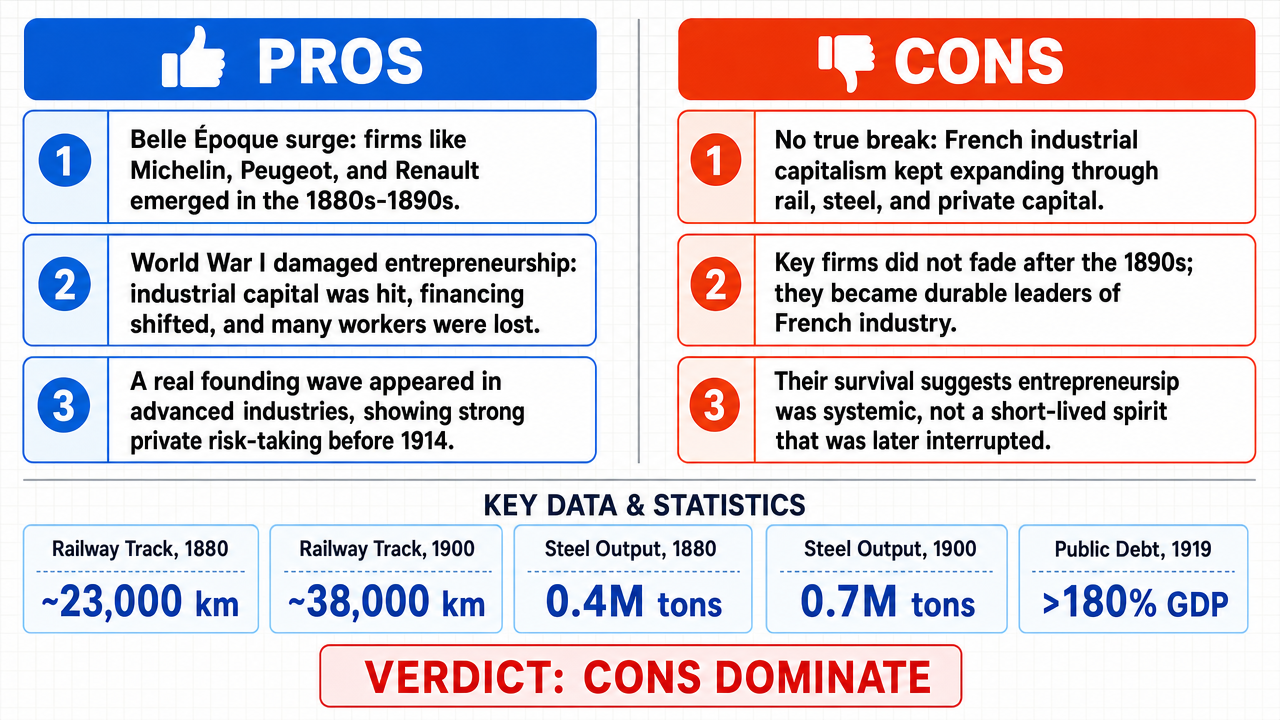
- ■France exhibited a distinct entrepreneurial surge during the Belle Époque of the 1880s and 1890s, evidenced by the founding of pioneering firms such as Michelin (1889), Peugeot's automobile venture (1896), and the Renault brothers' workshop (1898), alongside scientific and commercial breakthroughs by figures like Pasteur and the Lumière brothers.
- ■World War I severely interrupted this entrepreneurial dynamism, destroying approximately a quarter of France's industrial capital stock , killing or incapacitating 1.4 million prime-age men (over 10% of the active male workforce ), and ballooning national debt from 66% of GDP in 1913 to over 180% by 1919, which crippled private investment capacity .
- ■The late-nineteenth-century French founding cohort represented a recognizable burst of private firm creation and technical risk-taking in advanced industries (electricity, chemicals, optics, transport), distinct from earlier artisanal or state-directed activity.
❌ Key ANTI arguments:
- ■The claim of an 'interrupted spirit' is a historical fallacy that ignores the structural continuity of French industrial capitalism ; the growth in steel, rail, and advanced industry was part of a long-term transition toward a modern industrial economy that persisted through the early 20th century rather than a transient burst.
- ■The very companies cited as evidence of the 1880s-1890s entrepreneurial spirit (Michelin, Peugeot, Renault) did not merely exist in the 1890s; they became permanent structural pillars of the subsequent French economy, demonstrating that the underlying economic capacity and institutional frameworks for entrepreneurship were not destroyed but evolved.
- ■The survival and subsequent dominance of these flagship firms proves that the 'spirit' was a fundamental characteristic of the French economic system, not a temporary phenomenon that could be 'interrupted' by a war; the institutional and industrial foundations established during the Belle Époque provided structural continuity rather than collapse.
💭 Conclusion: False. The assertion that France's entrepreneurial spirit in the 1880s-1890s was 'interrupted' by subsequent historical events is not supported by the stronger evidence presented. While the PRO side correctly documented the founding of major firms like Michelin, Peugeot, and Renault during this period, the ANTI side more convincingly demonstrated that these companies became permanent structural pillars of the French economy rather than casualties of disruption. The survival and continued dominance of these firms through and after World War I indicates that the underlying economic capacity and institutional frameworks for entrepreneurship were preserved and evolved, not destroyed. The PRO side's evidence of wartime devastation, while factually accurate regarding capital destruction and debt increases, does not establish that the entrepreneurial 'spirit' itself was interrupted when the institutional and corporate structures it created endured. Therefore, characterizing French economic dynamism as a continuous structural feature rather than an interrupted pre-war phenomenon is the more defensible interpretation.
🔬 DeepResearch Result: likely FALSE ❌ (76%)
Assertion: A similar entrepreneurial spirit existed in France during the 1880s and 1890s, prior to World War I, which was then interrupted by subsequent historical events.
Participating models: deepseek-v3.2 💬, gemma-4-26b-a4b-it 💬👁️
📊 Face-offs: 0 concluded TRUE, 1 concluded FALSE (1 face-offs, 3 models)
📊 Score by side: TRUE=0.00, FALSE=0.76
🏅 Model score changes:
minimax-m3 💬👁️: +8
✅ PRO Arguments:
- ■France exhibited a distinct entrepreneurial surge during the Belle Époque of the 1880s and 1890s, evidenced by the founding of pioneering firms such as Michelin (1889), Peugeot's automobile venture (1896), and the Renault brothers' workshop (1898), alongside scientific and commercial breakthroughs by figures like Pasteur and the Lumière brothers. deepseek-v3.2 💬
- ■World War I severely interrupted this entrepreneurial dynamism, destroying approximately a quarter of France's industrial capital stock , killing or incapacitating 1.4 million prime-age men (over 10% of the active male workforce ), and ballooning national debt from 66% of GDP in 1913 to over 180% by 1919, which crippled private investment capacity . deepseek-v3.2 💬
- ■The late-nineteenth-century French founding cohort represented a recognizable burst of private firm creation and technical risk-taking in advanced industries (electricity, chemicals, optics, transport), distinct from earlier artisanal or state-directed activity. deepseek-v3.2 💬
❌ ANTI Arguments:
- ■The claim of an 'interrupted spirit' is a historical fallacy that ignores the structural continuity of French industrial capitalism ; the growth in steel, rail, and advanced industry was part of a long-term transition toward a modern industrial economy that persisted through the early 20th century rather than a transient burst. gemma-4-26b-a4b-it 💬👁️
- ■The very companies cited as evidence of the 1880s-1890s entrepreneurial spirit (Michelin, Peugeot, Renault) did not merely exist in the 1890s; they became permanent structural pillars of the subsequent French economy, demonstrating that the underlying economic capacity and institutional frameworks for entrepreneurship were not destroyed but evolved. gemma-4-26b-a4b-it 💬👁️
- ■The survival and subsequent dominance of these flagship firms proves that the 'spirit' was a fundamental characteristic of the French economic system, not a temporary phenomenon that could be 'interrupted' by a war; the institutional and industrial foundations established during the Belle Époque provided structural continuity rather than collapse. gemma-4-26b-a4b-it 💬👁️
💭 Reasoning: False. The assertion that France's entrepreneurial spirit in the 1880s-1890s was 'interrupted' by subsequent historical events is not supported by the stronger evidence presented. While the PRO side correctly documented the founding of major firms like Michelin, Peugeot, and Renault during this period, the ANTI side more convincingly demonstrated that these companies became permanent structural pillars of the French economy rather than casualties of disruption. The survival and continued dominance of these firms through and after World War I indicates that the underlying economic capacity and institutional frameworks for entrepreneurship were preserved and evolved, not destroyed. The PRO side's evidence of wartime devastation, while factually accurate regarding capital destruction and debt increases, does not establish that the entrepreneurial 'spirit' itself was interrupted when the institutional and corporate structures it created endured. Therefore, characterizing French economic dynamism as a continuous structural feature rather than an interrupted pre-war phenomenon is the more defensible interpretation.
📋 PRO Facts:
• Three major firms—Michelin, Peugeot, and Renault—were founded during the 1880s-1890s.
• World War I resulted in the destruction of approximately a quarter of France's industrial capital stock.
• 1.4 million French soldiers were killed during WWI.
• France's national debt rose from 66% of GDP in 1913 to over 180% by 1919.
📋 ANTI Facts:
• Companies founded in the 1880s-1890s such as Michelin, Peugeot, and Renault survived World War I and became permanent structural pillars of the subsequent French economy.
• French industrial growth in steel, rail, and advanced industries was part of a long-term structural transition toward a modern industrial economy that persisted through the early 20th century.
• The institutional frameworks for entrepreneurship established during the Belle Époque provided structural continuity rather than collapse after WWI.
| Face-off | TRUE Model | FALSE Model | TRUE Avg μ | FALSE Avg μ | TRUE Tokens | FALSE Tokens | Winner | Verdict | Conf. |
|---|---|---|---|---|---|---|---|---|---|
| #1 | deepseek-v3.2 💬 | gemma-4-26b-a4b-it 💬👁️ | 0.358 | 0.242 | 12 | 3 | TRUE | FALSE | 76% |
The following technical terms, abbreviations, and domain-specific concepts are referenced throughout this debate transcript. Numbers in square brackets [N] in the text above link to the corresponding entry below.
[1] active male workforce — The portion of the male population that is employed and economically active, typically measured as a share of the total working-age male population.
[2] aggregate industrial output — The total combined volume of production across all industrial sectors of an economy, often used as a broad measure of industrial activity.
[3] Belle Époque — A French term referring to the period of European history roughly spanning the late 19th century into the early 20th century, characterized in the transcript as the 1880s and 1890s and associated with cultural, scientific, and industrial flourishing.
[4] broad-based industrialization — Industrial development that spreads across multiple sectors of an economy rather than being concentrated in a few industries.
[5] capital formation — The process by which an economy builds up its stock of capital (such as factories, machinery, and infrastructure) through investment.
[6] corporate formation — The creation and establishment of new business entities or companies within an economy.
[7] founding cohort — A group of companies or organizations established within a similar time period, often used to analyze patterns of entrepreneurship.
[8] GDP — Gross Domestic Product — The total monetary value of all goods and services produced within a country's borders over a specified period, commonly used as a measure of economic size.
[9] industrial capital stock — The accumulated physical capital assets used in industrial production, such as factories, machinery, and equipment.
[10] industrial capitalism — An economic system characterized by private ownership of industrial means of production, wage labor, and market-based allocation of goods.
[11] industrial complex — A network of interconnected industries and firms that collectively form a significant portion of an economy.
[12] innovation-driven growth — Economic expansion fueled primarily by the development and adoption of new technologies, products, or processes.
[13] institutional frameworks — The formal and informal rules, structures, and organizations (such as legal systems, financial markets, and regulatory bodies) that shape economic and social activity.
[14] national debt — The total amount of money owed by a national government to creditors, often expressed as a percentage of GDP.
[15] postwar growth — Economic expansion occurring after a war, often associated with reconstruction and recovery.
[16] prime-age men — Men in the age range typically considered most economically productive, often defined as those between 25 and 54 years old.
[17] private investment capacity — The ability of private actors (businesses and individuals) to allocate financial resources toward productive investments.
[18] quantitative indicators — Numerical measures used to assess economic or social phenomena, such as production volumes, employment rates, or output levels.
[19] state-led modernization — A development model in which the government plays a central role in driving economic and industrial transformation through policy, investment, and regulation.
[20] structural continuity — The persistence of underlying economic, institutional, or social structures over time, even amid surface-level disruptions.
[21] substitution error — A logical fallacy in which one concept is improperly replaced with another as a proxy or substitute, as described in the debate when aggregate industrial output was used in place of 'entrepreneurial spirit.'
[22] Trente Glorieuses — the thirty glorious years — A French term referring to the approximately thirty-year period of strong economic growth in France following World War II, as defined in the transcript.
The following financial data tables were referenced during the debate exchanges:
| Indicator | 1880 | 11900 | Growth |
|---|---|---|---|
| Steel Production (metric tons) | 0.4M | 0.7M | +75% |
| Railway Track (km) | ~23,000 | ~38,000 | +65% |
Legend: Key industrial indicators for France, circa 1880 and 1900, showing substantial expansion during the period. Sources: historical economic datasets.
| Era | Economic Characterization | Primary Driver |
|---|---|---|
| 1880–1914 | Industrial Expansion | Private Capital & Infrastructure |
| 1914–1945 | Crisis & Reorganization | State-Directed Reconstruction |
| 1945–1975 | The "Trente Glorieuses" | Integrated Industrial Modernization |
Legend: Comparison of French economic eras showing the evolution of drivers rather than a total interruption of industrial capacity.
| Indicator | Approximate value | Unit |
|---|---|---|
| French public debt, 1913 | 66 | % of GDP |
| French public debt, 1919 | above 180 | % of GDP |
| French military deaths, 1914-1918 | 1.4 | million |
| New founding firms cited for the 1880s-1890s | 3 | firms |
*Legend: Quantitative markers used to support the claim. The debt figures show war financing redirected national capital; the deaths figure shows the loss of prime-age founders and workers; the three firms are Michelin (1889), Peugeot’s automobile venture (1896), and Renault (1898). Sources: Paul Bairoch, International Industrialization Levels from 1750 to 2000 (1982); League of Nations, Financial Reconstruction and the Stabilization of Currencies (1922); France’s Ministry of Armed Forces memorial records,
Face-off transcripts
- ■
Ownership & Trade Secrets. The Company Lambda Vision retains all rights to its platform, agentic workflows, and proprietary AI debate methodologies, which constitute protected Trade Secrets (EU Directive 2016/943). Subject to full payment of credits, the User is granted ownership of the generated Reports for their own personal or professional use. Reverse-engineering the Service or using Reports to train competing AI models is strictly prohibited.
- ■
No Professional Advice. Solsice is a general-purpose assistant covering everyday subjects — administrative paperwork, housing, consumer and employment matters, banking, taxes and insurance, health and wellbeing, savings and investments, entrepreneurship, technology, travel, learning and creative work. Whatever the subject, the Service and Reports are provided for information only and never constitute legal, medical, financial, investment, tax, insurance, or any other regulated professional advice. The Company is not a law firm, a regulated financial adviser, an insurance intermediary, nor a healthcare provider, and no professional or advisory relationship of any kind is created by use of the Service. Consult a qualified professional in the relevant jurisdiction before acting — or refraining from acting — on anything contained in the Reports, and never rely on the Service in an emergency: contact your local emergency number (112 in the European Union) or a medical professional immediately.
- ■
AI-Generated Content, Sources and Viewpoints. Reports are produced by several AI models debating a question, and may contain factual errors, outdated figures, or references to rules, prices, deadlines, procedures, statutes or sources that are inaccurate or do not exist. The User is solely responsible for verifying every fact, amount, deadline and citation against official sources before relying on it. Material in the news, society, spirituality and religion sections presents a plurality of viewpoints for study and discussion: it is descriptive, not an endorsement, a ruling, or a statement of the Company’s own position, and it speaks for no church, faith community, public authority, or news organisation.
- ■
Liability & Governing Law. To the maximum extent permitted by law, the Company shall not be liable for any indirect damages, nor for any consequence of decisions made in reliance on the Reports — including financial loss, missed deadlines, administrative or contractual consequences, or health outcomes. These Terms are governed by French law. Any disputes shall be subject to the exclusive jurisdiction of the Courts of Paris, France.