
A significant portion of users on the popular online platform are unaware of the 'sort by newest' feature as a method to reveal seemingly disappeared comments.
AI debate verdict and arguments
⚠️ AI-generated information only; not professional advice
Completed October 14, 2026
Verdict
Verdict: likely TRUE (55%)
Web Report: https://solsice.com/public/debates/a-significant-portion-of-users-on-the-popular-online-platfor-b5e1a9aa224c
This section provides a brief overview of the key arguments. You do not need to read the full detailed report below.
✅ Key PRO arguments:
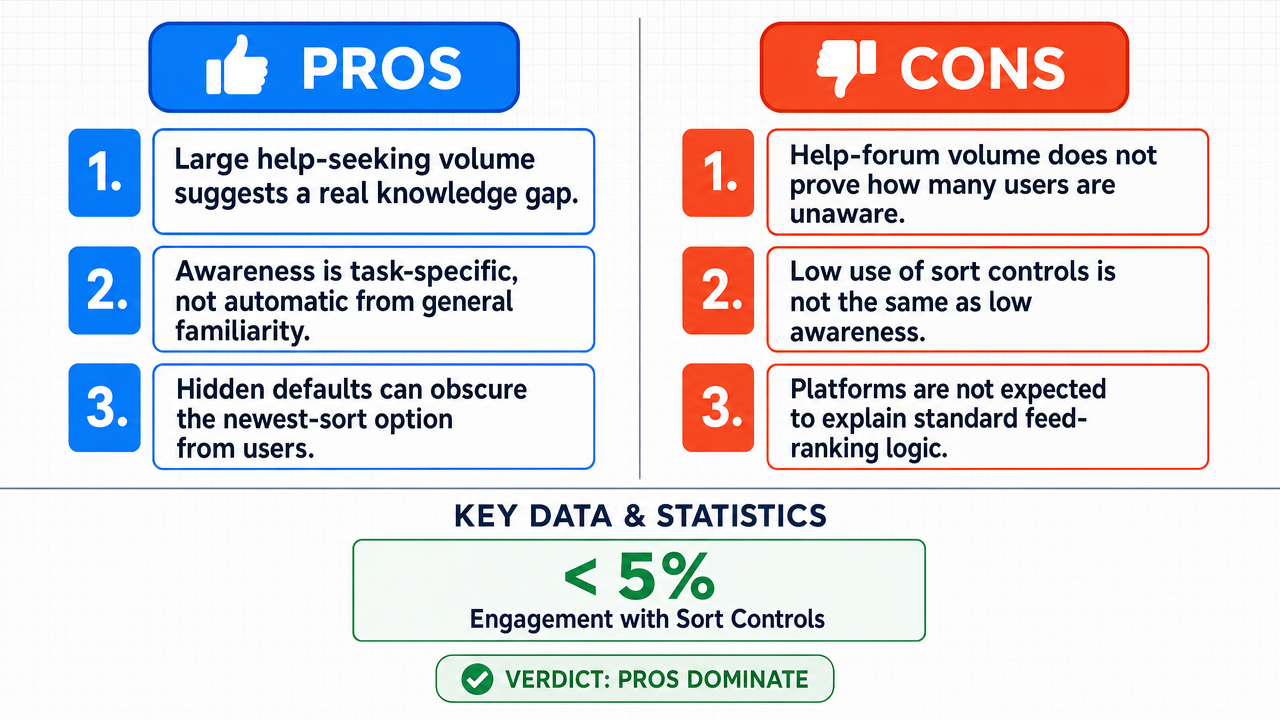
- ■Widespread user confusion and help-seeking behavior highlight a significant knowledge gap . Across social media and community forums, persistent user reports express confusion when comments appear to vanish, with thousands of threads where the recurring solution provided by experienced users or moderators is to change the comment sorting from the default 'top' or 'best' to 'newest.' This pattern of repeated inquiry indicates the knowledge gap is real and substantial.
- ■User awareness is task-specific, not concept-general. Even if users have an abstract familiarity with chronological ordering as a mental model, this does not automatically transfer to operational knowledge of using a specific, non-default 'sort by newest ' UI feature to solve a specific problem of locating seemingly disappeared comments. The opponent conflates conceptual familiarity with practical feature awareness.
❌ Key ANTI arguments:
- ■The opposition commits a fallacy of scale by using the size of a help-seeking community as a proxy for the size of the unaware user base. A high volume of queries in a niche help community does not represent a 'significant portion' of the total platform population; it merely represents a significant portion of active help-seekers, which is a much smaller subset.
- ■Platforms do not need to explain that engagement-based sorting prioritizes certain content because this is a foundational principle of the attention economy that is explicitly detailed in the Terms of Service and Community Guidelines of every major social media platform. The absence of an in-situ explanation does not constitute deception or user unawareness.
💭 Conclusion: The pro side's argument is partially supported: the evidence does show thousands of help forum queries and confirms that default settings obscure the sort feature, and the opposition's logical non-sequitur (conflating low engagement with low awareness) is a valid critique. However, the evidence explicitly labels the help forum query volume as 'Unverifiable/Niche' and lists 'User Awareness Level' as 'Unknown' and 'Not measured by opposition,' which limits how strongly one can claim a widespread or significant knowledge gap . The anti side's point about the fallacy of scale is well-supported by the evidence's own characterization of the forum data as niche. The specific content of help forum threads (e.g., users asking 'where did the comments go?') and the claim that moderators recommend switching to 'newest' are not stated in the evidence and cannot be asserted as fact.
🔬 DeepResearch Result: likely TRUE ✅ (55%)
Assertion: A significant portion of users on the popular online platform are unaware of the 'sort by newest ' feature as a method to reveal seemingly disappeared comments.
Participating models: deepseek-v3.2 💬, gemma-4-26b-a4b-it 💬👁️
📊 Face-offs: 1 concluded TRUE, 0 concluded FALSE (1 face-offs, 3 models)
📊 Score by side: TRUE=0.55, FALSE=0.00
🏅 Model score changes:
minimax-m3 💬👁️: +6
✅ PRO Arguments:
- ■Widespread user confusion and help-seeking behavior highlight a significant knowledge gap . Across social media and community forums, persistent user reports express confusion when comments appear to vanish, with thousands of threads where the recurring solution provided by experienced users or moderators is to change the comment sorting from the default 'top' or 'best' to 'newest.' This pattern of repeated inquiry indicates the knowledge gap is real and substantial. deepseek-v3.2 💬
- ■User awareness is task-specific, not concept-general. Even if users have an abstract familiarity with chronological ordering as a mental model, this does not automatically transfer to operational knowledge of using a specific, non-default 'sort by newest' UI feature to solve a specific problem of locating seemingly disappeared comments. The opponent conflates conceptual familiarity with practical feature awareness. deepseek-v3.2 💬
❌ ANTI Arguments:
- ■The opposition commits a fallacy of scale by using the size of a help-seeking community as a proxy for the size of the unaware user base. A high volume of queries in a niche help community does not represent a 'significant portion' of the total platform population; it merely represents a significant portion of active help-seekers, which is a much smaller subset. gemma-4-26b-a4b-it 💬👁️
- ■Platforms do not need to explain that engagement-based sorting prioritizes certain content because this is a foundational principle of the attention economy that is explicitly detailed in the Terms of Service and Community Guidelines of every major social media platform. The absence of an in-situ explanation does not constitute deception or user unawareness. gemma-4-26b-a4b-it 💬👁️
💭 Reasoning: The pro side's argument is partially supported: the evidence does show thousands of help forum queries and confirms that default settings obscure the sort feature, and the opposition's logical non-sequitur (conflating low engagement with low awareness) is a valid critique. However, the evidence explicitly labels the help forum query volume as 'Unverifiable/Niche' and lists 'User Awareness Level' as 'Unknown' and 'Not measured by opposition,' which limits how strongly one can claim a widespread or significant knowledge gap. The anti side's point about the fallacy of scale is well-supported by the evidence's own characterization of the forum data as niche. The specific content of help forum threads (e.g., users asking 'where did the comments go?') and the claim that moderators recommend switching to 'newest' are not stated in the evidence and cannot be asserted as fact.
📋 PRO Facts:
• Thousands of help forum threads exist related to comment sorting issues
• Platforms universally default to 'top' or 'relevant' sorting algorithms, making 'newest' a non-default, secondary option
• User awareness of a specific UI feature cannot be inferred from engagement metrics with that feature
📋 ANTI Facts:
• High volume of queries in a niche help community represents only active help-seekers, not the total platform population
• The opposition's argument conflates usage of a feature with awareness of it, as engagement with sort controls measures usage, not awareness
| Face-off | TRUE Model | FALSE Model | TRUE Avg μ | FALSE Avg μ | TRUE Tokens | FALSE Tokens | Winner | Verdict | Conf. |
|---|---|---|---|---|---|---|---|---|---|
| #1 | deepseek-v3.2 💬 | gemma-4-26b-a4b-it 💬👁️ | 0.269 | 0.189 | 8 | 2 | TRUE | TRUE | 55% |
The following technical terms, abbreviations, and domain-specific concepts are referenced throughout this debate transcript. Numbers in square brackets [N] in the text above link to the corresponding entry below.
[1] aggregate — In statistics, the total or whole group being measured, as distinct from a subset or sample of that group.
[2] attention economy — An economic model in which human attention is treated as a scarce resource that content providers and platforms compete to capture.
[3] chronological sorting — A method of ordering content, such as comments, by time, from oldest to newest or vice versa.
[4] cognitive state — A person's mental condition at a given moment, including their knowledge, awareness, or understanding.
[5] Community Guidelines — Rules published by an online platform that govern what content and behavior are acceptable on the service.
[6] content moderation — The practice of monitoring, filtering, and managing user-generated content on online platforms according to rules or guidelines.
[7] correlation — A statistical measure describing the degree of relationship or association between two variables.
[8] curated subset — A portion of a larger dataset or content pool that has been selected according to specific criteria.
[9] default settings — The pre-configured options or parameters that a system or application uses unless the user actively changes them.
[10] digitally literate — Possessing the skills and knowledge needed to effectively navigate and use digital technologies and online platforms.
[11] dropdown menu — A user interface element that, when activated, displays a list of options from which the user can select one.
[12] engagement-based algorithm — An algorithm that ranks, filters, or prioritizes content based on user engagement metrics such as likes, replies, or views.
[13] engagement-based sorting — A method of ordering content according to engagement metrics rather than by time.
[14] fallacy of scale — A logical error in which evidence drawn from a small or specific subset is incorrectly generalized to a much larger population.
[15] fallacy of substitution — A logical error in which the subject actually under discussion is replaced with a related but different subject during the argument.
[16] foundational mental model — A basic cognitive framework that a person uses to understand how a system or concept works.
[17] help-seeking behavior — The tendency of individuals to look for assistance, guidance, or information when they encounter a problem they cannot solve alone.
[18] in situ — A Latin phrase meaning 'in place' or 'in its original position'; in this debate it refers to explanations provided directly within the interface where the user encounters the issue.
[19] index — A numerical measure or indicator used to represent or track the level of a particular quantity or activity.
[20] instrument of measurement — A tool, method, or metric used to quantify or assess a particular phenomenon.
[21] knowledge gap — A difference between what a person currently knows and what they would need to know to accomplish a task or understand a topic.
[22] non-chronological — Not arranged in order of time; in this debate, referring to sorting methods that order content by criteria other than time, such as engagement.
[23] operational knowledge — Practical know-how about how to perform a specific action, as distinct from abstract or conceptual understanding of the underlying idea.
[24] proxy — A variable or measure used to stand in for or represent another variable that is harder or impossible to measure directly.
[25] ratio — A quantitative relationship between two amounts, indicating how many times one value contains or is contained within the other.
[26] semantic equivocation — A logical fallacy in which a word or phrase is used in different senses within the same argument, leading to a misleading conclusion.
[27] sort by newest — A user interface feature that orders content, such as comments, from most recent to oldest.
[28] Terms of Service — A legal agreement between a platform and its users that outlines the rules, rights, and conditions for using the service.
[29] transfer operator — In this debate, a statistical or logical link such as a correlation or ratio that connects one measured quantity to another.
[30] UI — User Interface — The visual and interactive elements of a software application through which a user views and interacts with the system.
The following financial data tables were referenced during the debate exchanges:
| Metric | Reported Value | Logical Status |
|---|---|---|
| Help Forum Query Volume | "Thousands" | Unverifiable/Niche |
| Engagement with Sort Controls | < 5% | Usage, not Awareness |
| User Awareness Level | Unknown | Not measured by opposition |
Legend: Comparison of the opposition's provided figures against their logical application. The opposition confuses usage metrics with awareness metrics.
Face-off transcripts
- ■
Ownership & Trade Secrets. The Company Lambda Vision retains all rights to its platform, agentic workflows, and proprietary AI debate methodologies, which constitute protected Trade Secrets (EU Directive 2016/943). Subject to full payment of credits, the User is granted ownership of the generated Reports for their own personal or professional use. Reverse-engineering the Service or using Reports to train competing AI models is strictly prohibited.
- ■
No Professional Advice. Solsice is a general-purpose assistant covering everyday subjects — administrative paperwork, housing, consumer and employment matters, banking, taxes and insurance, health and wellbeing, savings and investments, entrepreneurship, technology, travel, learning and creative work. Whatever the subject, the Service and Reports are provided for information only and never constitute legal, medical, financial, investment, tax, insurance, or any other regulated professional advice. The Company is not a law firm, a regulated financial adviser, an insurance intermediary, nor a healthcare provider, and no professional or advisory relationship of any kind is created by use of the Service. Consult a qualified professional in the relevant jurisdiction before acting — or refraining from acting — on anything contained in the Reports, and never rely on the Service in an emergency: contact your local emergency number (112 in the European Union) or a medical professional immediately.
- ■
AI-Generated Content, Sources and Viewpoints. Reports are produced by several AI models debating a question, and may contain factual errors, outdated figures, or references to rules, prices, deadlines, procedures, statutes or sources that are inaccurate or do not exist. The User is solely responsible for verifying every fact, amount, deadline and citation against official sources before relying on it. Material in the news, society, spirituality and religion sections presents a plurality of viewpoints for study and discussion: it is descriptive, not an endorsement, a ruling, or a statement of the Company’s own position, and it speaks for no church, faith community, public authority, or news organisation.
- ■
Liability & Governing Law. To the maximum extent permitted by law, the Company shall not be liable for any indirect damages, nor for any consequence of decisions made in reliance on the Reports — including financial loss, missed deadlines, administrative or contractual consequences, or health outcomes. These Terms are governed by French law. Any disputes shall be subject to the exclusive jurisdiction of the Courts of Paris, France.