
A recording session should continue immediately if there is unfinished business, regardless of previous agreements on episode length
AI debate verdict and arguments
⚠️ AI-generated information only; not professional advice
Completed October 11, 2026
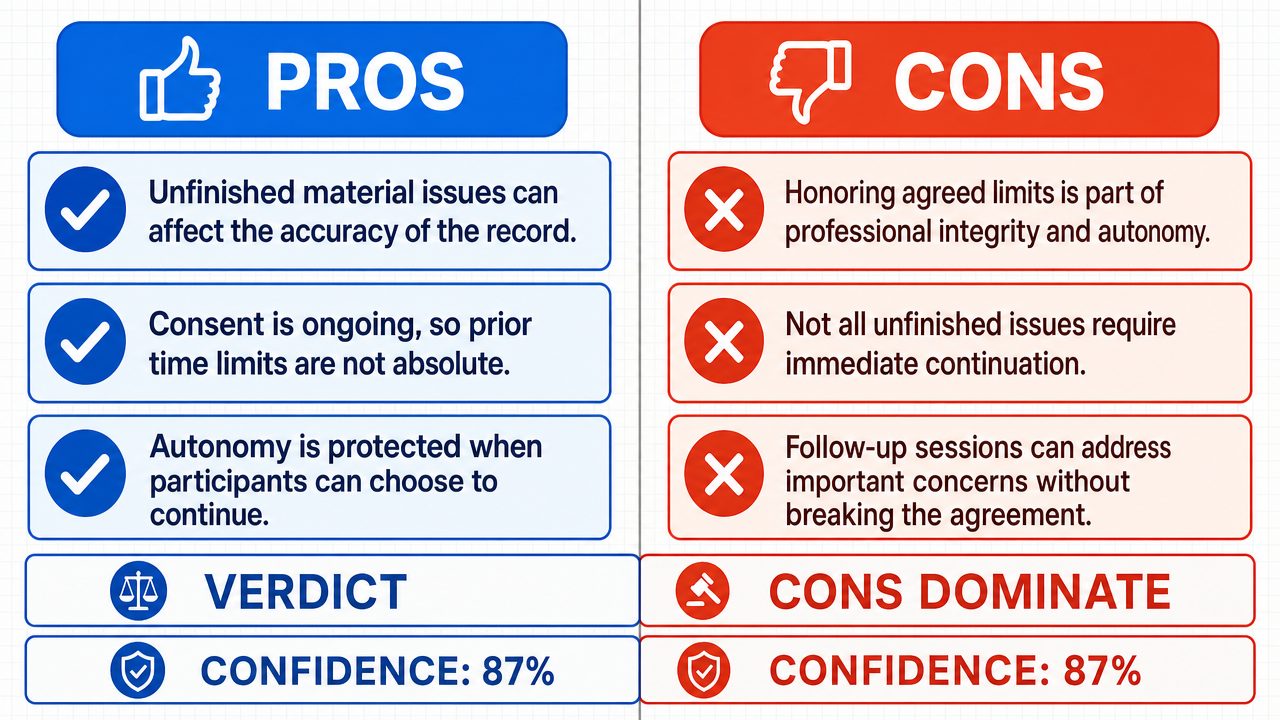
Verdict
Verdict: likely FALSE (87%)
This section provides a brief overview of the key arguments. You do not need to read the full detailed report below.
✅ Key PRO arguments:
- ■Material unfinished business overrides episode-length agreements because stopping solely because a planned runtime has been reached can make the record misleading; professional media ethics (SPJ Code of Ethics , NPR Ethics Handbook ) treats accuracy and context as duties, not optional production preferences.
- ■Informed consent is an ongoing process rather than a one-time waiver (per Belmont Report and Common Rule norms), so a prior episode-length agreement sets a production boundary , not consent to truncate material substance while a participant still has a material point to make.
- ■The Belmont Report 's respect-for-persons principle and federal informed-consent guidance support the view that autonomy is preserved only when participants retain the ability to complete substantive contributions, not merely when they sign off on a duration.
❌ Key ANTI arguments:
- ■Respect for agreed boundaries is a fundamental component of professional integrity and participant autonomy ; autonomy in a contractual or professional setting is expressed through the initial agreement on scope and duration, and forcing continuation 'immediately' overrides that exercise of autonomy.
- ■Unfinished business in a recording session falls into two mutually exclusive branches—material and non-material—and the duty to address unfinished business does not mandate an immediate breach of the duration agreement; the affirmative's framing collapses this distinction.
- ■Professional integrity is best preserved by honoring the agreed duration and addressing material concerns through follow-up sessions, which preserves both contractual stability and the substantive record without coercing continued participation past the agreed boundary.
💭 Conclusion: False. The debate verdict rejects the assertion that a recording session must continue immediately upon unfinished business regardless of prior episode-length agreements. The winning side (Negative) successfully argued that autonomy in professional recording contexts is exercised through the initial scope-and-duration agreement, and that honoring that agreement is essential to contractual stability and operational predictability . The Negative also exposed a critical weakness in the affirmative's case by distinguishing material from non-material unfinished business, showing that not all unfinished business creates an obligation to override the agreed boundary. The affirmative's reliance on Belmont/Common Rule informed-consent norms was rebutted as a misapplication, since consent to participate in a defined engagement is not equivalent to consent to an open-ended extension. Finally, the Negative offered a constructive alternative—follow-up sessions—that preserves both the substantive record and the integrity of the original agreement, making the 'regardless' clause in the assertion untenable.
🔬 DeepResearch Result: likely FALSE ❌ (87%)
Assertion: A recording session should continue immediately if there is unfinished business, regardless of previous agreements on episode length
Participating models: deepseek-v3.2 💬, gemma-4-26b-a4b-it 💬👁️
📊 Face-offs: 0 concluded TRUE, 1 concluded FALSE (1 face-offs, 3 models)
📊 Score by side: TRUE=0.00, FALSE=0.87
🏅 Model score changes:
minimax-m3 💬👁️: +9
✅ PRO Arguments:
- ■Material unfinished business overrides episode-length agreements because stopping solely because a planned runtime has been reached can make the record misleading; professional media ethics (SPJ Code of Ethics , NPR Ethics Handbook ) treats accuracy and context as duties, not optional production preferences. deepseek-v3.2 💬
- ■Informed consent is an ongoing process rather than a one-time waiver (per Belmont Report and Common Rule norms), so a prior episode-length agreement sets a production boundary , not consent to truncate material substance while a participant still has a material point to make. deepseek-v3.2 💬
- ■The Belmont Report's respect-for-persons principle and federal informed-consent guidance support the view that autonomy is preserved only when participants retain the ability to complete substantive contributions, not merely when they sign off on a duration. deepseek-v3.2 💬
❌ ANTI Arguments:
- ■Respect for agreed boundaries is a fundamental component of professional integrity and participant autonomy ; autonomy in a contractual or professional setting is expressed through the initial agreement on scope and duration, and forcing continuation 'immediately' overrides that exercise of autonomy. gemma-4-26b-a4b-it 💬👁️
- ■Unfinished business in a recording session falls into two mutually exclusive branches—material and non-material—and the duty to address unfinished business does not mandate an immediate breach of the duration agreement; the affirmative's framing collapses this distinction. gemma-4-26b-a4b-it 💬👁️
- ■Professional integrity is best preserved by honoring the agreed duration and addressing material concerns through follow-up sessions, which preserves both contractual stability and the substantive record without coercing continued participation past the agreed boundary. gemma-4-26b-a4b-it 💬👁️
💭 Reasoning: False. The debate verdict rejects the assertion that a recording session must continue immediately upon unfinished business regardless of prior episode-length agreements. The winning side (Negative) successfully argued that autonomy in professional recording contexts is exercised through the initial scope-and-duration agreement, and that honoring that agreement is essential to contractual stability and operational predictability . The Negative also exposed a critical weakness in the affirmative's case by distinguishing material from non-material unfinished business, showing that not all unfinished business creates an obligation to override the agreed boundary. The affirmative's reliance on Belmont/Common Rule informed-consent norms was rebutted as a misapplication, since consent to participate in a defined engagement is not equivalent to consent to an open-ended extension. Finally, the Negative offered a constructive alternative—follow-up sessions—that preserves both the substantive record and the integrity of the original agreement, making the 'regardless' clause in the assertion untenable.
📋 PRO Facts:
• The Society of Professional Journalists Code of Ethics requires seeking truth, providing context, and evaluating accuracy.
• The NPR Ethics Handbook emphasizes accuracy and fairness as core obligations.
• The Belmont Report frames respect for persons and informed consent as ongoing processes rather than one-time waivers.
📋 ANTI Facts:
• Autonomy in a contractual or professional setting is expressed through the initial agreement on scope and duration.
• Unfinished business in a recording session can be categorized into mutually exclusive material and non-material branches.
• Follow-up sessions are a recognized mechanism for addressing material concerns without breaching prior duration agreements.
| Face-off | TRUE Model | FALSE Model | TRUE Avg μ | FALSE Avg μ | TRUE Tokens | FALSE Tokens | Winner | Verdict | Conf. |
|---|---|---|---|---|---|---|---|---|---|
| #1 | deepseek-v3.2 💬 | gemma-4-26b-a4b-it 💬👁️ | 0.510 | 0.417 | 12 | 3 | TRUE | FALSE | 87% |
The following technical terms, abbreviations, and domain-specific concepts are referenced throughout this debate transcript. Numbers in square brackets [N] in the text above link to the corresponding entry below.
[1] 45 CFR §46.116 — Title 45 of the Code of Federal Regulations, Part 46, Section 116 — A section of U.S. federal regulation referenced in the debate as federal informed-consent guidance, cited in connection with ongoing informed-consent norms.
[2] Belmont Report — The Belmont Report — A document cited in the debate as the source of the 'respect for persons' principle and as supporting informed-consent norms applied to recording-session participants.
[3] Common Rule — A federal policy referenced in the debate alongside the Belmont Report as background for informed-consent norms in settings involving human participants.
[4] contractual stability — A principle invoked in the debate holding that honoring prior agreements on scope and duration is necessary to maintain stability in contractual and professional engagements.
[5] epistemic integrity — The quality of honesty and accuracy in how a discussion or record represents what was actually said or decided; cited in the affirmative case as a reason not to truncate material content.
[6] informed consent — An ethical process described in the debate as ongoing rather than a one-time waiver, under which a participant's voluntary agreement to be represented is treated as continuing throughout the session.
[7] NPR Ethics Handbook — National Public Radio Ethics Handbook — A journalism-ethics document cited in the debate as emphasizing accuracy and fairness as core obligations for professional media.
[8] operational predictability — A principle invoked in the debate holding that production processes should follow predictable patterns based on agreed-upon boundaries rather than ad-hoc extensions.
[9] participant autonomy — The ethical principle of respecting a participant's self-determination, discussed in the debate as either exhausted by the initial duration agreement or as an ongoing right not to be silenced by truncation.
[10] production boundary — A limit set for production purposes (such as an agreed episode length), distinguished in the affirmative's argument from consent to truncate a participant's substantive contribution.
[11] respect for persons — An ethical principle drawn from the Belmont Report and invoked in the debate on both sides regarding how a participant's contribution and agreed boundaries should be treated.
[12] SPJ Code of Ethics — Society of Professional Journalists Code of Ethics — A journalism-ethics code cited in the debate as requiring seeking truth, providing context, and evaluating accuracy, treated as duties rather than optional production preferences.
Face-off transcripts
- ■
Ownership & Trade Secrets. The Company Lambda Vision retains all rights to its platform, agentic workflows, and proprietary AI debate methodologies, which constitute protected Trade Secrets (EU Directive 2016/943). Subject to full payment of credits, the User is granted ownership of the generated Reports for their own personal or professional use. Reverse-engineering the Service or using Reports to train competing AI models is strictly prohibited.
- ■
No Professional Advice. Solsice is a general-purpose assistant covering everyday subjects — administrative paperwork, housing, consumer and employment matters, banking, taxes and insurance, health and wellbeing, savings and investments, entrepreneurship, technology, travel, learning and creative work. Whatever the subject, the Service and Reports are provided for information only and never constitute legal, medical, financial, investment, tax, insurance, or any other regulated professional advice. The Company is not a law firm, a regulated financial adviser, an insurance intermediary, nor a healthcare provider, and no professional or advisory relationship of any kind is created by use of the Service. Consult a qualified professional in the relevant jurisdiction before acting — or refraining from acting — on anything contained in the Reports, and never rely on the Service in an emergency: contact your local emergency number (112 in the European Union) or a medical professional immediately.
- ■
AI-Generated Content, Sources and Viewpoints. Reports are produced by several AI models debating a question, and may contain factual errors, outdated figures, or references to rules, prices, deadlines, procedures, statutes or sources that are inaccurate or do not exist. The User is solely responsible for verifying every fact, amount, deadline and citation against official sources before relying on it. Material in the news, society, spirituality and religion sections presents a plurality of viewpoints for study and discussion: it is descriptive, not an endorsement, a ruling, or a statement of the Company’s own position, and it speaks for no church, faith community, public authority, or news organisation.
- ■
Liability & Governing Law. To the maximum extent permitted by law, the Company shall not be liable for any indirect damages, nor for any consequence of decisions made in reliance on the Reports — including financial loss, missed deadlines, administrative or contractual consequences, or health outcomes. These Terms are governed by French law. Any disputes shall be subject to the exclusive jurisdiction of the Courts of Paris, France.