
A recession in the US, defined as two consecutive quarters of negative GDP growth, will occur before the end of 2026.
AI debate verdict and arguments
⚠️ AI-generated information only; not professional advice
Completed October 11, 2026
Verdict
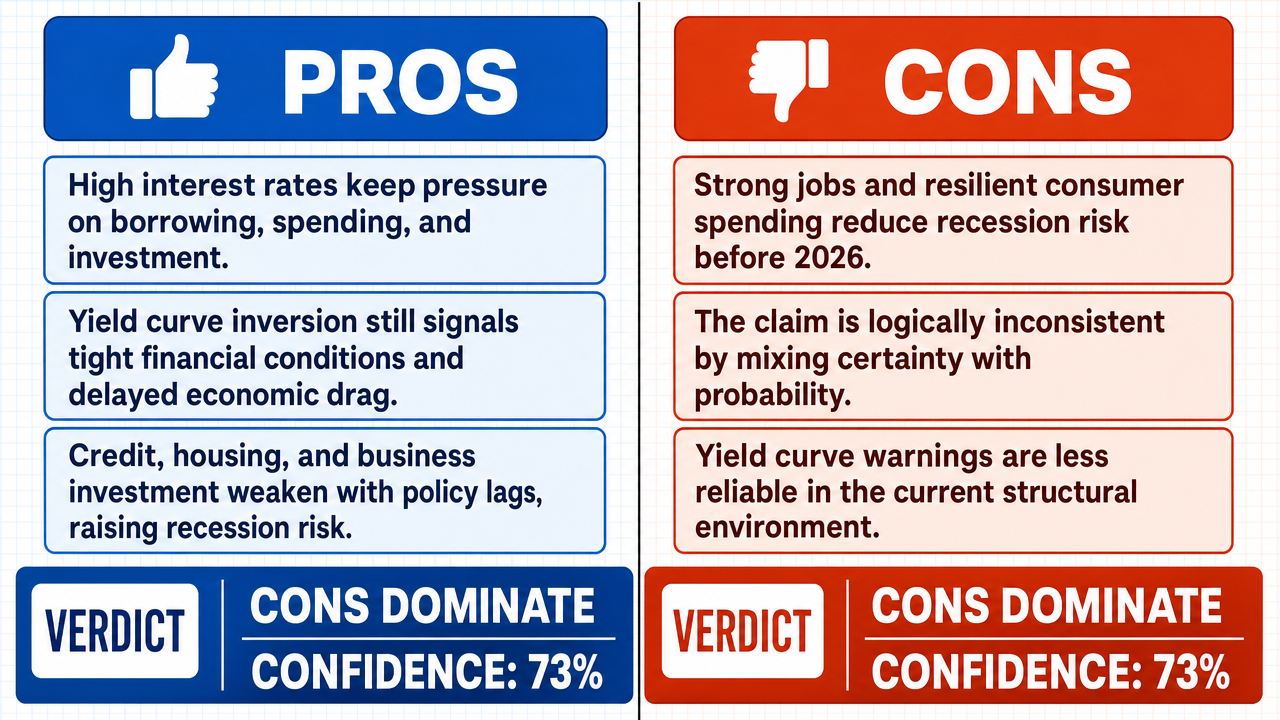
Verdict: likely FALSE (73%)
This section provides a brief overview of the key arguments. You do not need to read the full detailed report below.
✅ Key PRO arguments:
- ■The Federal Reserve 's sustained restrictive monetary policy , with interest rates held elevated until inflation reaches its 2% target, creates significant headwinds for economic growth by dampening consumer spending and business investment , making a recession within the timeframe likely.
- ■The yield curve inversion remains a relevant market-based signal that financing conditions are tight, and the transmission mechanism from rates to spending and output has not been shown to have fundamentally changed.
- ■Restrictive monetary policy tightens credit conditions , raises the cost of housing and business investment , and works with a lag into final output , supporting the case that GDP could contract for two consecutive quarters before end of 2026.
❌ Key ANTI arguments:
- ■Robust labor markets and resilient consumer spending will prevent a recession before 2026, as the current environment features structural changes (household balance sheet composition, post-pandemic money velocity shifts) that break historical correlations.
- ■The affirmative's core claim is logically incoherent because it asserts a strict, certain outcome ('will occur') while simultaneously hedging with probabilistic language ('is likely'), thereby failing to maintain consistent modal strength and establishing nothing.
- ■The affirmative's reliance on the yield curve as a recession predictor is a conjecture that lacks a proven transfer mechanism to GDP in the current structural environment, as it does not account for massive shifts in household balance sheet composition or changes in money velocity.
💭 Conclusion: The negative side successfully argued that the affirmative's claim was logically incoherent, mixing certain ('will occur') and probabilistic ('is likely') modal language, which undermined its burden of proof . The negative also effectively challenged the yield-curve inversion argument by pointing out that structural changes in household balance sheets and money velocity break the historical correlation to GDP outcomes. The affirmative's case relied heavily on monetary tightening transmission but failed to demonstrate that this transmission would necessarily produce two consecutive quarters of negative GDP growth before end of 2026. The negative's emphasis on robust labor markets and resilient consumer spending provided a stronger counter-narrative to the recession prediction.
🔬 DeepResearch Result: likely FALSE ❌ (73%)
Assertion: A recession in the US, defined as two consecutive quarters of negative GDP growth, will occur before the end of 2026.
Participating models: deepseek-v3.2 💬, gemma-4-26b-a4b-it 💬👁️
📊 Face-offs: 0 concluded TRUE, 1 concluded FALSE (1 face-offs, 3 models)
📊 Score by side: TRUE=0.00, FALSE=0.73
🏅 Model score changes:
minimax-m3 💬👁️: +7
✅ PRO Arguments:
- ■The Federal Reserve 's sustained restrictive monetary policy , with interest rates held elevated until inflation reaches its 2% target, creates significant headwinds for economic growth by dampening consumer spending and business investment , making a recession within the timeframe likely. deepseek-v3.2 💬
- ■The yield curve inversion remains a relevant market-based signal that financing conditions are tight, and the transmission mechanism from rates to spending and output has not been shown to have fundamentally changed. deepseek-v3.2 💬
- ■Restrictive monetary policy tightens credit conditions , raises the cost of housing and business investment, and works with a lag into final output , supporting the case that GDP could contract for two consecutive quarters before end of 2026. deepseek-v3.2 💬
❌ ANTI Arguments:
- ■Robust labor markets and resilient consumer spending will prevent a recession before 2026, as the current environment features structural changes (household balance sheet composition, post-pandemic money velocity shifts) that break historical correlations. gemma-4-26b-a4b-it 💬👁️
- ■The affirmative's core claim is logically incoherent because it asserts a strict, certain outcome ('will occur') while simultaneously hedging with probabilistic language ('is likely'), thereby failing to maintain consistent modal strength and establishing nothing. gemma-4-26b-a4b-it 💬👁️
- ■The affirmative's reliance on the yield curve as a recession predictor is a conjecture that lacks a proven transfer mechanism to GDP in the current structural environment, as it does not account for massive shifts in household balance sheet composition or changes in money velocity. gemma-4-26b-a4b-it 💬👁️
- ■The affirmative fails to meet the burden of proof required to establish such a definitive outcome, as historical correlations cannot be projected onto a structurally altered environment without providing the necessary transfer operator . gemma-4-26b-a4b-it 💬👁️
💭 Reasoning: The negative side successfully argued that the affirmative's claim was logically incoherent, mixing certain ('will occur') and probabilistic ('is likely') modal language, which undermined its burden of proof. The negative also effectively challenged the yield-curve inversion argument by pointing out that structural changes in household balance sheets and money velocity break the historical correlation to GDP outcomes. The affirmative's case relied heavily on monetary tightening transmission but failed to demonstrate that this transmission would necessarily produce two consecutive quarters of negative GDP growth before end of 2026. The negative's emphasis on robust labor markets and resilient consumer spending provided a stronger counter-narrative to the recession prediction.
📋 PRO Facts:
• The Federal Reserve has signaled commitment to maintaining restrictive monetary policy.
• The yield curve has been inverted, which historically has preceded recessions.
• Restrictive monetary policy works with a lag into final output.
📋 ANTI Facts:
• The current yield curve inversion does not account for massive shifts in the composition of household balance sheets.
• Post-pandemic changes in the velocity of money alter the transmission mechanism from rates to GDP.
• Robust labor markets and resilient consumer spending have characterized the current economic environment.
| Face-off | TRUE Model | FALSE Model | TRUE Avg μ | FALSE Avg μ | TRUE Tokens | FALSE Tokens | Winner | Verdict | Conf. |
|---|---|---|---|---|---|---|---|---|---|
| #1 | deepseek-v3.2 💬 | gemma-4-26b-a4b-it 💬👁️ | 0.300 | 0.388 | 12 | 3 | FALSE | FALSE | 73% |
The following technical terms, abbreviations, and domain-specific concepts are referenced throughout this debate transcript. Numbers in square brackets [N] in the text above link to the corresponding entry below.
[1] BEA — Bureau of Economic Analysis — A US government agency that measures GDP and other economic statistics.
[2] BLS — Bureau of Labor Statistics — A US government agency that measures labor market conditions, employment, wages, and inflation.
[3] borrowing costs — The interest expenses paid on debt, which rise when interest rates increase.
[4] burden of proof — The obligation on a party making a claim to provide sufficient evidence to support it.
[5] business investment — Capital expenditure by firms on equipment, structures, and inventories.
[6] conjecture — A proposition or hypothesis asserted without proof; in the debate, the negative side uses this term to challenge the affirmative's reliance on historical correlations.
[7] consumer spending — Expenditure by households on goods and services.
[8] covered employment — Employment that is included in BLS wage surveys, as referenced in the debate to distinguish from total employment.
[9] credit conditions — The terms under which credit is available to borrowers, including interest rates and lending standards.
[10] disposable income — Income remaining after taxes, available for spending or saving.
[11] ECI — Employment Cost Index — A BLS quarterly measure of changes in total compensation costs for workers.
[12] Federal Reserve — The central bank of the United States, which sets monetary policy including the federal funds rate.
[13] final output — A measure of GDP that counts the value of final goods and services produced.
[14] financial conditions — The overall state of credit markets, including interest rates, credit availability, and asset prices.
[15] financing conditions — The terms and availability of capital for borrowing.
[16] GDP — Gross Domestic Product — The total monetary value of final goods and services produced within a country over a period.
[17] headwind — A factor that hinders economic progress or growth.
[18] household balance sheets — The combined assets and liabilities of households.
[19] inflation — A general increase in the price level of goods and services in an economy over time.
[20] inflation target — A specific rate of inflation that a central bank aims to achieve, referenced in the debate as 2%.
[21] interest rates — The cost of borrowing money or the return on savings, set by central banks or determined by markets.
[22] inverted yield curve — A situation where short-term Treasury yields exceed long-term yields, which the affirmative cites as a recession predictor.
[23] labor markets — The supply of and demand for workers in an economy.
[24] leading economic indicators — Economic metrics that tend to change before the overall economy changes, used to forecast future activity.
[25] marginal spending — Additional spending that results from additional income.
[26] modal strength — In logic, the degree of certainty or probability attached to a claim (e.g., 'will' vs. 'likely').
[27] monetary policy — Central bank actions to influence the money supply and interest rates to achieve economic objectives.
[28] New York Fed — The Federal Reserve Bank of New York, which publishes research on the yield curve.
[29] policy framework — A central bank's stated approach to conducting monetary policy.
[30] rate hikes — Increases in interest rates by a central bank.
[31] real wages — Wages adjusted for inflation, representing purchasing power.
[32] recession — In the debate, defined as two consecutive quarters of negative GDP growth.
[33] restrictive monetary policy — A monetary policy stance intended to slow economic activity, typically through higher interest rates.
[34] structural buffers — Features of the economy (such as positive real wage growth or resilient labor markets) that absorb shocks.
[35] supply chains — Networks of organizations, people, activities, information, and resources involved in moving a product from supplier to customer.
[36] transfer operator — In the debate, a logical concept referring to the mechanism that allows a historical correlation to apply to a new environment.
[37] transmission — transmission channel — The mechanism by which monetary policy affects the real economy, such as through credit conditions or interest rates.
[38] Treasury yields — The returns on US government debt securities at various maturities.
[39] velocity of money — The rate at which money is exchanged in an economy.
The following financial data tables were referenced during the debate exchanges:
| Indicator | 2023 Value | 2024 Est. | 2025 Proj. | Trend |
|---|---|---|---|---|
| Real Wage Growth (Avg) | +1.2% | +1.5% | +1.4% | Upward |
| Personal Consumption Expenditures | $18.5T | $19.2T | $20.1T | Increasing |
| Unemployment Rate | 3.6% | 4.0% | 4.2% | Stable |
Legend: Annual estimates for US macroeconomic indicators. Real Wage Growth is inflation-adjusted; PCE is in USD trillions. Source: Bureau of Economic Analysis and Bureau of Labor Statistics.
Face-off transcripts
- ■
Ownership & Trade Secrets. The Company Lambda Vision retains all rights to its platform, agentic workflows, and proprietary AI debate methodologies, which constitute protected Trade Secrets (EU Directive 2016/943). Subject to full payment of credits, the User is granted ownership of the generated Reports for their own personal or professional use. Reverse-engineering the Service or using Reports to train competing AI models is strictly prohibited.
- ■
No Professional Advice. Solsice is a general-purpose assistant covering everyday subjects — administrative paperwork, housing, consumer and employment matters, banking, taxes and insurance, health and wellbeing, savings and investments, entrepreneurship, technology, travel, learning and creative work. Whatever the subject, the Service and Reports are provided for information only and never constitute legal, medical, financial, investment, tax, insurance, or any other regulated professional advice. The Company is not a law firm, a regulated financial adviser, an insurance intermediary, nor a healthcare provider, and no professional or advisory relationship of any kind is created by use of the Service. Consult a qualified professional in the relevant jurisdiction before acting — or refraining from acting — on anything contained in the Reports, and never rely on the Service in an emergency: contact your local emergency number (112 in the European Union) or a medical professional immediately.
- ■
AI-Generated Content, Sources and Viewpoints. Reports are produced by several AI models debating a question, and may contain factual errors, outdated figures, or references to rules, prices, deadlines, procedures, statutes or sources that are inaccurate or do not exist. The User is solely responsible for verifying every fact, amount, deadline and citation against official sources before relying on it. Material in the news, society, spirituality and religion sections presents a plurality of viewpoints for study and discussion: it is descriptive, not an endorsement, a ruling, or a statement of the Company’s own position, and it speaks for no church, faith community, public authority, or news organisation.
- ■
Liability & Governing Law. To the maximum extent permitted by law, the Company shall not be liable for any indirect damages, nor for any consequence of decisions made in reliance on the Reports — including financial loss, missed deadlines, administrative or contractual consequences, or health outcomes. These Terms are governed by French law. Any disputes shall be subject to the exclusive jurisdiction of the Courts of Paris, France.