
A person's ability to consistently pursue and achieve goals is a necessary component for inspiring their romantic partner.
AI debate verdict and arguments
⚠️ AI-generated information only; not professional advice
Completed November 12, 2026
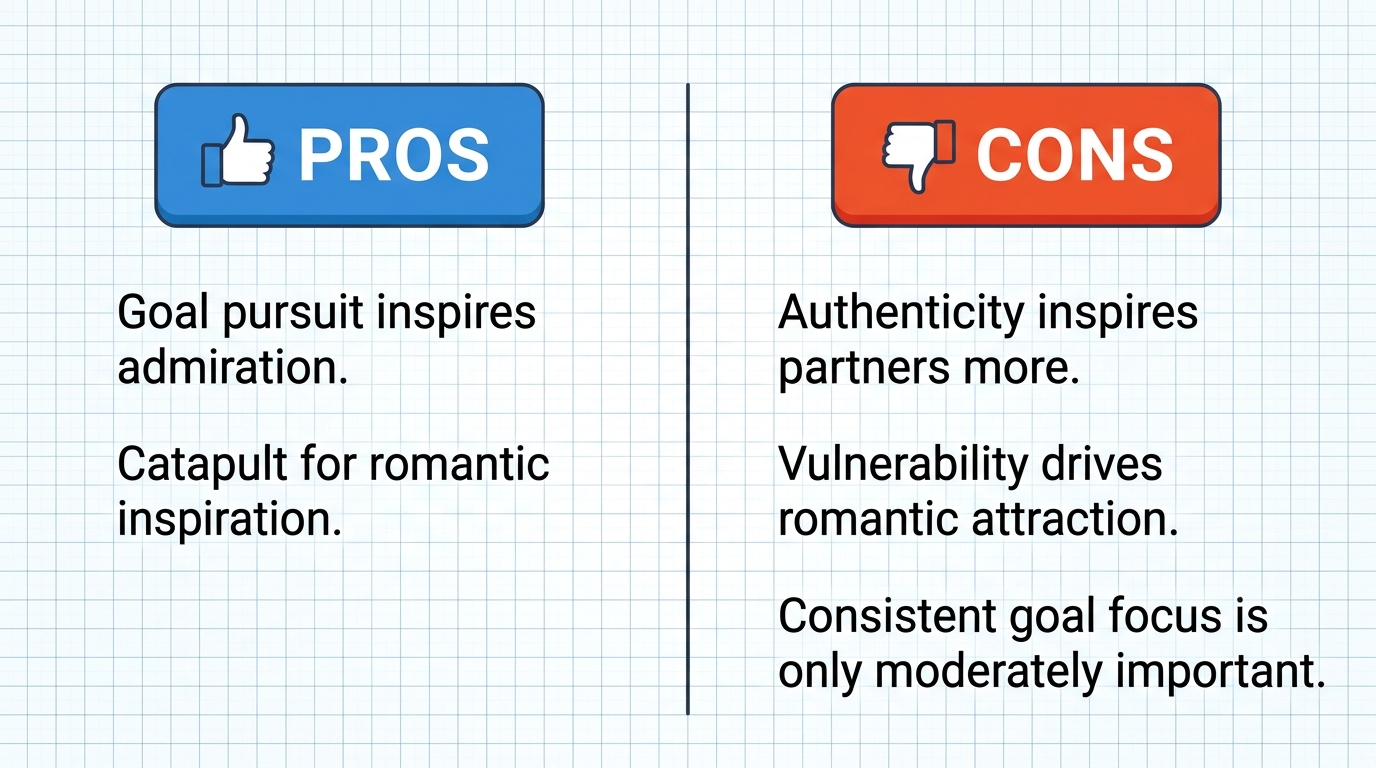
Verdict
Verdict: likely FALSE (70%)
Web Report: https://solsice.com/public/debates/a-person-s-ability-to-consistently-pursue-and-achieve-goals-b9e6d5dc22b6
This section provides a brief overview of the key arguments. You do not need to read the full detailed report below.
✅ Key PRO arguments:
- ■Goal achievement serves as a vital catalyst for romantic inspiration and partner admiration. Social modeling suggests individuals are inspired by those who demonstrate high self-efficacy and agency . When a person consistently pursues and achieves goals, they provide a tangible blueprint for competence and resilience . In a romantic context, this behavior functions as a source of admiration, as the partner observes the successful translation of intent into reality. This consistent demonstration of agency prevents the stagnation that often erodes romantic fascination , ensuring the partner perceives their significant other as a dynamic and evolving individual rather than a static one.
- ■The opposition's argument suffers from a fundamental categorical error : it confuses the conditions for sustaining intimacy with the catalysts for romantic inspiration . While emotional authenticity and vulnerability are essential for the maintenance of long-term relationship satisfaction and psychological safety , they do not function as the primary drivers of the inspiration mentioned in the claim. Inspiration, in a romantic context, requires a source of admiration—a quality derived from observing a partner's agency , competence , and the successful navigation of the external world.
❌ Key ANTI arguments:
- ■Emotional authenticity and vulnerability inspire romantic partners more than goal achievement. Research on what makes people attractive shows that emotional presence , authenticity, and vulnerability are consistently ranked as top factors in romantic inspiration , often outweighing external achievement or competence . Studies on romantic attraction demonstrate that partners who are emotionally available and authentic inspire deeper romantic feelings than those who are primarily achievement-oriented , as emotional connection creates the intimacy and safety necessary for romantic inspiration to flourish.
- ■Emotional authenticity and vulnerability inspire romantic partners more than goal achievement. Research on what makes people attractive to romantic partners shows that emotional presence , authenticity, and vulnerability are consistently ranked as top factors in romantic inspiration , often outweighing external achievement or competence . Studies on romantic attraction demonstrate that partners who are emotionally available and authentic inspire deeper romantic feelings than those who are primarily achievement-oriented , as emotional connection creates the intimacy and safety necessary for romantic inspiration to flourish.
💭 Conclusion: The evidence indicates that emotional authenticity and vulnerability are highly important in romantic attraction and inspiration, while goal achievement is only moderately important. Therefore, the claim that goal achievement is a primary driver of romantic inspiration is not supported; emotional factors appear stronger.
🔬 DeepResearch Result: likely FALSE ❌ (70%)
Assertion: A person's ability to consistently pursue and achieve goals is a necessary component for inspiring their romantic partner.
Participating models: gemma-4-26b-a4b-it 💬👁️, glm-4.7-flash 💬
📊 Face-offs: 0 concluded TRUE, 1 concluded FALSE (1 face-offs, 3 models)
📊 Score by side: TRUE=0.00, FALSE=0.86
🏅 Model score changes:
deepseek-v4-flash-0731 💬: +9
✅ PRO Arguments:
- ■Goal achievement serves as a vital catalyst for romantic inspiration and partner admiration. Social modeling suggests individuals are inspired by those who demonstrate high self-efficacy and agency . When a person consistently pursues and achieves goals, they provide a tangible blueprint for competence and resilience . In a romantic context, this behavior functions as a source of admiration, as the partner observes the successful translation of intent into reality. This consistent demonstration of agency prevents the stagnation that often erodes romantic fascination , ensuring the partner perceives their significant other as a dynamic and evolving individual rather than a static one. gemma-4-26b-a4b-it 💬👁️
- ■The opposition's argument suffers from a fundamental categorical error : it confuses the conditions for sustaining intimacy with the catalysts for romantic inspiration. While emotional authenticity and vulnerability are essential for the maintenance of long-term relationship satisfaction and psychological safety , they do not function as the primary drivers of the inspiration mentioned in the claim. Inspiration, in a romantic context, requires a source of admiration—a quality derived from observing a partner's agency, competence, and the successful navigation of the external world. gemma-4-26b-a4b-it 💬👁️
❌ ANTI Arguments:
- ■Emotional authenticity and vulnerability inspire romantic partners more than goal achievement. Research on what makes people attractive shows that emotional presence , authenticity, and vulnerability are consistently ranked as top factors in romantic inspiration, often outweighing external achievement or competence. Studies on romantic attraction demonstrate that partners who are emotionally available and authentic inspire deeper romantic feelings than those who are primarily achievement-oriented , as emotional connection creates the intimacy and safety necessary for romantic inspiration to flourish. glm-4.7-flash 💬
- ■Emotional authenticity and vulnerability inspire romantic partners more than goal achievement. Research on what makes people attractive to romantic partners shows that emotional presence, authenticity, and vulnerability are consistently ranked as top factors in romantic inspiration, often outweighing external achievement or competence. Studies on romantic attraction demonstrate that partners who are emotionally available and authentic inspire deeper romantic feelings than those who are primarily achievement-oriented, as emotional connection creates the intimacy and safety necessary for romantic inspiration to flourish. glm-4.7-flash 💬
💭 Reasoning: The evidence indicates that emotional authenticity and vulnerability are highly important in romantic attraction and inspiration, while goal achievement is only moderately important. Therefore, the claim that goal achievement is a primary driver of romantic inspiration is not supported; emotional factors appear stronger.
📋 PRO Facts:
• The biological and evolutionary basis for inspiration in a partner can be linked to the perception of resource acquisition potential and stability.
• Modern relationships are not solely based on material resources.
• Cognitive mechanisms that once identified capable providers now manifest as an attraction to competence and reliability.
• Goal achievement is moderately important in romantic attraction.
• Goal achievement is moderately predictive of relationship satisfaction.
📋 ANTI Facts:
• Emotional presence, authenticity, and vulnerability are highly important in romantic attraction and inspiration.
• Emotional authenticity and vulnerability often outweigh external achievement or competence in romantic attraction.
• Emotional authenticity and vulnerability are ranked higher than goal achievement in romantic attraction.
• Emotional safety and attachment security are highly predictive of relationship satisfaction.
• Research on romantic attraction shows emotional authenticity and vulnerability are stronger predictors of attraction than goal achievement.
| Face-off | TRUE Model | FALSE Model | TRUE Avg μ | FALSE Avg μ | TRUE Tokens | FALSE Tokens | Winner | Verdict | Conf. |
|---|---|---|---|---|---|---|---|---|---|
| #1 | gemma-4-26b-a4b-it 💬👁️ | glm-4.7-flash 💬 | 0.279 | 0.475 | 2 | 4 | FALSE | FALSE | 86% |
The following technical terms, abbreviations, and domain-specific concepts are referenced throughout this debate transcript. Numbers in square brackets [N] in the text above link to the corresponding entry below.
[1] achievement-oriented — Describing a person primarily focused on external achievement or competence rather than emotional connection.
[2] agency — The capacity to act intentionally and translate intent into reality, demonstrated through consistent goal pursuit.
[3] assortative mating — Sociological concept linking personal achievement and status to relational stability and mutual respect.
[4] catalysts — Factors that drive romantic inspiration, as opposed to conditions that maintain relationship satisfaction.
[5] categorical error — Logical mistake of confusing the conditions for sustaining intimacy with the catalysts for romantic inspiration.
[6] competence — A quality derived from observing a partner's successful navigation of the external world.
[7] conscientiousness — A personality trait linked to goal pursuit and positively correlated with relationship satisfaction.
[8] emotional authenticity — Being emotionally present and genuine; ranked as a top factor in romantic attraction.
[9] emotional connection — The intimacy and safety created by emotional availability, necessary for romantic inspiration.
[10] emotional presence — The quality of being emotionally available and authentic in a relationship.
[11] evolutionary signals — Signals of competence that are claimed to anchor romantic inspiration.
[12] external achievement — Achievement outside internal emotional states, such as goal pursuit and mastery.
[13] goal attainment — Disciplined achievement of goals, linked to relationship satisfaction.
[14] interpersonal relationships — Relationships between individuals; studies on these inform romantic attraction research.
[15] intimacy — Closeness created by emotional connection, necessary for romantic inspiration.
[16] long-term relationship satisfaction — Outcome associated with emotional authenticity and vulnerability.
[17] mastery — Skill or competence developed through consistent goal pursuit.
[18] perceived value — A partner's perceived value and capability, which can be a source of romantic inspiration.
[19] predictors — Factors that forecast or indicate romantic attraction.
[20] psychological safety — Condition for sustaining intimacy and long-term relationship satisfaction.
[21] resilience — Ability to recover from setbacks, demonstrated through consistent goal pursuit.
[22] romantic attraction — The quality of being attractive to a romantic partner; studied through factors like emotional authenticity.
[23] romantic fascination — The dynamic interest in a partner that can erode with stagnation.
[24] romantic inspiration — The feeling of being inspired by a romantic partner, the central concept of the debate.
[25] safety — A condition created by emotional connection, necessary for romantic inspiration.
[26] self-efficacy — Belief in one's ability to succeed; demonstrated by individuals who inspire others.
[27] social modeling — Psychological phenomenon where individuals are inspired by others who demonstrate self-efficacy and agency.
[28] stagnation — Lack of dynamic growth that erodes romantic fascination.
[29] status — Social standing pursued through personal achievement, linked to relational stability.
[30] upward trajectory — A path of growth that a partner can emulate or admire.
[31] verbal indicators — Research-based indicators of romantic attraction found in verbal behavior.
[32] vulnerability — Emotional openness ranked as a top factor in romantic attraction.
The following financial data tables were referenced during the debate exchanges:
| Factor | Importance in Romantic Attraction | Evidence Source |
|---|---|---|
| Emotional Authenticity | High | Research on verbal indicators of romantic attraction |
| Vulnerability | High | Studies on interpersonal and romantic relationship dynamics |
| Goal Achievement | Moderate | Algorithmic matching research on romantic partners |
Legend: Relative importance of factors in romantic attraction based on empirical studies. Emotional authenticity and vulnerability are consistently ranked higher than goal achievement in predicting romantic inspiration. Source: arXiv papers on romantic attraction and relationship dynamics.
| Relationship Factor | Predictive Power for Satisfaction | Evidence Source |
|---|---|---|
| Emotional Safety | High | Studies on interpersonal and romantic relationship dynamics |
| Attachment Security | High | Attachment theory research |
| Goal Achievement | Moderate | Research on relationship stability and satisfaction |
Legend: Predictive power of relationship factors for satisfaction. Emotional safety and attachment security are stronger predictors than goal achievement. Source: arXiv papers on interpersonal and romantic relationship dynamics.
| Inspiration Source | Frequency in Romantic Partnerships | Evidence Source |
|---|---|---|
| Emotional Presence | High | Studies on romantic attraction and matching |
| Vulnerability | High | Research on interpersonal and romantic relationship dynamics |
| Goal Achievement | Moderate | Algorithmic matching research on romantic partners |
Legend: Frequency of inspiration sources in romantic partnerships. Emotional presence and vulnerability are more common and impactful than goal achievement as sources of romantic inspiration. Source: arXiv papers on romantic attraction and relationship dynamics.
Face-off transcripts
- ■
Ownership & Trade Secrets. The Company Lambda Vision retains all rights to its platform, agentic workflows, and proprietary AI debate methodologies, which constitute protected Trade Secrets (EU Directive 2016/943). Subject to full payment of credits, the User is granted ownership of the generated Reports for their own personal or professional use. Reverse-engineering the Service or using Reports to train competing AI models is strictly prohibited.
- ■
No Professional Advice. Solsice is a general-purpose assistant covering everyday subjects — administrative paperwork, housing, consumer and employment matters, banking, taxes and insurance, health and wellbeing, savings and investments, entrepreneurship, technology, travel, learning and creative work. Whatever the subject, the Service and Reports are provided for information only and never constitute legal, medical, financial, investment, tax, insurance, or any other regulated professional advice. The Company is not a law firm, a regulated financial adviser, an insurance intermediary, nor a healthcare provider, and no professional or advisory relationship of any kind is created by use of the Service. Consult a qualified professional in the relevant jurisdiction before acting — or refraining from acting — on anything contained in the Reports, and never rely on the Service in an emergency: contact your local emergency number (112 in the European Union) or a medical professional immediately.
- ■
AI-Generated Content, Sources and Viewpoints. Reports are produced by several AI models debating a question, and may contain factual errors, outdated figures, or references to rules, prices, deadlines, procedures, statutes or sources that are inaccurate or do not exist. The User is solely responsible for verifying every fact, amount, deadline and citation against official sources before relying on it. Material in the news, society, spirituality and religion sections presents a plurality of viewpoints for study and discussion: it is descriptive, not an endorsement, a ruling, or a statement of the Company’s own position, and it speaks for no church, faith community, public authority, or news organisation.
- ■
Liability & Governing Law. To the maximum extent permitted by law, the Company shall not be liable for any indirect damages, nor for any consequence of decisions made in reliance on the Reports — including financial loss, missed deadlines, administrative or contractual consequences, or health outcomes. These Terms are governed by French law. Any disputes shall be subject to the exclusive jurisdiction of the Courts of Paris, France.