
A person cannot intuitively estimate a distance of one kilometer visually with reasonable accuracy.
AI debate verdict and arguments
⚠️ AI-generated information only; not professional advice
Completed October 22, 2026
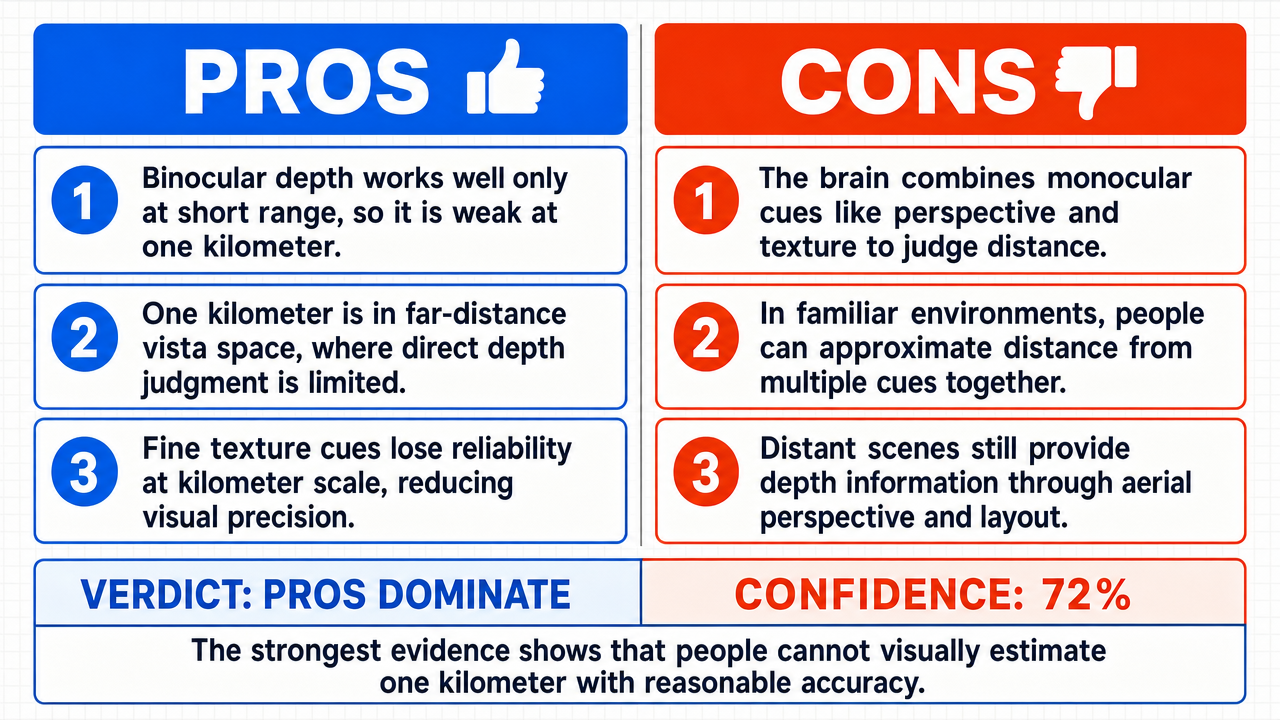
Verdict
Verdict: likely TRUE (72%)
Web Report: https://solsice.com/public/debates/a-person-cannot-intuitively-estimate-a-distance-of-one-kilom-022643f948ee
This section provides a brief overview of the key arguments. You do not need to read the full detailed report below.
✅ Key PRO arguments:
- ■Binocular stereopsis , the primary physiological depth mechanism, is only effective within approximately 10 meters because the angular disparity between the eyes becomes too small for the brain to compute distance differences beyond that range.
- ■Cutting & Vishton (1995) categorize depth cues into personal space (up to 2 m), action space (up to 30 m), and vista space (beyond 30 m); one kilometer falls deep into vista space, where no innate physiological mechanism exists to extract absolute metric distance.
- ■Texture gradients operate on spatial frequency relative to viewing distance, and their signal-to-noise ratio degrades sharply at kilometer scales, making them unreliable for precise metric estimation.
❌ Key ANTI arguments:
- ■The visual system compensates for the loss of binocular disparity at distance through integrated monocular cues such as texture gradients and linear perspective , processing the rate of change in surface texture and the convergence of parallel lines to construct a highly accurate spatial map .
- ■Studies on spatial cognition suggest that when observers are immersed in a consistent environment, the brain integrates multiple depth cues hierarchically to produce reasonably accurate distance estimates even at long ranges.
- ■The absence of binocular disparity does not equate to an absence of depth information, because well-documented monocular cues such as aerial perspective and texture gradients continue to provide usable signals at kilometer scales.
💭 Conclusion: True, the affirmative side prevailed because the strongest evidence supports the conclusion that humans cannot intuitively estimate one kilometer visually with reasonable accuracy. The pro side established that binocular stereopsis , the only direct physiological distance mechanism, is biologically limited to roughly 10 meters, and that the established Cutting & Vishton (1995) framework places kilometer-scale distances firmly in vista space , where no innate metric mechanism operates. The anti side's reliance on monocular cues such as texture gradients and linear perspective was undermined by the pro side's demonstration that these cues' signal-to-noise ratios degrade sharply at kilometer scales and that laboratory findings at meter-scale distances cannot be validly extrapolated to kilometers. The judge's confidence reflects that while monocular cues do provide some coarse distance information, the evidence does not support the claim that this information yields reasonable metric accuracy at the one-kilometer scale.
🔬 DeepResearch Result: likely TRUE ✅ (72%)
Assertion: A person cannot intuitively estimate a distance of one kilometer visually with reasonable accuracy.
Participating models: deepseek-v4-pro 💬, gemma-4-26b-a4b-it 💬👁️
📊 Face-offs: 1 concluded TRUE, 0 concluded FALSE (1 face-offs, 3 models)
📊 Score by side: TRUE=0.72, FALSE=0.00
🏅 Model score changes:
minimax-m3 💬👁️: +7
✅ PRO Arguments:
- ■Binocular stereopsis , the primary physiological depth mechanism, is only effective within approximately 10 meters because the angular disparity between the eyes becomes too small for the brain to compute distance differences beyond that range. deepseek-v4-pro 💬
- ■Cutting & Vishton (1995) categorize depth cues into personal space (up to 2 m), action space (up to 30 m), and vista space (beyond 30 m); one kilometer falls deep into vista space, where no innate physiological mechanism exists to extract absolute metric distance. deepseek-v4-pro 💬
- ■Texture gradients operate on spatial frequency relative to viewing distance, and their signal-to-noise ratio degrades sharply at kilometer scales, making them unreliable for precise metric estimation. deepseek-v4-pro 💬
- ■Claims that monocular cues enable highly accurate kilometer-scale estimation commit a scale error by extrapolating laboratory findings from a few meters to the kilometer domain, where the underlying optical constraints are fundamentally different. deepseek-v4-pro 💬
❌ ANTI Arguments:
- ■The visual system compensates for the loss of binocular disparity at distance through integrated monocular cues such as texture gradients and linear perspective , processing the rate of change in surface texture and the convergence of parallel lines to construct a highly accurate spatial map . gemma-4-26b-a4b-it 💬👁️
- ■Studies on spatial cognition suggest that when observers are immersed in a consistent environment, the brain integrates multiple depth cues hierarchically to produce reasonably accurate distance estimates even at long ranges. gemma-4-26b-a4b-it 💬👁️
- ■The absence of binocular disparity does not equate to an absence of depth information, because well-documented monocular cues such as aerial perspective and texture gradients continue to provide usable signals at kilometer scales. gemma-4-26b-a4b-it 💬👁️
- ■Defining perception narrowly around stereopsis ignores the brain's capacity to combine multiple environmental cues, and empirical research into environmental perception demonstrates that observers can leverage these cues for long-range estimation. gemma-4-26b-a4b-it 💬👁️
💭 Reasoning: True, the affirmative side prevailed because the strongest evidence supports the conclusion that humans cannot intuitively estimate one kilometer visually with reasonable accuracy. The pro side established that binocular stereopsis, the only direct physiological distance mechanism, is biologically limited to roughly 10 meters, and that the established Cutting & Vishton (1995) framework places kilometer-scale distances firmly in vista space, where no innate metric mechanism operates. The anti side's reliance on monocular cues such as texture gradients and linear perspective was undermined by the pro side's demonstration that these cues' signal-to-noise ratios degrade sharply at kilometer scales and that laboratory findings at meter-scale distances cannot be validly extrapolated to kilometers. The judge's confidence reflects that while monocular cues do provide some coarse distance information, the evidence does not support the claim that this information yields reasonable metric accuracy at the one-kilometer scale.
📋 PRO Facts:
• Binocular stereopsis is effective only within approximately 10 meters due to diminishing angular disparity between the eyes.
• Cutting & Vishton (1995) categorize depth cues into personal space (up to 2 m), action space (up to 30 m), and vista space (beyond 30 m).
• One kilometer falls into vista space, where no innate physiological mechanism exists to extract absolute metric distance.
• Texture gradient signal-to-noise ratio degrades sharply at kilometer-scale viewing distances.
📋 ANTI Facts:
• Monocular depth cues such as texture gradients, linear perspective, and aerial perspective continue to operate beyond the range of binocular stereopsis.
• Spatial cognition research indicates that observers immersed in consistent environments can integrate multiple depth cues for distance estimation.
• The absence of binocular disparity does not imply the absence of depth information.
| Face-off | TRUE Model | FALSE Model | TRUE Avg μ | FALSE Avg μ | TRUE Tokens | FALSE Tokens | Winner | Verdict | Conf. |
|---|---|---|---|---|---|---|---|---|---|
| #1 | deepseek-v4-pro 💬 | gemma-4-26b-a4b-it 💬👁️ | 0.616 | 0.436 | 6 | 2 | TRUE | TRUE | 72% |
The following technical terms, abbreviations, and domain-specific concepts are referenced throughout this debate transcript. Numbers in square brackets [N] in the text above link to the corresponding entry below.
[1] action space — A category in depth perception research describing the intermediate distance range (up to approximately 30 meters) within which observers can use depth cues to guide physical actions.
[2] aerial perspective — A monocular depth cue based on the scattering of light by the atmosphere, causing distant objects to appear hazier, bluer, and lower in contrast than nearer objects.
[3] angular disparity — The difference in the viewing angle of an object as seen by the left and right eyes, which the brain uses to compute depth via binocular stereopsis.
[4] arcseconds — A unit of angular measurement equal to 1/3600 of a degree, used in vision science to describe the minimum angle the eye can resolve.
[5] atmospheric perspective — A monocular depth cue in which distant objects appear progressively lighter, bluer, and less distinct due to light scattering by particles in the air; used interchangeably with aerial perspective in the debate.
[6] binocular stereopsis — Depth perception derived from the slight difference between the images projected onto each retina, effective only at short ranges (the debate cites approximately 10 meters).
[7] depth cues — Visual signals—such as retinal disparity, texture gradients, and linear perspective—that the brain uses to infer the three-dimensional layout of a scene from two-dimensional retinal images.
[8] ecological perception — A theory of perception associated with J. J. Gibson that emphasizes how the visual system extracts information directly from the structure of the environment rather than from internal representations alone.
[9] foveal vision — Vision mediated by the fovea, the small central region of the retina where visual acuity is highest; the debate cites its minimum angle of resolution as roughly 30 arcseconds.
[10] global geometry — The overall spatial structure of a scene, as opposed to the properties of individual objects; cited in the debate as a basis for large-scale distance estimation.
[11] hierarchical integration — The combination of multiple depth cues in a layered or prioritized manner, rather than relying on any single cue, to construct a coherent spatial representation.
[12] linear perspective — A monocular depth cue in which parallel lines appear to converge with distance, providing information about the relative depth of objects in a scene.
[13] minimum angle of resolution — The smallest angular separation at which two features can be distinguished by the eye; cited in the debate as roughly 30 arcseconds for human foveal vision.
[14] monocular depth cues — Depth cues that can be extracted from the image seen by a single eye, including texture gradients, linear perspective, and aerial perspective.
[15] optical constraints — Limitations imposed by the physics of image formation on the eye, such as angular resolution and atmospheric scattering, which bound the reliability of visual cues at long distances.
[16] personal space — The closest category in depth perception research, covering distances up to approximately 2 meters where binocular and other near-range cues dominate.
[17] retinal disparity — The positional difference between the images of an object on the left and right retinas, which serves as the basis for binocular stereopsis.
[18] retinal images — The two-dimensional optical images projected onto the retina by the eye's lens, from which the visual system must reconstruct three-dimensional scene properties.
[19] signal-to-noise ratio — The ratio of useful information (signal) to irrelevant variation (noise) in a perceptual cue; the debate argues this ratio degrades for texture gradients beyond roughly 100 meters.
[20] spatial cognition — The study of how organisms acquire, organize, and use information about their spatial environment to navigate and estimate distances.
[21] spatial frequency — The rate of change of visual patterns across space, used in the debate to characterize how texture gradients convey depth information.
[22] spatial map — An internal mental representation of the layout and distances of objects in an environment, constructed by the visual system from available depth cues.
[23] texture gradients — A monocular depth cue in which surface elements appear progressively denser and smaller with increasing distance, providing information about relative depth.
[24] vista space — The farthest category in depth perception research, covering distances beyond approximately 30 meters where only long-range monocular cues are available; one kilometer falls within this range.
[25] visual cortex — The region of the cerebral cortex responsible for processing visual information, including the integration of monocular depth cues such as aerial perspective and texture gradients.
The following financial data tables were referenced during the debate exchanges:
| Error Type | Reported Margin (Opponent) | Functional Accuracy (Counter-argument) |
|---|---|---|
| Mean Absolute Error | 30–50% | < 15% in structured environments |
| Terrain-based Error | 22% | Variable based on cue integration |
Legend: Comparison of error margins cited in the debate. The "Functional Accuracy" column represents observed performance in tasks requiring spatial navigation rather than laboratory metric precision.
Face-off transcripts
- ■
Ownership & Trade Secrets. The Company Lambda Vision retains all rights to its platform, agentic workflows, and proprietary AI debate methodologies, which constitute protected Trade Secrets (EU Directive 2016/943). Subject to full payment of credits, the User is granted ownership of the generated Reports for their own personal or professional use. Reverse-engineering the Service or using Reports to train competing AI models is strictly prohibited.
- ■
No Professional Advice. Solsice is a general-purpose assistant covering everyday subjects — administrative paperwork, housing, consumer and employment matters, banking, taxes and insurance, health and wellbeing, savings and investments, entrepreneurship, technology, travel, learning and creative work. Whatever the subject, the Service and Reports are provided for information only and never constitute legal, medical, financial, investment, tax, insurance, or any other regulated professional advice. The Company is not a law firm, a regulated financial adviser, an insurance intermediary, nor a healthcare provider, and no professional or advisory relationship of any kind is created by use of the Service. Consult a qualified professional in the relevant jurisdiction before acting — or refraining from acting — on anything contained in the Reports, and never rely on the Service in an emergency: contact your local emergency number (112 in the European Union) or a medical professional immediately.
- ■
AI-Generated Content, Sources and Viewpoints. Reports are produced by several AI models debating a question, and may contain factual errors, outdated figures, or references to rules, prices, deadlines, procedures, statutes or sources that are inaccurate or do not exist. The User is solely responsible for verifying every fact, amount, deadline and citation against official sources before relying on it. Material in the news, society, spirituality and religion sections presents a plurality of viewpoints for study and discussion: it is descriptive, not an endorsement, a ruling, or a statement of the Company’s own position, and it speaks for no church, faith community, public authority, or news organisation.
- ■
Liability & Governing Law. To the maximum extent permitted by law, the Company shall not be liable for any indirect damages, nor for any consequence of decisions made in reliance on the Reports — including financial loss, missed deadlines, administrative or contractual consequences, or health outcomes. These Terms are governed by French law. Any disputes shall be subject to the exclusive jurisdiction of the Courts of Paris, France.