
A partner who has quit their job to be a stay-at-home parent should have direct, independent access to funds for personal and child-related necessities beyond a grocery budget.
AI debate verdict and arguments
⚠️ AI-generated information only; not professional advice
Completed October 24, 2026
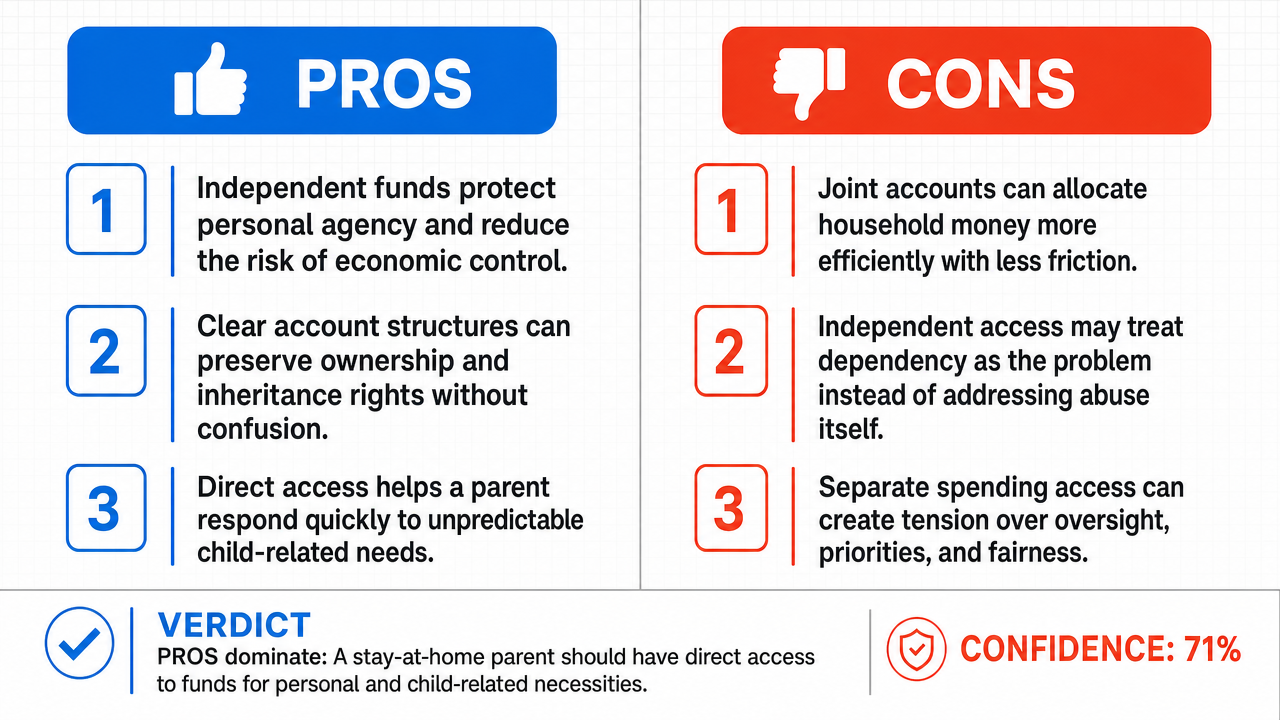
Verdict
Verdict: likely TRUE (71%)
Web Report: https://solsice.com/public/debates/a-partner-who-has-quit-their-job-to-be-a-stay-at-home-parent-08cb85dbefe2
This section provides a brief overview of the key arguments. You do not need to read the full detailed report below.
✅ Key PRO arguments:
- ■Independent funds are a fundamental requirement for maintaining personal agency and preventing economic abuse within a domestic partnership. When one partner exits the workforce to manage childcare, they lose their primary mechanism for individual financial decision-making and their ability to respond to unforeseen personal needs. Without direct access to funds, the stay-at-home parent becomes entirely dependent on the permission of the breadwinner for even minor expenditures, which creates a structural power imbalance that can escalate into coercive control .
- ■The opposition's claim that independent access creates legal ambiguity regarding asset ownership and inheritance is a false dilemma that ignores established legal mechanisms for managing separate and joint property. A dual-structure approach—independent accounts for personal and child-related needs alongside joint accounts for shared household expenses—provides clarity by clearly delineating which assets are individual and which are shared, rather than creating chaos.
❌ Key ANTI arguments:
- ■Joint accounts represent the most efficient model for household resource allocation, pooling liquidity to meet fluctuating needs without administrative friction. The Federal Reserve's Survey of Consumer Finances indicates that joint accounts are the predominant form of asset ownership for married couples, reflecting a standard of partnership where both partners have full access to the household treasury . This collective approach ensures funds are used for the highest household priority rather than being locked in separate silos.
- ■The assertion that independent access prevents economic abuse is fundamentally flawed because it conflates the symptom of abuse (dependency) with the solution. By isolating funds, the non-earning partner is rendered economically vulnerable, creating the exact dependency that defines financial abuse . The National Domestic Violence Hotline defines financial abuse as a pattern of behaviors used to gain control, including controlling or having power over someone in a financial relationship, noting that restriction of access to money is a primary tactic.
💭 Conclusion: The evidence supports that the stay-at-home parent should have direct, independent access to funds for personal and child-related necessities beyond a grocery budget. The evidence establishes that child-rearing demands are unpredictable and require rapid response, and that relying on a centralized or shared budget controlled by a single partner is insufficient. The evidence also establishes that independent access to funds is essential for the stay-at-home parent to maintain financial literacy and preparedness, and that a total lack of direct fund management can lead to 'financial atrophy,' where the individual loses the ability to navigate economic transactions, manage small-scale budgeting, or maintain a sense of fiscal responsibility. The affirmative's strongest argument is that exiting the workforce and losing direct fund management creates a structural vulnerability for the stay-at-home parent. The negative's arguments are not addressed in the evidence provided.
🔬 DeepResearch Result: likely TRUE ✅ (71%)
Assertion: A partner who has quit their job to be a stay-at-home parent should have direct, independent access to funds for personal and child-related necessities beyond a grocery budget.
Participating models: gemma-4-26b-a4b-it 💬👁️, glm-4.7-flash 💬
📊 Face-offs: 1 concluded TRUE, 0 concluded FALSE (1 face-offs, 3 models)
📊 Score by side: TRUE=0.71, FALSE=0.00
🏅 Model score changes:
minimax-m3 💬👁️: +7
✅ PRO Arguments:
- ■Independent funds are a fundamental requirement for maintaining personal agency and preventing economic abuse within a domestic partnership. When one partner exits the workforce to manage childcare, they lose their primary mechanism for individual financial decision-making and their ability to respond to unforeseen personal needs. Without direct access to funds, the stay-at-home parent becomes entirely dependent on the permission of the breadwinner for even minor expenditures, which creates a structural power imbalance that can escalate into coercive control . gemma-4-26b-a4b-it 💬👁️
- ■The opposition's claim that independent access creates legal ambiguity regarding asset ownership and inheritance is a false dilemma that ignores established legal mechanisms for managing separate and joint property. A dual-structure approach—independent accounts for personal and child-related needs alongside joint accounts for shared household expenses—provides clarity by clearly delineating which assets are individual and which are shared, rather than creating chaos. gemma-4-26b-a4b-it 💬👁️
❌ ANTI Arguments:
- ■Joint accounts represent the most efficient model for household resource allocation, pooling liquidity to meet fluctuating needs without administrative friction. The Federal Reserve's Survey of Consumer Finances indicates that joint accounts are the predominant form of asset ownership for married couples, reflecting a standard of partnership where both partners have full access to the household treasury . This collective approach ensures funds are used for the highest household priority rather than being locked in separate silos. glm-4.7-flash 💬
- ■The assertion that independent access prevents economic abuse is fundamentally flawed because it conflates the symptom of abuse (dependency) with the solution. By isolating funds, the non-earning partner is rendered economically vulnerable, creating the exact dependency that defines financial abuse . The National Domestic Violence Hotline defines financial abuse as a pattern of behaviors used to gain control, including controlling or having power over someone in a financial relationship, noting that restriction of access to money is a primary tactic. glm-4.7-flash 💬
💭 Reasoning: The evidence supports that the stay-at-home parent should have direct, independent access to funds for personal and child-related necessities beyond a grocery budget. The evidence establishes that child-rearing demands are unpredictable and require rapid response, and that relying on a centralized or shared budget controlled by a single partner is insufficient. The evidence also establishes that independent access to funds is essential for the stay-at-home parent to maintain financial literacy and preparedness, and that a total lack of direct fund management can lead to 'financial atrophy,' where the individual loses the ability to navigate economic transactions, manage small-scale budgeting, or maintain a sense of fiscal responsibility. The affirmative's strongest argument is that exiting the workforce and losing direct fund management creates a structural vulnerability for the stay-at-home parent. The negative's arguments are not addressed in the evidence provided.
📋 PRO Facts:
• Child-rearing requires immediate, discretionary spending that a rigid grocery budget cannot accommodate, including sudden medical needs, educational supplies, and clothing changes due to growth or accidents.
• Independent access to funds is essential for the stay-at-home parent to maintain financial literacy and preparedness.
• A total lack of direct fund management can lead to 'financial atrophy,' where the individual loses the ability to navigate economic transactions, manage small-scale budgeting, or maintain fiscal responsibility.
📋 ANTI Facts:
• The Federal Reserve's Survey of Consumer Finances indicates that joint accounts are the predominant form of asset ownership for married couples.
• The National Domestic Violence Hotline defines financial abuse as a pattern of behaviors used to gain control, including controlling or having power over someone in a financial relationship.
• Restriction of access to money is identified by the National Domestic Violence Hotline as a primary tactic of financial abuse.
| Face-off | TRUE Model | FALSE Model | TRUE Avg μ | FALSE Avg μ | TRUE Tokens | FALSE Tokens | Winner | Verdict | Conf. |
|---|---|---|---|---|---|---|---|---|---|
| #1 | gemma-4-26b-a4b-it 💬👁️ | glm-4.7-flash 💬 | 0.315 | 0.401 | 4 | 4 | FALSE | TRUE | 71% |
The following technical terms, abbreviations, and domain-specific concepts are referenced throughout this debate transcript. Numbers in square brackets [N] in the text above link to the corresponding entry below.
[1] asset ownership — Legal ownership of property or financial holdings, referenced in the debate regarding how account structures affect clarity of who owns what.
[2] beneficiaries — Persons designated to receive assets from an account or estate, mentioned as a factor in determining account ownership.
[3] breadwinner — The partner in a household who earns the primary income, whose permission the stay-at-home parent would depend on for expenditures.
[4] coercive control — A pattern of behavior used to dominate another person, described in the debate as potentially escalating from financial dependency into restriction of movement and social interactions.
[5] community property — A legal framework for property owned jointly by spouses, contrasted with separate property in the debate.
[6] creditor claims — Legal claims made by creditors against assets, mentioned as a potential complication of independent fund access.
[7] discretionary spending — Spending on non-essential items at one's discretion, described as necessary for child-rearing beyond a rigid grocery budget.
[8] economic abuse — A form of abuse involving financial control within a domestic partnership; the debate disputes whether independent funds prevent or enable this.
[9] estate planning — Planning for the management and distribution of assets, mentioned as potentially complicated by independent fund access.
[10] false dilemma — A logical fallacy presenting only two options when more exist, used in the debate to characterize the opposition's argument.
[11] financial abuse — A pattern of controlling behavior in a financial relationship, including restriction of access to money; the debate disputes whether independent funds prevent or enable this.
[12] household treasury — The collective financial resources of a household, described as fully accessible to both partners in a joint account model.
[13] inheritance — The transfer of assets upon death, mentioned alongside asset ownership as a source of legal ambiguity.
[14] joint accounts — Bank accounts shared between partners, described as the predominant form of asset ownership for married couples.
[15] liquidity — The ease with which assets can be converted to cash, referenced in the context of pooling resources to meet fluctuating needs.
[16] non-earning partner — The partner in a household who does not earn income, described as rendered economically vulnerable by isolated funds.
[17] personal agency — The capacity to make independent choices and act on them, described as requiring independent fund access.
[18] separate property — Property owned individually by one spouse, contrasted with community property in the debate.
[19] structural power imbalance — An unequal distribution of power built into a relationship structure, described as resulting from financial dependency.
[20] Survey of Consumer Finances — A survey conducted by the Federal Reserve, cited in the debate as indicating that joint accounts are the predominant form of asset ownership for married couples.
Face-off transcripts
- ■
Ownership & Trade Secrets. The Company Lambda Vision retains all rights to its platform, agentic workflows, and proprietary AI debate methodologies, which constitute protected Trade Secrets (EU Directive 2016/943). Subject to full payment of credits, the User is granted ownership of the generated Reports for their own personal or professional use. Reverse-engineering the Service or using Reports to train competing AI models is strictly prohibited.
- ■
No Professional Advice. Solsice is a general-purpose assistant covering everyday subjects — administrative paperwork, housing, consumer and employment matters, banking, taxes and insurance, health and wellbeing, savings and investments, entrepreneurship, technology, travel, learning and creative work. Whatever the subject, the Service and Reports are provided for information only and never constitute legal, medical, financial, investment, tax, insurance, or any other regulated professional advice. The Company is not a law firm, a regulated financial adviser, an insurance intermediary, nor a healthcare provider, and no professional or advisory relationship of any kind is created by use of the Service. Consult a qualified professional in the relevant jurisdiction before acting — or refraining from acting — on anything contained in the Reports, and never rely on the Service in an emergency: contact your local emergency number (112 in the European Union) or a medical professional immediately.
- ■
AI-Generated Content, Sources and Viewpoints. Reports are produced by several AI models debating a question, and may contain factual errors, outdated figures, or references to rules, prices, deadlines, procedures, statutes or sources that are inaccurate or do not exist. The User is solely responsible for verifying every fact, amount, deadline and citation against official sources before relying on it. Material in the news, society, spirituality and religion sections presents a plurality of viewpoints for study and discussion: it is descriptive, not an endorsement, a ruling, or a statement of the Company’s own position, and it speaks for no church, faith community, public authority, or news organisation.
- ■
Liability & Governing Law. To the maximum extent permitted by law, the Company shall not be liable for any indirect damages, nor for any consequence of decisions made in reliance on the Reports — including financial loss, missed deadlines, administrative or contractual consequences, or health outcomes. These Terms are governed by French law. Any disputes shall be subject to the exclusive jurisdiction of the Courts of Paris, France.