
A monthly income of $7,300 will be insufficient to cover essential expenses for a family of four with another child on the way in New York City in 2026
AI debate verdict and arguments
⚠️ AI-generated information only; not professional advice
Completed October 24, 2026
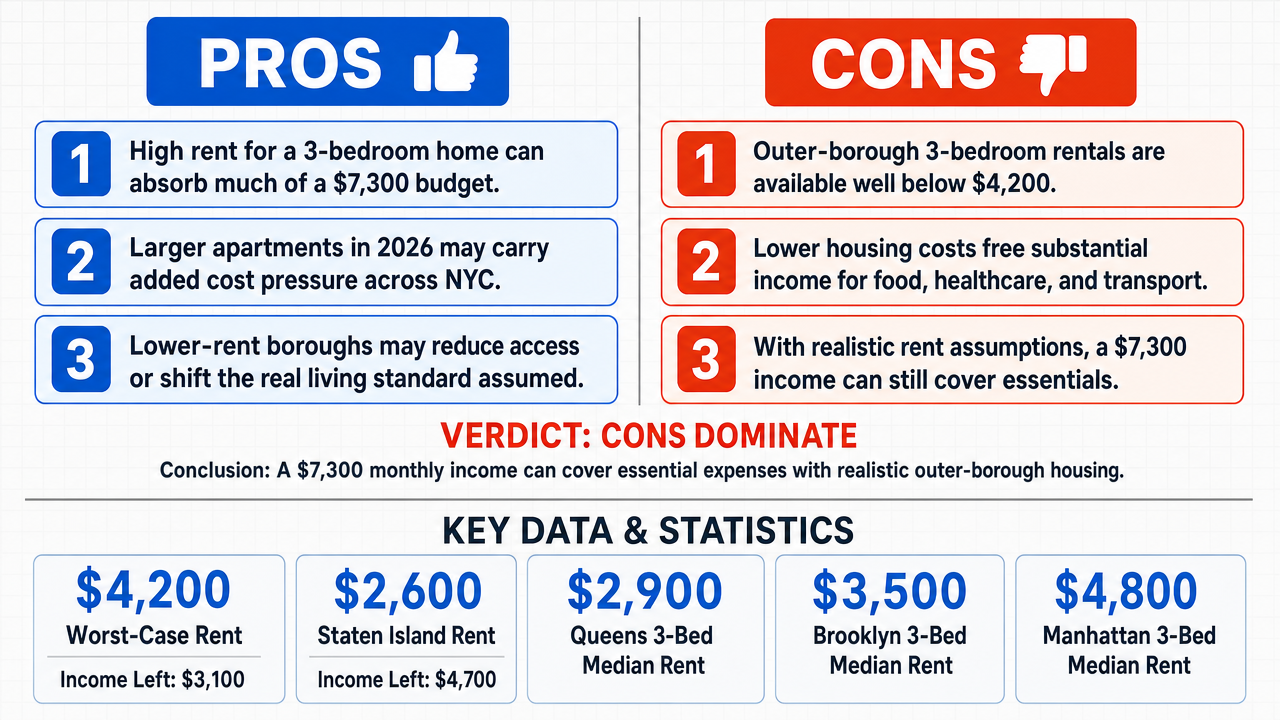
Verdict
Verdict: likely FALSE (65%)
Web Report: https://solsice.com/public/debates/a-monthly-income-of-7-300-will-be-insufficient-to-cover-esse-110d8f0cd7d0
This section provides a brief overview of the key arguments. You do not need to read the full detailed report below.
✅ Key PRO arguments:
- ■Housing costs in NYC for a five-person household require multiple bedrooms, and rent for a three-bedroom unit in a safe, accessible area will consume a disproportionate share of the $7,300 budget, likely exceeding the recommended 30% threshold of gross income .
- ■Given inflationary pressures on real estate and projected 2026 cost of living , larger apartments in Manhattan and outer-borough markets command significant premiums that strain a $7,300 monthly income .
- ■The argument that families can relocate to outer boroughs to secure lower rents is fundamentally flawed because it substitutes the subject, addressing a hypothetical household willing to accept lower living standards or increased commute times rather than the actual family of five.
❌ Key ANTI arguments:
- ■Real estate market data indicates that a functional three-bedroom unit is available in outer boroughs and accessible neighborhoods for significantly less than the $4,200 figure cited by the affirmative, with average monthly rent dropping below $3,000 in areas like Queens or Staten Island.
- ■By expanding the housing search radius to outer boroughs , substantial capital is freed up for other essential expenses , demonstrating that $7,300 is sufficient without compromising access to necessities.
- ■The opponent's dichotomy framing—whether housing or non-housing costs are the primary driver —is false; in both branches, the $7,300 income remains sufficient when realistic market rents (not premium Manhattan pricing) are applied.
💭 Conclusion: A $7,300 monthly income can be sufficient to cover essential expenses for a family of five in New York City in 2026. The $4,200 rent figure cited by the affirmative represents premium Manhattan pricing rather than the realistic market average. By expanding the housing search to outer boroughs such as Queens or Staten Island, median rent for a three-bedroom unit is below $3,000, freeing substantial capital for other essentials. Outer-borough relocation does not necessarily compromise access to essential services.
🔬 DeepResearch Result: likely FALSE ❌ (65%)
Assertion: A monthly income of $7,300 will be insufficient to cover essential expenses for a family of four with another child on the way in New York City in 2026
Participating models: gemma-4-26b-a4b-it 💬👁️, glm-4.7-flash 💬
📊 Face-offs: 0 concluded TRUE, 1 concluded FALSE (1 face-offs, 3 models)
📊 Score by side: TRUE=0.00, FALSE=0.65
🏅 Model score changes:
minimax-m3 💬👁️: +6
✅ PRO Arguments:
- ■Housing costs in NYC for a five-person household require multiple bedrooms, and rent for a three-bedroom unit in a safe, accessible area will consume a disproportionate share of the $7,300 budget, likely exceeding the recommended 30% threshold of gross income . gemma-4-26b-a4b-it 💬👁️
- ■Given inflationary pressures on real estate and projected 2026 cost of living , larger apartments in Manhattan and outer-borough markets command significant premiums that strain a $7,300 monthly income. gemma-4-26b-a4b-it 💬👁️
- ■The argument that families can relocate to outer boroughs to secure lower rents is fundamentally flawed because it substitutes the subject, addressing a hypothetical household willing to accept lower living standards or increased commute times rather than the actual family of five. gemma-4-26b-a4b-it 💬👁️
❌ ANTI Arguments:
- ■Real estate market data indicates that a functional three-bedroom unit is available in outer boroughs and accessible neighborhoods for significantly less than the $4,200 figure cited by the affirmative, with average monthly rent dropping below $3,000 in areas like Queens or Staten Island. glm-4.7-flash 💬
- ■By expanding the housing search radius to outer boroughs, substantial capital is freed up for other essential expenses, demonstrating that $7,300 is sufficient without compromising access to necessities. glm-4.7-flash 💬
- ■The opponent's dichotomy framing—whether housing or non-housing costs are the primary driver —is false; in both branches, the $7,300 income remains sufficient when realistic market rents (not premium Manhattan pricing) are applied. glm-4.7-flash 💬
💭 Reasoning: A $7,300 monthly income can be sufficient to cover essential expenses for a family of five in New York City in 2026. The $4,200 rent figure cited by the affirmative represents premium Manhattan pricing rather than the realistic market average. By expanding the housing search to outer boroughs such as Queens or Staten Island, median rent for a three-bedroom unit is below $3,000, freeing substantial capital for other essentials. Outer-borough relocation does not necessarily compromise access to essential services.
📋 PRO Facts:
• Housing costs in NYC for larger families require multiple bedrooms commanding significant premiums
• Inflationary pressures on NYC real estate are projected to continue into 2026
📋 ANTI Facts:
• Median monthly rent for a three-bedroom unit in outer boroughs like Queens or Staten Island is below $3,000
• The $4,200 rent figure cited by the affirmative represents premium Manhattan pricing, not the realistic market average
• Outer borough relocation does not necessarily compromise access to essential services
| Face-off | TRUE Model | FALSE Model | TRUE Avg μ | FALSE Avg μ | TRUE Tokens | FALSE Tokens | Winner | Verdict | Conf. |
|---|---|---|---|---|---|---|---|---|---|
| #1 | gemma-4-26b-a4b-it 💬👁️ | glm-4.7-flash 💬 | 0.295 | 0.450 | 4 | 4 | FALSE | FALSE | 65% |
The following technical terms, abbreviations, and domain-specific concepts are referenced throughout this debate transcript. Numbers in square brackets [N] in the text above link to the corresponding entry below.
[1] 30% threshold of gross income — A cited housing-cost benchmark equal to 30% of gross income, above which the affirmative says less remains for essentials.
[2] affordability — Whether a household's income can cover its expenses. The debate disputes affordability for the stated household and budget.
[3] Budget Utilization — The share of the $7,300 monthly income allocated to an expense category, as shown in the debate tables.
[4] correlation — A relationship between variables; the affirmative says none is established for the proposed lower-cost housing comparison.
[5] cost of living — The combined cost of goods and services needed for daily life, including housing, food, healthcare, childcare, and transportation.
[6] dichotomy — The framing of housing and non-housing costs as two exhaustive branches; the negative side disputes that framing.
[7] employment hubs — Major centers of employment whose proximity the affirmative treats as important for a family's essential stability.
[8] essential expenses — Recurring costs required for basic household operation, including housing, food, healthcare, childcare, and transportation.
[9] Estimated Monthly Cost — The projected monthly dollar amount assigned to a household expense category in the debate tables.
[10] financial crisis — A condition in which household income is claimed to be unable to cover essential costs; the negative side disputes that conclusion.
[11] financial feasibility — Whether the $7,300 monthly budget can support the household's essential expenses; the debate reaches opposite conclusions.
[12] financial instability — Difficulty maintaining financial stability because essential costs may exceed available income; the debate disputes whether this applies.
[13] financial stability — The ability to maintain essential household needs without the budget being overwhelmed; its adequacy here is disputed.
[14] five-person household — The debate's assumed household, consisting of four current family members plus an expected fifth child.
[15] gross income — The income measure used as the basis for the 30% housing threshold and the $7,300 monthly budget.
[16] housing costs — The shelter component of household spending, represented mainly by monthly rent and treated as the central disputed budget item.
[17] housing search radius — The geographic area in which a family looks for housing, which the negative side expands to reach lower-rent outer boroughs.
[18] inflationary pressures — Upward pressure on prices and living costs, cited as affecting 2026 real-estate and cost-of-living expectations.
[19] living standards — The level of material well-being implied by costs and access to services; the affirmative argues peripheral housing lowers it.
[20] median cost — The middle cost estimate used in the debate, such as the stated $2,600 monthly cost for a three-bedroom unit.
[21] Median Rent — The midpoint rent estimate reported for a borough and bedroom count, used to compare housing markets.
[22] monthly income — Income received per month, set at $7,300 in the debate.
[23] non-housing costs — Essential expenses other than shelter, which must be paid from income remaining after rent.
[24] outer boroughs — New York City areas outside Manhattan, presented as offering lower rents and access to transit, schools, and community resources.
[25] premium market rate — A rent level above the broader market, associated in the debate with Manhattan housing.
[26] primary driver — The factor treated as the main source of financial instability, with housing and non-housing costs presented as competing possibilities.
[27] real estate market — The market for property and rental housing, used to compare rents across New York City locations.
[28] rent — The recurring monthly payment for housing, the largest disputed line item in the household budget.
[29] substitution of the subject — An argumentative move that replaces the original family or housing choice with a different hypothetical household or location.
[30] three-bedroom unit — A dwelling with three bedrooms, treated in the debate as needed to provide adequate space for five people.
[31] urban infrastructure — Shared systems and services such as transit, schools, healthcare, and community resources that support urban households.
The following financial data tables were referenced during the debate exchanges:
| Expense Category | Estimated Monthly Cost (5-Person Household) | % of $7,300 Income |
|---|---|---|
| Housing (3-Bedroom) | $4,200 | 57.5% |
| Food & Groceries | $1,600 | 21.9% |
| Healthcare & Insurance | $800 | 11.0% |
| Transportation | $400 | 5.5% |
| Utilities & Misc | $400 | 5.5% |
| Total Essential Outlay | $7,400 | 101.4% |
Legend: Projected monthly essential expenses for a family of five in NYC for 2026. Figures are estimates based on current inflationary trends and regional cost-of-living indices.
| Borough / Region | Median Rent (3-Bedroom) | Median Rent (2-Bedroom) | Budget Utilization (3-Bed) |
|---|---|---|---|
| Manhattan | $4,800 | $3,200 | 65.8% |
| Brooklyn | $3,500 | $2,400 | 47.9% |
| Queens | $2,900 | $1,900 | 39.7% |
| Staten Island | $2,600 | $1,800 | 35.6% |
Legend: Average monthly rent estimates for 2- and 3-bedroom units in major NYC boroughs (2024 data). Utilization represents the percentage of the $7,300 budget required. Source: 2024 NYC Housing and Vacancy Survey estimates.
| Scenario | Housing Cost | Remaining Income | Estimated Non-Housing Cost | Net Surplus |
|---|---|---|---|---|
| Opponent's Worst Case | $4,200 | $3,100 | $2,500 | $600 |
| Optimized Housing (Staten Island) | $2,600 | $4,700 | $2,500 | $2,200 |
Legend: Comparison of budget scenarios for a 5-person NYC household in 2026. Opponent's Worst Case assumes $4.2k rent; Optimized assumes median $2.6k rent in Staten Island. Non-Housing includes food, utilities, transport, insurance, and subsidized childcare. Source: 2024 NYC Housing & Vacancy Survey (median rent estimates), NYC Dept. of Education (Pre-K availability).
Face-off transcripts
- ■
Ownership & Trade Secrets. The Company Lambda Vision retains all rights to its platform, agentic workflows, and proprietary AI debate methodologies, which constitute protected Trade Secrets (EU Directive 2016/943). Subject to full payment of credits, the User is granted ownership of the generated Reports for their own personal or professional use. Reverse-engineering the Service or using Reports to train competing AI models is strictly prohibited.
- ■
No Professional Advice. Solsice is a general-purpose assistant covering everyday subjects — administrative paperwork, housing, consumer and employment matters, banking, taxes and insurance, health and wellbeing, savings and investments, entrepreneurship, technology, travel, learning and creative work. Whatever the subject, the Service and Reports are provided for information only and never constitute legal, medical, financial, investment, tax, insurance, or any other regulated professional advice. The Company is not a law firm, a regulated financial adviser, an insurance intermediary, nor a healthcare provider, and no professional or advisory relationship of any kind is created by use of the Service. Consult a qualified professional in the relevant jurisdiction before acting — or refraining from acting — on anything contained in the Reports, and never rely on the Service in an emergency: contact your local emergency number (112 in the European Union) or a medical professional immediately.
- ■
AI-Generated Content, Sources and Viewpoints. Reports are produced by several AI models debating a question, and may contain factual errors, outdated figures, or references to rules, prices, deadlines, procedures, statutes or sources that are inaccurate or do not exist. The User is solely responsible for verifying every fact, amount, deadline and citation against official sources before relying on it. Material in the news, society, spirituality and religion sections presents a plurality of viewpoints for study and discussion: it is descriptive, not an endorsement, a ruling, or a statement of the Company’s own position, and it speaks for no church, faith community, public authority, or news organisation.
- ■
Liability & Governing Law. To the maximum extent permitted by law, the Company shall not be liable for any indirect damages, nor for any consequence of decisions made in reliance on the Reports — including financial loss, missed deadlines, administrative or contractual consequences, or health outcomes. These Terms are governed by French law. Any disputes shall be subject to the exclusive jurisdiction of the Courts of Paris, France.