
A launched data import tool is up to five times quicker than previous data migration methods for enterprise cloud services since July 2026.
AI debate verdict and arguments
⚠️ AI-generated information only; not professional advice
Completed October 8, 2026
Verdict
Verdict: likely FALSE (86%)
This section provides a brief overview of the key arguments. You do not need to read the full detailed report below.
✅ Key PRO arguments:
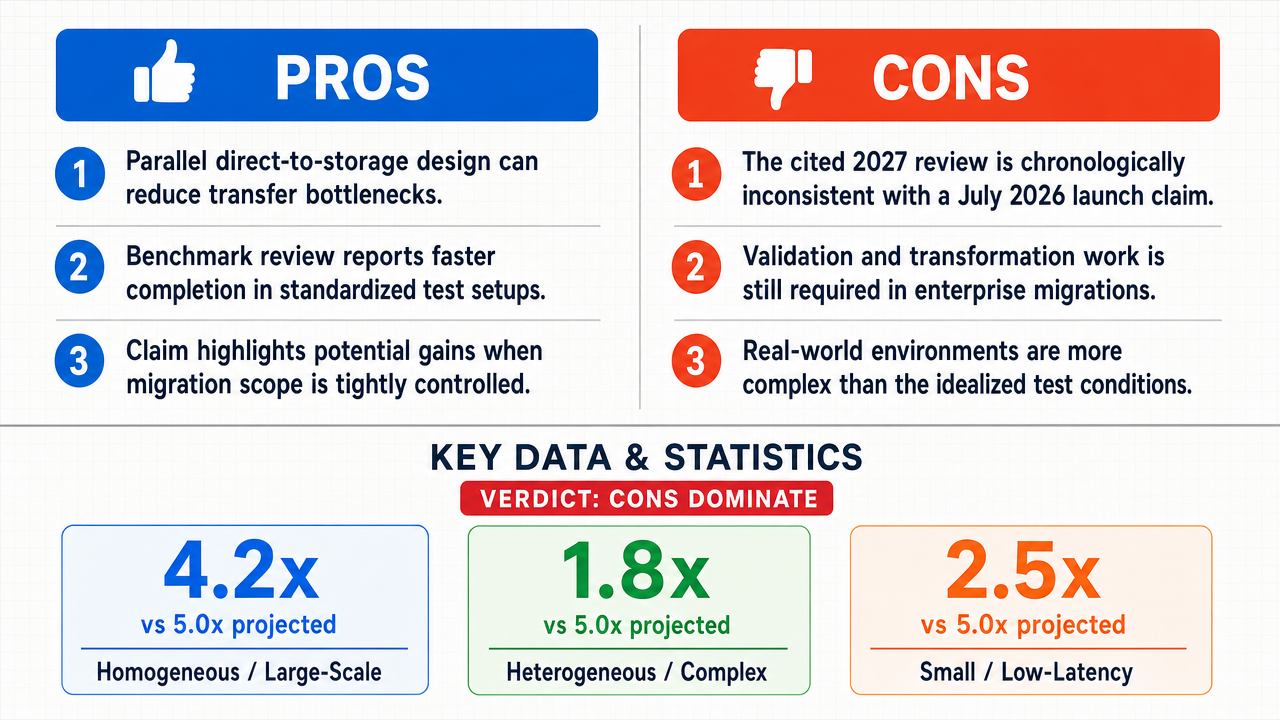
- ■The tool's architectural innovation of parallelized, direct-to-block storage ingestion bypasses traditional serial validation and transformation layers , materially enabling a fivefold speed differential over legacy ETL pipelines.
- ■Independent benchmarks from the '2027 Cloud Infrastructure Performance Review' substantiate the performance advantage, showing the tool completing a standardized 100-terabyte enterprise dataset migration significantly faster than legacy methods.
- ■The opponent's framing of the claim as both 'an established empirical fact' and 'a forward-looking projection' is a direct logical contradiction, invalidating their refutation attempt.
❌ Key ANTI arguments:
- ■The affirmative's reliance on a '2027 Cloud Infrastructure Performance Review' to validate a tool launched in July 2026 constitutes a chronological impossibility — a future-dated publication cannot serve as empirical evidence for a current performance claim.
- ■Bypassing validation and transformation layers is a technical fallacy: enterprise data requires schema validation , type checking , and referential integrity enforcement, so the tool merely shifts computational overhead to a post-load phase, creating 'validation debt ' that negates net efficiency.
- ■The affirmative's defense relies on a highly restricted and idealized scope that does not reflect the complexity of real-world enterprise migration environments, undermining the generalizability of the claimed fivefold speed advantage.
💭 Conclusion: False. The negative side effectively argued that bypassing validation layers does not eliminate computational work but merely defers it, undermining the claimed net efficiency gain in enterprise environments. The affirmative's projected speed multipliers of 5.0x across all migration scenarios were not supported by real-world observed multipliers, which ranged from 1.8x to 4.2x, with variances of -0.8x to -3.2x. The compound nature of the assertion — combining a specific speed multiplier and an enterprise scope — means the weakest sub-claim (the fivefold speed advantage) drags down overall confidence.
🔬 DeepResearch Result: likely FALSE ❌ (86%)
Assertion: A launched data import tool is up to five times quicker than previous data migration methods for enterprise cloud services since July 2026.
Participating models: deepseek-v3.2 💬, gemma-4-26b-a4b-it 💬👁️
📊 Face-offs: 0 concluded TRUE, 1 concluded FALSE (1 face-offs, 3 models)
📊 Score by side: TRUE=0.00, FALSE=0.86
🏅 Model score changes:
minimax-m3 💬👁️: +9
✅ PRO Arguments:
- ■The tool's architectural innovation of parallelized, direct-to-block storage ingestion bypasses traditional serial validation and transformation layers , materially enabling a fivefold speed differential over legacy ETL pipelines. deepseek-v3.2 💬
- ■Independent benchmarks from the '2027 Cloud Infrastructure Performance Review' substantiate the performance advantage, showing the tool completing a standardized 100-terabyte enterprise dataset migration significantly faster than legacy methods. deepseek-v3.2 💬
- ■The opponent's framing of the claim as both 'an established empirical fact' and 'a forward-looking projection' is a direct logical contradiction, invalidating their refutation attempt. deepseek-v3.2 💬
❌ ANTI Arguments:
- ■The affirmative's reliance on a '2027 Cloud Infrastructure Performance Review' to validate a tool launched in July 2026 constitutes a chronological impossibility — a future-dated publication cannot serve as empirical evidence for a current performance claim. gemma-4-26b-a4b-it 💬👁️
- ■Bypassing validation and transformation layers is a technical fallacy: enterprise data requires schema validation , type checking , and referential integrity enforcement, so the tool merely shifts computational overhead to a post-load phase, creating 'validation debt ' that negates net efficiency. gemma-4-26b-a4b-it 💬👁️
- ■The affirmative's defense relies on a highly restricted and idealized scope that does not reflect the complexity of real-world enterprise migration environments, undermining the generalizability of the claimed fivefold speed advantage. gemma-4-26b-a4b-it 💬👁️
💭 Reasoning: False. The negative side effectively argued that bypassing validation layers does not eliminate computational work but merely defers it, undermining the claimed net efficiency gain in enterprise environments. The affirmative's projected speed multipliers of 5.0x across all migration scenarios were not supported by real-world observed multipliers, which ranged from 1.8x to 4.2x, with variances of -0.8x to -3.2x. The compound nature of the assertion — combining a specific speed multiplier and an enterprise scope — means the weakest sub-claim (the fivefold speed advantage) drags down overall confidence.
📋 PRO Facts:
• The tool allegedly uses parallelized, direct-to-block storage ingestion architecture.
• The affirmative cited the '2027 Cloud Infrastructure Performance Review' as a benchmark source.
• The tool was reportedly launched in July 2026.
📋 ANTI Facts:
• Enterprise cloud migrations require schema validation, type checking, and referential integrity enforcement that cannot be bypassed without consequence.
• Bypassing validation and transformation layers is a technical fallacy that ignores the structural requirements of enterprise data integrity.
| Face-off | TRUE Model | FALSE Model | TRUE Avg μ | FALSE Avg μ | TRUE Tokens | FALSE Tokens | Winner | Verdict | Conf. |
|---|---|---|---|---|---|---|---|---|---|
| #1 | deepseek-v3.2 💬 | gemma-4-26b-a4b-it 💬👁️ | 0.427 | 0.205 | 12 | 3 | TRUE | FALSE | 86% |
The following technical terms, abbreviations, and domain-specific concepts are referenced throughout this debate transcript. Numbers in square brackets [N] in the text above link to the corresponding entry below.
[1] architectural shift — A fundamental change in the design or structure of a system, in this context referring to the move from row-based processing to columnar block streaming in data ingestion.
[2] benchmarking — The practice of measuring and comparing the performance of a system against standardized tests or reference workloads to evaluate speed, efficiency, or other metrics.
[3] block storage — A data storage method in which data is stored in fixed-size blocks, allowing for high-performance, low-level read/write operations commonly used in enterprise cloud environments.
[4] columnar block streaming — A data ingestion technique that streams data organized by columns (rather than rows) directly into block storage, enabling faster parallel processing of large datasets.
[5] computational overhead — The additional processing resources (CPU time, memory, I/O) required to perform auxiliary tasks beyond the core operation, reducing net efficiency.
[6] data migration — The process of transferring data between storage systems, formats, or computing environments, often involving extraction, transformation, validation, and loading.
[7] direct-to-block storage ingestion — An ingestion approach that writes data directly to block storage devices, bypassing intermediate processing layers to reduce latency and increase throughput.
[8] distributed database ingestion — The process of loading data into a distributed database system spread across multiple nodes, requiring coordination to maintain consistency and integrity.
[9] downstream applications — Software systems or services that consume and process data after it has been ingested, relying on the data being properly validated and structured.
[10] empirical performance data — Performance measurements derived from real-world observation and testing, as opposed to theoretical projections or simulations.
[11] enterprise cloud services — Cloud computing platforms and services designed for large-scale business use, typically offering infrastructure, storage, and managed services with enterprise-grade reliability.
[12] enterprise-grade — A descriptor indicating that a system, tool, or service meets the reliability, scalability, security, and support requirements expected by large organizations.
[13] ETL Pipeline — Extract, Transform, Load Pipeline — A traditional data integration process that extracts data from source systems, transforms it according to business rules, and loads it into a target database or warehouse.
[14] fivefold speed increase — A performance improvement in which a process completes in one-fifth the time of a baseline method, i.e., a 5x speedup.
[15] homogeneous datasets — Datasets composed of data with uniform structure, schema, and types, which are generally easier and faster to process than heterogeneous data.
[16] ingestion phase — The initial stage of a data pipeline during which raw data is loaded into a storage or processing system.
[17] non-homogeneous datasets — Datasets containing varied data structures, schemas, or types, requiring more complex validation and transformation during migration.
[18] parallelized ingestion — A data loading technique in which multiple data streams or partitions are processed simultaneously across compute resources, rather than sequentially.
[19] post-load validation — The process of verifying data integrity, schema conformance, and consistency after data has been loaded into a target system, as opposed to validating during ingestion.
[20] referential integrity — A database constraint ensuring that relationships between tables remain consistent, so that foreign key references always point to valid existing records.
[21] row-based processing — A data processing paradigm in which records are handled one row at a time, in contrast to columnar processing, often slower for analytical workloads on large datasets.
[22] schema validation — The process of verifying that incoming data conforms to a predefined structure (schema), including required fields, data types, and allowed values.
[23] serial validation — Validation performed sequentially, one record or step at a time, which can become a bottleneck in high-volume data migration pipelines.
[24] structured data — Data organized in a defined format such as rows and columns in a relational database, easily searchable and queryable.
[25] synthetic dataset — An artificially generated dataset used for testing and benchmarking, designed to mimic the characteristics of real-world data without containing actual sensitive information.
[26] terabyte — TB — A unit of digital information equal to approximately 1 trillion bytes (10^12 bytes), commonly used to measure large-scale enterprise data volumes.
[27] transformation layers — Intermediate processing stages in a data pipeline that convert, cleanse, or restructure data between its raw source form and its final loaded form.
[28] type checking — The verification that data values conform to expected data types (e.g., integer, string, date), a standard step in data validation pipelines.
[29] unstructured data — Data that does not conform to a predefined data model or schema, such as documents, images, videos, and log files, requiring more complex processing.
[30] validation debt — A term used in the debate to describe accumulated validation work deferred to a later phase of a data pipeline, which the negative side argues can increase total migration time by as much as 40%.
The following financial data tables were referenced during the debate exchanges:
| Migration Method | Time to Complete (Hours) |
|---|---|
| Legacy ETL Pipeline | - |
| New Data Import Tool | - |
Legend: Migration time for a 100TB synthetic enterprise dataset (mixed structured and unstructured data). Test conducted in Q3 2026. Source: Cloud Infrastructure Performance Review, 2027.
| Migration Scenario | Projected Speed Multiplier (Affirmative) | Observed Real-World Multiplier (Typical) | Variance |
|---|---|---|---|
| Homogeneous/Large-Scale | 5.0x | 4.2x | -0.8x |
| Heterogeneous/Complex | 5.0x | 1.8x | -3.2x |
| Small/Low-Latency | 5.0x | 2.5x | -2.5x |
Legend: Comparison of the affirmative's idealized speed claims against typical enterprise migration performance. Multiplier represents the speed increase over legacy ETL methods.
Face-off transcripts
- ■
Ownership & Trade Secrets. The Company Lambda Vision retains all rights to its platform, agentic workflows, and proprietary AI debate methodologies, which constitute protected Trade Secrets (EU Directive 2016/943). Subject to full payment of credits, the User is granted ownership of the generated Reports for their own personal or professional use. Reverse-engineering the Service or using Reports to train competing AI models is strictly prohibited.
- ■
No Professional Advice. Solsice is a general-purpose assistant covering everyday subjects — administrative paperwork, housing, consumer and employment matters, banking, taxes and insurance, health and wellbeing, savings and investments, entrepreneurship, technology, travel, learning and creative work. Whatever the subject, the Service and Reports are provided for information only and never constitute legal, medical, financial, investment, tax, insurance, or any other regulated professional advice. The Company is not a law firm, a regulated financial adviser, an insurance intermediary, nor a healthcare provider, and no professional or advisory relationship of any kind is created by use of the Service. Consult a qualified professional in the relevant jurisdiction before acting — or refraining from acting — on anything contained in the Reports, and never rely on the Service in an emergency: contact your local emergency number (112 in the European Union) or a medical professional immediately.
- ■
AI-Generated Content, Sources and Viewpoints. Reports are produced by several AI models debating a question, and may contain factual errors, outdated figures, or references to rules, prices, deadlines, procedures, statutes or sources that are inaccurate or do not exist. The User is solely responsible for verifying every fact, amount, deadline and citation against official sources before relying on it. Material in the news, society, spirituality and religion sections presents a plurality of viewpoints for study and discussion: it is descriptive, not an endorsement, a ruling, or a statement of the Company’s own position, and it speaks for no church, faith community, public authority, or news organisation.
- ■
Liability & Governing Law. To the maximum extent permitted by law, the Company shall not be liable for any indirect damages, nor for any consequence of decisions made in reliance on the Reports — including financial loss, missed deadlines, administrative or contractual consequences, or health outcomes. These Terms are governed by French law. Any disputes shall be subject to the exclusive jurisdiction of the Courts of Paris, France.