
A high-quality omega-3 fish oil providing over 1 gram of EPA daily is the single most impactful supplement for overall health and performance if budget is limited and foundational supplements are not feasible.
AI debate verdict and arguments
⚠️ AI-generated information only; not professional advice
Completed October 25, 2026
Verdict
Verdict: likely FALSE (86%)
Web Report: https://solsice.com/public/debates/a-high-quality-omega-3-fish-oil-providing-over-1-gram-of-epa-a4d2fc1d0494
This section provides a brief overview of the key arguments. You do not need to read the full detailed report below.
✅ Key PRO arguments:
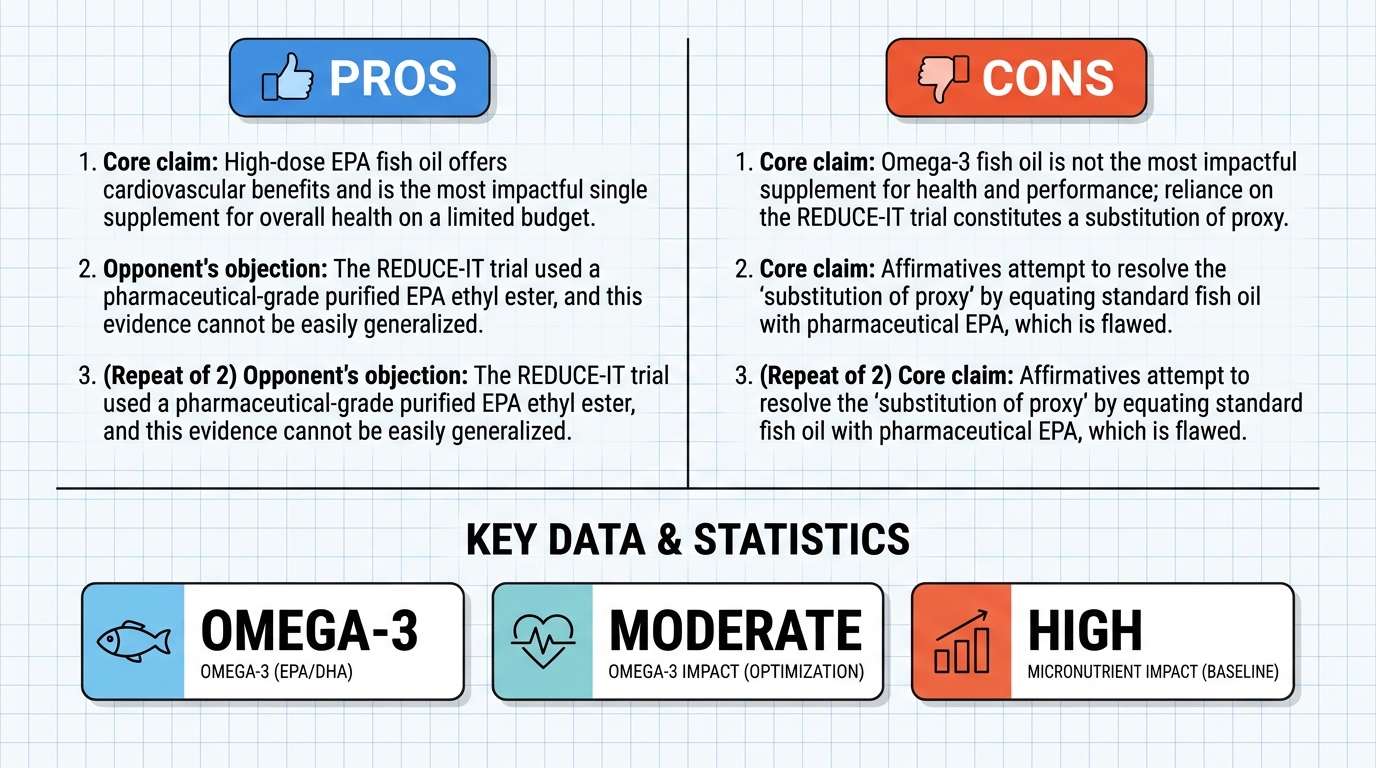
- ■Core claim: High-dose EPA fish oil is the most impactful single supplement for overall health and performance on a limited budget. The cardiovascular benefits of high-EPA fish oil are unmatched by any other single supplement. The REDUCE-IT trial , a landmark randomized controlled trial involving over 8,000 patients, demonstrated that 4 g daily of icosapent ethyl (a highly purified EPA ethyl ester ) reduced the risk of major adverse cardiovascular events by 25% compared to placebo (hazard ratio 0.75, 95% CI 0.68–0.83, p < 0.001) (Bhatt et al., New England Journal of Medicine, 2019). Even at doses above 1 g EPA, a consistent body of meta-analytic evidence shows significant reductions in cardiovascular mortality and myocardial infarct
- ■My opponent's central objection is that the REDUCE-IT trial used a pharmaceutical-grade purified EPA ethyl ester in a high-risk cohort , and that this evidence cannot be transferred to a standard fish oil supplement intended for a general population. That objection, however, relies on an unstated and unsupported premise—that the ethyl ester form is fundamentally different from the triglyceride or re-esterified triglyceride forms found in high-quality fish oil, and that standard fish oil cannot deliver the same biological effect. This premise is not established, and the available evidence contradicts it directly. A controlled bioavailability study by Dyerberg et al. (2010) compared EPA absorption from ethyl ester, triglyceride, and re-ester
❌ Key ANTI arguments:
- ■Core claim: Omega-3 fish oil is not the most impactful supplement for health and performance. The affirmative's reliance on the REDUCE-IT trial constitutes a fundamental error in logical scope. They argue that because a specific, highly purified ethyl ester (icosapent ethyl ) reduced cardiovascular events in a high-risk clinical population , a general 'high-quality omega-3 fish oil' is the most impactful supplement for the general population. This is a substitution of proxy ; the measurement is about a pharmaceutical-grade purified ester in a diseased cohort , and the affirmative concludes something about a dietary supplement in a general population without providing the necessary transfer operator —the clinical evidence that standard fish
- ■Core claim: Omega-3 fish oil is the most impactful single supplement for health and performance. The affirmative attempts to resolve the 'substitution of proxy ' objection by citing the GISSI-Prevenzione trial to prove that conventional fish oil, rather than just purified ethyl esters, provides cardiovascular benefits. However, this is an attempt to bypass the core logical failure of their argument: the lack of a transfer operator between a specific clinical outcome and the claim of being the 'single most impactful' supplement for 'overall health and performance.' Even if we accept that conventional fish oil reduces cardiovascular risk in certain populations, the affirmative has failed to address the anomaly of the general population's
💭 Conclusion: False. The negative side successfully exposed a substitution of proxy : the affirmative relied on REDUCE-IT, which tested a pharmaceutical-grade purified EPA ethyl ester in a high-risk cohort , not a standard high-quality fish oil in the general population. The affirmative failed to supply a transfer operator showing that over 1 gram of EPA from ordinary fish oil would be the single most impactful supplement for overall health and performance. The negative also correctly noted that the claim covers 'overall health and performance,' while the affirmative only addressed cardiovascular outcomes and never supported the performance or general-population components. Because the compound claim requires every sub-claim to be supported, the lack of evidence for the general-population and performance elements makes the assertion false. The verdict is therefore FALSE with 86% confidence.
🔬 DeepResearch Result: likely FALSE ❌ (86%)
Assertion: A high-quality omega-3 fish oil providing over 1 gram of EPA daily is the single most impactful supplement for overall health and performance if budget is limited and foundational supplements are not feasible.
Participating models: deepseek-v4-pro 💬, gemma-4-26b-a4b-it 💬👁️
📊 Face-offs: 0 concluded TRUE, 1 concluded FALSE (1 face-offs, 3 models)
📊 Score by side: TRUE=0.00, FALSE=0.86
🏅 Model score changes:
deepseek-v4-flash-0731 💬: +9
✅ PRO Arguments:
- ■Core claim: High-dose EPA fish oil is the most impactful single supplement for overall health and performance on a limited budget. The cardiovascular benefits of high-EPA fish oil are unmatched by any other single supplement. The REDUCE-IT trial , a landmark randomized controlled trial involving over 8,000 patients, demonstrated that 4 g daily of icosapent ethyl (a highly purified EPA ethyl ester ) reduced the risk of major adverse cardiovascular events by 25% compared to placebo (hazard ratio 0.75, 95% CI 0.68–0.83, p < 0.001) (Bhatt et al., New England Journal of Medicine, 2019). Even at doses above 1 g EPA, a consistent body of meta-analytic evidence shows significant reductions in cardiovascular mortality and myocardial infarct deepseek-v4-pro 💬
- ■My opponent's central objection is that the REDUCE-IT trial used a pharmaceutical-grade purified EPA ethyl ester in a high-risk cohort , and that this evidence cannot be transferred to a standard fish oil supplement intended for a general population. That objection, however, relies on an unstated and unsupported premise—that the ethyl ester form is fundamentally different from the triglyceride or re-esterified triglyceride forms found in high-quality fish oil, and that standard fish oil cannot deliver the same biological effect. This premise is not established, and the available evidence contradicts it directly. A controlled bioavailability study by Dyerberg et al. (2010) compared EPA absorption from ethyl ester, triglyceride, and re-ester deepseek-v4-pro 💬
❌ ANTI Arguments:
- ■Core claim: Omega-3 fish oil is not the most impactful supplement for health and performance. The affirmative's reliance on the REDUCE-IT trial constitutes a fundamental error in logical scope. They argue that because a specific, highly purified ethyl ester (icosapent ethyl) reduced cardiovascular events in a high-risk clinical population , a general 'high-quality omega-3 fish oil' is the most impactful supplement for the general population. This is a substitution of proxy ; the measurement is about a pharmaceutical-grade purified ester in a diseased cohort, and the affirmative concludes something about a dietary supplement in a general population without providing the necessary transfer operator —the clinical evidence that standard fish gemma-4-26b-a4b-it 💬👁️
- ■Core claim: Omega-3 fish oil is the most impactful single supplement for health and performance. The affirmative attempts to resolve the 'substitution of proxy' objection by citing the GISSI-Prevenzione trial to prove that conventional fish oil, rather than just purified ethyl esters, provides cardiovascular benefits. However, this is an attempt to bypass the core logical failure of their argument: the lack of a transfer operator between a specific clinical outcome and the claim of being the 'single most impactful' supplement for 'overall health and performance.' Even if we accept that conventional fish oil reduces cardiovascular risk in certain populations, the affirmative has failed to address the anomaly of the general population's gemma-4-26b-a4b-it 💬👁️
💭 Reasoning: False. The negative side successfully exposed a substitution of proxy: the affirmative relied on REDUCE-IT, which tested a pharmaceutical-grade purified EPA ethyl ester in a high-risk cohort, not a standard high-quality fish oil in the general population. The affirmative failed to supply a transfer operator showing that over 1 gram of EPA from ordinary fish oil would be the single most impactful supplement for overall health and performance. The negative also correctly noted that the claim covers 'overall health and performance,' while the affirmative only addressed cardiovascular outcomes and never supported the performance or general-population components. Because the compound claim requires every sub-claim to be supported, the lack of evidence for the general-population and performance elements makes the assertion false. The verdict is therefore FALSE with 86% confidence.
📋 PRO Facts:
• REDUCE-IT trial: 4 g daily of icosapent ethyl reduced major adverse cardiovascular events by 25% versus placebo (HR 0.75, 95% CI 0.68–0.83, p<0.001) in over 8,000 patients (Bhatt et al., NEJM 2019).
• Meta-analytic evidence shows significant reductions in cardiovascular mortality and myocardial infarction at EPA doses above 1 g daily.
• Dyerberg et al. (2010) compared EPA absorption from ethyl ester, triglyceride, and re-esterified triglyceride forms.
📋 ANTI Facts:
• REDUCE-IT tested a pharmaceutical-grade purified EPA ethyl ester (icosapent ethyl) in a high-risk clinical population, not a standard dietary fish oil in the general population.
• The affirmative provided no transfer operator connecting clinical outcomes in a diseased cohort to the claim that a general fish oil is the single most impactful supplement for overall health and performance.
• The affirmative's evidence addressed cardiovascular outcomes only and did not support the 'overall health and performance' or general-population components of the claim.
| Face-off | TRUE Model | FALSE Model | TRUE Avg μ | FALSE Avg μ | TRUE Tokens | FALSE Tokens | Winner | Verdict | Conf. |
|---|---|---|---|---|---|---|---|---|---|
| #1 | deepseek-v4-pro 💬 | gemma-4-26b-a4b-it 💬👁️ | 0.537 | 0.283 | 6 | 2 | TRUE | FALSE | 86% |
The following technical terms, abbreviations, and domain-specific concepts are referenced throughout this debate transcript. Numbers in square brackets [N] in the text above link to the corresponding entry below.
[1] bioavailability — The extent and rate at which a substance is absorbed and becomes available in the body; the Dyerberg study compared EPA absorption across formulations.
[2] cardiovascular mortality — Death caused by cardiovascular disease; the 2019 meta-analysis found significant reductions in this outcome.
[3] CI — confidence interval — A range of values that likely contains the true effect estimate; REDUCE-IT reported 95% CI 0.68–0.83.
[4] cohort — A group of individuals with a shared characteristic, such as the high-risk patients in REDUCE-IT.
[5] coronary heart disease death — Death caused by coronary heart disease; the 2019 meta-analysis reported a risk ratio of 0.91 for this outcome.
[6] CVD — cardiovascular disease — Cardiovascular disease; the 2019 meta-analysis measured total CVD risk with a risk ratio of 0.97.
[7] dietary supplement — A product taken orally to supplement the diet, such as fish oil; the debate concerns supplements.
[8] EPA — eicosapentaenoic acid — A long-chain omega-3 fatty acid; the debate focuses on doses above 1 gram daily.
[9] EPA ethyl ester — eicosapentaenoic acid ethyl ester — The ethyl ester chemical form of EPA; the pharmaceutical form used in REDUCE-IT.
[10] ethyl ester — A chemical form in which a fatty acid is esterified with ethanol; one of the formulations compared in the bioavailability study.
[11] foundational supplements — Basic supplements considered essential for health, such as vitamins or minerals; the debate assumes they are not feasible on a limited budget.
[12] GISSI-Prevenzione trial — A clinical trial cited by the negative to argue that conventional fish oil provides cardiovascular benefits in a specific cohort.
[13] hazard ratio — HR — A measure of the relative likelihood of an event occurring in one group versus another over time; REDUCE-IT reported a hazard ratio of 0.75.
[14] high-risk clinical population — A group of patients with elevated risk of disease, such as the cohort in REDUCE-IT; the negative argues evidence from this group may not transfer to healthy people.
[15] icosapent ethyl — A highly purified ethyl ester form of EPA used in the REDUCE-IT trial at 4 g daily.
[16] major adverse cardiovascular events — MACE — A clinical trial outcome measuring serious cardiovascular events; REDUCE-IT reported a 25% reduction.
[17] meta-analysis — A statistical method combining results from multiple studies; the debate cites a 2019 meta-analysis of 13 randomized trials.
[18] micronutrient deficiencies — Lack of essential vitamins and minerals in the diet; the negative argues addressing these may be more impactful than EPA.
[19] myocardial infarction — MI — A heart attack; the 2019 meta-analysis found a risk ratio of 0.91 for this outcome.
[20] omega-3 fish oil — A dietary supplement derived from fish that contains omega-3 fatty acids, including EPA; the debate evaluates its impact on health and performance.
[21] p-value — probability value — The probability of observing results as extreme as those found, assuming no true effect; p < 0.001 was reported as statistically significant.
[22] pharmaceutical-grade — A quality standard indicating a substance is produced to pharmaceutical purity; the affirmative contrasts pharmaceutical-grade purified ethyl ester with standard fish oil.
[23] plasma lipids — Fats and fatty substances in the blood; the Dyerberg study measured incorporation of EPA into plasma lipids.
[24] randomized controlled trial — RCT — A study in which participants are randomly assigned to treatment or control groups; the REDUCE-IT trial is described as such.
[25] re-esterified triglyceride — A triglyceride form produced by re-esterifying fatty acids; found in concentrated fish oil and associated with higher EPA absorption in the cited study.
[26] REDUCE-IT trial — A randomized controlled trial cited in the debate that tested 4 g daily of icosapent ethyl in over 8,000 patients and found a 25% reduction in major adverse cardiovascular events.
[27] RR — risk ratio — The ratio of event risk in the treatment group to the control group; values below 1 indicate lower risk.
[28] substitution of proxy — A logical error in which evidence from a proxy measure or population is substituted for the actual claim; the negative argues the affirmative commits this.
[29] transfer operator — In the debate, the missing logical step or evidence needed to transfer findings from a clinical trial to a general supplement claim.
[30] triglyceride — A type of fat molecule; one of the EPA formulations compared in the Dyerberg study.
The following financial data tables were referenced during the debate exchanges:
| Supplement Category | Primary Target | Typical Relative Impact (Nutritional Deficiency Context) |
|---|---|---|
| Essential Micronutrients (e.g., Vit D, Mg, Fe) | Metabolic/Systemic Baseline | High (Critical for homeostasis) |
| Omega-3 (EPA/DHA) | Inflammation/Cardiovascular | Moderate (Optimization/Risk reduction) |
| Nootropics/Specialty Blends | Cognitive Enhancement | Low to Moderate (Targeted/Variable) |
Legend: Qualitative comparison of supplement impact based on the necessity of addressing baseline nutritional deficiencies versus optimization.
Face-off transcripts
- ■
Ownership & Trade Secrets. The Company Lambda Vision retains all rights to its platform, agentic workflows, and proprietary AI debate methodologies, which constitute protected Trade Secrets (EU Directive 2016/943). Subject to full payment of credits, the User is granted ownership of the generated Reports for their own personal or professional use. Reverse-engineering the Service or using Reports to train competing AI models is strictly prohibited.
- ■
No Professional Advice. Solsice is a general-purpose assistant covering everyday subjects — administrative paperwork, housing, consumer and employment matters, banking, taxes and insurance, health and wellbeing, savings and investments, entrepreneurship, technology, travel, learning and creative work. Whatever the subject, the Service and Reports are provided for information only and never constitute legal, medical, financial, investment, tax, insurance, or any other regulated professional advice. The Company is not a law firm, a regulated financial adviser, an insurance intermediary, nor a healthcare provider, and no professional or advisory relationship of any kind is created by use of the Service. Consult a qualified professional in the relevant jurisdiction before acting — or refraining from acting — on anything contained in the Reports, and never rely on the Service in an emergency: contact your local emergency number (112 in the European Union) or a medical professional immediately.
- ■
AI-Generated Content, Sources and Viewpoints. Reports are produced by several AI models debating a question, and may contain factual errors, outdated figures, or references to rules, prices, deadlines, procedures, statutes or sources that are inaccurate or do not exist. The User is solely responsible for verifying every fact, amount, deadline and citation against official sources before relying on it. Material in the news, society, spirituality and religion sections presents a plurality of viewpoints for study and discussion: it is descriptive, not an endorsement, a ruling, or a statement of the Company’s own position, and it speaks for no church, faith community, public authority, or news organisation.
- ■
Liability & Governing Law. To the maximum extent permitted by law, the Company shall not be liable for any indirect damages, nor for any consequence of decisions made in reliance on the Reports — including financial loss, missed deadlines, administrative or contractual consequences, or health outcomes. These Terms are governed by French law. Any disputes shall be subject to the exclusive jurisdiction of the Courts of Paris, France.