
A Dell Optiplex 7040 with an RTX 3050 and its stock 180W power supply can reliably run demanding games like Forza Horizon 6 at 1080p for extended periods without PSU failure.
AI debate verdict and arguments
⚠️ AI-generated information only; not professional advice
Completed October 26, 2026
Verdict
Verdict: likely FALSE (86%)
Web Report: https://solsice.com/public/debates/a-dell-optiplex-7040-with-an-rtx-3050-and-its-stock-180w-pow-c2e749a1383c
This section provides a brief overview of the key arguments. You do not need to read the full detailed report below.
✅ Key PRO arguments:
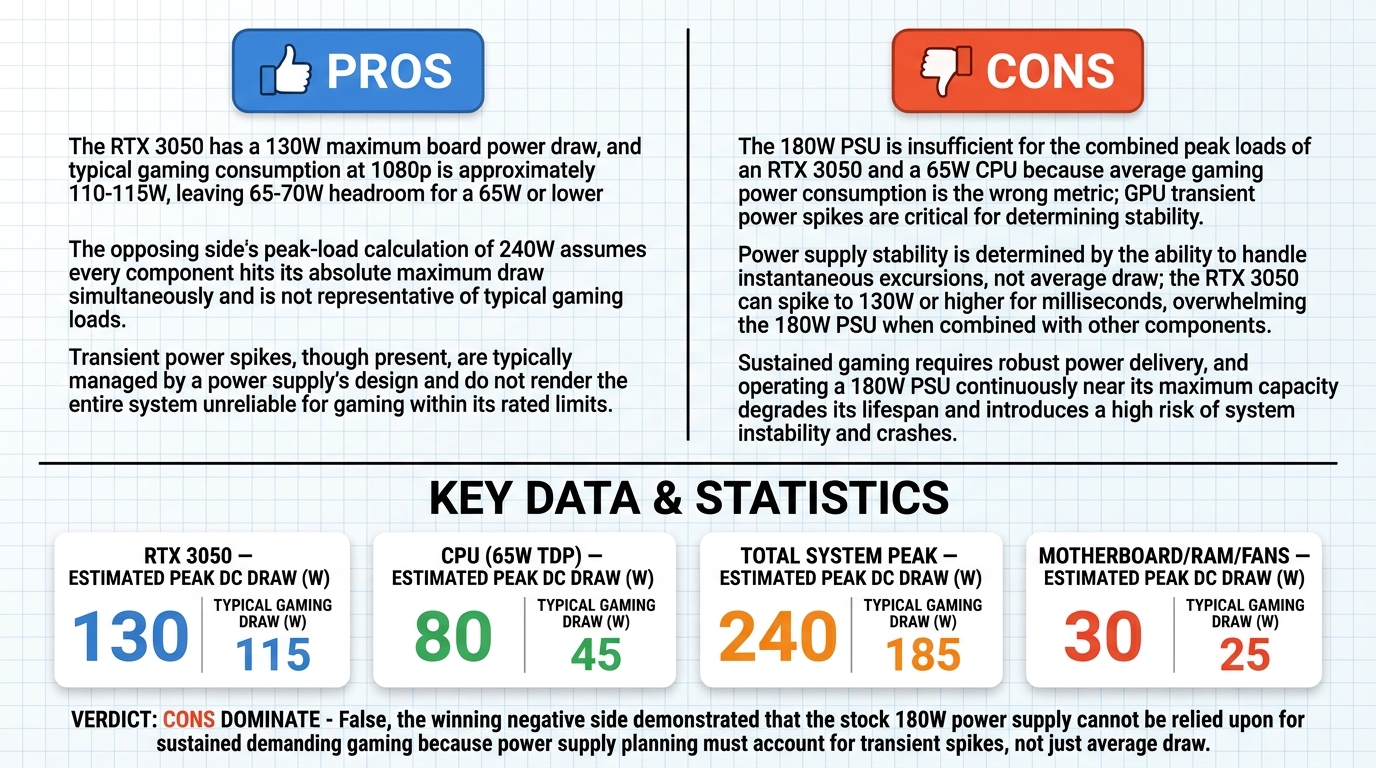
- ■The RTX 3050 has a 130W maximum board power draw, and typical gaming consumption at 1080p is approximately 110-115W, leaving 65-70W headroom for a 65W or lower CPU and the rest of the system, which is within the 180W PSU 's rated capacity.
- ■The opposing side's peak-load calculation of 240W (130W GPU + 80W CPU + 30W rest) assumes every component hits its absolute maximum draw simultaneously and sustains it, which does not occur in real gaming workloads; the burden of proof for that worst-case model is not met.
❌ Key ANTI arguments:
- ■The 180W PSU is insufficient for the combined peak loads of an RTX 3050 and a 65W CPU because average gaming power consumption is the wrong metric; GPU transients can momentarily exceed TDP , and when they coincide with CPU boost events in open-world titles like Forza Horizon, instantaneous demand can exceed 180W.
- ■Power supply stability is determined by the ability to handle instantaneous excursions, not average draw; the RTX 3050 can spike to 130W or higher for milliseconds, and when these spikes coincide with a 65W CPU 's power-draw spikes during complex scene transitions, the total instantaneous demand can exceed the PSU 's capacity.
💭 Conclusion: False, the winning negative side demonstrated that the stock 180W power supply cannot be relied upon for sustained demanding gaming because power supply planning must account for transient spikes, not just average draw. The affirmative's argument rested on the RTX 3050 's typical 110-115W gaming consumption and claimed 65-70W headroom , but this ignores millisecond-scale GPU power excursions that can reach or exceed 130W. When those GPU transients coincide with CPU boost events in open-world titles like Forza Horizon 6, the instantaneous system demand can exceed the 180W PSU threshold. The judge accepted this peak-load reasoning over the average-consumption model, giving the negative side an 86% confidence verdict. Therefore, the assertion that the configuration can run such games for extended periods without PSU failure is not supported.
🔬 DeepResearch Result: likely FALSE ❌ (86%)
Assertion: A Dell Optiplex 7040 with an RTX 3050 and its stock 180W power supply can reliably run demanding games like Forza Horizon 6 at 1080p for extended periods without PSU failure.
Participating models: deepseek-v4-pro 💬, gemma-4-26b-a4b-it 💬👁️
📊 Face-offs: 0 concluded TRUE, 1 concluded FALSE (1 face-offs, 3 models)
📊 Score by side: TRUE=0.00, FALSE=0.86
🏅 Model score changes:
deepseek-v4-flash-0731 💬: +9
✅ PRO Arguments:
- ■The RTX 3050 has a 130W maximum board power draw, and typical gaming consumption at 1080p is approximately 110-115W, leaving 65-70W headroom for a 65W or lower CPU and the rest of the system, which is within the 180W PSU 's rated capacity. deepseek-v4-pro 💬
- ■The opposing side's peak-load calculation of 240W (130W GPU + 80W CPU + 30W rest) assumes every component hits its absolute maximum draw simultaneously and sustains it, which does not occur in real gaming workloads; the burden of proof for that worst-case model is not met. deepseek-v4-pro 💬
❌ ANTI Arguments:
- ■The 180W PSU is insufficient for the combined peak loads of an RTX 3050 and a 65W CPU because average gaming power consumption is the wrong metric; GPU transients can momentarily exceed TDP , and when they coincide with CPU boost events in open-world titles like Forza Horizon, instantaneous demand can exceed 180W. gemma-4-26b-a4b-it 💬👁️
- ■Power supply stability is determined by the ability to handle instantaneous excursions, not average draw; the RTX 3050 can spike to 130W or higher for milliseconds, and when these spikes coincide with a 65W CPU's power-draw spikes during complex scene transitions, the total instantaneous demand can exceed the PSU's capacity. gemma-4-26b-a4b-it 💬👁️
💭 Reasoning: False, the winning negative side demonstrated that the stock 180W power supply cannot be relied upon for sustained demanding gaming because power supply planning must account for transient spikes, not just average draw. The affirmative's argument rested on the RTX 3050's typical 110-115W gaming consumption and claimed 65-70W headroom, but this ignores millisecond-scale GPU power excursions that can reach or exceed 130W. When those GPU transients coincide with CPU boost events in open-world titles like Forza Horizon 6, the instantaneous system demand can exceed the 180W PSU threshold. The judge accepted this peak-load reasoning over the average-consumption model, giving the negative side an 86% confidence verdict. Therefore, the assertion that the configuration can run such games for extended periods without PSU failure is not supported.
📋 PRO Facts:
• The RTX 3050 has a 130W maximum board power draw.
• Typical RTX 3050 gaming power consumption at 1080p is approximately 110-115W.
• The Dell Optiplex 7040 stock power supply is rated at 180W.
• The CPU in the configuration is 65W or lower.
• The combined peak load of 240W is a theoretical worst-case summation.
📋 ANTI Facts:
• The RTX 3050 can experience transient power spikes that momentarily exceed its 130W TDP.
• A power supply must be able to handle instantaneous excursions, not just average power draw.
• GPU transients can coincide with CPU boost events in open-world titles like Forza Horizon.
• The instantaneous system demand can exceed the 180W threshold of the Dell Optiplex 7040 PSU.
| Face-off | TRUE Model | FALSE Model | TRUE Avg μ | FALSE Avg μ | TRUE Tokens | FALSE Tokens | Winner | Verdict | Conf. |
|---|---|---|---|---|---|---|---|---|---|
| #1 | deepseek-v4-pro 💬 | gemma-4-26b-a4b-it 💬👁️ | 0.524 | 0.311 | 6 | 2 | TRUE | FALSE | 86% |
The following technical terms, abbreviations, and domain-specific concepts are referenced throughout this debate transcript. Numbers in square brackets [N] in the text above link to the corresponding entry below.
[1] 1080p — 1920x1080 resolution — A display resolution of 1920 by 1080 pixels, used as the gaming resolution in the debate.
[2] 180W PSU — 180-watt power supply unit — The 180-watt power supply unit in the Dell Optiplex 7040; the debate questions whether it can reliably power an RTX 3050.
[3] 65W CPU — 65-watt central processing unit — A central processing unit with a 65W power envelope, mentioned as the CPU paired with the RTX 3050.
[4] 80 PLUS Platinum — 80 PLUS Platinum certification — An efficiency certification that the affirmative claims the Optiplex 7040's PSU holds, indicating high efficiency under load.
[5] AC input — alternating current input — Alternating current drawn from a wall outlet; the negative argues the affirmative conflates AC input with DC output.
[6] ATX — Advanced Technology eXtended — A common form factor for consumer power supplies; the affirmative contrasts the Optiplex's PSU with consumer-grade ATX units.
[7] board power — board power draw — The maximum power draw of a graphics card as specified by its design; the RTX 3050's board power is 130W.
[8] CPU boost — CPU boost clock — A temporary increase in CPU clock speed and power draw; the negative argues it can coincide with GPU transients.
[9] DC output — direct current output — Direct current delivered by a power supply to computer components; the debate distinguishes it from AC input.
[10] Dell Optiplex 7040 — A Dell desktop computer model whose stock 180W PSU is the subject of the debate.
[11] GPU — graphics processing unit — The processor on a graphics card; the RTX 3050 is the GPU in question.
[12] headroom — power supply headroom — The margin between a PSU's rated capacity and the system's expected power draw; the affirmative claims there is 65-70W headroom.
[13] OCP — Over Current Protection — A power supply protection circuit that can trigger a system shutdown if current exceeds limits.
[14] OPP — Over Power Protection — A power supply protection circuit that can trigger a system shutdown if power exceeds limits.
[15] output capacitors — Capacitors in a power supply that the affirmative says absorb sub-millisecond transient spikes.
[16] peak-load capacity — peak load capacity — The maximum instantaneous power a PSU can handle; the negative argues it is the relevant metric for reliability.
[17] power envelope — The range of power draw a system is designed to operate within; the affirmative says the 180W PSU operates within a safe envelope.
[18] PSU — power supply unit — The component that converts AC power to DC power for a computer; the debate concerns whether the Optiplex's 180W PSU is sufficient.
[19] RTX 3050 — NVIDIA GeForce RTX 3050 — A graphics card model; the debate centers on whether the Optiplex's PSU can power it during gaming.
[20] server-grade PSU — server-grade power supply unit — A power supply engineered for continuous 24/7 operation, as the affirmative describes the Optiplex's unit.
[21] TDP — Thermal Design Power — A specification for a component's maximum designed power draw; the RTX 3050's TDP is cited as 130W.
[22] transient power spikes — Brief, millisecond-scale increases in power draw that can exceed a component's rated TDP; the negative argues they must be accounted for.
[23] vBIOS — video BIOS — The firmware on a graphics card that enforces power limits; the affirmative says the 130W figure is enforced by driver and vBIOS.
[24] wall power — Power drawn from an electrical outlet; the negative argues the affirmative conflates wall power with DC load.
The following financial data tables were referenced during the debate exchanges:
| Component | Estimated Peak DC Draw (W) | Typical Gaming Draw (W) |
|---|---|---|
| RTX 3050 | 130 | 115 |
| CPU (65W TDP) | 80 | 45 |
| Motherboard/RAM/Fans | 30 | 25 |
| Total System Peak | 240 | 185 |
Legend: Estimated power consumption profiles for a Dell Optiplex 7040 configuration. Peak values include transient spikes and CPU boost; typical values represent sustained gaming averages.
Face-off transcripts
- ■
Ownership & Trade Secrets. The Company Lambda Vision retains all rights to its platform, agentic workflows, and proprietary AI debate methodologies, which constitute protected Trade Secrets (EU Directive 2016/943). Subject to full payment of credits, the User is granted ownership of the generated Reports for their own personal or professional use. Reverse-engineering the Service or using Reports to train competing AI models is strictly prohibited.
- ■
No Professional Advice. Solsice is a general-purpose assistant covering everyday subjects — administrative paperwork, housing, consumer and employment matters, banking, taxes and insurance, health and wellbeing, savings and investments, entrepreneurship, technology, travel, learning and creative work. Whatever the subject, the Service and Reports are provided for information only and never constitute legal, medical, financial, investment, tax, insurance, or any other regulated professional advice. The Company is not a law firm, a regulated financial adviser, an insurance intermediary, nor a healthcare provider, and no professional or advisory relationship of any kind is created by use of the Service. Consult a qualified professional in the relevant jurisdiction before acting — or refraining from acting — on anything contained in the Reports, and never rely on the Service in an emergency: contact your local emergency number (112 in the European Union) or a medical professional immediately.
- ■
AI-Generated Content, Sources and Viewpoints. Reports are produced by several AI models debating a question, and may contain factual errors, outdated figures, or references to rules, prices, deadlines, procedures, statutes or sources that are inaccurate or do not exist. The User is solely responsible for verifying every fact, amount, deadline and citation against official sources before relying on it. Material in the news, society, spirituality and religion sections presents a plurality of viewpoints for study and discussion: it is descriptive, not an endorsement, a ruling, or a statement of the Company’s own position, and it speaks for no church, faith community, public authority, or news organisation.
- ■
Liability & Governing Law. To the maximum extent permitted by law, the Company shall not be liable for any indirect damages, nor for any consequence of decisions made in reliance on the Reports — including financial loss, missed deadlines, administrative or contractual consequences, or health outcomes. These Terms are governed by French law. Any disputes shall be subject to the exclusive jurisdiction of the Courts of Paris, France.