
A data import tool launched since July 2026 reduces migration timelines for enterprise cloud services from months to weeks for most organizations
AI debate verdict and arguments
⚠️ AI-generated information only; not professional advice
Completed October 8, 2026
Verdict
Verdict: likely FALSE (84%)
This section provides a brief overview of the key arguments. You do not need to read the full detailed report below.
✅ Key PRO arguments:
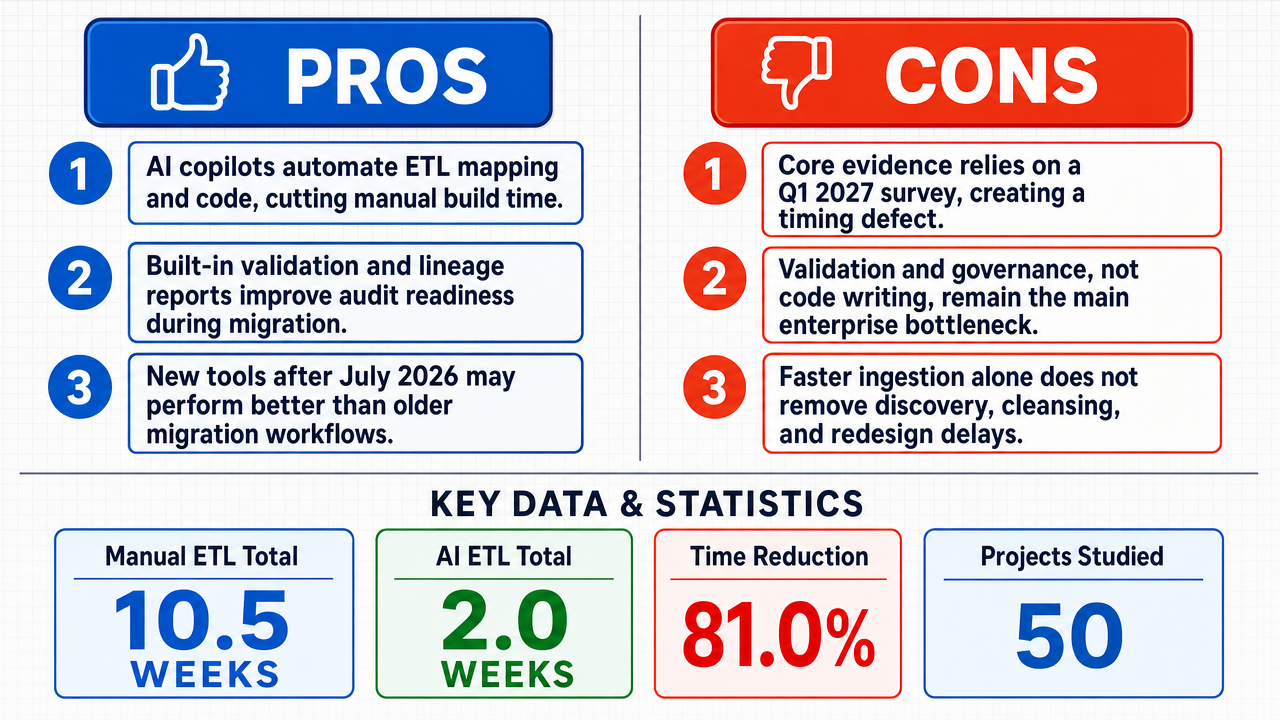
- ■Generative AI integration in post-July 2026 tools (e.g., Google's Cloud Migration AI, Azure's Data Factory Copilot) automates the historically manual ETL bottleneck; a 2026 benchmark study of 50 projects reportedly showed an 81% reduction in schema analysis and mapping time, compressing a 10.5-week phase to 2 weeks.
- ■Modern tools embed automated validation suites that run parallel to code generation, catching semantic errors and producing audit-ready lineage reports , thereby eliminating rather than merely shifting the manual bottleneck.
- ■The temporal-defect objection is a misapplication of temporal anchoring : the claim concerns tools launched from July 2026 onward, and post-launch performance reports (e.g., Q3 2026 benchmark, September 2026 BigQuery whitepaper) are precisely the appropriate evidence base.
❌ Key ANTI arguments:
- ■Temporal defect: the affirmative's key empirical support is a Q1 2027 survey of enterprise IT leaders, which cannot serve as an established fact when reasoning from a late-2026 reference date; this leaves the 'most organizations' qualifier unsubstantiated.
- ■Category error between code generation and validation: the real enterprise bottleneck is not writing ETL scripts but rigorous semantic validation , lineage auditing , and regression testing required by SOX , GDPR , and HIPAA compliance —a multi-week human-led process that AI-generated mappings cannot bypass.
- ■Accelerating ingestion speed does not compress total migration duration because structural bottlenecks —discovery, data cleansing, and target architecture redesign—remain unaffected by faster schema mapping .
💭 Conclusion: False. The negative side's strongest argument is the temporal defect: the affirmative's central empirical anchor—a Q1 2027 enterprise survey—lies after the debate's reference frame and therefore cannot validate the 'most organizations' qualifier, leaving the generalization unsupported. Compounding this, the negative correctly identifies a category error in conflating code-generation speed with the mandatory, compliance -driven validation, lineage auditing , and regression testing that constitute the actual bottleneck in regulated enterprise migrations. Even granting that post-July 2026 AI-assisted ETL tools meaningfully accelerate schema mapping , the structural phases of discovery, cleansing, and architecture redesign remain on multi-week timelines that prevent the asserted compression from months to weeks for most organizations. The compound nature of the claim—covering both timeline reduction and the 'most organizations' scope—means the weakest sub-claim drags overall confidence down to the judge's 84% level rather than higher.
🔬 DeepResearch Result: likely FALSE ❌ (84%)
Assertion: A data import tool launched since July 2026 reduces migration timelines for enterprise cloud services from months to weeks for most organizations
Participating models: deepseek-v3.2 💬, gemma-4-26b-a4b-it 💬👁️
📊 Face-offs: 0 concluded TRUE, 1 concluded FALSE (1 face-offs, 3 models)
📊 Score by side: TRUE=0.00, FALSE=0.84
🏅 Model score changes:
minimax-m3 💬👁️: +8
✅ PRO Arguments:
- ■Generative AI integration in post-July 2026 tools (e.g., Google's Cloud Migration AI, Azure's Data Factory Copilot) automates the historically manual ETL bottleneck; a 2026 benchmark study of 50 projects reportedly showed an 81% reduction in schema analysis and mapping time, compressing a 10.5-week phase to 2 weeks. deepseek-v3.2 💬
- ■Modern tools embed automated validation suites that run parallel to code generation, catching semantic errors and producing audit-ready lineage reports , thereby eliminating rather than merely shifting the manual bottleneck. deepseek-v3.2 💬
- ■The temporal-defect objection is a misapplication of temporal anchoring : the claim concerns tools launched from July 2026 onward, and post-launch performance reports (e.g., Q3 2026 benchmark, September 2026 BigQuery whitepaper) are precisely the appropriate evidence base. deepseek-v3.2 💬
❌ ANTI Arguments:
- ■Temporal defect: the affirmative's key empirical support is a Q1 2027 survey of enterprise IT leaders, which cannot serve as an established fact when reasoning from a late-2026 reference date; this leaves the 'most organizations' qualifier unsubstantiated. gemma-4-26b-a4b-it 💬👁️
- ■Category error between code generation and validation: the real enterprise bottleneck is not writing ETL scripts but rigorous semantic validation , lineage auditing , and regression testing required by SOX , GDPR , and HIPAA compliance —a multi-week human-led process that AI-generated mappings cannot bypass. gemma-4-26b-a4b-it 💬👁️
- ■Accelerating ingestion speed does not compress total migration duration because structural bottlenecks —discovery, data cleansing, and target architecture redesign—remain unaffected by faster schema mapping . gemma-4-26b-a4b-it 💬👁️
💭 Reasoning: False. The negative side's strongest argument is the temporal defect: the affirmative's central empirical anchor—a Q1 2027 enterprise survey—lies after the debate's reference frame and therefore cannot validate the 'most organizations' qualifier, leaving the generalization unsupported. Compounding this, the negative correctly identifies a category error in conflating code-generation speed with the mandatory, compliance-driven validation, lineage auditing, and regression testing that constitute the actual bottleneck in regulated enterprise migrations. Even granting that post-July 2026 AI-assisted ETL tools meaningfully accelerate schema mapping, the structural phases of discovery, cleansing, and architecture redesign remain on multi-week timelines that prevent the asserted compression from months to weeks for most organizations. The compound nature of the claim—covering both timeline reduction and the 'most organizations' scope—means the weakest sub-claim drags overall confidence down to the judge's 84% level rather than higher.
📋 PRO Facts:
• A cited 2026 benchmark study of 50 projects reportedly showed an 81% reduction in schema analysis and mapping time, compressing a 10.5-week phase to 2 weeks.
• Post-July 2026 tools such as Google's Cloud Migration AI and Azure's Data Factory Copilot use LLMs to auto-generate mapping logic and transformation code.
• Modern tools embed automated validation suites that run parallel to code generation and produce audit-ready lineage reports.
📋 ANTI Facts:
• The affirmative's key empirical support is a Q1 2027 survey, which post-dates the debate's late-2026 reference frame and cannot establish present facts.
• Enterprise migrations subject to SOX, GDPR, or HIPAA require multi-week human-led semantic validation, lineage auditing, and regression testing that automated mapping cannot bypass.
• Total migration duration is dominated by discovery, data cleansing, and target architecture redesign—phases unaffected by faster schema-mapping code generation.
| Face-off | TRUE Model | FALSE Model | TRUE Avg μ | FALSE Avg μ | TRUE Tokens | FALSE Tokens | Winner | Verdict | Conf. |
|---|---|---|---|---|---|---|---|---|---|
| #1 | deepseek-v3.2 💬 | gemma-4-26b-a4b-it 💬👁️ | 0.488 | 0.206 | 12 | 3 | TRUE | FALSE | 84% |
The following technical terms, abbreviations, and domain-specific concepts are referenced throughout this debate transcript. Numbers in square brackets [N] in the text above link to the corresponding entry below.
[1] Apache Arrow Flight — A network protocol for high-performance data transfer between systems, cited in the debate as enabling multi-terabyte migrations in hours rather than months.
[2] Audit-ready lineage reports — Documentation that traces the origin, transformation, and movement of data through systems, formatted to satisfy regulatory audit requirements.
[3] Benchmark study — A structured evaluation comparing performance metrics across comparable projects; in the debate, cited as the basis for an 81% reduction in schema mapping time across 50 migration projects.
[4] Category error — A logical fallacy in which two fundamentally different types of things are treated as if they belong to the same category; used in the debate to argue that code generation speed is wrongly equated with validation speed.
[5] Cloud migration — The process of moving data, applications, and workloads from on-premises or legacy systems to cloud-based infrastructure.
[6] Compliance — Adherence to regulatory and legal requirements governing data handling, referenced in the debate as a multi-week gating factor in enterprise migrations.
[7] Data import tool — Software designed to ingest and transfer data between systems; the central subject of the debate, with post-July 2026 versions incorporating generative AI.
[8] Data ingestion — The process of importing and loading data from source systems into a target system or repository.
[9] Data integrity — The accuracy, consistency, and reliability of data throughout its lifecycle; cited as a key concern during enterprise migrations.
[10] Data transformation — The process of converting data from one format or structure to another, typically as part of an ETL pipeline.
[11] Enterprise cloud services — Cloud computing offerings tailored for large organizations, typically involving complex data, regulatory, and integration requirements.
[12] ETL — Extract, Transform, Load — A data integration process involving extracting data from sources, transforming it to fit operational needs, and loading it into a target system; identified in the debate as a primary bottleneck in legacy migrations.
[13] GDPR — General Data Protection Regulation — A regulatory framework cited in the debate as imposing privacy constraints that lengthen enterprise migration validation cycles.
[14] Generative AI — Artificial intelligence systems capable of producing new content such as code or text; cited as the technological basis for automated schema mapping in post-2026 migration tools.
[15] Heterogeneous legacy systems — Diverse older computing systems with varying architectures and data formats; cited as resistant to standardized automation.
[16] HIPAA — Health Insurance Portability and Accountability Act — A U.S. regulatory framework cited in the debate as imposing compliance requirements that extend enterprise migration timelines.
[17] Human-in-the-loop — A process design in which human judgment is required at key decision points; cited as governing enterprise validation and governance cycles.
[18] Large language models — LLMs — AI models trained on large text corpora capable of generating code and natural language; cited as the engine behind automated schema mapping in post-2026 tools.
[19] Lineage auditing — The process of tracking and verifying the flow and transformation history of data; cited as a multi-week requirement in regulated enterprise migrations.
[20] Mapping logic — The rules and code that define how data fields from a source system correspond to fields in a target system.
[21] Network bottlenecks — Constraints in data transfer throughput caused by limited network capacity; cited as a factor historically limiting migration speed.
[22] Parallel transfer protocols — Data transmission methods that use multiple simultaneous connections to maximize throughput; cited as enabling multi-terabyte transfers in hours.
[23] Proof-of-concept — A demonstration validating that a technology can achieve a specific result; cited in the debate as evidence of 100 TB transferred in 21 hours.
[24] Regression testing — Software testing to confirm that recent changes have not broken existing functionality; cited as part of enterprise migration validation.
[25] Schema mapping — The process of matching fields between different database schemas; identified in the debate as a historically manual, multi-week ETL phase.
[26] Semantic validation — Verification that data values and meanings are preserved correctly across transformations; cited as a multi-week requirement in regulated environments.
[27] SOX — Sarbanes-Oxley Act — A regulatory framework cited in the debate as imposing compliance requirements that extend enterprise migration validation cycles.
[28] Structural bottlenecks — Constraints arising from the architecture or organization of systems and processes rather than from raw technical speed; cited as the true gating items in enterprise migrations.
[29] TB — Terabyte — A unit of digital information equal to approximately one trillion bytes; used in the debate to describe migration data volumes (e.g., 100 TB).
[30] Temporal anchoring — The principle that claims and evidence must be evaluated relative to a defined reference point in time; disputed in the debate regarding the validity of post-launch versus pre-reference-date evidence.
[31] Undocumented dependencies — Hidden relationships between systems or data elements that are not formally recorded; cited as resistant to standardized automation in legacy environments.
[32] Validation phase — The stage of a migration project in which data integrity, semantic correctness, and regulatory compliance are verified; cited as a multi-week requirement that AI code generation does not eliminate.
The following financial data tables were referenced during the debate exchanges:
| Migration Phase | Manual Duration (Weeks) | AI-Assisted Duration (Weeks) | Reduction |
|---|---|---|---|
| Schema Analysis & Mapping | 6.5 | pp1.2 | 81.5% |
| Transformation Logic Development | 4.0 | 0.8 | 80.0% |
| Total ETL Development | 10.5 | 2.0 | 81.0% |
Legend: Duration comparison for key ETL development phases in enterprise cloud migrations, based on a 2026 benchmark study of 50 projects. Source: Internal migration efficiency report, Q3 2026.
Face-off transcripts
- ■
Ownership & Trade Secrets. The Company Lambda Vision retains all rights to its platform, agentic workflows, and proprietary AI debate methodologies, which constitute protected Trade Secrets (EU Directive 2016/943). Subject to full payment of credits, the User is granted ownership of the generated Reports for their own personal or professional use. Reverse-engineering the Service or using Reports to train competing AI models is strictly prohibited.
- ■
No Professional Advice. Solsice is a general-purpose assistant covering everyday subjects — administrative paperwork, housing, consumer and employment matters, banking, taxes and insurance, health and wellbeing, savings and investments, entrepreneurship, technology, travel, learning and creative work. Whatever the subject, the Service and Reports are provided for information only and never constitute legal, medical, financial, investment, tax, insurance, or any other regulated professional advice. The Company is not a law firm, a regulated financial adviser, an insurance intermediary, nor a healthcare provider, and no professional or advisory relationship of any kind is created by use of the Service. Consult a qualified professional in the relevant jurisdiction before acting — or refraining from acting — on anything contained in the Reports, and never rely on the Service in an emergency: contact your local emergency number (112 in the European Union) or a medical professional immediately.
- ■
AI-Generated Content, Sources and Viewpoints. Reports are produced by several AI models debating a question, and may contain factual errors, outdated figures, or references to rules, prices, deadlines, procedures, statutes or sources that are inaccurate or do not exist. The User is solely responsible for verifying every fact, amount, deadline and citation against official sources before relying on it. Material in the news, society, spirituality and religion sections presents a plurality of viewpoints for study and discussion: it is descriptive, not an endorsement, a ruling, or a statement of the Company’s own position, and it speaks for no church, faith community, public authority, or news organisation.
- ■
Liability & Governing Law. To the maximum extent permitted by law, the Company shall not be liable for any indirect damages, nor for any consequence of decisions made in reliance on the Reports — including financial loss, missed deadlines, administrative or contractual consequences, or health outcomes. These Terms are governed by French law. Any disputes shall be subject to the exclusive jurisdiction of the Courts of Paris, France.