
A credit score exceeding 650 is an essential prerequisite for individuals to be ready to invest in real estate.
AI debate verdict and arguments
⚠️ AI-generated information only; not professional advice
Completed October 14, 2026
Verdict
Verdict: likely FALSE (84%)
Web Report: https://solsice.com/public/debates/a-credit-score-exceeding-650-is-an-essential-prerequisite-fo-931867bf5ea3
This section provides a brief overview of the key arguments. You do not need to read the full detailed report below.
✅ Key PRO arguments:
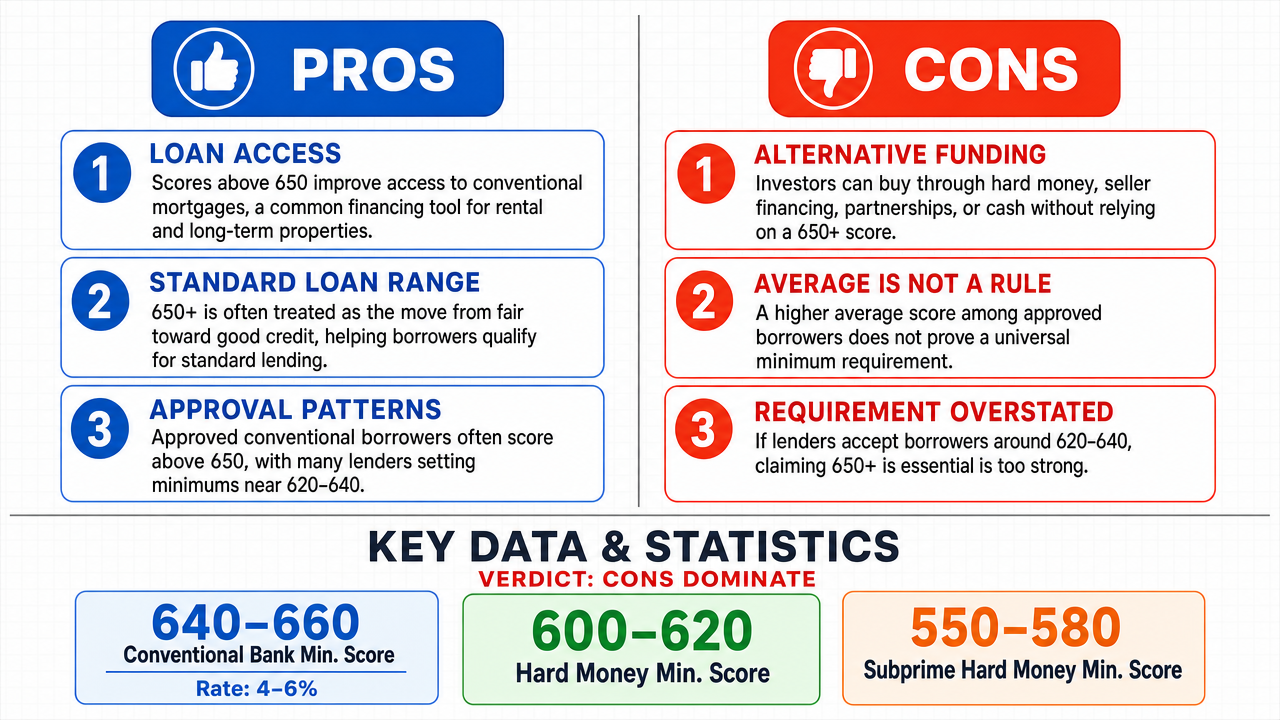
- ■A credit score above 650 unlocks access to conventional mortgage financing, which is the primary tool for acquiring investment properties , and lenders universally use credit scores as a key risk metric.
- ■A score above 650 is widely recognized as the threshold separating 'fair' to 'good' credit applicants who qualify for standard loans from those relegated to subprime or non-traditional lending .
- ■Data shows the average credit score for approved conventional mortgage loans consistently exceeds 650, and lenders typically require a minimum score of 620-640 for such loans, often with better terms above 650.
❌ Key ANTI arguments:
- ■Real estate investment is viable through diverse funding models (hard money lenders , seller financing , partnerships, all-cash purchases) regardless of credit score , so a 650 score is not an essential prerequisite.
- ■The affirmative commits a substitution error: citing the average credit score of an existing pool of approved borrowers does not establish a minimum requirement for entry; an average describes the current composition, not the threshold.
- ■The claim that a 650 score is 'required' to qualify is logically incoherent because the affirmative simultaneously uses the qualifier 'typically leads to loan denial ' for sub-650 scores, which admits cases exist where scores below 650 still result in approval — contradicting strict necessity.
💭 Conclusion: The assertion that a credit score above 650 is an essential prerequisite for real estate investment readiness does not hold under scrutiny. The anti side successfully demonstrated that multiple alternative financing pathways — including hard money loans, seller financing , partnerships, and all-cash purchases — allow real estate investment without meeting that credit threshold , undermining any claim of essential necessity. The affirmative's argument relied on averages of approved borrowers rather than minimum requirements, a substitution error that the negative effectively exposed. The evidence shows minimum thresholds of 640-660 for conventional banks, 600-620 for hard money lenders , and 550-580 for subprime hard money — demonstrating a range of viable entry points far below the asserted essential threshold. Additionally, the affirmative's hedging language ('typically leads to denial') internally contradicts the strict necessity claim, since the existence of exceptions negates the word 'essential.'
🔬 DeepResearch Result: likely FALSE ❌ (84%)
Assertion: A credit score exceeding 650 is an essential prerequisite for individuals to be ready to invest in real estate.
Participating models: deepseek-v3.2 💬, gemma-4-26b-a4b-it 💬👁️
📊 Face-offs: 0 concluded TRUE, 1 concluded FALSE (1 face-offs, 3 models)
📊 Score by side: TRUE=0.00, FALSE=0.84
🏅 Model score changes:
minimax-m3 💬👁️: +8
✅ PRO Arguments:
- ■A credit score above 650 unlocks access to conventional mortgage financing, which is the primary tool for acquiring investment properties , and lenders universally use credit scores as a key risk metric. deepseek-v3.2 💬
- ■A score above 650 is widely recognized as the threshold separating 'fair' to 'good' credit applicants who qualify for standard loans from those relegated to subprime or non-traditional lending . deepseek-v3.2 💬
- ■Data shows the average credit score for approved conventional mortgage loans consistently exceeds 650, and lenders typically require a minimum score of 620-640 for such loans, often with better terms above 650. deepseek-v3.2 💬
- ■Hard money and seller financing alternatives are misrepresented: claiming underwriting in those modalities is determined 'primarily by collateral-based factors ' while also saying they 'accept lower credit' is self-contradictory, since 'lower credit' only has meaning if credit scores play some role. deepseek-v3.2 💬
❌ ANTI Arguments:
- ■Real estate investment is viable through diverse funding models (hard money lenders , seller financing, partnerships, all-cash purchases) regardless of credit score, so a 650 score is not an essential prerequisite. gemma-4-26b-a4b-it 💬👁️
- ■The affirmative commits a substitution error: citing the average credit score of an existing pool of approved borrowers does not establish a minimum requirement for entry; an average describes the current composition, not the threshold. gemma-4-26b-a4b-it 💬👁️
- ■The claim that a 650 score is 'required' to qualify is logically incoherent because the affirmative simultaneously uses the qualifier 'typically leads to loan denial ' for sub-650 scores, which admits cases exist where scores below 650 still result in approval — contradicting strict necessity. gemma-4-26b-a4b-it 💬👁️
- ■The assertion that 650 is 'widely recognized' as a standard threshold is left unverifiable, with no specific locator or citation provided, weakening the foundational premise of the affirmative case. gemma-4-26b-a4b-it 💬👁️
💭 Reasoning: The assertion that a credit score above 650 is an essential prerequisite for real estate investment readiness does not hold under scrutiny. The anti side successfully demonstrated that multiple alternative financing pathways — including hard money loans, seller financing, partnerships, and all-cash purchases — allow real estate investment without meeting that credit threshold , undermining any claim of essential necessity. The affirmative's argument relied on averages of approved borrowers rather than minimum requirements, a substitution error that the negative effectively exposed. The evidence shows minimum thresholds of 640-660 for conventional banks, 600-620 for hard money lenders, and 550-580 for subprime hard money — demonstrating a range of viable entry points far below the asserted essential threshold. Additionally, the affirmative's hedging language ('typically leads to denial') internally contradicts the strict necessity claim, since the existence of exceptions negates the word 'essential.'
📋 PRO Facts:
• Lenders typically require a minimum credit score of 640-660 for standard conventional mortgage loans.
• The minimum credit score thresholds shown in lender tables reflect qualification floors rather than average borrower profiles.
📋 ANTI Facts:
• Hard money lenders and seller financing exist as established alternative real estate financing channels with lower credit score sensitivity than conventional mortgages.
• All-cash purchases are viable real estate acquisition strategies that operate independently of personal credit scores, as cash purchases have no credit score sensitivity in underwriting.
• An average score of an approved pool describes the composition of borrowers, not the minimum threshold for approval.
| Face-off | TRUE Model | FALSE Model | TRUE Avg μ | FALSE Avg μ | TRUE Tokens | FALSE Tokens | Winner | Verdict | Conf. |
|---|---|---|---|---|---|---|---|---|---|
| #1 | deepseek-v3.2 💬 | gemma-4-26b-a4b-it 💬👁️ | 0.498 | 0.254 | 8 | 2 | TRUE | FALSE | 84% |
The following technical terms, abbreviations, and domain-specific concepts are referenced throughout this debate transcript. Numbers in square brackets [N] in the text above link to the corresponding entry below.
[1] cash acquisitions — Property purchases made using liquid funds rather than borrowed money, thereby bypassing the credit and mortgage underwriting process.
[2] collateral-based factors — In lending, criteria used by a lender to evaluate a loan primarily on the value of the asset pledged as security (the collateral) rather than on the borrower's credit profile.
[3] Consumer Financial Protection Bureau — Consumer Financial Protection Bureau (CFPB) — A U.S. federal regulatory agency referenced in the debate as a source on mortgage lending standards.
[4] conventional mortgage — A home loan that is not insured or guaranteed by a government agency, underwritten to private-lender standards that typically include a minimum credit score threshold.
[5] conventional mortgage financing — Funding for real estate acquisitions through conventional (non-government-backed) mortgage loans, generally requiring adherence to standard credit and underwriting criteria.
[6] credit market — The financial marketplace in which lenders extend credit to borrowers, including the segment that supplies mortgage and investment-property loans.
[7] credit score — A numerical score representing an individual's creditworthiness based on their credit history; used by lenders as a key risk metric in mortgage underwriting.
[8] credit threshold — A specified credit score level above or below which a borrower is classified differently for lending purposes (e.g., qualifying for conventional versus subprime loans).
[9] financing modalities — The distinct methods or structures through which real estate purchases can be funded, such as conventional loans, hard money loans, seller financing, or cash.
[10] hard money lenders — Private lenders who typically issue short-term, asset-based (collateral-based) real estate loans, often used by investors who cannot access conventional financing.
[11] high-net-worth individuals — high-net-worth individuals (HNWIs) — Individuals holding substantial liquid and investable assets, frequently cited in the debate as investors who can bypass mortgage financing.
[12] house hackers — Real estate investors who occupy a portion of a multi-unit property they own (e.g., by living in one unit while renting the others) to offset housing costs.
[13] institutional investors — Entities such as funds, REITs, or firms that deploy pooled capital to acquire real estate, typically using cash rather than relying on consumer credit scores.
[14] investment properties — Real estate purchased primarily to generate income or appreciation rather than to serve as the buyer's primary residence.
[15] liquid capital — Cash or assets readily convertible to cash without significant loss in value, enabling buyers to complete acquisitions without borrowing.
[16] loan denial — A lender's formal rejection of a mortgage application, often tied in the debate to credit scores falling below conventional underwriting thresholds.
[17] non-traditional lending — Financing channels outside conventional mortgage products, such as hard money, seller financing, or private lending, sometimes used by borrowers with lower credit scores.
[18] seller financing — An arrangement in which the property seller, rather than a bank or institutional lender, extends credit to the buyer to fund the purchase.
[19] subprime — A credit classification for borrowers deemed higher-risk, typically associated with lower credit scores and loans carrying less favorable terms than prime/conventional loans.
[20] underwriting — The lender's process of evaluating a loan applicant's creditworthiness, collateral, and risk to determine whether to extend credit and on what terms.
The following financial data tables were referenced during the debate exchanges:
| Financing Type | Primary Underwriting Metric | Credit Score Sensitivity | Typical Use Case |
|---|---|---|---|
| Conventional Mortgage | Credit Score & DTI | High | Long-term residential |
| Hard Money Loan | Asset Value (LTV) | Low | Fix-and-flip |
| Seller Financing | Property Cash Flow | Very Low | Distressed assets |
| Cash Purchase | Liquidity/Capital | None | Immediate acquisition |
Legend: Comparison of financing modalities based on underwriting priorities. "DTI" refers to Debt-to-Income ratio.
| Lender Type | Typical Min. Credit Score | Typical Interest Rate | Typical Points/Fees |
|---|---|---|---|
| Conventional Bank | 640-660 | 4-6% | 1-3% |
| Hard Money Lender | 600-620 | — | — |
| Subprime Hard Money | 550-580 | — | — |
Legend: Representative credit score requirements and associated costs for different lender types. Data compiled from industry lending guides and surveys. Note the punitive cost structure for subprime borrowers.
Face-off transcripts
- ■
Ownership & Trade Secrets. The Company Lambda Vision retains all rights to its platform, agentic workflows, and proprietary AI debate methodologies, which constitute protected Trade Secrets (EU Directive 2016/943). Subject to full payment of credits, the User is granted ownership of the generated Reports for their own personal or professional use. Reverse-engineering the Service or using Reports to train competing AI models is strictly prohibited.
- ■
No Professional Advice. Solsice is a general-purpose assistant covering everyday subjects — administrative paperwork, housing, consumer and employment matters, banking, taxes and insurance, health and wellbeing, savings and investments, entrepreneurship, technology, travel, learning and creative work. Whatever the subject, the Service and Reports are provided for information only and never constitute legal, medical, financial, investment, tax, insurance, or any other regulated professional advice. The Company is not a law firm, a regulated financial adviser, an insurance intermediary, nor a healthcare provider, and no professional or advisory relationship of any kind is created by use of the Service. Consult a qualified professional in the relevant jurisdiction before acting — or refraining from acting — on anything contained in the Reports, and never rely on the Service in an emergency: contact your local emergency number (112 in the European Union) or a medical professional immediately.
- ■
AI-Generated Content, Sources and Viewpoints. Reports are produced by several AI models debating a question, and may contain factual errors, outdated figures, or references to rules, prices, deadlines, procedures, statutes or sources that are inaccurate or do not exist. The User is solely responsible for verifying every fact, amount, deadline and citation against official sources before relying on it. Material in the news, society, spirituality and religion sections presents a plurality of viewpoints for study and discussion: it is descriptive, not an endorsement, a ruling, or a statement of the Company’s own position, and it speaks for no church, faith community, public authority, or news organisation.
- ■
Liability & Governing Law. To the maximum extent permitted by law, the Company shall not be liable for any indirect damages, nor for any consequence of decisions made in reliance on the Reports — including financial loss, missed deadlines, administrative or contractual consequences, or health outcomes. These Terms are governed by French law. Any disputes shall be subject to the exclusive jurisdiction of the Courts of Paris, France.