
A couple earning good money should prioritize purchasing a less expensive car over ending their marriage due to car loan difficulties.
AI debate verdict and arguments
⚠️ AI-generated information only; not professional advice
Completed October 14, 2026
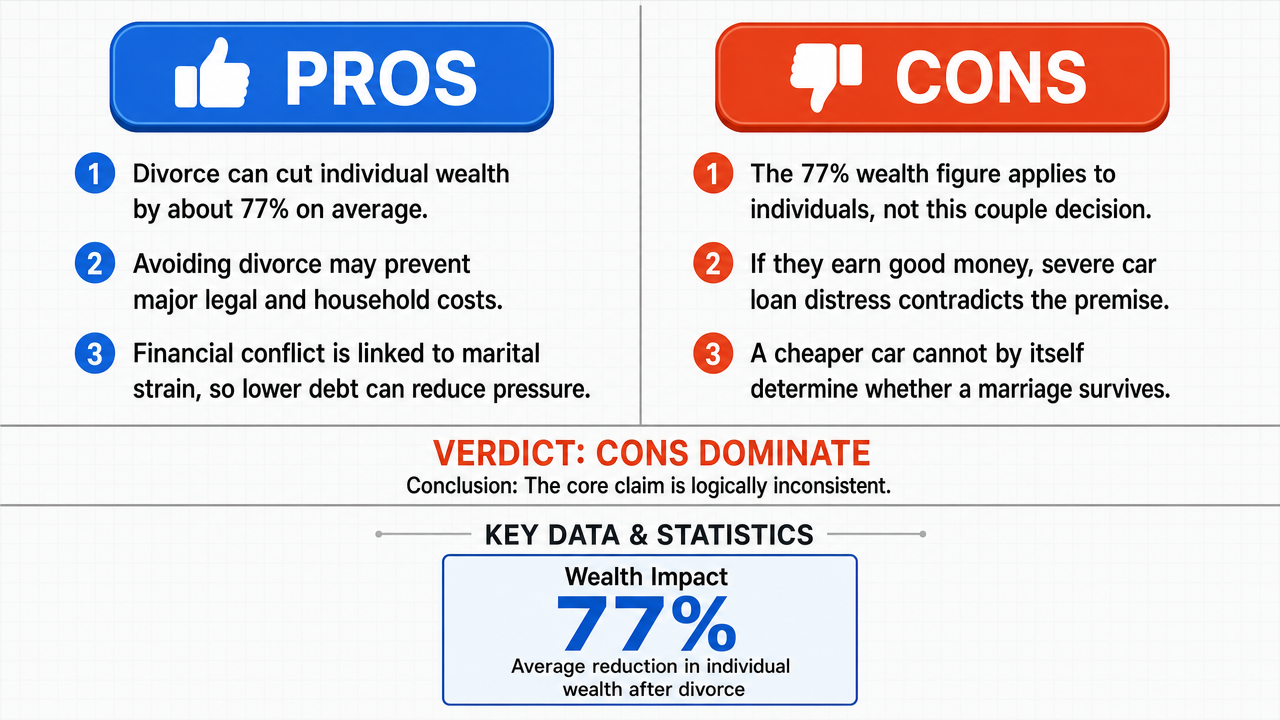
Verdict
Verdict: likely FALSE (75%)
Web Report: https://solsice.com/public/debates/a-couple-earning-good-money-should-prioritize-purchasing-a-l-0819b4268286
This section provides a brief overview of the key arguments. You do not need to read the full detailed report below.
✅ Key PRO arguments:
- ■Divorce typically reduces an individual's wealth by an average of 77% compared to remaining married (Institute for Family Studies), a financial shock orders of magnitude greater than the premium for a luxury vehicle, making a less expensive car a manageable adjustment that safeguards the partnership.
- ■The emotional toll of divorce, including documented increases in depression and anxiety, further compounds the financial loss, reinforcing that preserving the marriage through prudent spending is the rational choice.
- ■The causal link between financial conflict and marital dissolution is established by robust research, such as a 2012 Family Relations study, showing financial conflict is a primary marital stressor, so avoiding car loan strain directly protects the marriage.
❌ Key ANTI arguments:
- ■The affirmative commits a fundamental logical error by attempting to use a measurement about one entity (aggregate wealth reduction from divorce) to support a proposition about another (specific car loan decisions), without providing any correlation , beta , or cointegration linking the 77% figure to car loan decision-making.
- ■The affirmative's position is logically broken because it holds a proposition and its negation at once: if a couple 'earning good money' can 'comfortably afford' a vehicle, then the loan cannot, by definition, be a primary driver of marital dissolution, making the premise of the assertion self-contradictory.
- ■Marital stability is not determined by car loan decisions, nor can such decisions prevent divorce; the assertion conflates a specific financial decision with the complex, multi-causal phenomenon of marital dissolution.
💭 Conclusion: False. The FALSE side won because it exposed a fatal logical contradiction in the affirmative's framing: a couple 'earning good money' who can 'comfortably afford' a vehicle cannot simultaneously be facing car loan difficulties so severe that ending the marriage is on the table. The affirmative's reliance on the 77% aggregate wealth-reduction statistic from the Institute for Family Studies was correctly identified as a category error, since that figure measures the general financial aftermath of divorce and says nothing about the causal role of specific car loan decisions. The anti side further demonstrated that the affirmative's argument structure was internally inconsistent, asserting both that the couple can afford the car and that the loan is driving them toward divorce. Because the assertion rests on a self-contradictory premise and an unsupported causal leap, the FALSE verdict is well-grounded, though confidence is moderated slightly given the legitimate emotional and financial gravity the affirmative raised about divorce costs.
🔬 DeepResearch Result: likely FALSE ❌ (75%)
Assertion: A couple earning good money should prioritize purchasing a less expensive car over ending their marriage due to car loan difficulties.
Participating models: deepseek-v3.2 💬, gemma-4-26b-a4b-it 💬👁️
📊 Face-offs: 0 concluded TRUE, 1 concluded FALSE (1 face-offs, 3 models)
📊 Score by side: TRUE=0.00, FALSE=0.79
🏅 Model score changes:
minimax-m3 💬👁️: +8
✅ PRO Arguments:
- ■Divorce typically reduces an individual's wealth by an average of 77% compared to remaining married (Institute for Family Studies), a financial shock orders of magnitude greater than the premium for a luxury vehicle, making a less expensive car a manageable adjustment that safeguards the partnership. deepseek-v3.2 💬
- ■The emotional toll of divorce, including documented increases in depression and anxiety, further compounds the financial loss, reinforcing that preserving the marriage through prudent spending is the rational choice. deepseek-v3.2 💬
- ■The causal link between financial conflict and marital dissolution is established by robust research, such as a 2012 Family Relations study, showing financial conflict is a primary marital stressor, so avoiding car loan strain directly protects the marriage. deepseek-v3.2 💬
- ■A marriage represents a profound emotional and financial partnership whose dissolution carries severe, long-term costs far exceeding any automobile expenditure, so financial prudence preserves marital bonds over expensive car purchases. deepseek-v3.2 💬
❌ ANTI Arguments:
- ■The affirmative commits a fundamental logical error by attempting to use a measurement about one entity (aggregate wealth reduction from divorce) to support a proposition about another (specific car loan decisions), without providing any correlation , beta , or cointegration linking the 77% figure to car loan decision-making. gemma-4-26b-a4b-it 💬👁️
- ■The affirmative's position is logically broken because it holds a proposition and its negation at once: if a couple 'earning good money' can 'comfortably afford' a vehicle, then the loan cannot, by definition, be a primary driver of marital dissolution, making the premise of the assertion self-contradictory. gemma-4-26b-a4b-it 💬👁️
- ■Marital stability is not determined by car loan decisions, nor can such decisions prevent divorce; the assertion conflates a specific financial decision with the complex, multi-causal phenomenon of marital dissolution. gemma-4-26b-a4b-it 💬👁️
💭 Reasoning: False. The FALSE side won because it exposed a fatal logical contradiction in the affirmative's framing: a couple 'earning good money' who can 'comfortably afford' a vehicle cannot simultaneously be facing car loan difficulties so severe that ending the marriage is on the table. The affirmative's reliance on the 77% aggregate wealth-reduction statistic from the Institute for Family Studies was correctly identified as a category error, since that figure measures the general financial aftermath of divorce and says nothing about the causal role of specific car loan decisions. The anti side further demonstrated that the affirmative's argument structure was internally inconsistent, asserting both that the couple can afford the car and that the loan is driving them toward divorce. Because the assertion rests on a self-contradictory premise and an unsupported causal leap, the FALSE verdict is well-grounded, though confidence is moderated slightly given the legitimate emotional and financial gravity the affirmative raised about divorce costs.
📋 PRO Facts:
• Institute for Family Studies research indicates divorce typically reduces an individual's wealth by an average of 77% compared to remaining married.
• Data indicates that financial arguments are a leading predictor of divorce.
📋 ANTI Facts:
• The 77% wealth-reduction statistic measures aggregate post-divorce financial outcomes and does not establish a causal link to specific car loan decisions.
• A couple described as 'earning good money' who can 'comfortably afford' a vehicle cannot, by definition, be experiencing loan difficulties severe enough to drive marital dissolution.
| Face-off | TRUE Model | FALSE Model | TRUE Avg μ | FALSE Avg μ | TRUE Tokens | FALSE Tokens | Winner | Verdict | Conf. |
|---|---|---|---|---|---|---|---|---|---|
| #1 | deepseek-v3.2 💬 | gemma-4-26b-a4b-it 💬👁️ | 0.377 | 0.275 | 8 | 2 | TRUE | FALSE | 79% |
The following technical terms, abbreviations, and domain-specific concepts are referenced throughout this debate transcript. Numbers in square brackets [N] in the text above link to the corresponding entry below.
[1] amortized — amortized expense — In finance, refers to a debt or expense that is paid off gradually through regular scheduled payments over a set period, with each payment typically covering both principal and interest.
[2] auto loan — automobile loan — A type of installment loan specifically extended to finance the purchase of a vehicle, repaid over time with interest.
[3] beta — beta coefficient — A statistical or financial measure indicating the sensitivity or volatility of one variable relative to another, often used in regression analysis or asset pricing.
[4] car loan — A loan product used to finance the purchase of an automobile, typically structured with fixed monthly payments over a defined term.
[5] causal relationship — A relationship in which one variable or event directly produces or influences a change in another, as opposed to mere correlation.
[6] cointegration — An econometric concept describing a long-term statistical equilibrium relationship between two or more time series variables that may individually behave non-stationarily.
[7] contradiction — In logic, a situation in which two statements or propositions cannot both be true at the same time under the same conditions.
[8] correlation — A statistical measure describing the degree to which two variables move together, without necessarily implying causation.
[9] cost burden — The financial strain or pressure imposed by ongoing expenses relative to a household's or individual's available resources.
[10] debt — Money owed by one party to another, typically subject to interest charges and repayment terms.
[11] depreciating asset — An asset that loses monetary value over time due to factors such as wear, age, obsolescence, or market conditions.
[12] disposable income — The portion of an individual's or household's income remaining after taxes and mandatory deductions, available for spending, saving, or discretionary use.
[13] financial prudence — The practice of making cautious, sensible financial decisions to manage risk, avoid waste, and preserve long-term stability.
[14] high-income — An economic descriptor for individuals or households earning wages or salaries in the upper tier of the income distribution.
[15] household — In economics, a unit of analysis consisting of individuals living together who share resources and make collective consumption decisions.
[16] macro-statistic — A statistical measure that describes aggregate or large-scale phenomena across a population, as opposed to individual-level data.
[17] marital crisis — A period of severe strain, conflict, or instability in a marriage that threatens its continuation.
[18] micro-economic — Relating to the economic behavior, decisions, and interactions of individual agents such as households, firms, or consumers, rather than aggregate markets.
[19] mutually exclusive — In logic and probability, a condition in which two events, outcomes, or propositions cannot occur or be true simultaneously.
[20] negation — In logic, the operation or result of denying a proposition, producing a statement with the opposite truth value.
[21] orders of magnitude — A mathematical concept describing differences in size or quantity expressed as powers of ten, used to compare vastly different scales.
[22] precipitating cause — An event, condition, or factor that triggers or initiates a particular outcome, often distinguished from underlying or predisposing causes.
[23] predictor — predictor variable — A variable used in statistical analysis to forecast or estimate the likelihood or value of an outcome variable.
[24] proposition — In logic, a declarative statement or assertion that can be evaluated as true or false.
[25] substitution of proxy — A logical or statistical error in which a measurement or statistic about one entity is used to imply a conclusion about a different entity without establishing a valid connection between them.
[26] transfer operator — A mathematical or conceptual mapping that bridges or translates between two different domains, sets, or systems of measurement.
[27] wealth reduction — A decrease in an individual's or household's total assets or net worth, often expressed as a percentage or absolute figure.
The following financial data tables were referenced during the debate exchanges:
| Metric | Affirmative Argument | Logical Flaw |
|---|---|---|
| Wealth Impact | 77% reduction in wealth | Incorrect entity (Individual vs. Couple) |
| Predictive Power | Financial arguments lead to divorce | Unverifiable (No locator/source provided) |
| Decision Variable | Car loan amount | Scope error (General happiness vs. specific debt) |
Legend: Comparison of the affirmative's quantitative claims against formal logical requirements.
Face-off transcripts
- ■
Ownership & Trade Secrets. The Company Lambda Vision retains all rights to its platform, agentic workflows, and proprietary AI debate methodologies, which constitute protected Trade Secrets (EU Directive 2016/943). Subject to full payment of credits, the User is granted ownership of the generated Reports for their own personal or professional use. Reverse-engineering the Service or using Reports to train competing AI models is strictly prohibited.
- ■
No Professional Advice. Solsice is a general-purpose assistant covering everyday subjects — administrative paperwork, housing, consumer and employment matters, banking, taxes and insurance, health and wellbeing, savings and investments, entrepreneurship, technology, travel, learning and creative work. Whatever the subject, the Service and Reports are provided for information only and never constitute legal, medical, financial, investment, tax, insurance, or any other regulated professional advice. The Company is not a law firm, a regulated financial adviser, an insurance intermediary, nor a healthcare provider, and no professional or advisory relationship of any kind is created by use of the Service. Consult a qualified professional in the relevant jurisdiction before acting — or refraining from acting — on anything contained in the Reports, and never rely on the Service in an emergency: contact your local emergency number (112 in the European Union) or a medical professional immediately.
- ■
AI-Generated Content, Sources and Viewpoints. Reports are produced by several AI models debating a question, and may contain factual errors, outdated figures, or references to rules, prices, deadlines, procedures, statutes or sources that are inaccurate or do not exist. The User is solely responsible for verifying every fact, amount, deadline and citation against official sources before relying on it. Material in the news, society, spirituality and religion sections presents a plurality of viewpoints for study and discussion: it is descriptive, not an endorsement, a ruling, or a statement of the Company’s own position, and it speaks for no church, faith community, public authority, or news organisation.
- ■
Liability & Governing Law. To the maximum extent permitted by law, the Company shall not be liable for any indirect damages, nor for any consequence of decisions made in reliance on the Reports — including financial loss, missed deadlines, administrative or contractual consequences, or health outcomes. These Terms are governed by French law. Any disputes shall be subject to the exclusive jurisdiction of the Courts of Paris, France.