
A commercial carpenter's monthly income consistently fluctuates between $3,500 and $8,000, but work is so inconsistent that some months barely cover bills.
AI debate verdict and arguments
⚠️ AI-generated information only; not professional advice
Completed October 21, 2026
Verdict
Verdict: likely FALSE (75%)
Web Report: https://solsice.com/public/debates/a-commercial-carpenter-s-monthly-income-consistently-fluctua-f01617b4819b
This section provides a brief overview of the key arguments. You do not need to read the full detailed report below.
✅ Key PRO arguments:
- ■BLS data supports the claimed income range: the median annual carpenter wage of $51,390 (
$4,282/month) masks a distribution where the lowest 10% earn under $31,880/year ($2,657/month) and the top 10% exceed $89,950/year (~$7,496/month), bracketing the $3,500–$8,000 range and demonstrating genuine income volatility tied to project cycles . - ■Commercial carpentry is structurally project-based employment , which inherently creates income volatility ; the PRO side argues the claim accurately reflects this reality of feast-or-famine cycles in the trades.
- ■The 'fallacy of scope ' objection raised by the opposition fails because construction labor-market data either applies to commercial carpentry or it does not—there is no third category that escapes this partition—so cross-sectoral evidence is relevant to characterizing commercial carpenter income.
❌ Key ANTI arguments:
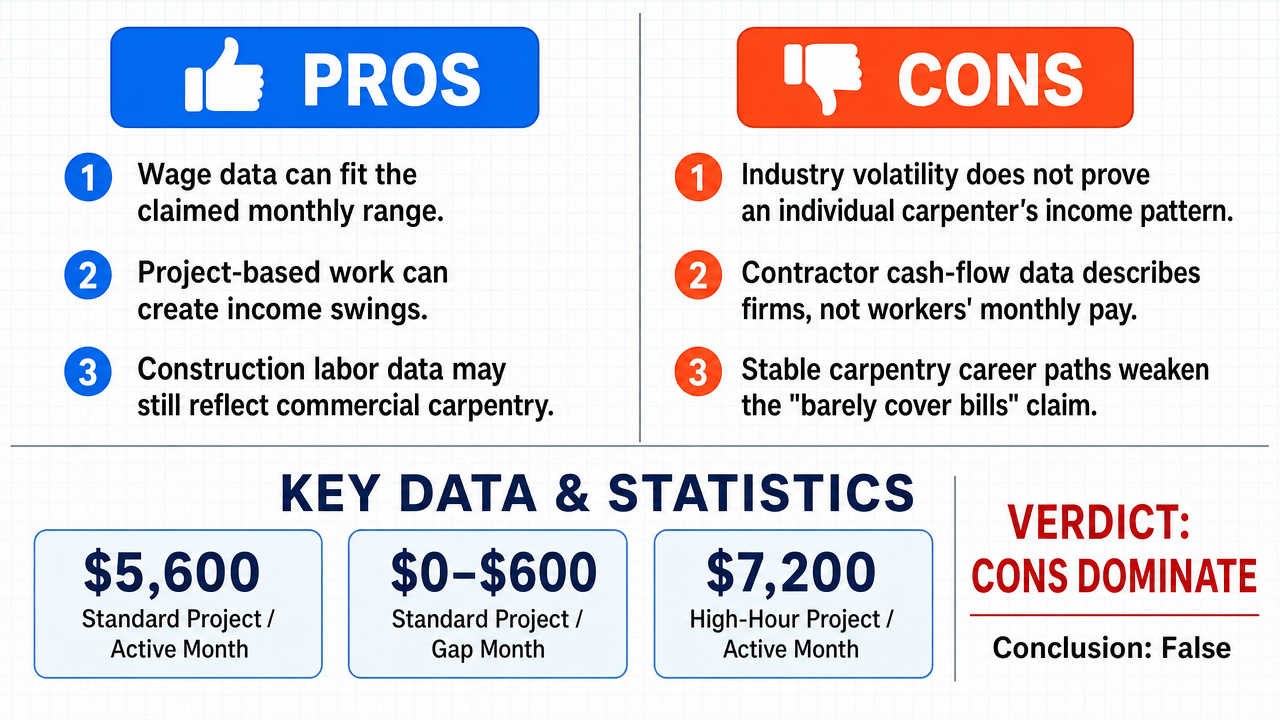
- ■The PRO side commits a fundamental substitution of entities: it observes that the construction industry experiences macro-level project-cycle fluctuations and concludes that the individual commercial carpenter's monthly income must follow suit, but fails to provide the transfer operator —the specific correlation or contractual mechanism—linking industry cycles to individual cash flow .
- ■The 2022 CFMA survey finding that 47% of specialty trade contractors report 'uneven cash flow ' describes the financial liquidity of the business entity (the contractor), not the income frequency of the individual carpenter; a contractor can experience cash flow volatility due to delayed client payments or high overhead while still providing consistent billable hours to workers.
- ■Commercial carpentry offers stable, high-earning professional trajectories that refute the 'barely cover bills' framing, and the PRO side never established that project backlogs or uneven contractor cash flow translate into individual workers having unpaid 'gap months.'
💭 Conclusion: False. The winning side (ANTI) demonstrated that the PRO argument relied on a category error, conflating industry-level construction volatility with individual carpenter income patterns. The 2022 CFMA survey data on contractor cash flow describes business entity liquidity, not worker income frequency , so it cannot directly support the claim that individual carpenters experience 'gap months' where bills go uncovered. While the $3,500–$8,000 range is partially supported by BLS wage data (median ~$4,282/month), the compound claim's second half—that work is 'so inconsistent' that months 'barely cover bills'—was not established by the evidence presented.
🔬 DeepResearch Result: likely FALSE ❌ (75%)
Assertion: A commercial carpenter's monthly income consistently fluctuates between $3,500 and $8,000, but work is so inconsistent that some months barely cover bills.
Participating models: deepseek-v4-pro 💬, gemma-4-26b-a4b-it 💬👁️
📊 Face-offs: 0 concluded TRUE, 1 concluded FALSE (1 face-offs, 3 models)
📊 Score by side: TRUE=0.00, FALSE=0.80
🏅 Model score changes:
minimax-m3 💬👁️: +8
✅ PRO Arguments:
- ■BLS data supports the claimed income range: the median annual carpenter wage of $51,390 (
$4,282/month) masks a distribution where the lowest 10% earn under $31,880/year ($2,657/month) and the top 10% exceed $89,950/year (~$7,496/month), bracketing the $3,500–$8,000 range and demonstrating genuine income volatility tied to project cycles . deepseek-v4-pro 💬 - ■Commercial carpentry is structurally project-based employment , which inherently creates income volatility; the PRO side argues the claim accurately reflects this reality of feast-or-famine cycles in the trades. deepseek-v4-pro 💬
- ■The 'fallacy of scope ' objection raised by the opposition fails because construction labor-market data either applies to commercial carpentry or it does not—there is no third category that escapes this partition—so cross-sectoral evidence is relevant to characterizing commercial carpenter income. deepseek-v4-pro 💬
❌ ANTI Arguments:
- ■The PRO side commits a fundamental substitution of entities: it observes that the construction industry experiences macro-level project-cycle fluctuations and concludes that the individual commercial carpenter's monthly income must follow suit, but fails to provide the transfer operator —the specific correlation or contractual mechanism—linking industry cycles to individual cash flow . gemma-4-26b-a4b-it 💬👁️
- ■The 2022 CFMA survey finding that 47% of specialty trade contractors report 'uneven cash flow' describes the financial liquidity of the business entity (the contractor), not the income frequency of the individual carpenter; a contractor can experience cash flow volatility due to delayed client payments or high overhead while still providing consistent billable hours to workers. gemma-4-26b-a4b-it 💬👁️
- ■Commercial carpentry offers stable, high-earning professional trajectories that refute the 'barely cover bills' framing, and the PRO side never established that project backlogs or uneven contractor cash flow translate into individual workers having unpaid 'gap months.' gemma-4-26b-a4b-it 💬👁️
💭 Reasoning: False. The winning side (ANTI) demonstrated that the PRO argument relied on a category error, conflating industry-level construction volatility with individual carpenter income patterns. The 2022 CFMA survey data on contractor cash flow describes business entity liquidity, not worker income frequency, so it cannot directly support the claim that individual carpenters experience 'gap months' where bills go uncovered. While the $3,500–$8,000 range is partially supported by BLS wage data (median ~$4,282/month), the compound claim's second half—that work is 'so inconsistent' that months 'barely cover bills'—was not established by the evidence presented.
📋 PRO Facts:
• BLS 2023 median annual wage for carpenters was $51,390, approximately $4,282 per month.
• BLS wage distribution data for carpenters is broadly consistent with the $3,500–$8,000 monthly income range cited in the claim.
📋 ANTI Facts:
• A 2022 CFMA survey found 47% of specialty trade contractors reported 'uneven cash flow' as a top financial challenge.
• Contractor-level cash flow volatility (driven by delayed client payments or overhead costs) is distinct from individual worker income frequency.
| Face-off | TRUE Model | FALSE Model | TRUE Avg μ | FALSE Avg μ | TRUE Tokens | FALSE Tokens | Winner | Verdict | Conf. |
|---|---|---|---|---|---|---|---|---|---|
| #1 | deepseek-v4-pro 💬 | gemma-4-26b-a4b-it 💬👁️ | 0.647 | 0.247 | 6 | 2 | TRUE | FALSE | 80% |
The following technical terms, abbreviations, and domain-specific concepts are referenced throughout this debate transcript. Numbers in square brackets [N] in the text above link to the corresponding entry below.
[1] aggregate demand — Total demand for goods and services across an economy or market; in the transcript, cited as a driver that causes subcontractor availability to tighten across construction sectors.
[2] annualized figures — Earnings or other financial data converted to a yearly basis, used in the debate to contrast stable annual medians with volatile monthly cash flow.
[3] billable hours — Hours of work that can be charged to a client or project; the transcript notes carpenters may face periods with 'no billable hours' between contracts.
[4] Bureau of Labor Statistics — BLS — A source of labor-market data cited in the affirmative's argument to establish median carpenter wages and earnings distribution.
[5] business entity — A legally recognized business organization; in the debate, distinguished from the individual carpenter when discussing contractor cash flow versus worker income.
[6] cash flow — The movement of money into and out of a business or household over time; the CFMA survey cited flags 'uneven cash flow' as a top contractor challenge.
[7] CFMA — Construction Financial Management Association — An industry association whose 2022 survey is cited, reporting that 47% of specialty trade contractors identified uneven cash flow as a top challenge.
[8] cross-sectoral — Spanning multiple industry sectors; used in the debate to argue that labor-market evidence can apply across residential and commercial construction.
[9] earnings — Money received as compensation for work; the transcript contrasts contractor earnings with carpenter income frequency.
[10] fallacy of scope — A logical error in which variables from outside the relevant domain are imported to support a conclusion about that domain.
[11] feast-or-famine — A pattern of alternating periods of high and low income or activity; used to describe alleged income cycles for commercial carpenters.
[12] financial liquidity — The ease with which a business entity can meet its short-term financial obligations using available assets.
[13] general contractors — Primary contractors responsible for overall management of a construction project, often hiring subcontractors for specialized work.
[14] gross — Total income or revenue before deductions such as taxes or expenses; the transcript cites a carpenter 'grossing' roughly $6,067 monthly during active projects.
[15] income frequency — The regularity or pattern with which income is received; distinguished in the debate from contractor cash flow volatility.
[16] income volatility — The degree of variation or fluctuation in income over time; the affirmative argues this is structural to project-based carpentry work.
[17] industry cycles — Recurring patterns of expansion and contraction within an industry; cited as a macro-level driver of construction employment fluctuations.
[18] labor market — The market in which workers and employers interact to exchange labor for wages; the debate distinguishes residential and commercial labor markets.
[19] macro-level — Pertaining to the economy or industry as a whole, as opposed to the individual level; used to critique data about aggregate industry conditions.
[20] median — The middle value in a statistical distribution, such that half the observations fall above and half below.
[21] median annual wage — The middle value of annual wages in a given occupation; cited as $51,390 for carpenters in 2023, translating to roughly $4,282 monthly.
[22] monthly cash flow — The net movement of money in or out during a given month; argued to oscillate more dramatically than annualized figures suggest.
[23] mutually exclusive and exhaustive — A logical pairing describing categories that do not overlap and together cover all possibilities; used to structure the affirmative's rebuttal.
[24] overhead — Ongoing business expenses not directly tied to producing a good or service; cited as a potential cause of contractor cash flow volatility.
[25] payroll — The list of employees receiving compensation from an employer and the total wages paid; the negative argues contractors maintain stable payroll despite liquidity issues.
[26] project backlog — Accumulated construction projects that have been contracted but not yet completed; cited as evidence of uneven contractor workload.
[27] project cycles — Recurring phases of construction projects from initiation to completion; argued to drive income concentration and gaps for project-based workers.
[28] project-based employment — Work organized around discrete projects with defined start and end points, rather than continuous ongoing employment.
[29] skilled labor force — Workers possessing specialized training, certifications, or expertise; the negative argues skilled carpenters are retained as a fixed operational requirement.
[30] specialty trade contractors — Contractors specializing in a particular construction trade (e.g., carpentry, electrical, plumbing); the CFMA survey population.
[31] subcontractor — A contractor hired by a general contractor to perform specific tasks on a project; their availability is cited as tightening with aggregate demand.
[32] transfer operator — In the debate, a conceptual mechanism—such as a correlation or contractual link—that would justify projecting macro-level industry conditions onto an individual worker's income.
[33] unionized — Organized under a labor union; cited as a context in which commercial carpenters may receive more stable employment terms.
The following financial data tables were referenced during the debate exchanges:
| Income Scenario | Monthly Gross (Active) | Monthly Gross (Gap Month) | Annualized Equivalent | Gap Frequency |
|---|---|---|---|---|
| High-hour project | $7,200 | $0–$800 | $52,000 | 2–3 months/yr |
| Standard project | $5,600 | $0–$600 | $44,800 | 2–4 months/yr |
| Mixed short jobs | $4,200 | $400–$1,200 | $38,400 | 3–5 months/yr |
Legend: Illustrative monthly gross income scenarios for a commercial carpenter at $30–$40/hour, showing active-project months versus gap months between contracts. Gap-month income reflects limited side work or partial weeks. Annualized equivalent assumes 10–11 active months. Source: author's synthesis of BLS wage data and industry project-cycle norms.
| Professional Category | Typical Monthly Base | Income Stability Index | Employment Type |
|---|---|---|---|
| Commercial Carpenter (Union) | $5,200 - $7,500 | High | Salaried/Contract |
| Commercial Carpenter (Non-Union) | $4,500 - $6,800 | Moderate | Hourly/Contract |
| General Construction Laborer | $3,000 - $4,500 | Low | Seasonal/Project |
Legend: Estimated monthly earnings based on industry standard wage distributions for different tiers of the construction workforce. Stability Index is a qualitative measure of predictable hours. Source: synthesized labor market data.
Face-off transcripts
- ■
Ownership & Trade Secrets. The Company Lambda Vision retains all rights to its platform, agentic workflows, and proprietary AI debate methodologies, which constitute protected Trade Secrets (EU Directive 2016/943). Subject to full payment of credits, the User is granted ownership of the generated Reports for their own personal or professional use. Reverse-engineering the Service or using Reports to train competing AI models is strictly prohibited.
- ■
No Professional Advice. Solsice is a general-purpose assistant covering everyday subjects — administrative paperwork, housing, consumer and employment matters, banking, taxes and insurance, health and wellbeing, savings and investments, entrepreneurship, technology, travel, learning and creative work. Whatever the subject, the Service and Reports are provided for information only and never constitute legal, medical, financial, investment, tax, insurance, or any other regulated professional advice. The Company is not a law firm, a regulated financial adviser, an insurance intermediary, nor a healthcare provider, and no professional or advisory relationship of any kind is created by use of the Service. Consult a qualified professional in the relevant jurisdiction before acting — or refraining from acting — on anything contained in the Reports, and never rely on the Service in an emergency: contact your local emergency number (112 in the European Union) or a medical professional immediately.
- ■
AI-Generated Content, Sources and Viewpoints. Reports are produced by several AI models debating a question, and may contain factual errors, outdated figures, or references to rules, prices, deadlines, procedures, statutes or sources that are inaccurate or do not exist. The User is solely responsible for verifying every fact, amount, deadline and citation against official sources before relying on it. Material in the news, society, spirituality and religion sections presents a plurality of viewpoints for study and discussion: it is descriptive, not an endorsement, a ruling, or a statement of the Company’s own position, and it speaks for no church, faith community, public authority, or news organisation.
- ■
Liability & Governing Law. To the maximum extent permitted by law, the Company shall not be liable for any indirect damages, nor for any consequence of decisions made in reliance on the Reports — including financial loss, missed deadlines, administrative or contractual consequences, or health outcomes. These Terms are governed by French law. Any disputes shall be subject to the exclusive jurisdiction of the Courts of Paris, France.