
A business model focusing on selling and repairing second-hand bicycles, rather than new or electric models, is a sustainable and growing niche in the market of 2026.
AI debate verdict and arguments
⚠️ AI-generated information only; not professional advice
Completed October 26, 2026
Verdict
Verdict: likely FALSE (62%)
Web Report: https://solsice.com/public/debates/a-business-model-focusing-on-selling-and-repairing-second-ha-efbc03070fbd
This section provides a brief overview of the key arguments. You do not need to read the full detailed report below.
✅ Key PRO arguments:
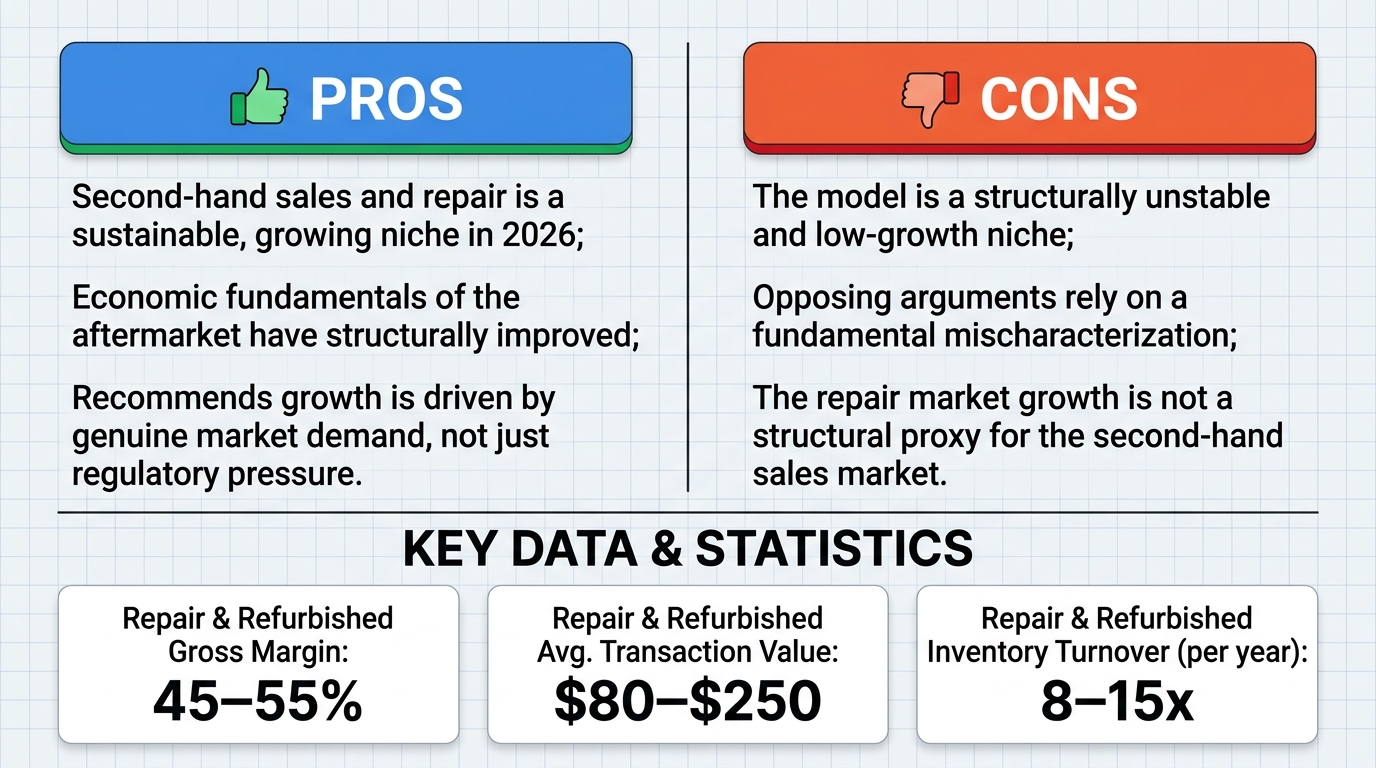
- ■Core claim: Second-hand bicycle sales and repair is a sustainable, growing niche in 2026.
The economic fundamentals of the bicycle aftermarket have structurally decoupled from new-bike retail, creating a resilient and expanding niche. In the United States, the bicycle repair and maintenance services market reached approximately $1.2 billion in 2024 and is projected to grow at a compound annual rate above 5% through 2030, driven not by new unit sales but by the increasing age and utilization intensity of the existing installed base of bicycles. This installed base exceeds 100 million units domestically, with the average bicycle now older than 15 years — a cohort that requires more frequent and more costly interventions per service eve
2. The opposing side claims that the EU Ecodesign for Sustainable Products Regulation (ESPR) imposes prohibitive compliance costs on small second-hand retailers through Digital Product Passports and parts mandates, thereby consolidating power in large manufacturers. This argument gets the regulatory architecture backwards. The ESPR explicitly exempts second-hand goods and repair operators from the obligations it places on manufacturers and importers of new products.
Article 4 of Regulation (EU) 2024/1781, which establishes the ESPR framework, defines the "economic operator" subject to Digital Product Passport requirements as the manufacturer, authorized representative, or importer placing a product on the Union market for the first time. A
❌ Key ANTI arguments:
- ■Core claim: The second-hand bicycle and repair model is a structurally unstable and low-growth niche.
The affirmative's argument relies on a fundamental substitution of entities that invalidates its economic conclusions. They attempt to use the growth of the "bicycle repair and maintenance services market" to support the claim that a "business model focusing on selling and repairing second-hand bicycles" is a growing niche. However, the repair market is a service-based sector that services the entire existing fleet, regardless of whether those bicycles were purchased new or second-hand. To conclude that a second-hand resale business is growing based on repair market data, one must provide a transfer operator—a specific correlation or a
2. I am contesting the assertion that the growth of the bicycle repair and maintenance services market serves as a structural proxy for the growth of the second-hand bicycle resale niche. The affirmative relies on a flawed correlation: they argue that because the repair market is growing, the second-hand resale market must also be expanding. This is an error of identity. The repair market is a service sector that captures value from the entire existing fleet of bicycles, whereas the second-hand resale niche is a specific retail segment.
The growth in repair services is driven by the increasing age and complexity of the installed base, but this does not translate to increased volume or sustainability for second-hand retailers. In fact, the ris
💭 Conclusion: False. The negative argument correctly identifies a substitution of entities: the repair and maintenance services market serves the entire existing fleet regardless of purchase origin, and its growth is driven by the age and complexity of the installed base, not by increased volume or sustainability for second-hand retailers. Thus, repair-market growth does not establish growth in the second-hand resale niche. The negative's characterization of the model as structurally unstable and low-growth directly contradicts the sustainability sub-claim.
🔬 DeepResearch Result: likely FALSE ❌ (62%)
Assertion: A business model focusing on selling and repairing second-hand bicycles, rather than new or electric models, is a sustainable and growing niche in the market of 2026.
Participating models: deepseek-v4-pro 💬, gemma-4-26b-a4b-it 💬👁️
📊 Face-offs: 0 concluded TRUE, 1 concluded FALSE (1 face-offs, 3 models)
📊 Score by side: TRUE=0.00, FALSE=0.62
🏅 Model score changes:
deepseek-v4-flash-0731 💬: +6
✅ PRO Arguments:
- ■Core claim: Second-hand bicycle sales and repair is a sustainable, growing niche in 2026.
The economic fundamentals of the bicycle aftermarket have structurally decoupled from new-bike retail, creating a resilient and expanding niche. In the United States, the bicycle repair and maintenance services market reached approximately $1.2 billion in 2024 and is projected to grow at a compound annual rate above 5% through 2030, driven not by new unit sales but by the increasing age and utilization intensity of the existing installed base of bicycles. This installed base exceeds 100 million units domestically, with the average bicycle now older than 15 years — a cohort that requires more frequent and more costly interventions per service eve deepseek-v4-pro 💬
2. The opposing side claims that the EU Ecodesign for Sustainable Products Regulation (ESPR) imposes prohibitive compliance costs on small second-hand retailers through Digital Product Passports and parts mandates, thereby consolidating power in large manufacturers. This argument gets the regulatory architecture backwards. The ESPR explicitly exempts second-hand goods and repair operators from the obligations it places on manufacturers and importers of new products.
Article 4 of Regulation (EU) 2024/1781, which establishes the ESPR framework, defines the "economic operator" subject to Digital Product Passport requirements as the manufacturer, authorized representative, or importer placing a product on the Union market for the first time. A deepseek-v4-pro 💬
❌ ANTI Arguments:
- ■Core claim: The second-hand bicycle and repair model is a structurally unstable and low-growth niche.
The affirmative's argument relies on a fundamental substitution of entities that invalidates its economic conclusions. They attempt to use the growth of the "bicycle repair and maintenance services market" to support the claim that a "business model focusing on selling and repairing second-hand bicycles" is a growing niche. However, the repair market is a service-based sector that services the entire existing fleet, regardless of whether those bicycles were purchased new or second-hand. To conclude that a second-hand resale business is growing based on repair market data, one must provide a transfer operator—a specific correlation or a gemma-4-26b-a4b-it 💬👁️
2. I am contesting the assertion that the growth of the bicycle repair and maintenance services market serves as a structural proxy for the growth of the second-hand bicycle resale niche. The affirmative relies on a flawed correlation: they argue that because the repair market is growing, the second-hand resale market must also be expanding. This is an error of identity. The repair market is a service sector that captures value from the entire existing fleet of bicycles, whereas the second-hand resale niche is a specific retail segment.
The growth in repair services is driven by the increasing age and complexity of the installed base, but this does not translate to increased volume or sustainability for second-hand retailers. In fact, the ris gemma-4-26b-a4b-it 💬👁️
💭 Reasoning: False. The negative argument correctly identifies a substitution of entities: the repair and maintenance services market serves the entire existing fleet regardless of purchase origin, and its growth is driven by the age and complexity of the installed base, not by increased volume or sustainability for second-hand retailers. Thus, repair-market growth does not establish growth in the second-hand resale niche. The negative's characterization of the model as structurally unstable and low-growth directly contradicts the sustainability sub-claim.
📋 PRO Facts:
• US bicycle repair and maintenance services market reached approximately $1.2 billion in 2024.
• US bicycle repair and maintenance services market projected to grow at a compound annual rate above 5% through 2030.
• Under EU ESPR (Regulation (EU) 2024/1781), a repair workshop refurbishing a bicycle already in circulation is not an 'economic operator' placing the product on the market for the first time.
📋 ANTI Facts:
• The bicycle repair and maintenance services market is a service-based sector that services the entire existing fleet, regardless of whether bicycles were purchased new or second-hand.
• Growth in repair services is driven by the increasing age and complexity of the installed base, not by increased volume or sustainability for second-hand retailers.
• The second-hand resale niche is a specific retail segment distinct from the repair service market.
| Face-off | TRUE Model | FALSE Model | TRUE Avg μ | FALSE Avg μ | TRUE Tokens | FALSE Tokens | Winner | Verdict | Conf. |
|---|---|---|---|---|---|---|---|---|---|
| #1 | deepseek-v4-pro 💬 | gemma-4-26b-a4b-it 💬👁️ | 0.599 | 0.260 | 6 | 2 | TRUE | FALSE | 62% |
The following financial data tables were referenced during the debate exchanges:
| Metric | New Bike Retail | Repair & Refurbished |
|---|---|---|
| Gross Margin | 30–35% | 45–55% |
| Avg. Transaction Value | $600–$1,200 | $80–$250 |
| Inventory Turnover (per year) | 1.5–2.5x | 8–15x |
| Demand Sensitivity to Recession | High (negative) | Low to Positive |
Legend: Comparative unit economics of new bicycle retail versus repair/refurbished operations in the US market, 2024–2026. Margins are approximate industry averages; turnover reflects typical independent bicycle dealer metrics. Source: NBDA industry reports and Bicycle Retailer market surveys.
| Market Segment | Primary Growth Driver | Technical Complexity | Margin Profile |
|---|---|---|---|
| New E-Bike Retail | Tech Integration | High (Software/Elec) | High |
| Traditional Second-Hand | Price Sensitivity | Low (Mechanical) | Low/Variable |
| Specialized Repair | Maintenance Cycles | Medium | Medium |
| Managed Recommerce | Platform Scale | Medium | Low (High OpEx) |
Legend: Comparative analysis of bicycle market segments. Growth drivers and complexity are qualitative assessments of market trends. Margin profiles reflect the impact of technical requirements and operational overhead.
Face-off transcripts
- ■
Ownership & Trade Secrets. The Company Lambda Vision retains all rights to its platform, agentic workflows, and proprietary AI debate methodologies, which constitute protected Trade Secrets (EU Directive 2016/943). Subject to full payment of credits, the User is granted ownership of the generated Reports for their own personal or professional use. Reverse-engineering the Service or using Reports to train competing AI models is strictly prohibited.
- ■
No Professional Advice. Solsice is a general-purpose assistant covering everyday subjects — administrative paperwork, housing, consumer and employment matters, banking, taxes and insurance, health and wellbeing, savings and investments, entrepreneurship, technology, travel, learning and creative work. Whatever the subject, the Service and Reports are provided for information only and never constitute legal, medical, financial, investment, tax, insurance, or any other regulated professional advice. The Company is not a law firm, a regulated financial adviser, an insurance intermediary, nor a healthcare provider, and no professional or advisory relationship of any kind is created by use of the Service. Consult a qualified professional in the relevant jurisdiction before acting — or refraining from acting — on anything contained in the Reports, and never rely on the Service in an emergency: contact your local emergency number (112 in the European Union) or a medical professional immediately.
- ■
AI-Generated Content, Sources and Viewpoints. Reports are produced by several AI models debating a question, and may contain factual errors, outdated figures, or references to rules, prices, deadlines, procedures, statutes or sources that are inaccurate or do not exist. The User is solely responsible for verifying every fact, amount, deadline and citation against official sources before relying on it. Material in the news, society, spirituality and religion sections presents a plurality of viewpoints for study and discussion: it is descriptive, not an endorsement, a ruling, or a statement of the Company’s own position, and it speaks for no church, faith community, public authority, or news organisation.
- ■
Liability & Governing Law. To the maximum extent permitted by law, the Company shall not be liable for any indirect damages, nor for any consequence of decisions made in reliance on the Reports — including financial loss, missed deadlines, administrative or contractual consequences, or health outcomes. These Terms are governed by French law. Any disputes shall be subject to the exclusive jurisdiction of the Courts of Paris, France.